Metal Detectors in Schools: Effectiveness & Alternatives
.webp)

90%+ alerts resolved in under a minute. See how.
Metal Detectors in Schools: Effectiveness & Alternatives
School administrators and security directors face mounting pressure to protect students from violence while keeping campuses conducive to learning. Metal detectors remain one of the most visible and debated security measures in K-12 education, yet research reveals critical gaps between perception and reality. For professionals tasked with risk mitigation, vendor evaluation, and capital planning, understanding the effectiveness and emerging alternatives is essential to making defensible decisions.
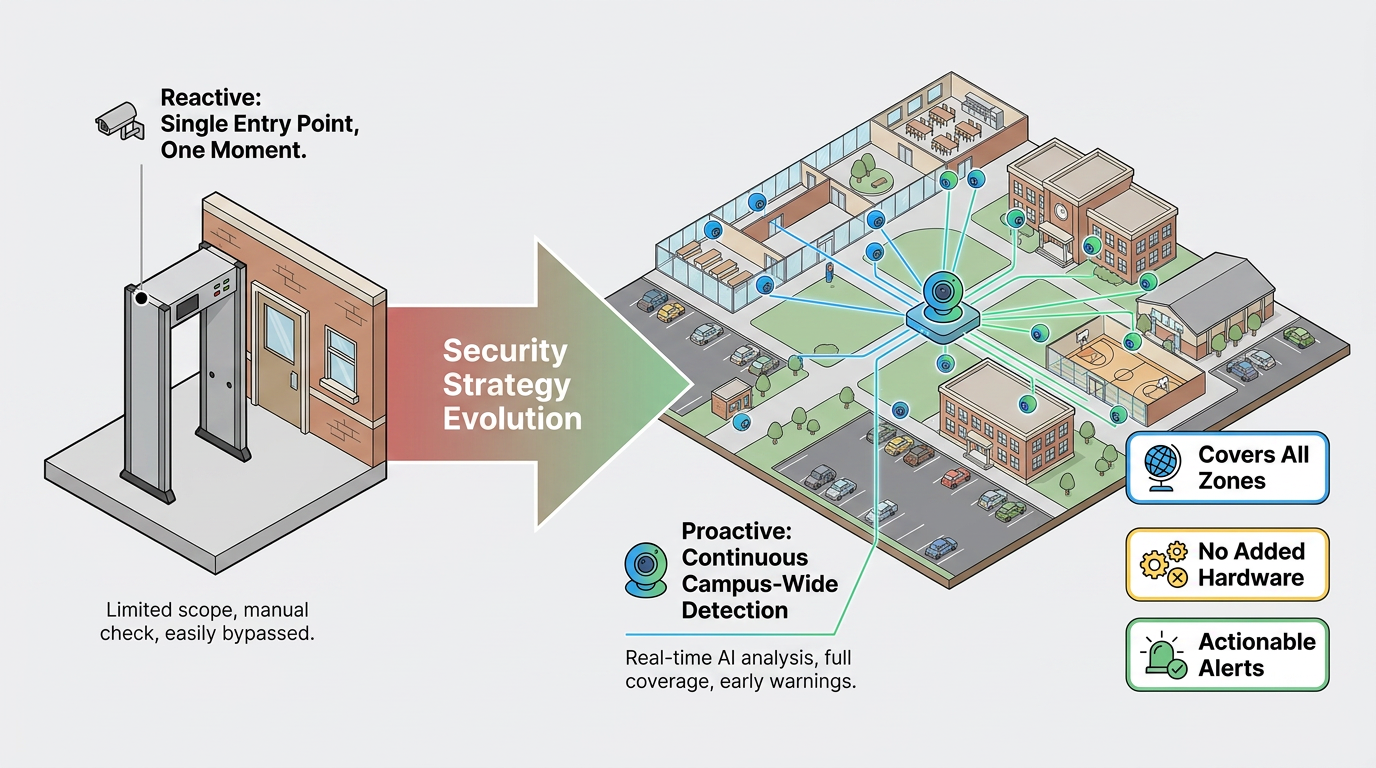
With roughly 18–20% of active shooter incidents occurring in education settings, schools face unique threat profiles. Critically, 69% of these incidents end in five minutes or less, underscoring why continuous, campus-wide monitoring offers significant operational advantages over entry-point screening that addresses only a single moment of access.
Key Takeaways
- Metal detectors lack strong research evidence for preventing school violence and can negatively impact student well-being and school climate
- Federal agencies and security organizations recommend layered defense-in-depth approaches over single-point screening solutions
- Proactive campus-wide monitoring provides continuous threat detection across all security layers, rather than addressing only entry points
- Schools should prioritize access control, behavioral threat assessment, and comprehensive security strategies over standalone metal detector programs
What the Evidence Actually Shows
A 2025 scoping review analyzing empirical studies from 2005 to 2025 found that only two interventions met inclusion criteria for reducing weapon carriage in U.S. schools: random mandatory metal detector searches and the Say Something Anonymous Reporting System. While both interventions showed limited positive outcomes, the overall evidence base is weak, and long-term effectiveness is unclear. 'Target hardening' strategies like metal detectors may negatively affect student perceptions of safety, highlighting the need for more holistic, evidence-based approaches that go beyond physical security.
Earlier work reached similar conclusions. Of the two studies examining the relationship between metal detectors and school safety, one found reports of fewer weapons being carried to school; however, neither found that the presence of metal detectors reduced the number of reported threats, physical fights, or instances of student victimization in school. For security leaders weighing capital investment, this is a critical distinction: reduced self-reported weapon carriage is not the same as a measurable reduction in violent incidents on campus.
Psychological and Social Impacts on Students
Rather than enhancing safety, metal detectors frequently correlate with decreased feelings of security and increased anxiety among students.
A study found that students report feeling less safe, not more, when subjected to metal detectors. The research describes how these measures create a "threatening or prison-like atmosphere, potentially increasing anxiety or discomfort."
The documented impacts extend beyond perception:
- Increased stress, anxiety, and depression among students, with metal detectors contributing to toxic stress and poor psychological functioning
- Negative effects on school climate and connectedness, with students reporting that metal detectors create a "prison-like atmosphere" that undermines the sense of school as a nurturing educational space
- Disproportionate impact on students of color, with increased security measures coinciding with higher rates of exclusionary discipline and student arrests
Research suggests that more visible or invasive school security measures can be associated with lower perceived safety among parents and students, and that more invasive measures such as bag inspections generate more discomfort than less intrusive measures. For security professionals, this matters operationally: community trust drives tip-line volume, behavioral reporting, and the early-warning intelligence that prevents incidents in the first place.
Layered Security as the Recommended Approach
Federal agencies and professional security organizations converge on layered defense-in-depth approaches rather than single-point screening solutions.
The CISA security guide establishes four primary security layers: grounds perimeter, school grounds, building perimeter, and building interior. Each layer emphasizes detect, delay, and respond strategies, creating multiple opportunities to identify and mitigate threats before they reach students. CISA's systems-based approach integrates five core elements (equipment/technology, site/building design, personnel, policies/procedures, and training) to work cohesively for detection, delay, and response to threats, organizing security across four campus layers to prevent single points of failure.
One of the principles of a systems approach to security is that measures in one layer can reinforce the performance of measures in other layers. Detection measures in outer layers allow the system to mitigate risk inside the school. Delay measures in outer layers can provide time to implement mitigation measures more effectively in inner layers, and for school staff to initiate response actions. However, communications capability that allows those outer layers to warn the school that an incident is occurring or call police directly is the wiring that leads to the realization of those benefits. A standalone metal detector at a single doorway provides none of that interconnected detect-delay-respond capability.
The PASS Guidelines expands to five layers, notably adding district-wide security coordination and digital infrastructure protection. ASIS International describes enterprise security risk management (ESRM) as a strategic, holistic approach to managing security risk across an organization, but the available ASIS sources reviewed do not explicitly require integrating physical protection systems, behavioral threat assessment programs, emergency preparedness protocols, and operational security procedures. Even as new standards emerge, overemphasis on physical security and technology can obscure the need for prevention-focused strategies like behavioral threat assessments, school climate initiatives, and emergency planning.
These recommendations emphasize that access control should serve as a foundational security measure rather than entry-point screening technologies such as metal detectors. Core layered measures include:
- Reinforced doors and windows
- Controlled access points with single-point entry during school hours
- Electronic access control integrated with visitor management
- Video surveillance with strategic camera positioning
- Communication systems for mass notification
Federal Funding for School Security Improvements
Substantial federal funding is available for school security improvements through multiple grant programs. The Stronger Connections Grant provides significant funding for high-need Local Educational Agencies. The COPS School Violence Prevention Program (SVPP) offers competitive grant funding for school security projects, with awards capped per application rather than as fixed individual grants per district.
Eligible purchases consistently include access control systems, surveillance cameras, communication systems, and visitor management technology. State programs provide additional funding, with Texas, Florida, and Virginia implementing substantial security grant programs and compliance mandates that security directors should align procurement roadmaps against.
Access control systems specifically include reinforced doors, electronic locks, and card readers; surveillance includes interior and exterior monitoring; communication systems encompass emergency notification and intercom capabilities; and visitor management involves secure vestibule implementation and credential-based entry systems.
Moving Toward Proactive Physical Security
The research points toward a fundamental shift in school security strategy: from reactive to proactive threat detection across entire campuses. The limitations of metal detectors are well-documented: low detection yields, substantial operational costs (staffing, throughput delays, secondary screening), negative school climate impacts, and weak evidence for violence prevention. For a security director sizing a program, the total cost of ownership (operators, maintenance, queue management, false-alarm resolution) rarely pencils against the measurable risk reduction.
AI-powered computer vision offers a fundamentally different approach. Rather than funneling students through invasive checkpoints that research shows create anxiety and a prison-like atmosphere, it monitors existing camera infrastructure continuously to detect weapons and behavioral threats before they escalate. For large campuses and multi-building districts, this distinction matters operationally: a single metal detector screens one doorway, while AI-powered monitoring can cover every hallway, entrance, parking lot, loading dock, and common area simultaneously, without adding hardware footprints or staffing bottlenecks at peak arrival times.
Ambient.ai delivers this through Agentic Physical Security, transforming existing cameras into a unified intelligence layer. The platform is built on a Privacy by Design architecture, using no facial recognition and, according to Ambient.ai, collecting no personally identifiable information, positioning it as a privacy-conscious alternative to screening technologies. With 150+ threat signatures, including Person Brandishing Firearm, Fighting, Glass Break Active, and behavioral precursors like loitering and crowd formation, the platform is described as providing proactive campus-wide monitoring across all CISA security layers, giving SOC operators and SROs actionable, prioritized alerts rather than raw video feeds.
Because the platform is infrastructure-agnostic, schools can deploy it on their existing cameras and video management systems with no rip-and-replace, extending intelligent monitoring across sprawling campuses and large building footprints that would be impractical to secure with entry-point screening alone. Edge processing supports real-time analysis at scale, which is important for districts managing multiple buildings with a centralized security team.
Ambient.ai's education solutions provide continuous, campus-wide monitoring rather than concentrating resources at a single entry point, delivering broader protection with greater respect for student privacy, and a defensible, standards-aligned answer to the board, the community, and the next round of grant reviewers.
Frequently Asked Questions
How much do metal detectors in schools cost compared to AI-powered camera monitoring systems when factoring in staffing, maintenance, and operational expenses?
Metal detector total cost of ownership includes purchase price, dedicated operators, secondary screening stations, queue management, and maintenance contracts. AI-powered monitoring leverages existing cameras, eliminating staffing bottlenecks at entries while covering entire campuses through edge processing.
What does the research say about the effectiveness of metal detectors in actually reducing school violence versus just reducing self-reported weapon carrying?
Studies found metal detectors may reduce self-reported weapon carriage but documented no measurable reductions in actual violent incidents such as threats, fights, or victimization. This perception-versus-outcome gap matters for capital planning and risk mitigation strategies.
What are the recommended layered security measures for schools according to CISA and other federal agencies, and how do they compare to standalone metal detector programs?
CISA's layered approach creates interconnected detection across four campus zones where outer measures enable faster mitigation inside. Metal detectors screen one doorway without connecting to broader systems, offering no multi-layer coordination or early warning capability.