AI-Powered Physical Security Posture


Investigations that took days. Now answered in seconds.
Most enterprise security programs were built to record and review, not to prevent. Perimeters keep threats out, but once someone is inside, the cameras mostly just watch. Forensic video captures what happened after the fact, while the warning signs that led up to it play out on those same cameras unnoticed. That is starting to change.
AI-assisted programs are helping teams spot trouble earlier, before it becomes an incident report. To build that kind of posture, it helps to first understand why the old reactive model keeps coming up short.
What Is an AI-Powered Physical Security Posture?
An AI-powered physical security posture is a prevention-oriented physical security posture in which AI analysis, unified video and access data, and human-led response work together to catch threat precursors before they escalate.
It differs from a traditional reactive posture, which detects and responds after an incident occurs, and from simply adding camera feeds analyzed by an AI layer, which adds detection hardware without changing how the program operates. Posture covers the whole program: coverage, monitoring, escalation, response, and measurement, all pointed at prevention.
A protection program is dynamic. It requires continual monitoring, evaluation, and top-management buy-in to adapt to changing organizational objectives, staff, and operating environments. A posture has to be maintained after it is bought.
The National Safety Council describes medically consulted work injury events as carrying meaningful direct costs, before downtime and the negligent-security litigation that follows an incident on your property. Every one of those costs attaches to an incident that reached execution, which is the case for catching the behavior that precedes it.
Why Traditional Security Posture Fails to Prevent Security Incidents?
Most organizations still run programs designed for documentation rather than prevention. Rule-based analytics trigger on motion and line-crossing without understanding behavioral context, and system integrations flag events without determining whether the context indicates genuine risk or benign activity. These systems just detect movement, record activity, and sound alarms, flooding security teams with false positives and forcing human operators to filter through the noise.
Volume compounds the problem. Enterprises operate more live video than any operator can absorb simultaneously, and high false-alarm volume contributes to operator fatigue and missed critical incidents. That is a scale failure, not a human one.
The deeper gap is behavioral correlation across time and systems. A loitering event early in the week, unusual perimeter testing later, and a group loitering together afterward remain isolated records in separate systems, so no one sees a developing pattern. Post-incident reviews consistently find the warning signs existed; they were never assembled into a threat narrative. Breaches get discovered only after perpetrators reach interior spaces, leaving teams with reactive documentation instead of security incident prevention.
Assessing Your Current Physical Security Posture
Baseline before you build. Measure what you are asking operators to absorb before adding to it, including live-video load, alert volume, system switching, and the point in the incident sequence when events are first detected. A posture assessment borrows the structure of risk identification, analysis, and evaluation, and applies it to core questions:
- Where are the blind spots? Audit camera coverage against current floor plans, confirm dedicated angles on critical assets, and log obstructions, glare, and dead zones with owners and due dates.
- How noisy is the alert load? Count alarms by source and the share that prove benign; certain doors can generate disproportionate noise.
- How siloed are the systems? Tally the applications an operator touches in a shift. Video, physical access control system (PACS), and sensor data that never meet cannot be correlated.
- How reactive is the program? Classify recent incidents by when they were detected: during precursor behavior, or after execution.
These answers show whether the current physical security posture gives operators early warning or mainly gives investigators better evidence after the fact.
AI Amplifies Existing Infrastructure
AI amplifies these foundations rather than replacing them. Solid PACS, camera coverage, working sensors, and a staffed monitoring function are prerequisites, and poorly maintained sensors and frequent false alarms produce noisy data that degrades AI accuracy. Fix the foundation first.
The Threat Progression Model
Attacks tend to move through grievance, ideation, research and planning, preparation, breach, and attack. Condensed into phases a security operations team can actually watch for on camera, that progression looks like reconnaissance, probing, positioning, and execution, and each phase is an intervention opportunity.
The U.S. Secret Service's National Threat Assessment Center found that most attackers in its study of mass attacks exhibited concerning behaviors or communications beforehand, and warns that waiting for an explicit threat "will result in missed opportunities to prevent violence." That pre-attack window is where a preventive posture operates.
Reconnaissance
Reconnaissance begins the cycle: "Person Loitering" near restricted areas, close interaction with secured assets, or repeated presence outside a gate during shift changes. The activity looks harmless in isolation, so it rarely gets reported, and rule-based analytics cannot read the intent behind it.
Probing
Probing escalates the behavior. The same individual triggers repeated perimeter testing, unusual movement patterns, or after-hours boundary tests. Traditional systems log each action separately and miss that the same actor is systematically gathering intelligence. Intervening here still means sending someone to ask a question.
Positioning
Positioning shows clearer intent: "Person Carrying Package" and "Person Removing Item" signatures fire, or loitering resolves into a group acting together.
Execution
Execution is the incident itself: forced entry, violence, asset theft. Cameras record everything, alarms fire, and response protocols activate, but the damage is already underway.
How AI Enables Preventive Security Posture?
The gap between early reconnaissance and execution is the prevention window. Closing it requires detection that reasons about behavior, not just pixels.
From Motion Alerts to Behavioral Intent
Computer vision models detect people, objects, and activities in each frame. Reasoning Vision-Language Models (VLMs) go further, fusing visual perception with language to interpret scenes and behaviors, so that when the same individual triggers escalating patterns over time, the progression gets flagged rather than logged as unrelated events.
The precursors worth catching are specific: loitering, tailgating, forced-entry attempts, perimeter probing, and weapon indicators. The same models make video searchable in plain language: typing "person in a red jacket near the loading dock during a defined afternoon window" returns matching footage.
Context Separates Routine Activity From Developing Threats
Distinguishing the two requires reasoning about context: the relationship between people, objects, the environment, and typical patterns for that location and time. A technician kneeling at a data center badge reader with hand tools during a scheduled maintenance window is authorized work. The same posture at the same reader during overnight hours, with no badge activity anywhere on site, reads as a forced-entry attempt.
This reasoning turns generic detections into specific threat assessments: loitering patterns become "potential reconnaissance," fence interactions become "perimeter breach attempts," and unusual equipment handling indicates "incident preparation." Operators receive actionable intelligence during reconnaissance and probing, when intervention options still include a conversation rather than a lockdown.
Unifying Video, PACS, and Sensor Signals Into One Picture
Cross-system correlation is where a posture stops being a collection of tools. A denied badge swipe at a side door, followed seconds later by someone tailgating through it, reads as unrelated low-priority events in siloed systems; correlated, it is an unauthorized entry in progress. The same logic applies across sensor types: a door held open during overnight hours means something different than the same door held open during a delivery window.
Integration measurably improves outcomes. In ASIS International's PACS-related research, the share of security professionals rating their PACS programs highly effective rises materially when video surveillance is integrated with it. Unifying visual, PACS, and environmental data gives operators full incident context instead of isolated alarms, so benign events resolve quietly and genuine sequences surface as a coherent narrative with a complete movement timeline.
Operational Integration for Verification, Escalation, and Humans in the Loop
Visual verification comes before dispatch: an alert arrives with video evidence attached, an operator in the security operations center (SOC) confirms or dismisses it in seconds, and responders receive footage and guidance before they move. Visible early intervention can end a sequence during reconnaissance, before anyone has to respond to an execution. Municipalities are forcing this discipline anyway; some police departments have recently stopped responding to most security alarms without verification.
Escalation runs on tiers. Low-risk events resolve automatically with an audit trail, ambiguous events route to an operator for judgment, and high-severity sequences escalate straight to response. The effect is that people stop triaging floods of raw alerts and start working a short queue of verified events.
None of this replaces human judgment. High-stakes decisions such as emergency escalations, evacuations, and granting access require human judgment, because models cannot replicate the context and experience those calls demand. AI carries the monitoring load; people decide.
Building a Preventive Security Posture
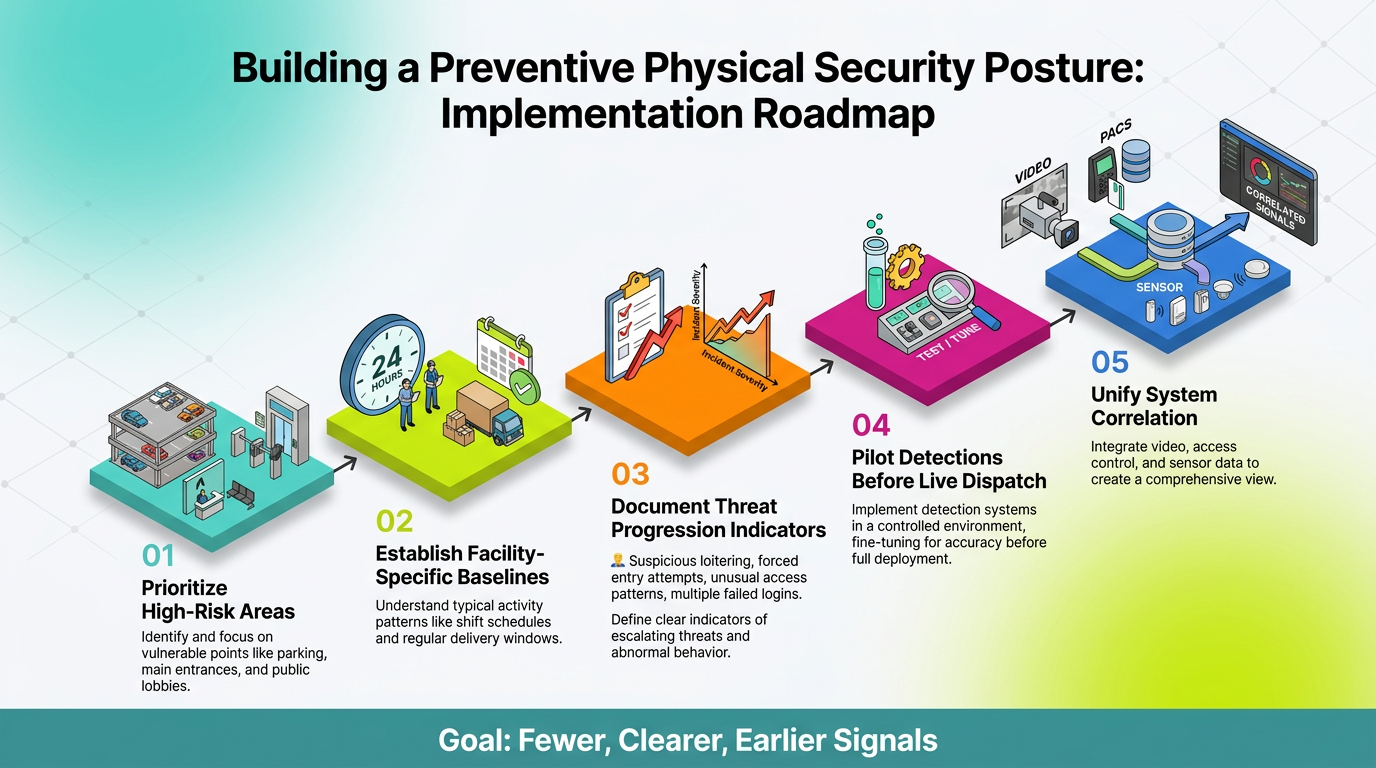
Turning these capabilities into posture is a phased exercise: deploy where risk concentrates, teach the system what normal looks like at each facility, and wire signals together so teams can detect threats early.
- Prioritize high-risk areas. Example initial zones include parking structures, primary entrances, and lobbies, then extend to wherever a failure costs the most at your sites, and map camera coverage so visual events can be correlated across locations. Early detection at these points means breaches surface before perpetrators reach interior spaces, giving teams time to intervene during reconnaissance rather than respond during execution.
- Establish facility-specific baselines. Use behavioral analytics that learn shift changes, delivery schedules, and typical activity patterns; generic assumptions cannot distinguish normal from anomalous at your site.
- Document threat progression indicators. Define the escalation markers specific to each facility and monitor them across time, so a sequence of minor events raises priority even when each one looks trivial.
- Pilot new detections before live dispatch. Tune each detection type against real site conditions before wiring it to live dispatch.
- Unify system correlation. Integrate visual data with sensor and facility information so benign events resolve automatically and genuine threat sequences escalate for immediate intervention.
The implementation goal is not more alerts. It is a physical security posture that gives operators fewer, clearer, and earlier signals.
Responsible AI Use in a Physical Security Posture
Prevention only holds up if the detection layer is accurate, lawful, and governed. Accuracy is environment-specific: validate detections against your own scenes, monitor false positives per camera, and retune as conditions change, because models perform differently outside the environments they were tuned for.
Privacy obligations increasingly shape architecture choices. The EU AI Act's prohibited-practices rules now apply to prohibited uses of remote biometric identification in publicly accessible spaces for law enforcement. This is a large part of why behavioral analysis can carry a lower compliance burden than identity-based recognition. Behavioral detection evaluates observable actions and scene conditions rather than who a person is, so it avoids the biometric identification workflows that carry the heaviest compliance obligations.
Govern automated actions explicitly: define which responses the system may take autonomously, log every automated decision, and review the escalations humans overrode.
Measuring Your Physical Security Posture
Prevention shows up in leading indicators, the measures that precede an incident, rather than only in lagging counts of what already happened. A preventive program tracks a short set of security KPIs:
- Precursor catch rate: incidents interrupted during reconnaissance or probing versus discovered at execution.
- False-alarm trend: the share of alerts auto-resolved or verified benign, tracked per camera and per door.
- Mean time to verify and mean time to respond: how long from signal to classification, and from classification to action.
- Incident-rate trend: period-over-period incidents by site and category, the lagging proof that prevention is working.
Together, these measures help leaders see whether the physical security posture is changing outcomes before incidents reach execution.
Report these to leadership on a fixed cadence. A posture that cannot show its precursor catches will keep being funded like a cost center.
A Maturity Roadmap for Physical Security Posture
Posture matures in stages, from ad hoc security that responds to incidents as they occur to security that operates as a risk advisor with unified functions and continuous improvement. Most programs adopting AI move through the middle: pilot zones first, then expanded coverage, then correlation across systems, then automated escalation with human oversight.
Treat the roadmap as a recurring cycle. Review detection accuracy and behavioral baselines regularly, retune as facilities and schedules change, relocate idle cameras to better positions, and expand signature coverage as the team's verification workflow absorbs it. AI models keep improving through field feedback after deployment, and the program should improve on the same cadence.
Operationalizing Threat Progression Analysis at Enterprise Scale
For programs ready to make prevention operational, Ambient.ai frames that destination as Agentic Physical Security: AI observes, detects, assesses, and responds in real time while people handle judgment. Trusted by Fortune 100 enterprises, the Ambient Platform delivers this through Ambient Intelligence, powered by Ambient Pulsar, an always-on, edge-optimized reasoning VLM purpose-built for physical security.
Teams evaluating this operating model can request a demo to see how it applies to their own sites. Ambient Threat Detection applies 150+ threat signatures and helps teams resolve over 80% of alerts in under one minute by reasoning continuously across video, access, and sensor data while intervention is still an option.
Frequently Asked Questions
How does AI-powered behavioral detection differ from traditional rule-based video analytics in reducing false alarm rates for security teams?
AI-powered behavioral detection evaluates relationships between objects, environmental conditions, and time-of-day patterns to determine context, while rule-based analytics trigger mechanically on motion or line-crossing regardless of circumstances. This contextual reasoning enables benign events to resolve automatically without operator review.
What are the key metrics and KPIs to track when transitioning from a reactive to a preventive physical security posture?
Track operator workload reduction measured in hours freed from manual feed monitoring, cost per prevented incident compared to incident response costs, system uptime and camera availability percentages, and training hours required to maintain human verification competency alongside AI-assisted workflows.
How does behavioral analysis help organizations maintain compliance with privacy regulations like the EU AI Act compared to biometric identification systems?
Behavioral analysis evaluates observable actions and environmental context without processing biometric data, keeping it outside the EU AI Act's prohibited remote biometric identification category. This architectural distinction reduces regulatory burden because the system never captures identity markers triggering biometric compliance workflows.