AI-Powered Physical Security: Why Modern Enterprises Need an AI-Driven Revolution



It's not a people problem. It's a systems problem.
The modern enterprise, with its global campuses, hybrid workforces, and intricate supply chains, creates unmatched opportunities for growth and innovation. But this landscape also presents a complex and ever-expanding attack surface. While headlines focus on cybersecurity breaches, a quieter but equally critical threat is escalating within the physical world. For today's fast-paced, global enterprise, the traditional approach to physical security is no longer just outdated; it's turning into a liability.
The challenge is a matter of scale, speed, and cost. How do you secure sprawling corporate campuses that are more like small cities? How do you protect thousands of employees and billions of dollars in assets across dozens or even hundreds of sites, each with its own unique risks and regulatory requirements?
The previous model, which relied only on guards, gates, and traditional cameras, is buckling under this pressure. This legacy approach not only generates an overwhelming amount of unmanageable data but also fails at the most important task: delivering on the mission of keeping people and critical assets safe. Without the right intelligence layer, security operations become reactive and slow, bogged down in endless investigations rather than rapid responses. More headcount, more cameras, and more spend are added, but the result is often the same: delayed responses, escalating costs, and higher risk.
The Hidden Costs of Outdated Physical Security

Traditional physical security models were not designed for the scale and complexity of today's enterprise. Guards, gates, and motion-based cameras struggle to keep up with sprawling campuses and a global workforce. What's at stake is not just operational efficiency, but the core responsibilities of protecting people and critical assets.
Without intelligence at the core, legacy systems fail to differentiate between true threats and harmless activity, leaving organizations exposed and in a reactive state. When a breach does occur, the consequences are immediate, starting from data loss and operational shutdowns to risks to human safety.
At the same time, the model drives unsustainable costs. More buildings and cameras translate directly into more guards and analysts, increasing headcount without delivering stronger protection. This outdated model doesn't just fall short, it turns physical security into a liability.
Why False Alarms Undermine Security Operations
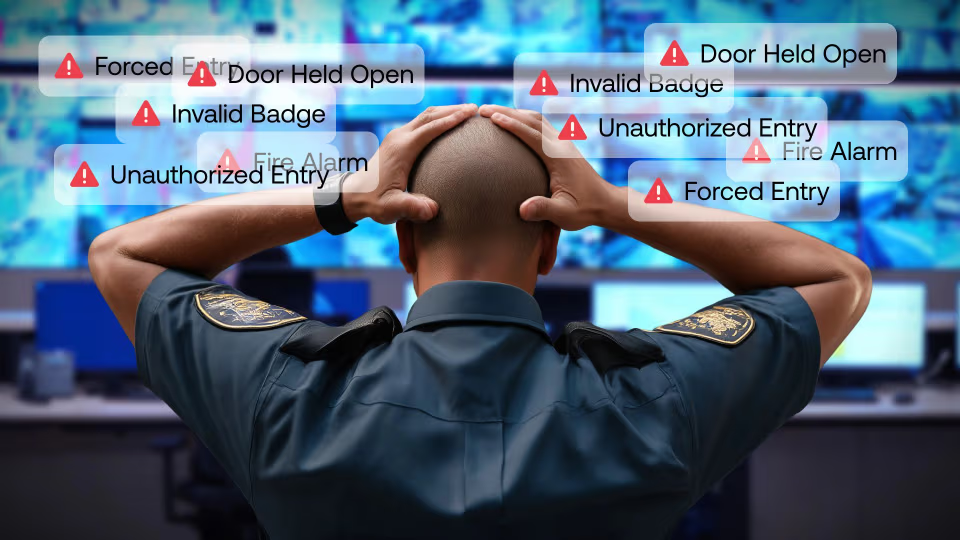
Behind the blinking screens of every Global Security Operations Center (GSOC) are teams of dedicated professionals tasked with protecting people and assets. GSOC analysts are drowning in data, spending their days chasing ghosts born from unsophisticated motion-based alerts triggered by basic video analytics. This constant stream of "cry wolf" alerts leads directly to a well-documented phenomenon: alert fatigue.
This leads to burnout, high turnover, and a perpetual cycle of hiring and retraining that drains institutional knowledge and weakens the team's overall effectiveness. For security teams, this has three major consequences:
- Genuine risks are buried in a sea of false positives
- Erodes the quality of service
- Drives up the cost of operations
Every false alarm consumes resources, and to cope with the volume, organizations add more analysts, more contractors, and more turnover. The result is a reactive security posture, where teams are perpetually responding to incidents rather than proactively preventing them.
How AI Improves GSOC Efficiency

The future of physical security depends on breaking this cycle. The answer isn't more personnel or more cameras; the answer is intelligent, more efficient security.
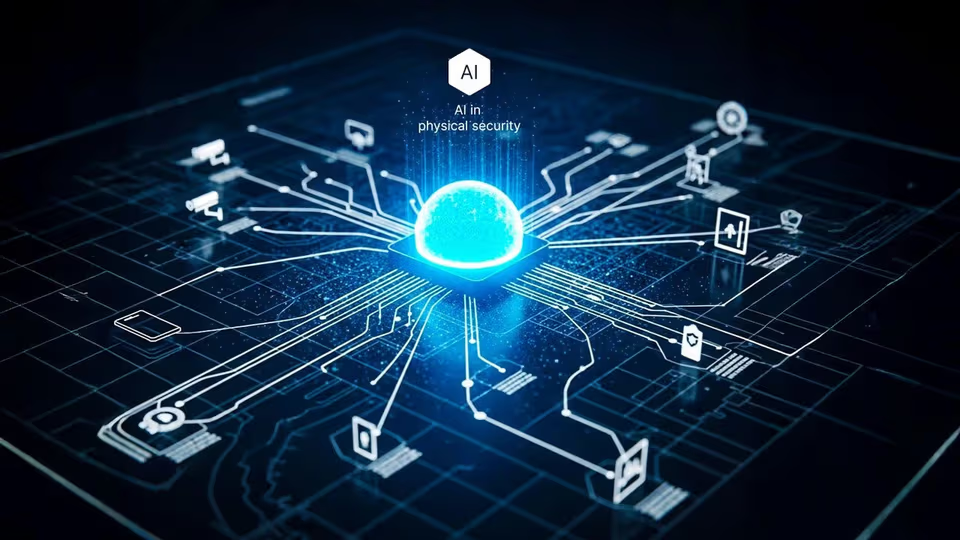
The future of physical security lies in leveraging the power of Artificial Intelligence (AI) to augment human expertise, transforming physical security from a reactive cost center into a proactive, data-driven strategic enabler. That's the shift to Agentic Physical Security — and it's how Ambient.ai is changing the game.
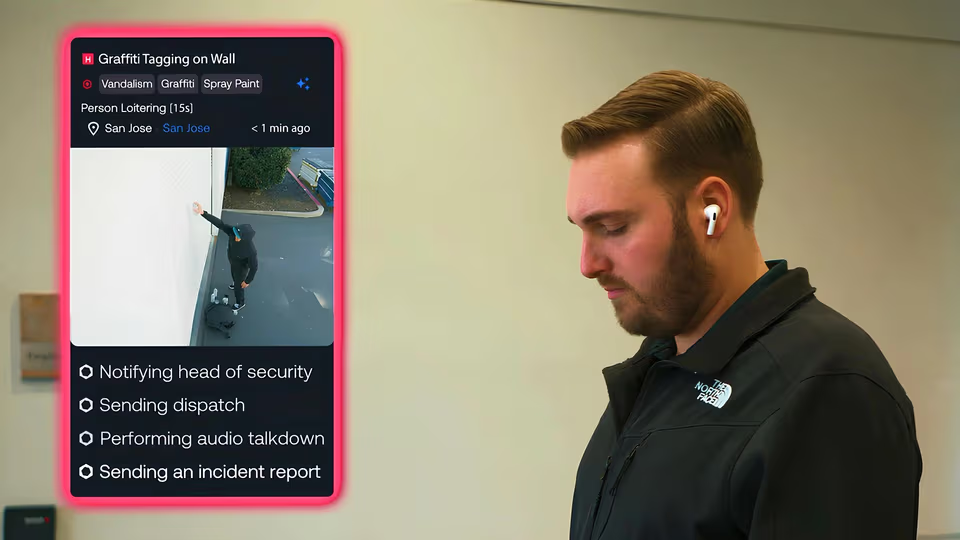
Ambient.ai is a force multiplier for security teams. Our platform uses advanced computer vision and deep learning to analyze video feeds in real time, understanding the context of events as they unfold. It differentiates between a genuine threat, like a person tailgating through a secure door or an unauthorized individual in a restricted area, and the thousands of benign events that trigger false alarms in legacy systems. By filtering out the noise, we empower security teams to focus exclusively on the incidents that require their attention.
This is not about replacing humans; it's about elevating them. By automating the monotonous, low-value task of manually triaging countless alerts, we free up GSOC analysts to do what they do best: manage critical incidents, coordinate responses, and engage in proactive security.
Case Study: ServiceNow Transforms Physical Security with AI
The impact of this AI-powered physical security approach is not just theoretical. Here's how ServiceNow achieved a 94% false alarm reduction with Ambient.ai's AI-powered physical security platform. Faced with the challenge of securing 13 of its U.S. sites, ServiceNow deployed Ambient.ai across its security camera infrastructure to drive operational efficiency and scale its security operations sustainably.
The results, documented in the first half of 2025, are a powerful testament to the AI-powered physical security ROI.

In these months, the Ambient.ai platform processed over 240,831 alarms. 94% of these alarms were automatically cleared by the AI, requiring no human intervention, which left only 14,792 critical events escalated for human review.
The operational impact was immediate:
1. 15,069 hours of manual triage saved
2. Over $500,000 saved in costs
3. 61,000 threat alerts resolved in under a minute.
As one of ServiceNow's security leaders, Brian, shared about the deployment:
"From AI detection to resolution in under a minute. I'm pumped to have Ambient.ai now in full production across all our ServiceNow U.S. locations... With Ambient.ai, we're eliminating thousands of hours of manual triage and enabling our GSOC to focus on what really matters—protecting our people and assets."
This experience demonstrates a fundamental shift in how physical security is managed. Instead of adding more headcount to monitor an ever-increasing number of cameras, ServiceNow was able to scale its security monitoring across 13 sites without proportional headcount growth. This is the essence of strategic agility, the ability to grow and expand without compromising security or exponentially increasing costs.
The ROI of AI-Powered Physical Security
The financial ROI is compelling, but the true value of an AI-driven physical security platform runs much deeper, touching every facet of the security organization. The ServiceNow deployment highlights several key dimensions of return on investment:
- Operational focus and quality: By eliminating 94% of false positives, Ambient.ai drastically improved the signal-to-noise ratio for the security team. This allowed them to move from a state of constant distraction to one of focused, proactive protection. As Brian noted, "Less time spent on false alarms and busywork; more time on proactive protection." The quality of their security operations improved, downstream disruptions were reduced, and their ability to respond to genuine threats became faster and more precise.
- Scalability and strategic agility: For a global enterprise, the ability to scale security operations efficiently is non-negotiable. The challenges of standardizing security across multiple sites, integrating disparate systems, and navigating diverse regulatory environments can be immense. Ambient.ai provides a centralized, intelligent platform that enables scalable monitoring, allowing enterprises to expand their footprint without a linear increase in security personnel.
- Employee morale and retention: The relentless pressure and monotony of traditional GSOC work are a direct path to burnout. By minimizing the repetitive, low-value task of clearing false alarms, Ambient.ai directly addresses this critical issue. This improves morale, reduces the risk of burnout, and allows talented security professionals to focus on more strategic and engaging work, ultimately boosting employee retention.
Future-Proofing Enterprise Security Operations with Ambient.ai
The deployment at ServiceNow validates a core principle: technology is a powerful tool, but true transformation comes from the behavioral shift it enables.
Ambient.ai is more than just a security tool; it's a transformation enabler. It provides the foundation for a data-driven, scalable, and intelligent approach to physical security that aligns with the pace and complexity of the modern enterprise.
The modern enterprise requires a security posture that is as agile, intelligent, and scalable as the business it protects. It's time to empower your security teams, eliminate the noise, and focus on what truly matters. Keeping your employees, your assets, and your campuses safe.
Ready to eliminate false alarms and scale your GSOC efficiently? Schedule a demo with Ambient.ai today.