Why Our Platform Flagged a Toy Blaster, and Why That's Exactly the Point
Our AI weapon detection flagged a group of costumed kids carrying toy blasters, and skeptics asked whether the platform can really reason. The full alert shows how contextual reasoning, plus a deliberate human in the loop, turned a high-severity firearm alert into a quick all clear.
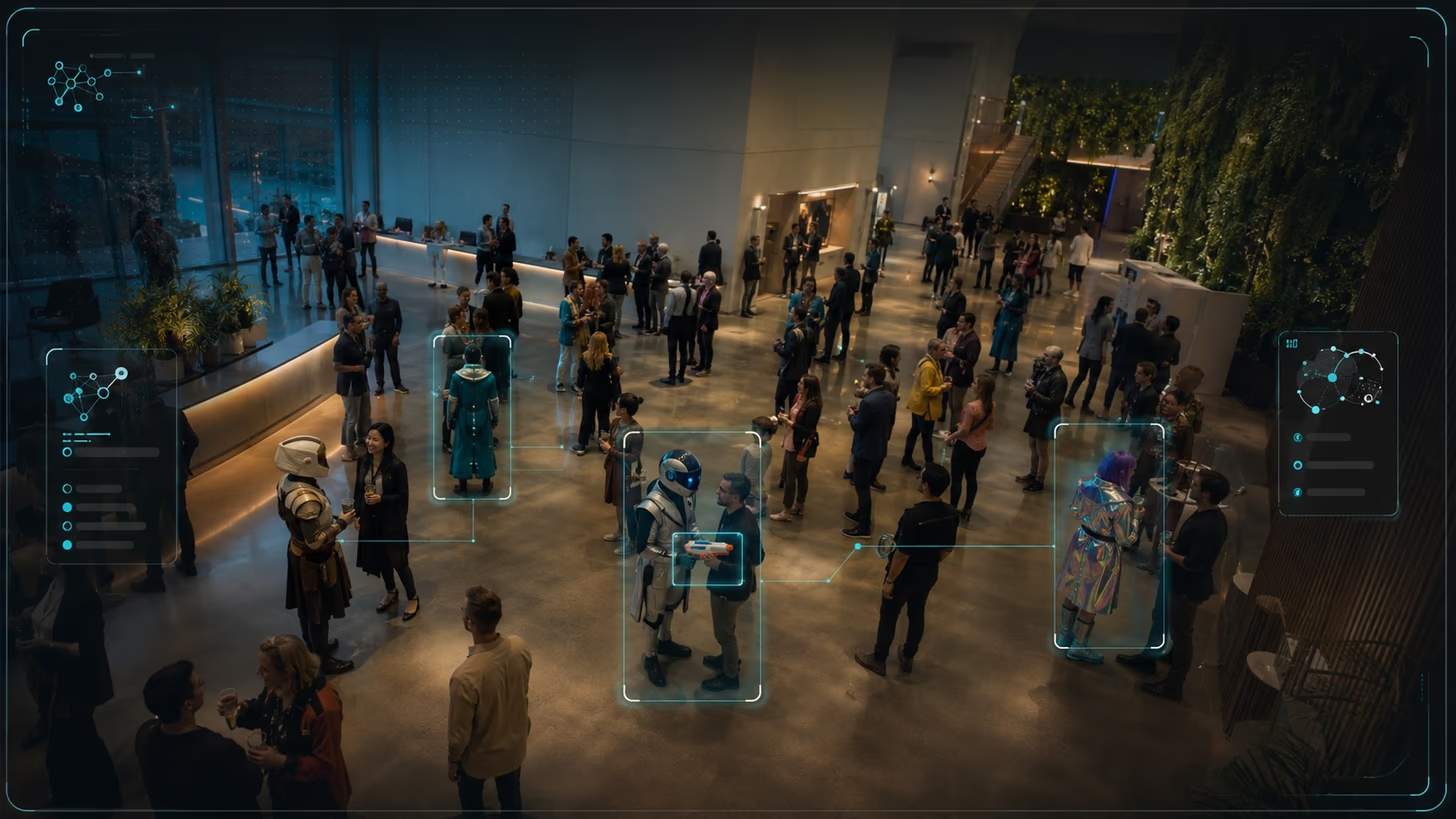


This isn’t theory, It’s deployment-proven performance
Earlier this week, we shared a story that made a lot of people smile. At one of our customer sites, a group of kids showed up in full Star Wars costumes, a little squad of stormtroopers with plastic blasters, an adult playing chaperone in a Darth Vader mask, and a bystander wandering over to snap a photo. It was a crowded public lobby on a summer evening, exactly the kind of happy chaos you would expect. And in the middle of all of it, our platform did something that, at first glance, looks almost comical: it raised a high-severity alert for a person brandishing a firearm.
You can probably guess where this went. The clip traveled, people laughed, and then a few skeptics asked a fair and pointed question. If we market a platform that can actually reason about a scene and assess intent, rather than just match shapes, then why didn't it recognize what any human operator would have seen instantly, a couple of children in costume carrying prop weapons? It is a good question, and it deserves a real answer rather than a defensive one. So I want to do something we do not do often enough in this industry, which is to show you exactly what the system saw and let it speak for itself.
What the platform actually said
When we shared that first post, we chose to show only the video clip, because we wanted the focus to be on the complexity and quality of the detection itself. So here is the part the clip left out: the full alert. When it fired, the platform did not simply shout "firearm" and hand an operator a red banner with no explanation. It wrote out what it understood about the scene, in plain language, the moment it flagged the frame. It described a group of individuals gathered in a public space, some of them dressed in costumes resembling characters from a well-known science fiction franchise. It noted that one person was holding a prop weapon that appeared to be a blaster, as part of a costume. It recognized that the scene was busy and social, consistent with a public event or gathering. It even tagged the moment with the context a person would want at a glance: costumed individuals, prop weapon, public gathering.
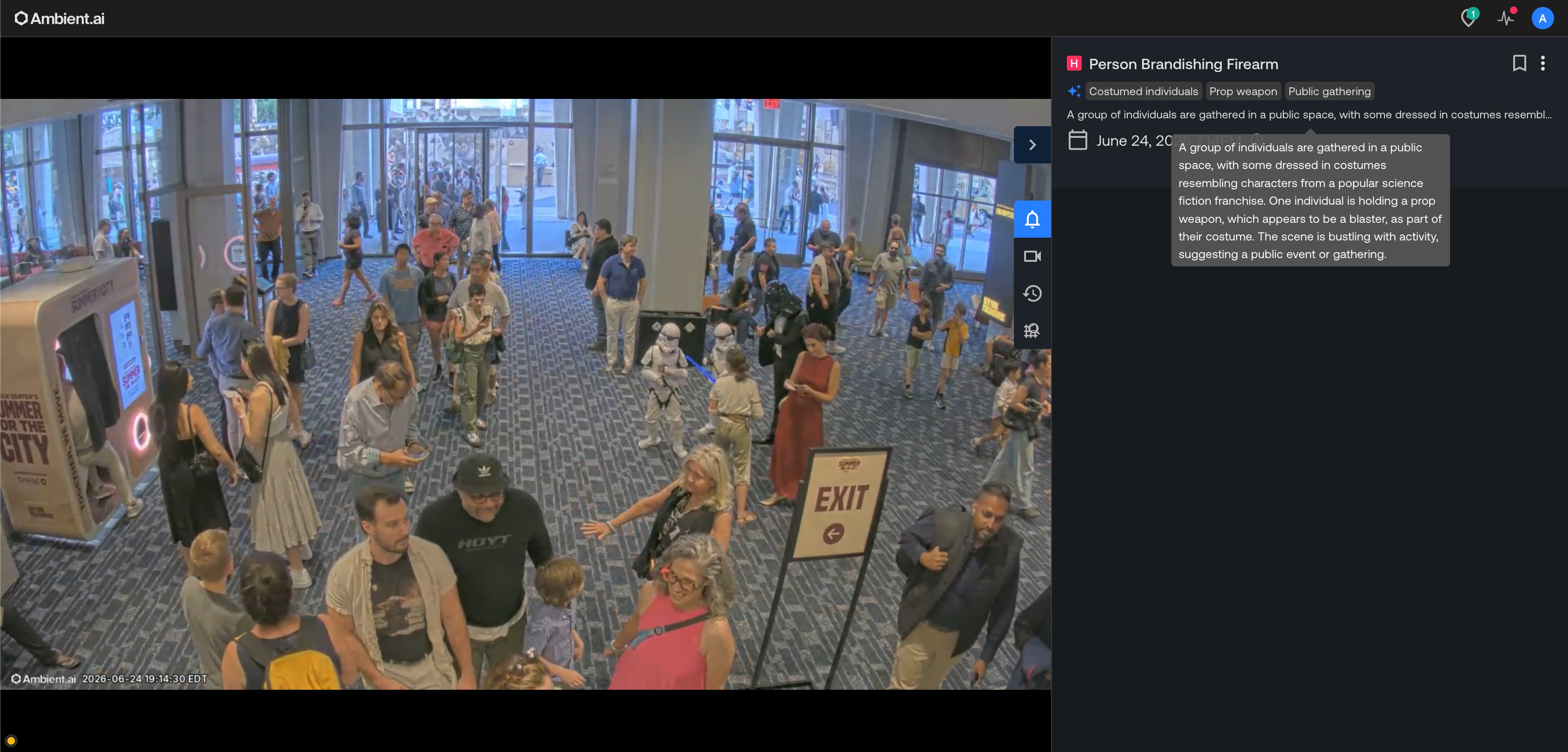
Read that back for a second. The system recognized the costumes. It recognized the toy. It understood that these were characters, not combatants, and that the setting was a celebration rather than a standoff. Then a human confirmed the assessment, and the whole thing was closed out in moments. That is not a reasoning failure. That is the reasoning, written down in the system's own words, working alongside a person who made the final call quickly precisely because the context was already laid out in front of them.
What weapon detection done right actually requires
That alert raised some fair questions when we first shared the clip, and they are worth acknowledging. But the more useful conversation is not whether this single alert should or should not have fired. It is what a weapon detection system has to get right to be trusted inside a real building, with real people in it. That is a higher bar than most systems clear, and it comes down to a handful of things we treat as non-negotiable.
The first is that the system has to bias toward surfacing, never toward silence. Anything that reads as a firearm being carried openly in a crowded space needs to be raised, because the two possible outcomes are nowhere near symmetrical. A weapon that gets surfaced and turns out to be a prop costs a team a few seconds of attention. A real weapon that gets quietly waved off, because software decided on its own that it was probably nothing, can cost far more than seconds. Weapon detection done right respects that asymmetry and errs, every single time, toward putting the moment in front of a person.
The second is that surfacing without context is not enough. A red banner that says only "firearm" teaches people to distrust the system, because most of what it raises will be harmless and none of it will be explained. The real bar is to surface the object and, in the same motion, describe the scene around it well enough that someone can make a confident decision in seconds. The costumes, the posture, the behavior of the crowd, the nature of the event, all of it has to travel with the alert. That is the line between handing an operator a problem and handing them an answer.
The third, and the one we hold to most firmly, is that a person stays in the loop on the decisions that carry real weight. For a high-severity event like a weapon, we do not let software close the loop on its own. This is the part worth sitting with: in this case the platform read the scene clearly enough that it could have cleared the alert automatically, with genuine confidence. It understood the costumes, the prop, and the public event, and it was right. We still put it in front of a person, because the moment you allow a machine to unilaterally decide a weapon is harmless and stay quiet, you have built the one thing you cannot afford to build. Human confirmation on high-severity events is not a limitation we are working to remove. It is a requirement we chose, deliberately.
The fourth is speed, because none of the rest matters if the answer shows up late. The entire reason for attaching rich context to a detection is to collapse the time between the alert and the all clear. Here that was roughly two minutes, from the moment the platform flagged the frame to the moment a person closed it, for a high-severity firearm alert in a packed lobby. Surfacing, context, human judgment, and speed are not four priorities you trade against one another. Done properly, they are one system behaving the way a security team would if it could be everywhere at once.
How the platform actually thinks
It is worth opening up how this works, because the stormtrooper moment is a clean window into what separates reasoning from plain detection, and it is where our differences from legacy systems are easiest to see.
Most of what gets sold as AI in physical security is single-frame object detection. Point that kind of model at our lobby and it does exactly one thing: it sees a shape that resembles a firearm and it fires, and then it stops. It holds no concept of costumes, no sense of who is holding the object or how, no read on whether the crowd is fleeing or posing for photos, and no memory of the seconds on either side. It matches a shape and moves on, which is more or less the experience that taught a whole generation of security teams to distrust their own tools. Our platform does not stop at the shape, and that gap is the core of what we mean by Agentic Physical Security. Ambient Threat Detection runs on Ambient Pulsar, a vision-language model built for physical security from the ground up rather than a general model adapted after the fact. Instead of one snap judgment, it runs a continuous loop, and each step of that loop is where the difference actually lives.
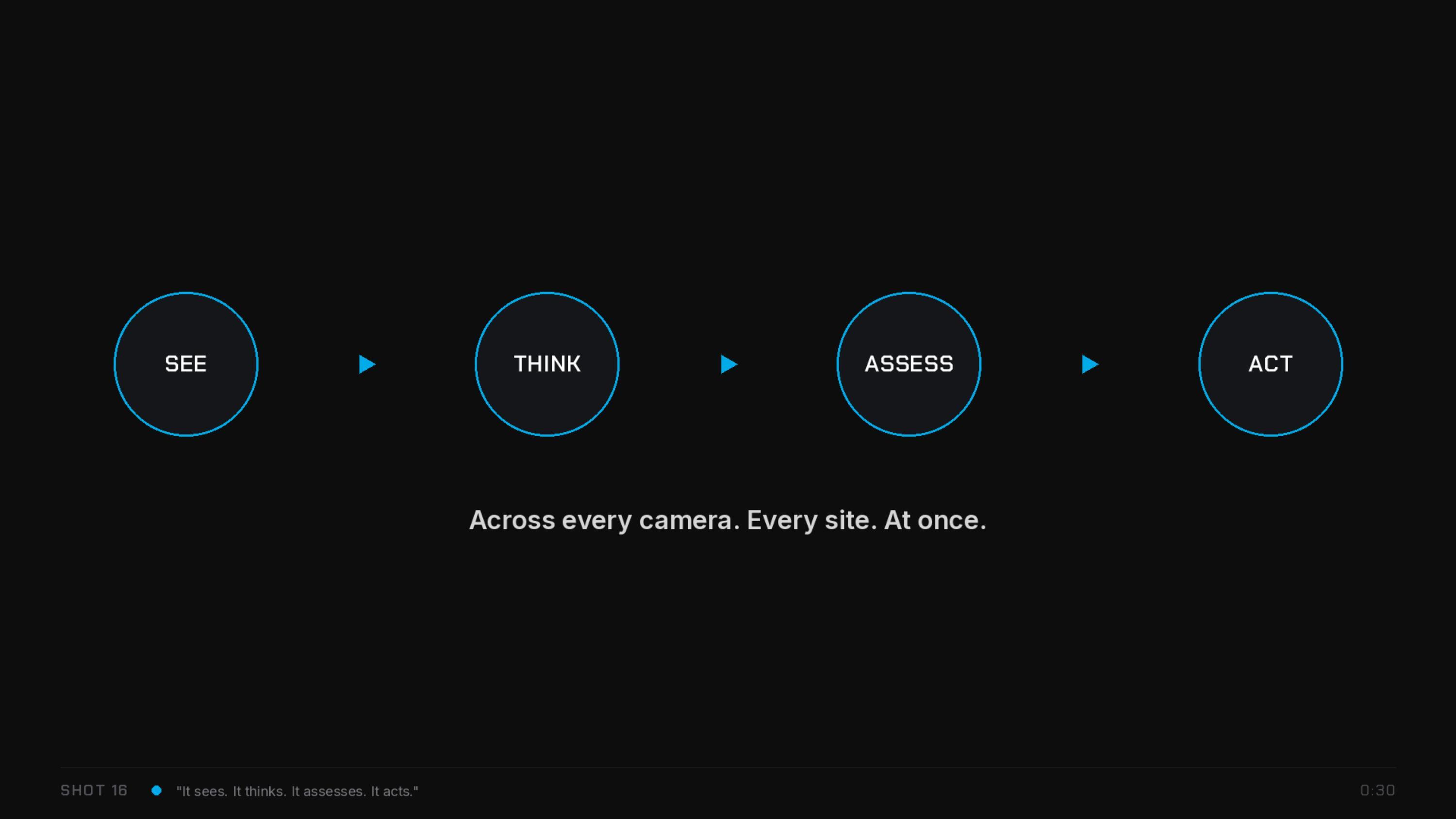
Legacy object detection stops at the first step. Ambient Threat Detection runs the full loop, continuously and in real time.
See everything, miss nothing
Pulsar processes every frame on every stream, in real time, at the edge, with nothing sub-sampled away. That matters far more than it sounds, because the cloud-dependent systems that check a frame every few seconds are precisely the ones that miss a weapon drawn and lowered in the gap between samples. If it happens on camera, the platform sees it.
Think about the whole scene, not the object
This is the step plain detection skips. Rather than asking only whether there is a gun shape in view, Pulsar reads the scene the way a person would, taking in the costumes, the prop and the way it is being held, the age and posture of the people, and the simple fact that the crowd is relaxed and taking pictures. That is exactly where the language in our alert came from. The platform did not guess that these were costumed characters, it observed it, and it wrote down what it saw.
Assess intent and true criticality
Perception on its own still is not enough, so the platform weighs location, behavior, and intent to judge how much a given moment actually matters. This is the difference between a delivery and a break-in, or between a guard adjusting a holstered weapon and a person drawing one in anger. Routine activity is suppressed, real anomalies are elevated, and the few moments that genuinely deserve attention rise to the top instead of disappearing into noise.
Act, with judgment built in
Only then does the platform act, and acting means far more than sounding off. It attaches the context it has gathered and routes the moment to the right place, which for a high-severity event like a weapon means a person confirms the call before anything escalates. What lands in front of an operator is not a context-free alert, it is a briefed decision they can make in seconds.
Run that loop across more than a hundred and fifty verified threat signatures and you cover the full arc of an incident, from someone loitering near a restricted entrance long before anything happens to an active, high-severity event like a brandished firearm. And the platform does all of it by reasoning about behavior and objects rather than identities. There is no facial recognition and no personal data anywhere in the loop, which is worth saying plainly about a lobby this full of faces. It is watching for what is happening, not for who is there.
What we actually take from this
So when I look at the stormtrooper alert, I see a clean, public demonstration of the very thing we have been building toward. The platform caught the one object in a crowded room that genuinely warranted a look, understood the scene well enough to explain why it was almost certainly harmless, and handed a person everything they needed to close it out in about two minutes. Detection on its own would have given that operator noise. This gave them an answer.
Detection without intelligence is just noise. What happened in that lobby was intelligence, and it is the same intelligence quietly doing its job across every camera we cover, every day, on all the scenes that are nowhere near as fun to write about.

Key Takeaways
Reasoning is not the same as detection.
A single-frame object detector only sees a gun-shaped object and alerts. Ambient Threat Detection reasons about context, behavior, and intent, so it recognized costumed individuals, a prop blaster, and a public gathering, and captured all of it inside the alert itself.
For high-severity events like a weapon, a human stays in the loop by design.
The platform's context here was clear enough to auto-clear the alert on its own, but Ambient.ai deliberately keeps a person on weapon decisions rather than letting software close the loop alone, because the cost of being wrong on a real weapon is too high.
A context-rich alert that a person resolves quickly is the system working, not failing.
Because the reasoning was attached to the alert, an operator cleared a high-severity firearm detection quickly, which is the difference between actionable intelligence and undifferentiated noise.


