Can a Gun Be Detected by AI? Top Myths Debunked

.webp)

90%+ alerts resolved in under a minute. See how.
Every security leader knows the challenge: threats don't announce themselves neatly on camera. Operators juggle dozens of feeds, endless alerts, and pressure to act fast without overreacting. False positives drain resources. False negatives cost lives.
AI-powered gun detection promises to change that equation, but some skepticism remains. Can it really spot weapons early enough? Is it accurate? Does it invade privacy? Or is it just another buzzword solution that creates more noise than value?
The truth is that while modern AI systems have made incredible strides to detect firearms, not every system can achieve the same level of high-fidelity alerts by interpreting context, behavior, and environmental cues.
In this article, we'll tackle ten of the most common myths about AI gun detection — separating hype from reality, clarifying what today's systems can (and can't) do, and showing how security teams are already using them to improve response times, reduce false alarms, and maintain privacy.
Myth 1: AI Gun Detection Is Just Fancy Object Recognition
Most people think AI gun detection simply scans the video feed for weapons, recognizes a gun, and sends an alert. But it's not that simple.
Ambient.ai offers an advanced layer of contextual analysis that can distinguish between a weapon (e.g., a brandished knife) or a tool (e.g., a knife on a chopping board). These systems analyze posture, movement trajectory, and crowd reactions before triggering an alert.
Deep-learning vision models process video sequences rather than static snapshots, recognizing firearms across various angles and lighting conditions, while ignoring non-threatening scenarios.
Instead of simply spotting gun-shaped pixels and sounding all the alarms, next-generation gun detection systems interpret the behaviors that turn visible objects into genuine threats.
Moreover, some of these systems incorporate real-time human review of potential threats, and can analyze behavioral context — such as crowd reactions and other threat indicators — even when a weapon is only partially visible.
Myth 2: The Camera Must See the Gun to Detect a Threat
Many security professionals believe AI can only detect weapons when they're clearly visible to cameras, which can be a significant limitation in active threat scenarios.
That's why Ambient.ai also interprets human behavior patterns. Security operators monitoring dozens of feeds simultaneously inevitably miss subtle pre-incident indicators, often learning about threats only after violence has begun and 911 calls are made.
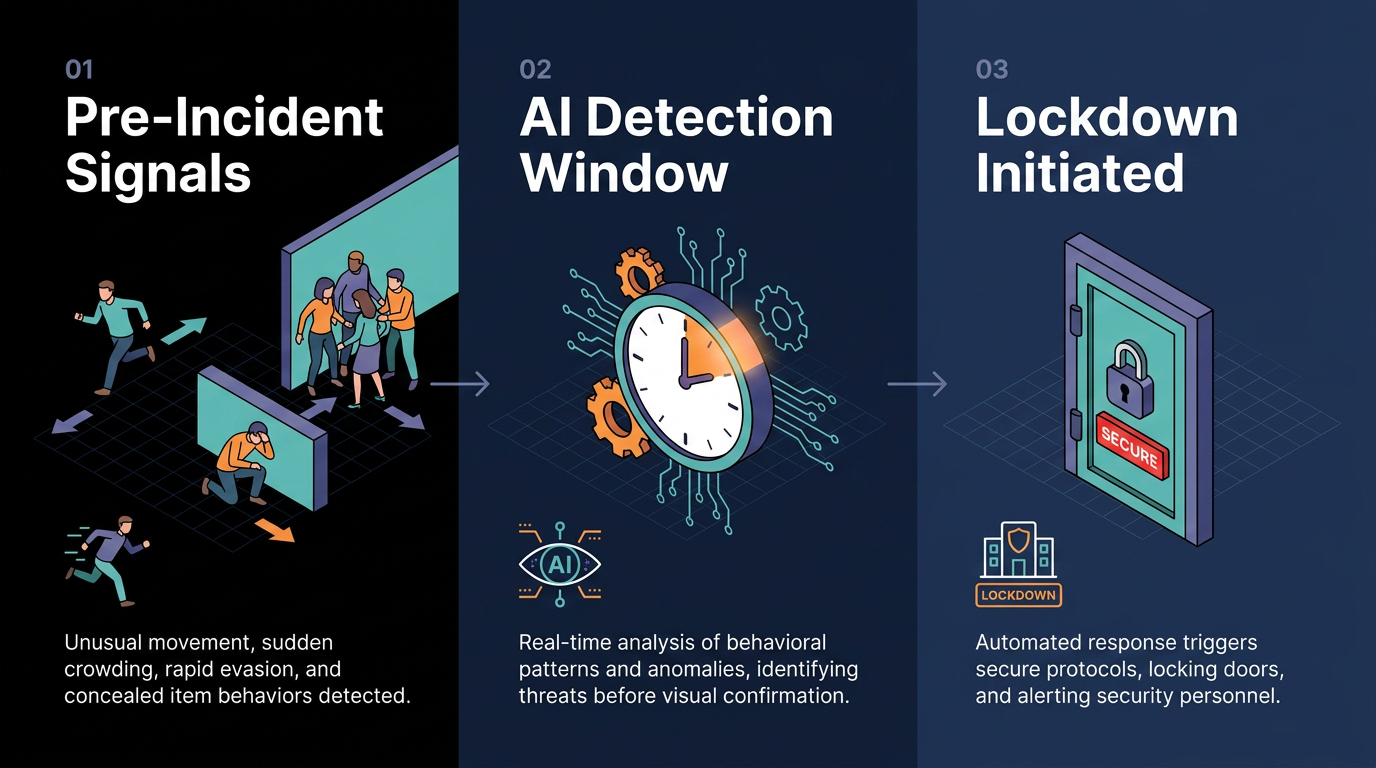
Next-generation systems detect potential threats by analyzing crowd panic, sudden ducking, directional running, and other behavioral anomalies that precede visible weapon brandishing. These platforms process behavioral and contextual signals — such as movement patterns, body language, object cues, and spatial relationships — to identify high-risk situations without requiring facial recognition or storing personal identifiers.
These extra minutes between behavioral detection and weapon brandishing often determine whether lockdown protocols succeed or fail.
Myth 3: Gun Detection Uses Facial Recognition and Compromises Privacy
Many security leaders (and civilians) worry about the privacy implications of AI surveillance. This fear stems from a misunderstanding of how weapon detection actually works.
Many modern AI security platforms focus on objects, behaviors, and scene context rather than identifying individuals, and some explicitly avoid facial recognition or personal profiling. They process video without facial recognition or personally identifiable information storage, do not store biometric data, and retain footage according to configurable retention policies. This privacy-first approach may support organizations' privacy and security obligations in healthcare and educational settings.
Weapon detection systems use computer vision to recognize firearm characteristics like barrel shapes, grip patterns, and carried positions, without processing facial features. Advanced systems capture only single keyframes when potential weapons appear, then automatically purge non-threat data.
Myth 4: AI Gun Detection Generates Harmful False Alarms
Weapon-related false alarms trigger facility-wide lockdowns, emergency responder deployments, and organizational disruption. Beyond operational costs, these false positives create psychological stress for everyone involved while systematically eroding confidence in security systems.
A single gun alert activates full-scale emergency protocols affecting hundreds or thousands of people simultaneously. This usually forces organizations to choose between responding to every alert as if genuine or risking missing a real threat. Without high-confidence verification, security teams cannot sustain effective operations.
Context-aware intelligence solves this dilemma through sophisticated behavioral analysis. Ambient.ai has systems that evaluate posture, grip, and surrounding activity to differentiate actual threats from benign situations. The technology distinguishes between a security guard holding a firearm and someone brandishing a weapon with intent.
High-fidelity alerts with human verification deliver the perfect balance of speed and accuracy. The technology transmits only keyframes showing potential weapons to trained reviewers who verify threats quickly. This approach maintains rapid response capability while preventing unnecessary escalations.
What matters for your security operation is both speed and precision. Every verified alert provides actionable intelligence with location, context, and visual confirmation. Every false positive prevented saves your organization from disruptive emergency responses, while ensuring real threats receive immediate attention when seconds matter most.
Myth 5: Visual AI Encourages a Surveillance State
Critics claim that AI weapon detection creates a surveillance state where everyone is constantly monitored, privacy disappears, and ordinary behavior is scrutinized by automated systems with the power to flag individuals as suspicious.
But this assumption is misaligned with how modern weapons detection systems operate today. Modern AI-based gun detection systems analyze video frames in milliseconds and send real-time alerts when a potential threat is detected. When the system flags a potential weapon, it sends only a single keyframe for verification, not continuous footage, identities, or personal data.
This architecture uses data minimization by design. Instead of requiring operators to stare at dozens of screens hoping to catch threats, AI silently monitors feeds and alerts only when detecting specific risk patterns. The system captures only essential threat information, maintains no identity database, and creates no searchable archive of daily activities.
For security leaders, this approach delivers more effective protection while reducing privacy concerns. Your team stops wasting hours watching empty hallways and instead responds only to verified alerts. The public benefits from both increased safety and preserved civil liberties.
Myth 6: Gun Detection Infringes on Second Amendment Rights
The Second Amendment is the constitutional protection of Americans' right to keep and bear arms. Critics worry that gun detection systems create a surveillance system that flags lawful gun owners and infringes on protected freedoms.
But the reality is more nuanced. Modern AI weapon detection often emphasizes brandishing behavior and threatening actions, but also detects visible weapons based on their appearance, not just behavior. The technology distinguishes between a holstered firearm (legal in many jurisdictions) and one that's drawn and raised (potentially illegal). This mirrors how existing laws already differentiate between lawful carrying and prohibited brandishing.
The technology works by analyzing camera feeds for specific threat patterns, not searching for concealed firearms. When a potential threat is detected, the system captures a single keyframe showing the weapon and immediate context (though it doesn't identify the person). This keyframe goes to human reviewers who verify whether the situation warrants response, ensuring legally carried weapons don't trigger unnecessary alerts.
For security leaders, this approach provides the critical seconds needed for lockdown protocols and coordinated response without creating constitutional conflicts. You gain enhanced protection against active threats while respecting the legal rights of responsible gun owners.
Myth 7: Existing Security Cameras (or 911 Calls) Are Enough
Passive video systems capture evidence for investigators, not intelligence for first responders. By the time an operator rewinds footage or a witness dials 911, the attack is already underway, and every second lost increases casualties.
AI weapon detection changes that timeline, running on your existing cameras to watch for weapons or crowd behavior and guiding responders to the exact location as a threat unfolds.
Early visual detection plugs the critical gap between weapon reveal and the first 911 call. Agencies briefed with location, suspect imagery, and real-time camera links arrive with stronger situational awareness rather than scattered eyewitness reports. In high-risk environments, like school campuses and transit hubs, relying on passive cameras or delayed phone calls is no longer defensible.
Myth 8: AI Is Too Young for Critical Missions
Skeptics argue that computer vision weapon detection remains experimental technology, too immature for mission-critical security applications.
This perception contradicts operational reality.
Visual AI weapons detection systems analyze data using deep learning models that recognize firearms and threatening behaviors across camera networks. The software integrates with existing security infrastructure, requiring no additional hardware while providing threat verification and location context.
For security leaders evaluating weapon detection, the key questions aren't about feasibility but about implementation strategy and integration with human verification workflows.
Myth 9: Simple Motion Detection Covers Our Needs
Motion-based analytics flood GSOCs with noise because every pixel change, including janitorial carts, swaying banners, and late employees, triggers the same high-priority alarm. Operators burn hours clearing these non-events and start ignoring the console altogether. False-alarm fatigue erodes credibility and delays response when a real gun appears.
Context-aware AI tackles the problem at the source. Instead of flagging motion, the model looks for the visual signature of a firearm and the behavior around it. A person walking with a laptop is ignored, while a handgun raised above the waistline generates an immediate, high-confidence alert.
Schools relying on basic scanners learned this lesson the hard way: systems sometimes mistook water bottles and Chromebooks for weapons, triggering false alarms and extra searches that rattled staff and students. Each unnecessary lockdown disrupts learning and siphons resources from genuine risk mitigation.
Once motion noise is stripped away, security teams regain bandwidth. Pixel-change sensors may be cheap to deploy, but the operational cost of their false alarms isn't.
The Future of Agentic Physical Security Intelligence
Vendors say these systems use data minimization and SOC 2 compliance and are designed to focus on illegal brandishing rather than lawful possession.
Next-generation AI gun detection systems use advanced visual reasoning that distinguishes between similar objects like umbrella handles versus gun barrels based on context rather than pixel patterns. Systems are also evolving to track behavioral anomalies that precede weapon brandishing, giving security teams more time to respond.
The future of weapons detection lies in adaptive threat assessment that combines scene understanding with local security protocols.
These systems detect more than just the weapon. They evaluate threat levels based on location sensitivity, nearby crowd density, and subject behavior, automatically initiating appropriate response protocols without human prompting. Security professionals who embrace these advancements will shift from reactive alarm clearing to proactive threat detection, redefining physical security as we know it.
Frequently Asked Questions
How does AI gun detection work without facial recognition while still being able to identify threats accurately?
AI gun detection analyzes weapon characteristics like barrel shapes and grip patterns through computer vision while evaluating behavioral signals including posture and movement. This dual-layer approach identifies threats through observable actions and object features rather than identity.
What is the difference between traditional motion detection and context-aware AI gun detection in terms of false alarm rates?
Motion detection flags every pixel change regardless of context, generating alerts for benign activity. Context-aware AI analyzes visual signatures and behavior patterns, producing high-confidence alerts only when genuine threat indicators appear, dramatically reducing false positives.
Can AI gun detection systems detect threats before a weapon is visibly brandished on camera?
Yes, advanced systems can detect behavioral precursors such as people running in panic, aggressive postures, unusual crowding, and other spatial anomalies that may signal danger before a weapon is visible. This provides critical early warning for proactive lockdown protocols rather than reactive response after brandishing.