What Contextual Awareness Brings to Modern Physical Security


Investigations that took days. Now answered in seconds.
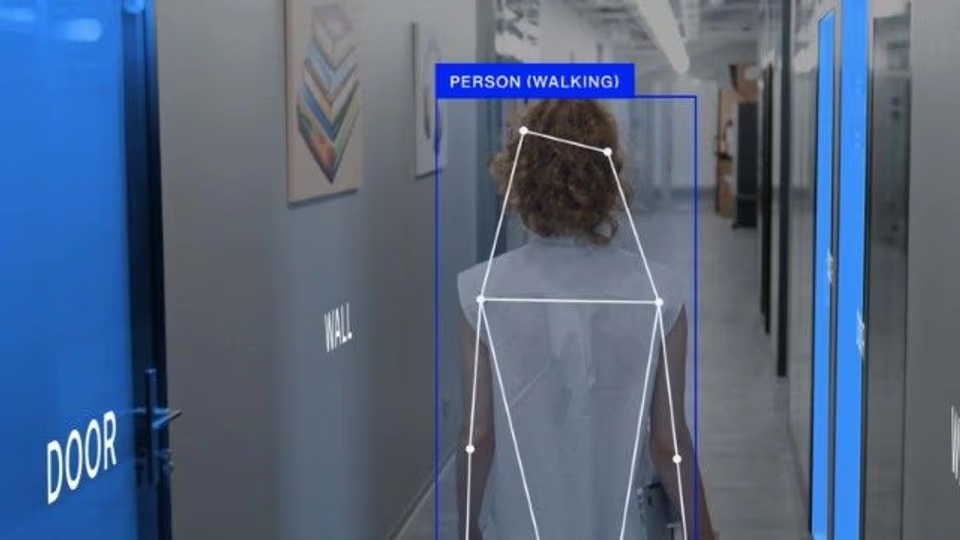
Security systems have evolved from grainy motion sensors to analytics systems that label objects like "person," "crowbar," or "backpack." Each advancement sharpened situational awareness, yet security teams still spend nights clearing alerts that reveal nothing about intent. A technician carrying a crowbar to fix a door and a burglar prying the same door look identical to object-recognition engines. Both trigger alarms.
The core issue is that traditional approaches make decisions on a single cue. Contextual awareness closes that gap by fusing spatial, temporal, and behavioral signals to transform simple detection into intelligent threat assessment.
Why Detection Alone Generates Operational Noise
Video analytics flag motion, badge readers log door activity, and dashboards fill with alerts that reveal nothing about intent. Each notification becomes a potential incident until someone proves otherwise.
Object-focused analytics treat a jogger on the company fitness track exactly like an employee fleeing a fire. Location context matters equally: a technician opening a panel in the maintenance bay is routine, but the same movement inside a restricted lab warrants escalation. Time compounds the problem. Numerous people entering at 8 a.m. is normal; the same headcount at 2 a.m. deserves scrutiny.
The most telling factor is behavior over time. A single badge denial looks innocuous until the same person tries four different doors in ten minutes. Static approaches log isolated events; contextual awareness stitches fragments together, enabling action on intent instead of noise.
How Contextual Awareness Enables Intelligent Threat Assessment
Contextual awareness transforms security operations by pairing every detection with location, time, behavioral history, and surrounding conditions. Instead of forcing operators to cross-reference multiple data sources, intelligent analysis performs the correlation in real time and surfaces only the events that warrant action.
Why Location Changes Everything
Cameras and badge readers already confirm that an individual is present, but intelligent analysis overlays that signal on a live map of the facility. The analysis knows the research lab is restricted after 7 p.m. while the lobby is public 24/7. When a contractor badge pings in the loading dock, no alert fires.
When the same badge appears outside the executive suite, operators receive a priority notification. Environment data, floor plans, and zone designations form the backbone of this logic, turning raw sightings into location-aware intelligence.
How Time Transforms Threat Assessment
Building on spatial awareness, temporal context adds another intelligence layer. The same movement has very different implications at 2 p.m. versus 2 a.m. Advanced approaches tie each event to shift schedules, holidays, and building hours. A pallet jack rolling through the warehouse during the day matches established patterns, but the identical motion after closing triggers automated video verification and a text to the on-call supervisor.
By weighting time alongside identity and place, intelligent analysis suppresses routine alerts and escalates anomalies that occur outside normal windows, sharpening overnight posture without drowning teams in noise.
Reading Intent Through Behavioral Sequences
While location and time provide critical context, behavioral patterns reveal intent. Real threats often unfold in sequences: loitering, repeated swipes, tailgating. Machine-learning models trained on behavioral data surface these progressions so security teams can intervene before an incident materializes.
A visitor making three short trips past a badge-protected door gets flagged for closer review because historical analysis links that pattern to scouting behavior.
Environmental Factors That Separate Normal from Suspicious
Environmental factors provide the final piece of intelligent assessment. The analysis inspects surrounding conditions. A door held open while a forklift passes is routine. The same door propped with a rock during a late-night smoke break is not.
By ingesting sensor status, access events, and camera feeds, intelligent engines separate maintenance activity from forced-entry attempts. Correlating multiple environmental factors, rather than acting on a single trigger, keeps consoles clear so operators can focus on the alerts that matter.
These four dimensions (location, time, behavior, and environment) work together to deliver a live, layered picture of intent, enabling decisive action rather than reactive scrambling.
Operational Benefits of Context-Aware Threat Detection
Context-aware approaches solve three operational problems plaguing security teams: false alarm overload, missed threat categories, and response delays from inadequate alert intelligence.
Dramatically Reduced False Positives
Traditional motion analytics treat every moving object as a potential threat. Cleaners, delivery personnel, and authorized staff trigger constant alerts that operators must manually review and dismiss.
Advanced behavioral intelligence powered by a reasoning visual language model, understand the context in which an event happens automatically generating a threat assessment, classifying events by criticality, reducing noise from false positives and directing security analysts towards the most critical detection first. This ends the cycle of alert fatigue and frees analysts for genuine incident response.
Expanded Threat Coverage Through Behavioral Understanding
Approaches that understand spatial relationships and behavioral patterns identify threats beyond basic object, person, vehicle or intrusion detection. A single intelligence layer built on extensible reasoning VLMs can detect from perimeter breaches to tailgating, unsafe crowd density, and equipment tampering across multiple security categories.
Enriched Alert Context for Faster Response
Alerts arrive with operational context: detection description, location, badge reader data, timestamps, and risk scores derived from environmental factors. Instead of generic motion alerts requiring investigation, operators receive complete incident narratives enabling immediate response decisions, whether dispatching guards, logging after-hours crews, or triggering lockdowns.
Integration Requirements for Context-Aware Security
To achieve these operational benefits, certain technical foundations must be in place. Human-level scene understanding requires more than object detection. The analysis must correlate door events, know the campus blueprint, and understand daily operational cadence. Without these three data streams, advanced intelligence becomes another motion detector.
Access Control Integration
Pairing every badge swipe or door alarm with matching video instantly separates valid entry from forced door events. Integrations with leading providers supply the credential feed, while the intelligence engine enriches this data with behavioral signals to confirm whether the person at the reader belongs there.
Facility Mapping
The analysis needs a living map of security zones, utility rooms, and restricted labs to judge risk accurately. Location awareness ties every pixel to a specific zone. A technician working on a pump station and a trespasser near a data closet look different to advanced behavioral models.
Dispatch Integration
Connecting dispatch workflows to the intelligence layer closes the loop between detection and response. When an alert fires, the system can automatically route context to mobile teams — location, camera feed, event type — so responders arrive informed rather than blind. Logged dispatch activity also feeds back into the analysis, helping the system learn which events required physical response and which resolved without intervention. Over time, this feedback sharpens escalation logic and reduces unnecessary dispatches.
Behavioral Intelligence at Operational Scale
With access control data, facility maps, and dispatch workflows feeding a single intelligence layer, contextual reasoning moves from concept to operational reality. Computer vision intelligence cuts through the flood of nuisance alerts security teams battle every shift.
Ambient.ai's Agentic Physical Security platform applies behavioral analytics to identify and respond to security threats in real time. Ambient Threat Detection monitors camera networks for 150+ threat signatures, from loitering and tailgating to brandished firearms. By analyzing spatial, temporal, and behavioral patterns, it distinguishes genuine risks from routine activity. Fortune 100 data centers, manufacturing plants, and corporate campuses rely on this contextual understanding to prevent incidents without drowning teams in noise.
The result is physical security operations that finally match human judgment at machine scale. By discerning intent through behavioral understanding rather than simple object detection, this proactive approach repositions security from a cost center focused on reaction into a strategic asset designed for prevention.