AI Gun Detection for Schools: Top Solutions & Buying Guide


90%+ alerts resolved in under a minute. See how.
Traditional cameras record incidents but rarely prevent them. AI gun detection for schools is changing that equation, applying computer vision and behavioral analysis to existing camera networks so threats surface in seconds, not after the SRO radio call.
For school safety directors and district security leaders weighing how to modernize campus safety without replacing infrastructure, the starting point is understanding how this technology works and which approaches actually deliver early warnings before a lockdown. This guide explains core mechanics, proven accuracy rates, five leading school-ready platforms, and a practical deployment framework.
What Is AI Gun Detection for Schools?
AI gun detection software transforms the cameras you already own into weapon detection systems that spot a drawn firearm and alert responders within seconds.
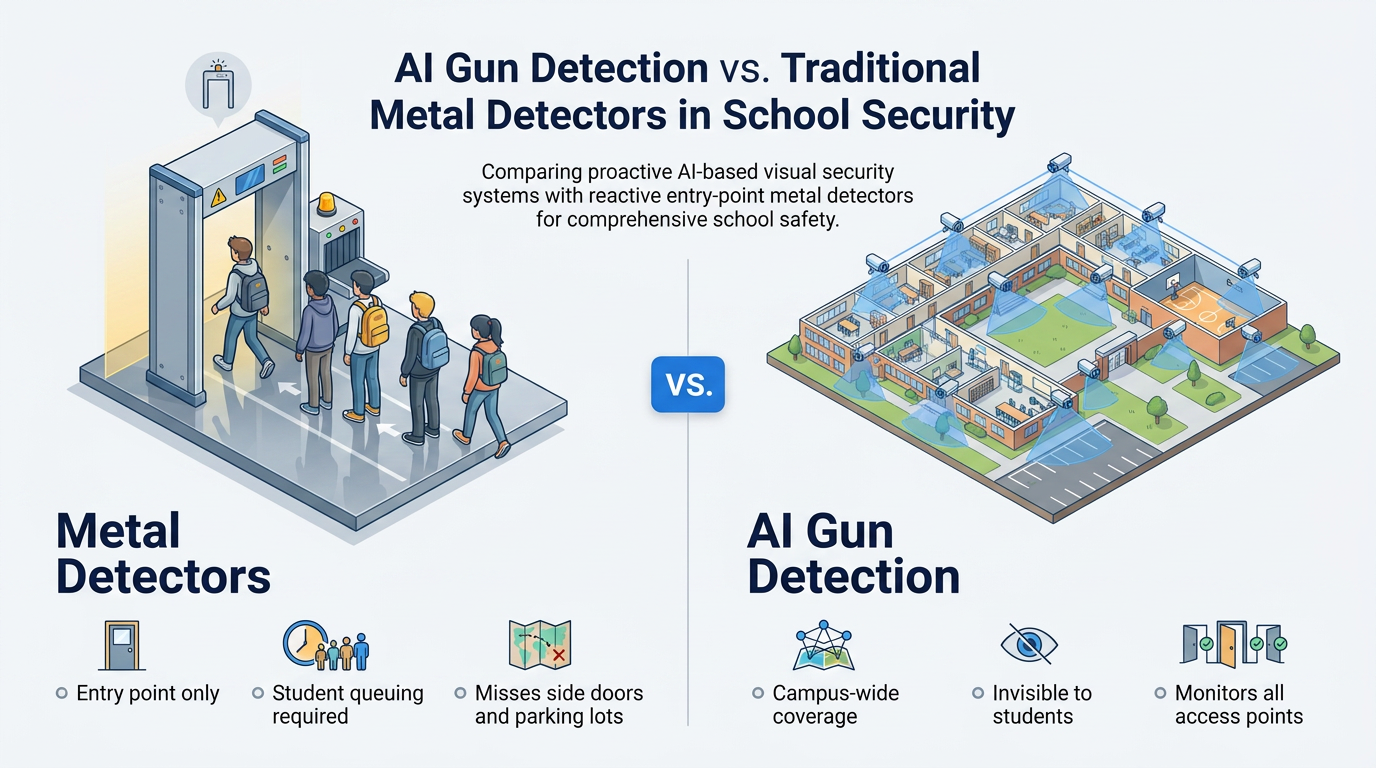
Traditional motion or metal detectors trigger only after a shot is fired or a checkpoint is breached, but intelligent video assessment software can identify threats before violence erupts. Unlike metal detectors at the front entrance, which can feel intrusive and turn the start of the school day into an airport-style screening line, AI gun detection works invisibly through the cameras already mounted in hallways and common areas.
AI gun detection software overlays computer vision on your existing camera network to spot visible firearms, verify threats, and trigger lockdown procedures in seconds. The expectation is that detection happens before the first 911 call from a classroom or front office. By automating the most challenging aspect of surveillance, AI gun detection gives School Resource Officers and local first responders critical minutes that manual monitoring routinely loses.
The software operates through three escalating levels of sophistication:
- Basic object recognition distinguishes handgun or rifle shapes from everyday objects like phone cases, laptop bags, or umbrellas, using multi-frame analysis
- Contextual understanding adds spatial awareness to detect threatening situations, like a firearm in a school hallway during passing period versus a baseball bat near the athletic fields
- Behavioral analysis monitors body language, crowd reactions, and movement patterns for early violence indicators, from fights in the cafeteria to a student concealing an object near a restricted entry
AI weapons detection technology processes live video in real time through on-premises hardware or cloud services, where machine learning analyzes every frame. When threats are detected, the system can automatically send alerts to SRO radios, administrator phones, and front-office workstations, and deliver location-tagged images to first responders within seconds. High-severity alerts are typically verified by a human analyst before campus-wide notification to prevent unnecessary lockdowns and classroom disruptions.
Educational campuses present unique challenges like dense foot traffic between bells, after-school events and night games that alter lighting conditions, and open quads where students carry sports equipment, instrument cases, and theater props that can resemble weapons. Continuous learning algorithms adapt to these variables while preserving privacy by ignoring faces and other personally identifiable student information.
These platforms can integrate with door controls, intercom and PA systems, mass notification tools, and other emergency communication systems, helping centralize coordination and reduce manual communication handoffs during emergencies.
The result is a prevention-focused layer that transforms existing cameras from passive recording devices into proactive security assets, delivering the early-warning capability school safety teams need most.
A Less Disruptive Alternative to Metal Detectors
For many districts, the choice between visible screening hardware and invisible AI monitoring comes down to school climate. Metal detector lines at the front doors can create throughput delays and may signal to students that they are entering a high-security environment rather than a place of learning. They also miss anything that enters through a side door, a propped-open exit, or a parking lot.
AI gun detection takes a different approach. Because it runs on cameras already installed across the campus, students never have to queue, empty backpacks, or remove jackets to walk into class. The technology stays in the background, watching for weapons and threatening behavior without interrupting the daily routine that supports learning. For parents, staff, and students, the experience feels less like a checkpoint and more like the campus they already know — only safer.
Benefits of AI Gun Detection in Schools
Intelligent threat detection delivers early warning that manual monitoring cannot match, alerting SROs and security operators to weapon threats while human verification prevents false lockdowns. Key advantages include:
- Cuts through false alarm noise: Vision Language Models (VLMs) are designed to focus on weapons and other threat-related context, which can help reduce irrelevant motion-based alerts during busy bell schedules and dismissal
- Provides 24/7 vigilance: Automated agents monitor every feed simultaneously across hallways, cafeterias, gyms, parking lots, and athletic fields without fatigue or shift-change vulnerabilities
- Enables coordinated response: When verified, location-tagged alerts flow directly to access control systems, SRO radios, and PA systems, supporting lockdown protocols and limiting attacker mobility between wings
- Works with existing infrastructure: Software layers onto current IP cameras from any major manufacturer with minimal capital costs and rapid deployment, preserving bond and grant dollars
- Student-friendly experience: Unlike metal detector checkpoints, AI gun detection operates silently in the background, avoiding the lines, bag checks, and prison-like atmosphere that can make students feel unwelcome on their own campus
- Maintains privacy compliance: Operates without facial recognition and minimizes video retention by focusing on threats rather than students, which can support FERPA compliance as part of broader school policies and controls
Overall, the biggest benefit of integrating AI gun detection in schools is that the extra layer transforms technology from reactive incident response to proactive prevention, providing critical seconds for intervention before violence erupts in a classroom or common area.
6 AI Gun Detection Solutions for Schools
District and campus security directors evaluate various vendors with different technical approaches, from behavioral analysis to walk-through screening at building entrances, based on their existing infrastructure and emergency response protocols.
1. Ambient.ai
Ambient.ai reads behavioral context, which goes beyond simple object recognition and fundamentally changes how threats are detected on K-12 and higher-education campuses.
While other systems only identify visible weapons, Ambient's platform can detect human behaviors that signal imminent danger. This analysis lets it detect threats even when no weapon is visible by analyzing crowd reactions, body language, and spatial context across hallways, stairwells, and exterior gathering areas.
School security teams using Ambient.ai gain crucial capabilities that address the unique challenges of campus safety:
- Works with existing cameras: Integrates with Axis, Hikvision, Avigilon, and other systems from camera manufacturers without replacement costs, protecting prior capital investment
- Early warning indicators: Leveraging a library of over 150 validated threat signatures, it detects pre-incident behaviors like sudden crowd dispersal in a hallway, loitering, fights, and weapon brandishing before an incident escalates
- Contextual understanding: Through its AI models, it distinguishes actual threats from false positives by accounting for environmental context and behavioral analysis relevant to different campus areas
- Patented Access Control: Using patented technology, it correlates PACS events with corresponding video in real time, providing deeper insight into perimeter security at vestibules, side doors, and after-hours entry points
- Real-time investigations and forensics: Enables operators to find incident footage in an instant using everyday language to describe people, objects, or events for SRO reports and post-incident review.
- Human verification workflow: Automatically filters alerts, with security personnel reviewing high-severity events to prevent unnecessary lockdowns and instructional disruption
- Privacy-first design: Operates without facial recognition or student identification, maintaining FERPA compliance
This behavioral layer provides the context that pure object detection misses, transforming existing security infrastructure into a proactive prevention system that keeps students focused on learning rather than lockdown drills.
2. ZeroEyes
ZeroEyes provides AI-driven gun detection software that processes video feeds from existing security cameras. The platform uses computer vision to identify firearms in camera footage and sends alerts to school security personnel and SROs. The system focuses on object detection capabilities and integrates with standard K-12 security camera infrastructure. An important drawback of this solution is that it does not offer any detection capabilities outside of weapons, seriously limiting its ability to drive proactive prevention of fights, medical emergencies, or perimeter intrusions.
3. Scylla AI
Scylla offers an edge-based video analytics solution that processes footage directly at the camera or in cloud environments. The platform provides basic weapon detection capabilities with cloud-based management for system configuration. Districts can deploy the system across existing campus camera infrastructure with standard integration protocols.
4. Omnilert
Omnilert provides detection models with SOC 2 compliance for school environments. The platform offers weapon detection capabilities through existing camera systems and includes integration with mass notification and emergency communication protocols commonly used in K-12 districts. It also processes video feeds through cloud-based analytics with standard alert mechanisms.
5. VOLT AI
VOLT provides a detection platform that includes weapon identification along with other security monitoring capabilities relevant to school environments. The system offers cloud-based video analysis with basic threat detection features and standard integration with existing campus camera networks. It delivers alert notifications through conventional security protocols.
6. Evolv Technologies
Evolv Technologies uses physical security screening gates at building entrances for physical screening, often deployed at main entries, athletic events, and ticketed gatherings. The hardware-based approach focuses on entry point detection rather than campus-wide monitoring across hallways and exterior spaces. The system processes individuals walking through designated checkpoints and provides basic threat identification capabilities.
Tips for Implementing AI Gun Detection
Successful deployment builds a foundation for reliable threat detection without creating operational blind spots through camera network audit, IT infrastructure planning, alert protocol design, and continuous system tuning aligned with the school's emergency operations plan.
- Assess camera coverage: Map all entrances, hallways, cafeterias, gyms, and student gathering areas to verify coverage against your campus security plan. Reposition or upgrade cameras with poor resolution, backlighting from exterior windows, or blind corners near stairwells and lockers.
- Plan IT infrastructure: Route video feeds to the detection engine without overwhelming district network bandwidth. Design privacy policies that limit video retention and focus detection on weapons rather than student faces, in line with FERPA and district data governance.
- Design alert protocols: Route every detection to school security personnel or SROs for confirmation before triggering campus-wide responses. Human verification prevents unnecessary classroom disruptions and lockdowns.
- Maintain and tune the system: Conduct regular response drills aligned with applicable state- or district-required active threat, lockdown, or emergency exercises, track false-positive rates, and adjust detection sensitivity based on each zone's requirements, from the front vestibule to the bus loop.
When cameras, software, SROs, and administrators operate as an integrated security team, automated detection becomes reliable campus protection that adapts to your school's unique lighting conditions, bell-schedule traffic patterns, and seasonal variations across athletic and after-school programming.
Building Safer Schools Through Intelligent Prevention
Intelligent threat detection transforms your existing cameras into active monitors, delivering alerts within seconds of weapon detection and showing operators the threat location before incidents escalate. This shifts school security from post-incident response to threat detection, without the visible barriers and screening lines that make students feel like they are entering a fortress instead of a school.
Early detection systems primarily recognized movement or motion. Ambient.ai analyzes behavioral context like stance, movement patterns, and crowd reactions to identify threats even when weapons are partially concealed in a backpack or under clothing.
These systems reduce false alarm rates, with human verification teams confirming genuine threats before triggering lockdown protocols that disrupt instruction.
The technology integrates with your current camera networks without hardware replacement. Every entrance, hallway, cafeteria, and common area becomes a monitored space that never loses focus or requires breaks.
School security teams gain critical intervention time that traditional reactive measures cannot provide. Instead of managing violence after it erupts, districts can stop threats during crucial moments before triggers are pulled.
This prevention-focused approach is intended to support a secure learning environment on campus.
Frequently Asked Questions
How accurate is AI gun detection compared to traditional metal detectors in preventing school shootings?
AI gun detection and metal detectors serve different functions. Metal detectors reliably identify metallic objects at checkpoints, but checkpoint-based screening only covers designated entry points. AI gun detection monitors continuously across entire campuses, detecting drawn weapons in real time with accuracy depending on verification workflows.
Does AI gun detection software comply with FERPA and student privacy regulations if it runs on cameras that record students throughout the school day?
Yes, when designed with privacy-first architecture. Compliant systems analyze video for objects and behaviors without storing biometric identifiers or using facial recognition. FERPA compliance depends in part on what data the system collects and retains, as well as how that data is maintained, used, and disclosed.
What is the typical cost and timeline for deploying AI gun detection across an entire school district's existing camera network?
Deployment timelines vary by district size, infrastructure, and rollout complexity, with vendors describing the process as rapid and often including a two-to-four-week parallel operations phase or a proof of concept lasting at least 30 days. Costs vary by camera count and integration complexity, structured as annual subscriptions per camera or site rather than upfront capital expenditures.