Everyone Saw the Sewer Videos. No One Saw Them in Time.
Why security built to investigate incidents misses them, and how AI closes the gap.


95% fewer false alarms. Zero changes to your infrastructure.
For weeks, groups of people climbed into New York City sewers at night.
Security cameras in Brooklyn and Queens recorded them: headlamps, tools, protective gear, groups of three to seven people, one person reportedly underground for roughly three hours, according to AP reporting. The Department of Environmental Protection inspected the locations and found no damage. Police swept the areas and found no public safety threat. Nobody knows who they were or what they were doing.
That is a scary thought to sit with.
The footage existed from day one, but nobody appears to have seen it in real time. The city found out only after residents and shop owners reviewed their own recordings and the clips spread online.
Footage reviewed days later is not security.
It is archaeology.
Security That Only Looks Backward
The sewer story sounds unusual, but the failure mode is common.
Most physical security programs are still built around investigation. Cameras record. Something happens. Someone reports it. An investigator pulls footage. Hours later, the organization understands what occurred.
That model can produce evidence, but it does not produce awareness.
For critical infrastructure, that difference matters. Underground networks, substations, water systems, transit lines, energy sites, data centers, and logistics hubs depend on access points that are often remote, distributed, and operationally noisy. Some are obvious. Some are forgotten until something goes wrong.
The enterprise version looks familiar too: perimeter gates, loading docks, roof hatches, utility rooms, server rooms, stairwells, and employee-only doors that are technically monitored but practically invisible.
The question is not whether a camera captured the event.
The question is whether the security operation understood it while there was still time to act.
More Cameras Will Not Solve an Awareness Problem
The instinctive answer is more coverage.
Coverage matters, but New York's sewer entries were not missed because cameras were absent. They were missed because recording and awareness are different operational capabilities.
No human operator can stare at video all day and catch everything that matters. As the National Institute of Justice found, operators can lose roughly 95% of their attention on video monitors after about just 20 minutes. That is not laziness or poor training. It is biology.
Now scale that across a real environment.
A security operations center responsible for a few hundred cameras can only give each feed a glance every so often. A utility, campus, transit agency, or city environment with thousands of access points cannot even do that. Camera counts grow. Storage grows. Video quality improves. But real-time awareness does not automatically improve with it.
That is the trap.
Organizations keep getting better at proving what happened yesterday while still missing the moment when they could have changed the outcome.
The Signal Was Obvious
What makes the sewer videos so frustrating is that the behavior was not subtle.
A group of people in protective gear, carrying tools, wearing headlamps, descending into a maintenance hole at 2 a.m., repeatedly, across multiple boroughs.
Any human operator who saw that live would have acted on it immediately.
The issue was not perception. The cameras perceived the activity clearly.
The issue was understanding.
There was no intelligence layer between the lens and the investigator, no system looking across time, location, behavior, and access context to recognize that this was not just motion. It was a pattern.
And in security, patterns are where intent starts to become visible.
The Gap AI Designed for Physical Security Can Close
This is where AI designed for physical security changes the model.
Not generic AI bolted onto a video wall. Not another dashboard for operators to ignore. Not motion alerts dressed up as intelligence.
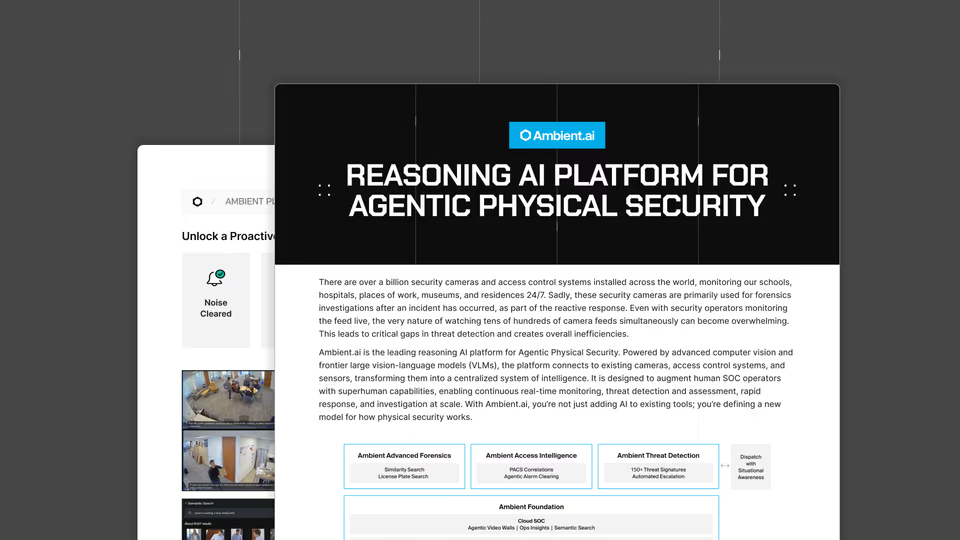
A purpose-built AI platform becomes the convergence layer for physical security signals.
Video is one signal. Access control is another. Door events, forced opens, alarms, badge activity, tailgating events, location context, time of day, known schedules, historical behavior, and operator workflow all tell part of the story.
The problem is that most environments still treat those signals as separate systems. The camera records video. The access system logs a badge event. The alarm panel fires. The operator sees a queue. The investigator pulls clips later.
Each system may technically work, but the security team is still left assembling the truth manually.
This model does not scale.
A modern AI platform should converge those signals in real time. It should see what is happening, understand the context, connect related events, assess what matters, and bring the right moment to a human operator with enough clarity to act.
That means four things.
See. Watch every relevant feed continuously, with the same attention on camera 4,000 as camera 1.
Think. Connect signals over time. One person near a maintenance hole may be nothing. The same access point entered three nights in a row by groups carrying equipment is something else entirely.
Assess. Weigh behavior, location, time, identity, schedule, and surrounding signals. A utility crew at 2 p.m. and an unidentified group descending underground at 2 a.m. may look similar to a motion sensor. They look very different to a system that understands context.
Act. Put the assessed event in front of a human operator in seconds with the information needed to dispatch, notify the agency that owns the asset, escalate, or stand down.
The operator stays in command, while the AI makes sure the moment is not missed.
This is why shifting to Agentic Physical Security is critical. Agentic Physical Security unlocks a new operational model where the system operates alongside the security team, continuously interpreting the environment and surfacing the moments that require human judgment.
From Separate Signals to Security Understanding
The future of critical infrastructure security monitoring is not just better cameras, more alarms, or more access control data. Most organizations already have more signals than their teams can process.
The missing piece is convergence.
A person entering a restricted area matters more when the access system shows no authorized entry. A door forced open matters more when video shows someone entering behind an employee. A camera view matters more when the location is a known critical access point. A repeated after-hours event matters more when it happens across multiple nights.
Individually, these signals can be easy to miss.
Together, they tell the story.
That is what purpose-built AI should provide: not just detection, but understanding.
From Documentation to Prevention
Imagine the sewer story with that layer in place.
The first entry is flagged within seconds of the group approaching the access point. The platform understands the location, time of day, group behavior, equipment, and absence of normal work context. An operator receives the event with the relevant clip and supporting signals. The responsible agency is notified while the group is still underground.
The question the whole city spent weeks asking -- who are these people -- gets asked while there is still someone there to answer it.
And the second entry probably never happens.
Response to the first event means hardening, follow-up, presence, and investigation around the affected access points. Weeks of repeated access compress into one detected incident.
That is what prevention looks like in physical security.
Not predicting the future, but responding fast enough to change it.
Investigation still matters. It also gets better, because the same intelligence that watches in real time can make historical footage searchable by behavior, location, object, time, and context instead of forcing teams to scrub through hours manually.
But investigation becomes the backstop, not the entire security model.
Most Blind Spots Never Go Viral
Police concluded there was no threat under New York. That is the outcome everyone should hope for.
But "urban explorers or something worse?" should never take weeks and a viral video to answer.
Critical infrastructure operators do not get to count on the internet as a detection layer.
Somewhere right now, there is an access point being entered, a restricted door being propped, a perimeter being crossed, a utility room being accessed, or an alarm being ignored because it looks like every other alarm.
And there is probably a camera watching it happen and seeing more than any team can process.
The work now is to converge those signals into understanding while there is still time to act.
That is the gap AI designed for physical security is built to close.

Key Takeaways
Recording and real-time awareness are different operational capabilities. Most physical security programs are built around investigation: cameras capture everything, but footage reviewed hours or days later is evidence, not security. The gap between "recorded" and "understood in time to act" is where incidents become crises.
The problem is understanding, not perception. The NYC sewer entries weren't missed because cameras were absent. They were missed because no intelligence layer existed between the lens and the investigator to connect behavior, location, time, and access context into a recognizable pattern. More cameras don't close that gap.
AI designed for physical security converges signals into understanding. A purpose-built AI platform watches every feed continuously, connects events across time and location, weighs behavior against context, and surfaces the right moment to a human operator in seconds, transforming physical security from reactive documentation to proactive prevention.