Autonomous GSOC: The Future of Global Security Ops
.webp)

It's not a people problem. It's a systems problem.
A global security operations center (GSOC) now takes in more video, access, and sensor data than any team of operators can absorb, regardless of skill or dedication. Enterprises keep adding sites and cameras, and the traditional response, more screens and more headcount, stopped scaling years ago. The autonomous GSOC offers a different operating model for managing that scale while preserving human authority. Understanding what that shift means starts with what a GSOC actually is, and why the manual version reached its limit.
What Is a Global Security Operations Center (GSOC)?
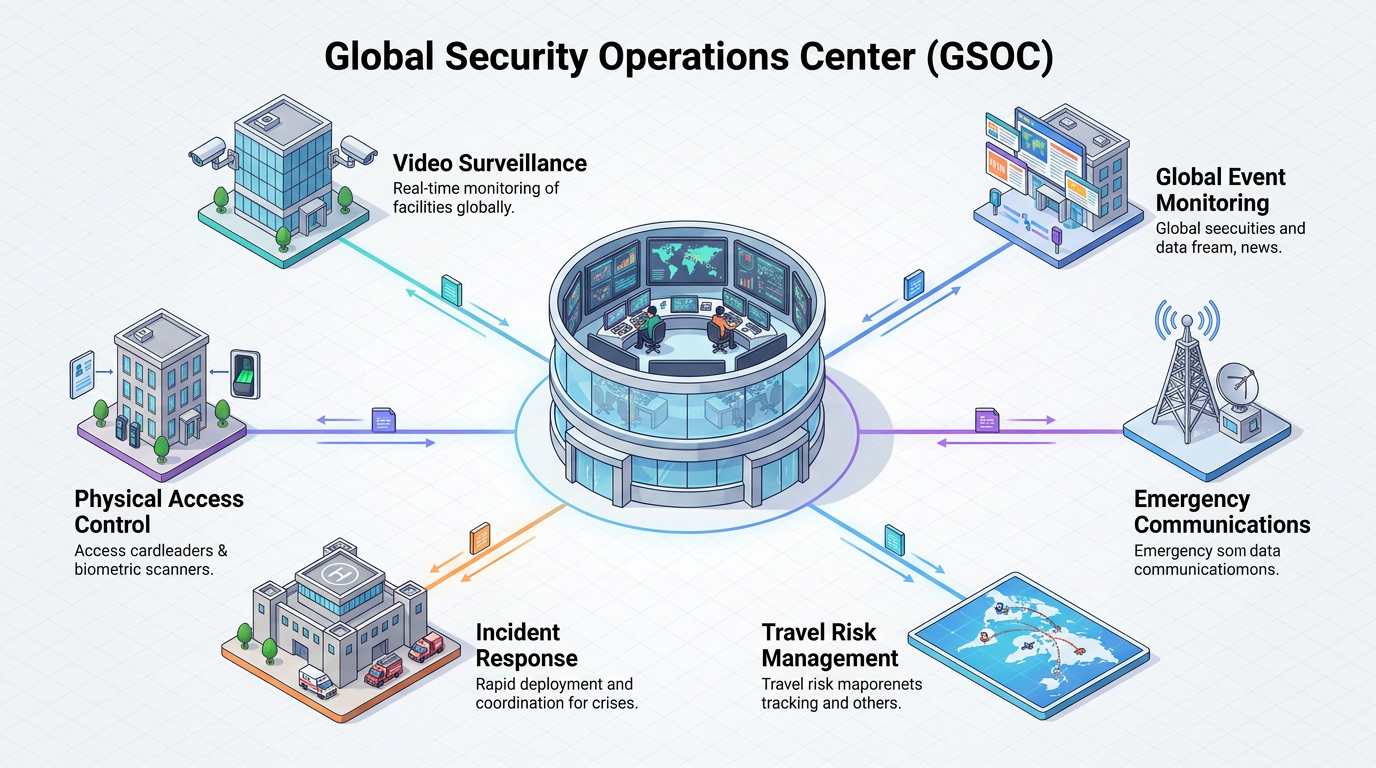
A global security operations center is a centralized command facility where incoming physical security data from an organization's sites worldwide is collected, analyzed, and acted on around the clock. A modern GSOC manages video surveillance, physical access control system (PACS) data, emergency communications, risk intelligence, executive protection, supply chain concerns, and incident response coordination around the clock across multiple locations.
In practice, that scope covers:
- Alarm monitoring and video verification across camera and PACS infrastructure
- Door and gate operations, credential administration, and visitor management
- Global event monitoring, including natural disasters and civil disruption that could affect business operations
- Incident response coordination, dispatch of security personnel, and emergency communications
- Travel risk management and executive protection
Together, these functions give the GSOC a unified operating view across sites, incidents, and response teams.
The "global" distinguishes the GSOC from a regional security operations center (SOC): organizations use the term GSOC when they manage multiple sites around the world from a single location, while a SOC implies a more regional focus. It also differs from a cybersecurity SOC, which concentrates on network threats; the GSOC's remit is physical security, intelligence, and operational risk.
Organizations run GSOCs with internal staff, outsource them, blend both, or adopt a virtual GSOC, where external experts oversee and respond to physical security events in real time from a centralized location.
Why the Global Security Operations Center Hit Its Scaling Limit
The volume problem is easiest to see in PACS operations. Enterprise deployments routinely generate an overwhelming volume of alarms each month, and the volume makes sustained alarm triage increasingly difficult.
Video presents the same math. Enterprise camera networks produce more live video than any operator can absorb simultaneously, so the vast majority of feeds go unwatched. Operators are expected to catch incidents as they unfold, but the data simply outruns human attention.
The workforce cannot close the gap either. Security services experience substantially higher annual turnover than the private sector overall, and manual verification of alarms that turn out to be nothing consumes the hours that remain.
Understanding Autonomous GSOC Security
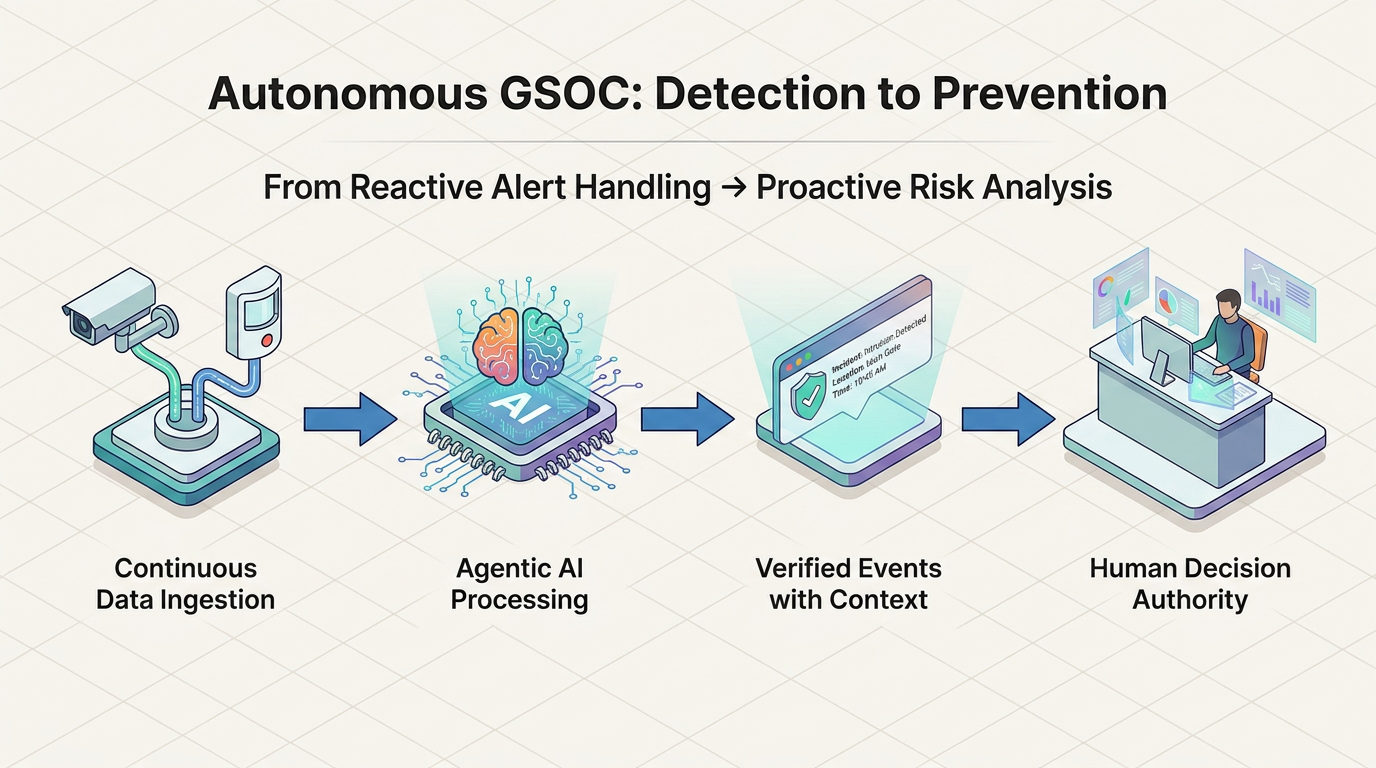
Autonomous GSOC security changes what a command center does with all that data. Instead of operators triaging noise from disconnected systems, AI processes every camera feed and door access event continuously and surfaces only verified, meaningful events with full context attached. Operators keep their authority; what changes is where their attention goes. Technology handles the routine monitoring, and people concentrate on the decisions that require judgment.
Agentic AI shifts the operating model from detection to prevention. Intelligent analytics handle the watching so security personnel can move from reactive notification-watching to proactive risk analysis.
What Autonomous GSOC Operations Look Like
In autonomous GSOC operations, agentic AI observes and assesses events and initiates response in real time. Assessment happens as events unfold rather than sitting in an operator's queue, and each escalation arrives with visual context already attached, so the operator verifies and acts instead of hunting across consoles to reconstruct what happened.
The larger value sits upstream of the incident. Behavioral detection surfaces precursors to high-severity events: loitering in a restricted area, an unauthorized access attempt, or a brandished firearm. Early warning of that kind gives teams a window to intervene before a situation escalates, which is the practical difference between reactive alert handling and incident prevention.
How AI Changes Security Operations
Traditional cameras and monitoring systems see events, not meaning. Rule-based tools trigger an alert when a door opens or a badge is used, but they cannot interpret what actually happened. These systems detect movement, record activity, and sound alarms without understanding context, flooding security teams with false positives and forcing human operators to filter through the noise.
From Rules-Based Alerts to Reasoning Vision-Language Models
Vision-Language Models (VLMs) fuse visual perception with language, which lets them interpret scenes, behaviors, and observable human-object interactions rather than just classify objects. Contextual analysis means understanding the scene itself: the relationship between objects, the environment, and the typical behavioral patterns for that specific location and time of day.
At a data center perimeter, a technician kneeling at the fence line with a toolbox during a scheduled fiber maintenance window is routine activity. The same posture at the same fence overnight, outside any work order, is an event worth an operator's attention. A motion rule fires identically on both; a reasoning model separates the verified alert from the noise.
Closing the Tailgating Blind Spot in PACS
Physical access operations are where the gap between events and meaning costs the most. A PACS electronically authenticates the credential presented at a reader, not the person walking through the door. So if someone slips in behind an authorized employee, the system logs a clean badge event and nothing else. There is no alarm to investigate because, to the PACS, nothing happened. That silent failure is common: 61% of security professionals had experienced tailgating or piggybacking in the prior six months.
AI closes this blind spot by correlating door access events with real-time visual context. Rather than trying to identify who is entering, the model analyzes how many people pass through, how they move relative to one another, and whether the flow of behavior matches a single legitimate credential use. Automated correlation links each PACS alarm with live video of the door, so the check runs on movement through the opening rather than on the credential.
The same correlation solves a separate problem: door-forced and door-held-open sensor alarms, the kind that flood operators at high volume. Automated visual verification clears the false ones before a person ever sees them, while behavioral analysis makes the previously invisible tailgating event visible. Different failures share an underlying fix: restoring sight to a system that has historically operated blind.
Human Oversight and Critical Decision Authority
While AI handles detection and initial assessment, human judgment remains essential for consequential decisions. Organizations must establish clear governance frameworks defining which actions AI can take autonomously and which require human authorization. Personnel must understand the system's capacities and limitations, stay alert to automation bias, and retain the ability to disregard, override, or interrupt its output.
In a GSOC, that translates into tiered escalation design:
- Low-severity events auto-clear after visual verification.
- Suspicious behaviors route to immediate operator review.
- Life-safety situations, including evacuations, law enforcement coordination, and medical emergencies, always run through human decision-makers who can weigh broader context and organizational priorities.
Transparency holds the model together. When an alert is escalated or cleared, operators should be able to see the reasoning, and audits should review detection accuracy over time. Oversight that cannot explain itself invites the rubber-stamping the frameworks were written to prevent.
Implementing an Autonomous Global Security Operations Center
The path to autonomous operations does not require ripping out existing infrastructure. AI detection integrates with the cameras, video management systems (VMS), and PACS an organization already owns, with the intelligence layer sitting on top. Processing can run on edge appliances, in the cloud, or in hybrid configurations, with tradeoffs across latency, bandwidth, data privacy, and cost. The staged path runs from agentic monitoring to investigations, access intelligence, threat detection, and finally response.
Scope matters more than speed at the start. Begin with a small number of repetitive, high-volume processes, measure cycle-time improvements and downstream risk reduction, and build from there. Access alarm verification and after-hours monitoring are natural first candidates because they are easy to measure and quick to deliver operator hours back.
The gains compound at multi-site scale. Investigations compress the same way: a natural-language search for "white van circling the north gate after business hours" returns results in seconds instead of hours of manual scrubbing.
Success metrics shift accordingly. Rather than counting total alerts handled, teams track:
- Meaningful interventions
- Response times to verified events
- False alarm rates
- Operator hours reclaimed
The operator role itself also needs deliberate redesign. Key upskilling areas for the transition include:
- AI and data literacy
- Human-machine interface proficiency
- Bias detection and model oversight
- Critical thinking with machine output
Enabling the Future-Proof GSOC
The autonomous GSOC is not a replacement for skilled operators but a reset of where their attention belongs. When continuous reasoning absorbs the volume of routine monitoring, teams recover the bandwidth to intervene early, investigate faster, and hold the line on the decisions that require judgment. The organizations that move first will define what modern command center performance looks like, measured not by alerts handled but by incidents prevented and hours returned to the work that matters.
Frequently Asked Questions
How does an autonomous GSOC handle tailgating detection differently from traditional physical access control systems?
Autonomous GSOCs correlate video with door events to count people and analyze movement patterns through access points. Traditional PACS only verifies credentials, creating no record when unauthorized individuals follow authorized badge holders through doors.
What are the best metrics to measure the success of an autonomous GSOC implementation compared to a traditional security operations center?
Success metrics should shift from volume-based measures to outcome-oriented indicators: mean time to verify incidents, percentage of auto-cleared events, operator utilization on high-value tasks versus noise filtering, and cost per meaningful intervention.
What is the recommended phased approach for transitioning from a manual GSOC to an autonomous one without replacing existing infrastructure?
Start with high-volume tasks like access alarm verification and after-hours monitoring to demonstrate time savings. Add agentic monitoring and natural language investigations next, then expand to threat detection and response orchestration as confidence builds and measurable improvements emerge.