Artificial Intelligence Surveillance: Add AI to Cameras


95% fewer false alarms. Zero changes to your infrastructure.
How to Implement Artificial Intelligence Surveillance in Your Existing Camera Systems
Traditional security cameras capture everything but require human operators to make sense of what they record. Across parking lots, perimeters, and facilities, hundreds of enterprise IP cameras generate massive volumes of video data, more than any Security Operations Center (GSOC) team can absorb simultaneously. The result is a reactive posture where critical moments, the precursors to high-severity incidents, can go undetected until situations escalate.
An AI surveillance system is a software intelligence layer that applies computer vision and contextual reasoning to existing camera feeds, enabling automated detection of behavioral threats without replacing physical infrastructure. Advanced platforms identify precursors to serious incidents, such as suspicious loitering, physical altercations, unusual crowding, individuals in distress, and unauthorized access attempts, giving teams the early warning they need to intervene.
Why Traditional Surveillance Falls Short
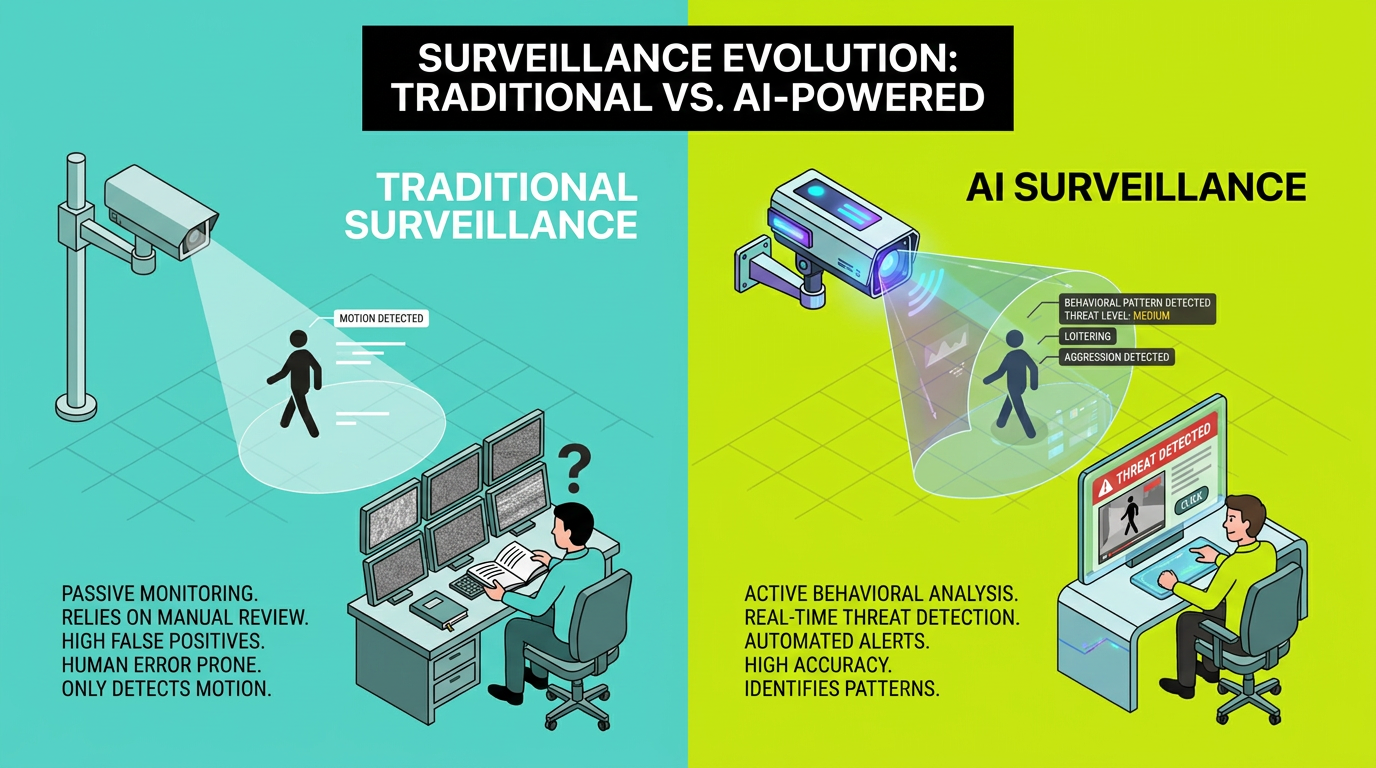
Traditional cameras and monitoring systems can detect motion, count people, or recognize vehicles, functioning as sophisticated triggers that generate alerts based on movement patterns and object presence. However, these systems tell you what appeared in the frame without understanding what those observations mean operationally.
Next-generation physical security systems based on true AI add behavioral understanding through contextual reasoning. These platforms analyze how individuals interact with environments over time, identifying patterns like prolonged presence near restricted perimeters, unusual movement patterns during off-hours, or behavioral indicators of distress or aggression.
By incorporating time, location, and operational context, these platforms assess whether detected activity represents routine operations or developing security concerns. This progression from detection to understanding enables systems to surface genuine security incidents requiring immediate response rather than generating alerts for every detected movement.
How AI Surveillance Works
AI surveillance operates as an intelligence layer that sits on top of existing camera infrastructure, transforming passive video streams into active threat analysis. Rather than functioning as a standalone product, it integrates with the video management systems (VMS), cameras, and access control platforms already in place, applying advanced analytics to feeds that would otherwise require constant human attention.
The process unfolds through several interconnected stages:
Video Ingestion from Existing Cameras
The platform connects to enterprise IP cameras through standard protocols, pulling live video feeds without requiring hardware replacement. Whether cameras are deployed across a single facility or hundreds of locations, the system ingests footage from each feed in parallel, establishing a unified view of the entire camera network.
Computer Vision Analysis
Computer vision models analyze each frame to identify objects, people, vehicles, and their attributes. Unlike basic motion detection, these models aim to interpret what they are seeing, such as distinguishing potential weapons from everyday objects and using contextual signals to help differentiate routine activity from possible unauthorized access.
Contextual Reasoning and Behavioral Analysis
The system applies contextual reasoning to interpret what is happening in the scene. It considers the location, time of day, behavioral patterns, and relationships between objects to determine whether an activity represents normal operations or a developing security concern. This is where AI surveillance moves beyond detection into genuine understanding.
Threat Signature Matching
Detected behaviors are compared against a library of threat signatures that represent known patterns of concern, from tailgating and loitering to weapon presence and crowd commotion. When a behavior matches a signature, the system generates a prioritized alert.
Alert Delivery and Operator Verification
Verified threats are surfaced to security operators through a unified interface with relevant video clips, location data, and contextual information. Operators retain final decision authority, using the AI-generated context to coordinate response quickly rather than spending time hunting for relevant footage.
Benefits of AI Surveillance for Security Operations
Advanced computer vision addresses operational limitations that persist even with extensive camera coverage. These improvements reflect how behavioral analysis fundamentally changes security operations rather than simply adding features to existing systems.
Here are some of the immediate benefits of AI surveillance for security operations:
Proactive Threat Identification Through Behavioral Analysis
Platforms analyzing behavioral patterns can identify concerning activities before escalation occurs. This includes individuals bypassing authorization protocols, suspicious reconnaissance of secured areas, distress behaviors indicating active incidents, and precursor signals like unusual loitering, crowding, or physical altercations. Security teams gain critical response windows that passive recording cannot deliver, enabling intervention before situations deteriorate.
Enhanced Threat Detection Through Contextual Analysis
Contextual analysis means the system understands the scene itself, not just what objects are present, but the relationship between those objects, the environment, and typical behavioral patterns for that specific location and time of day. A person carrying a knife in a commercial kitchen represents normal activity, while the same object in a lobby entrance represents a potential threat.
Systems with contextual understanding can make these distinctions automatically, focusing operator attention where human judgment matters most while filtering the noise from motion-based triggers caused by cleaning crews, delivery personnel, or environmental factors.
Accelerated Investigation Timelines Through Intelligent Search
Natural language queries across camera networks eliminate the manual review of footage that consumes investigators' time. For example, searching for "person in red jacket near loading dock between 2 and 4 PM" returns relevant clips in seconds rather than hours of scrubbing through recorded footage.
When security incidents occur, investigators can locate relevant evidence rapidly by searching for specific behaviors, clothing descriptions, or movement patterns. This capability proves particularly critical during active security incidents requiring immediate suspect identification or timeline establishment.
Reduced Operator Workload Through Automated Access Verification
When integrated with access control systems, automated verification eliminates hours spent manually confirming routine sensor triggers.
Doors left propped during loading operations, emergency exits triggered during evacuation drills, and badge readers detecting authorized tailgating can receive automatic video verification. This frees security personnel to redirect their time toward proactive monitoring and genuine incident response rather than chasing false positives generated by sensitive sensors.
How to Implement AI Surveillance in Your Existing Physical Security Infrastructure
Most organizations already have the camera infrastructure to support behavioral threat detection. Enterprise IP cameras deployed within the past decade typically use standard protocols that allow integration with modern intelligence platforms. The challenge organizations face is not replacing existing hardware but adding the intelligence layer that transforms raw video feeds into actionable threat analysis, identifying genuine security threats before they escalate.
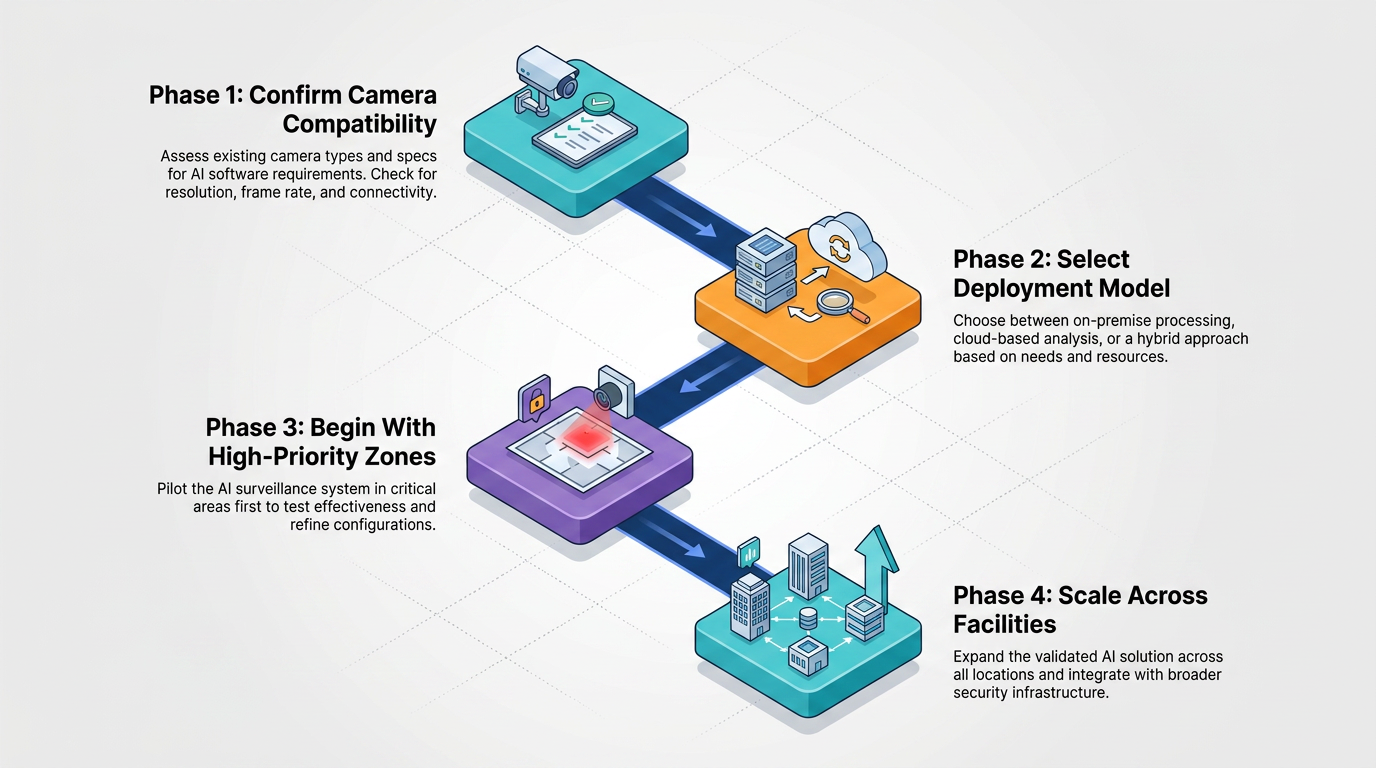
The deployment follows a practical progression that builds confidence through demonstrated threat detection:
Confirm Camera Compatibility
Organizations document existing camera specifications and network capacity during initial assessment, focusing on coverage of entry points, perimeters, and areas with recurring security concerns.
This phase identifies which cameras provide optimal positioning for detecting behavioral threats. Most organizations discover that their current infrastructure already supports intelligent analysis, allowing them to layer behavioral understanding onto existing camera networks without incurring replacement costs or operational disruption.
Select the Deployment Model
Organizations choose deployment architectures based on their bandwidth capacity and compliance requirements. Cloud-first deployments route video to centralized servers for analysis, enabling unified monitoring across multiple sites through a single interface.
Edge-optimized architectures process video locally on premises and forward only relevant alerts and metadata to the cloud, reducing bandwidth demands while maintaining continuous threat detection even during connectivity interruptions. Most enterprise deployments blend both approaches, balancing centralized visibility with local processing resilience based on site-specific needs.
Begin With High-Priority Zones
Connecting the platform to video management systems using cameras covering critical areas, such as entry points, perimeters, and locations with recurring security concerns, delivers immediate value. Operators familiarize themselves with how contextual analysis distinguishes genuine threats from routine activity, identifying individuals exhibiting distress, unauthorized entry attempts, or suspicious reconnaissance behaviors that traditional motion detection would miss.
Detection parameters are tuned to site-specific operational conditions during this phase, learning normal patterns to better surface genuine security concerns.
Scale Across Facilities
After validating that infrastructure supports continuous monitoring and security teams understand response protocols, organizations extend deployment to additional locations. Successful configurations from initial sites replicate across the enterprise, accelerating implementation timelines while maintaining consistent threat detection standards.
This phased approach avoids infrastructure replacement while gaining contextual intelligence that identifies threats requiring immediate response. Matching deployment scope to the highest security priorities ensures resources focus on perimeter protection, unauthorized access detection, and security incident prevention.
Addressing the Implementation Challenges
Even carefully planned deployments encounter predictable obstacles that require systematic solutions rather than reactive troubleshooting.
Technical Limitations
Existing cameras sometimes lack modern capabilities or network capacity proves insufficient for continuous video processing. Organizations address compatibility issues during the assessment phase, planning device upgrades within normal replacement cycles rather than emergency procurement.
Most compatibility gaps involve legacy analog systems or cameras with insufficient resolution for detailed behavioral analysis. Identifying these limitations early prevents mid-deployment surprises.
Staff Adoption Concerns
Security teams sometimes worry about skill obsolescence when new technologies are introduced, particularly when automation handles tasks previously requiring manual review. Positioning behavioral analysis as an operator augmentation tool that filters distractions while preserving human decision authority addresses these concerns directly.
Operators receive higher-quality threat alerts requiring their expertise for final threat verification and response coordination. The technology multiplies their effectiveness rather than replacing their judgment.
Data Protection Requirements
Organizations process video across jurisdictions with varying privacy regulations. On-premises edge processing keeps original footage local while forwarding only event metadata and relevant clips to central monitoring locations. This architecture addresses compliance obligations while maintaining analytical capabilities.
Organizations can adopt architectures that keep raw video within the facility perimeter while still using advanced behavioral analysis.
Performance Optimization
Security environments constantly evolve. Cameras positioned for basic recording may not provide optimal angles for behavioral analysis. Regular reviews, positioning adjustments, and tuning of detection parameters ensure systems adapt as facility operations and threat landscapes change. Organizations can schedule quarterly performance reviews during the first year, then transition to semi-annual reviews once operations stabilize.
Proactive Prevention with Artificial Intelligence Surveillance
Security operations have operated under the same constraint for decades: cameras record continuously, but the volume of data exceeds what any team can fully absorb in real time. No matter how skilled or dedicated, operators cannot watch every feed simultaneously, and incidents that develop outside their current view may only be discovered during post-event investigations.
The shift toward proactive prevention requires systems that can process video at scale, understand behavioral context, and surface the early warning signals that enable intervention before situations escalate.
Trusted by Fortune 100 companies, Ambient.ai is the leader in Agentic Physical Security. Its AI-native video management platform, Ambient Foundation, transforms existing cameras, sensors, and access control systems into a unified threat intelligence infrastructure.
Ambient Threat Detection identifies over 150 threat signatures in real time through contextual analysis of behavioral patterns. Book a demo to see how Ambient.ai can help implement AI in your existing camera systems.
Frequently Asked Questions
What are the minimum camera resolution and network bandwidth requirements for implementing AI surveillance on existing IP camera systems?
Most modern enterprise IP cameras support AI surveillance when deployed within the past decade using standard protocols. Specific resolution and bandwidth needs vary by deployment architecture, with edge processing significantly reducing network demands compared to cloud-first models.
How does AI surveillance distinguish between false alarms and genuine threats in high-traffic environments like lobbies or loading docks?
AI surveillance evaluates location norms, time of day, object relationships, and activity duration. Propped doors during delivery windows register as routine, while midnight occurrences trigger review. Contextual reasoning filters expected patterns from genuine anomalies requiring attention.
Can AI surveillance be deployed on legacy analog camera systems, or do they need to be upgraded to IP cameras first?
Legacy analog cameras may require digital encoding or other upgrades for advanced behavioral analysis, depending on the system and existing infrastructure. Most AI platforms require IP cameras with modern protocols, though some hybrid solutions use video encoders to convert analog signals into digital streams.