5 Ways AI is Revolutionizing Healthcare Security Solutions


It's not a people problem. It's a systems problem.
Alert fatigue strains hospital security to the breaking point. Healthcare systems see tens of thousands of security alerts every shift while safeguarding vulnerable patients, protected health information, and controlled substances.
Violence compounds the pressure, with healthcare workers experiencing workplace assault at a rate five times higher than the overall workforce. Motion-based cameras, door contacts, and pagers drown teams with noise faster than operators can triage, letting real threats slip through.
AI-driven automation flips this scenario, filtering noise, surfacing context-rich events, and buying back seconds that save lives. Here are five ways AI is transforming healthcare security from reactive firefighting to proactive protection.
1. Watch Every Camera When Security Teams Can't
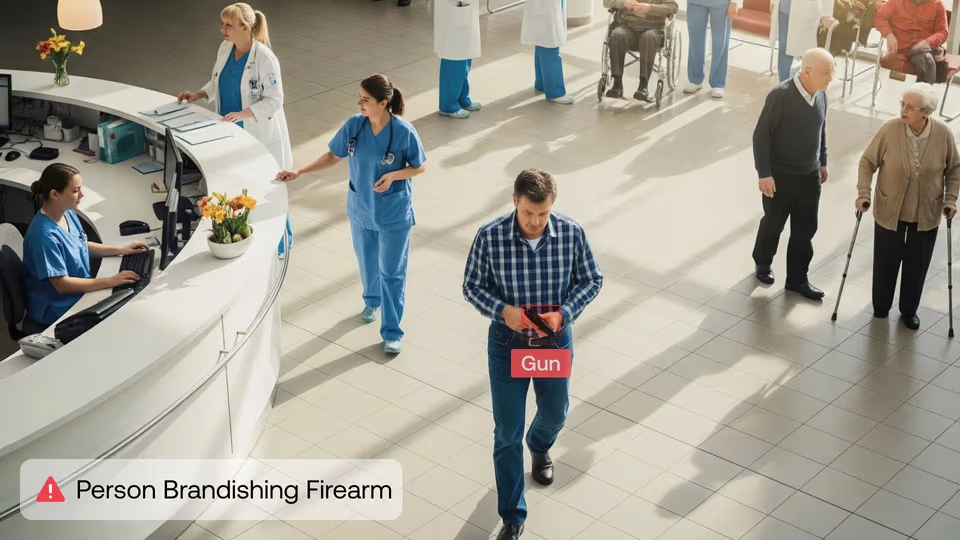
You own hundreds of cameras, but no shift schedule keeps human eyes on every feed. AI-powered threat detection closes that gap by monitoring every pixel continuously and flagging only genuine threats. The system ingests live video, compares behavior against a library of threat signatures, and identifies danger such as loitering outside the pharmacy, aggressive posture in the ED, or person-down events, often before weapons become visible.
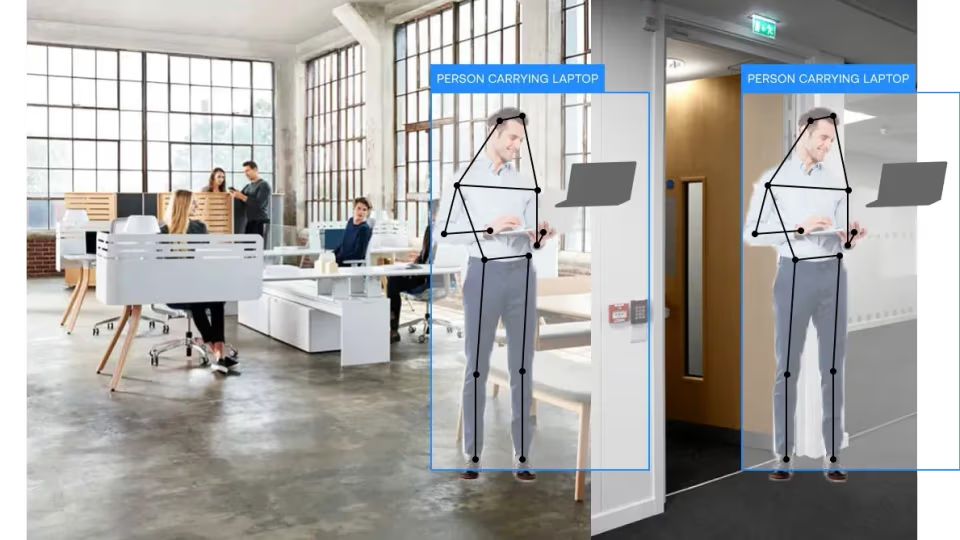
Legacy motion analytics trigger identical alerts when maintenance staff restock supplies or when a janitor wheels a cart down the hall. Contextual AI reads spatial and behavioral cues like intent, speed, and trajectory.
When actual incidents occur, such as stairwell slips or violent triage outbursts, alerts arrive with relevant clips and locations, enabling immediate actionable response. Privacy remains intact through behavioral detection without facial recognition.
Every camera becomes an always-on analyst. Incident detection shifts from minutes to seconds, and teams act on trusted intelligence.
2. Stop Chasing Door Ghosts
Beyond real-time detection, Access Intelligence eliminates false alarms by correlating PACS data with live camera feeds, letting your GSOC operators focus on real threats instead of chasing ghosts.
Your operators wade through more than a million door-forced and door-held events every year from access control platforms. Coffee carts trigger forced-door alerts. Maintenance crews prop doors during equipment transfers. The overflow breeds alert fatigue: real threats hide in the noise, and experienced analysts become human filters instead of security professionals.
When a door alarm fires, AI checks the corresponding video frame and dismisses the event if no intrusion is visible. This single correlation help with detecting benign alerts around entry points.
Previously, operators acknowledged every access alert, pivoted to the VMS, scrubbed footage, and logged the outcome, a process repeated thousands of times per shift. Or worse, the noisy access alerts are muted, preventing even the real alerts from getting through.
With Access Intelligence, only verified alarms showing real risk reach the console. This enables analysts to respond quickly by dispatching the nearest officers, locking down adjacent doors, or exporting evidence for incident reports.
The staffing relief is immediate, as you can reclaim hundreds of hours per month. This is the time you can redirect toward trend analysis, policy refinement, and running active threat mock drills. Once the noise disappears, the same data pipeline reveals patterns that help stop incidents before they materialize.
3. Find What Matters in Minutes, Not Hours
Incident investigations drain hours of the team's attention. GSOC analysts spend hours scrubbing camera timelines, fast-forwarding through footage, and still miss the decisive moment when incidents span multiple cameras and floors. Auto-indexing using AI changes this by tagging every person, object, and behavior the very moment the footage is recorded. When an incident occurs, you pull up the relevant clip with a keyword search instead of scrubbing through hours and days of video.
Time-stamped video, access logs, and analyst actions eliminate manual note-taking, which slows post-incident analysis and associated administrative tasks. Faster root-cause analysis means you brief leadership with clear evidence and pivot to preventive measures rather than replay yesterday's problems.
4. Prevent Problems Before They Start
You already know the cost of chasing alarms that fire only after a door is forced or a patient lashes out. Predictive analytics changes that tempo. Using years of camera footage training data, machine-learning models surface subtle precursors, such as repeated loitering outside the narcotics vault, and escalating agitation in a behavioral-health area, like a person fallen down.
The system assigns a real-time risk score to every pattern it observes. Cross a threshold and it auto-queues a guard patrol, tightens door schedules, or directs cameras to track the subject, often minutes before a conventional alarm would fire.
Early warning pays off differently across the hospital. Pharmacy teams get advance notice of drug-seeking behavior. Labor and delivery receive instant alerts when someone circles the infant ward without a badge. Security teams struggling with lean staffing redeploy officers to the highest-scoring zones instead of walking fixed rounds. The result is a shift from perpetual firefighting to resource-smart prevention backed by continuous, objective risk data.
5. Document Everything Without the Paperwork
Building on faster, more advanced forensics and predictive capabilities, intelligent automation generates tamper-proof audit trails that turn every security event into a complete evidence package, including time-stamped video, access-control data, and operator response, assembled instantly when incidents close. This eliminates the manual reconciliation that currently takes your team days to complete.
Automated systems can handle the heavy lifting by indexing footage in real time, and in some advanced setups, machine learning can link door events and badge data to relevant frames.
The resulting data is typically stored in secure databases ready for regulatory review, though true immutable ledger storage is not yet common practice. During inspections, you surface months of incidents with a single query, rather than manually searching through terabytes of footage.
Privacy stays protected through behavioral analysis that focuses on motion and posture, not identity. Patient areas get automatically blurred, so no protected health information leaves your VMS. This design keeps you compliant with evolving privacy regulations without facial recognition systems.
From Firefighting to Prevention
Instant detection, trusted alarms, faster investigations, predictive prevention, and easier compliance. These five capabilities work together to turn security teams from firefighters into threat managers. For healthcare facilities ready to implement these capabilities, the right platform delivers all five without replacing existing infrastructure.
Ambient.ai: Agentic Physical Security for Healthcare
Protecting vulnerable patients, controlled substances, and staff requires proactive threat prevention, not reactive surveillance. Ambient.ai delivers this through a purpose-built platform powered by VLMs that understand behavior through contextual reasoning rather than simple object detection.
The platform continuously analyzes live video to validate every access control event, behavioral pattern, and safety incident in real time with the following capabilities:
- Ambient Access Intelligence achieves 95% false alarm reduction from access control systems by connecting PACS data with live camera feeds, returning hundreds of operator hours to proactive monitoring.
- Ambient Threat Detection processes video feeds to identify brandished weapons, unauthorized pharmacy access, patient falls, aggressive behavior, and crowd patterns, responding 10x faster than conventional systems.
- Ambient Advanced Forensics enables 20x faster investigations using natural language search.
Schedule a free consultation to learn more about the platform, which is SOC 2 compliant and trusted by Fortune 100 companies.