Introducing Ambient Pulsar: The Reasoning VLM that Unlocks Agentic Physical Security


10x faster response. Same cameras. Same team.
Register to join us today at 10am PT. Shikhar Shrestha, CEO, and Vikesh Khanna, CTO, will be hosting our first online keynote and presenting about Ambient Pulsar, the first ever reasoning VLM for physical security, and the new agentic physical security model it unlocks.
Why Physical Security Has Reached a Breaking Point
The mission of physical security has always been clear: to prevent incidents before they happen. However, despite decades of investment, that outcome still remains out of reach.
Across corporate campuses, manufacturing sites, hospitals, and schools, incidents continue to occur with concerning frequency: intrusions, workplace violence, insider theft, and safety failures. And while the volume of cameras and sensors has skyrocketed, so has the complexity of interpreting everything they generate.
Enterprises now capture millions of visual and access events every day, but very little of that volume becomes usable intelligence. Operators drown in feeds and alerts, forced to look backward at what happened, as opposed to ahead at what's about to happen.
Humans excel at intuition and judgment, but not at monitoring thousand feeds in parallel. In contrast, machines excel at attention and scale, but up until now, have been lacking the ability to grasp context or intent.
This gap between perception and cognition is the fundamental barrier preventing the industry from reaching true prevention. The physical security industry needs more than automation or analytics. It needs AI capable of reasoning about the physical world.
The AI Revolution Has Transformed the Digital World — But Not the Physical One
In the last few years, AI has reshaped knowledge work. LLMs can summarize complex documents, write code, analyze contracts, and generate creative ideas.
But security in the physical world presents a different challenge:
- Dynamic environments
- Human motion and behavior
- Suboptimal lighting conditions
- Temporal sequences that matter
- Safety-critical decisions
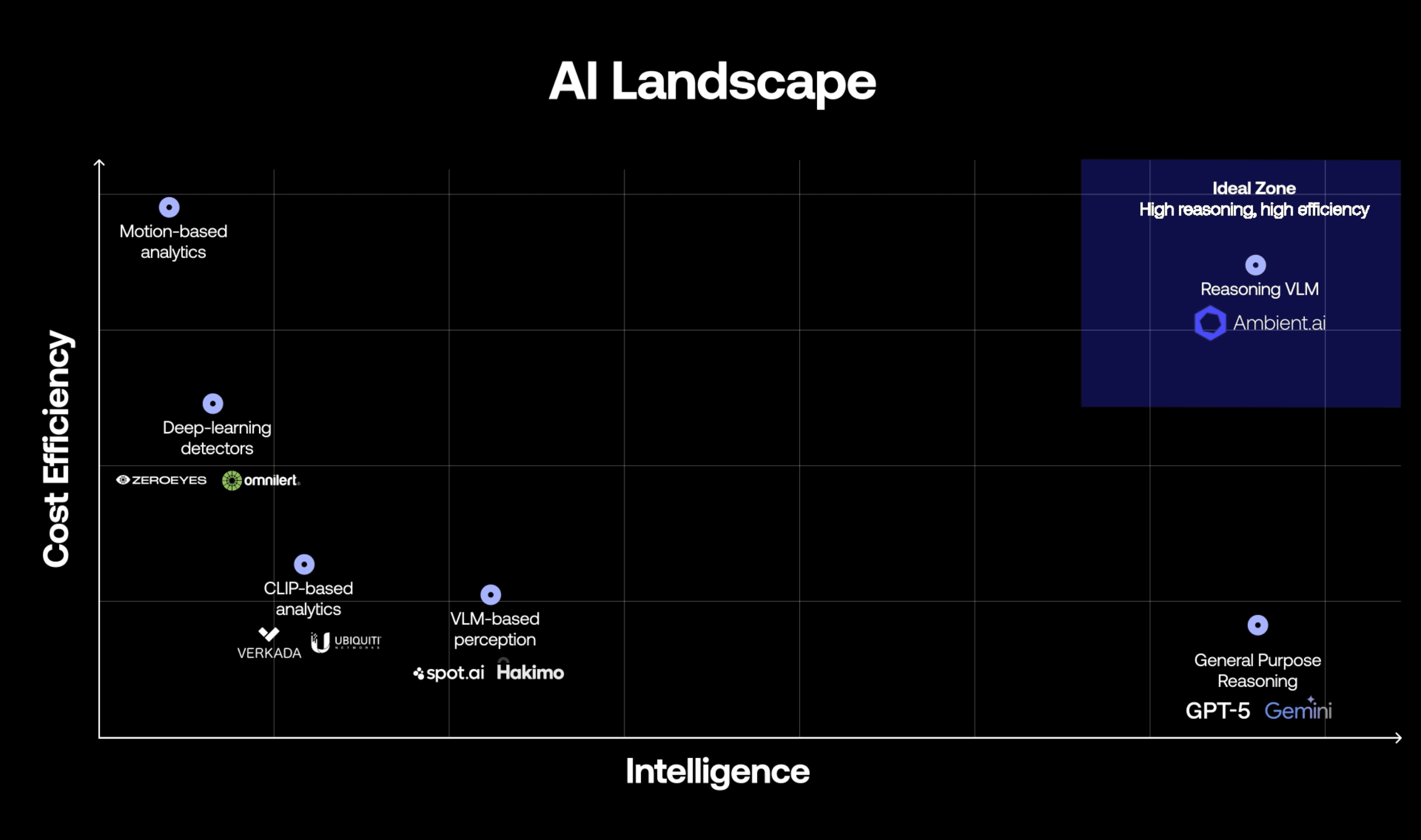
Most systems today marketed as "AI-powered" for video security actually rely on earlier generations of computer-vision technology. Each step in the evolution brought improvements, but none could deliver the reasoning required for prevention. Here's how the landscape breaks down:
- Motion-Based Analytics: These systems detect simple pixel changes, offering extremely limited insight and producing high volumes of false alarms. They have no concept of people, objects, or behavior, which makes their value minimal in real-world environments.
- Deep-Learning Detectors: These models identify predefined objects such as people or vehicles, but only within isolated frames. They lack the ability to interpret interactions, sequences, or intent, resulting in purely surface-level understanding.
- CLIP-Based Analytics: These systems add flexible, language-aligned queries on top of visual data, allowing operators to search for concepts like "person with backpack." However, they remain fundamentally frame-bound, providing fragmented and incomplete contextual understanding.
- VLM-Based Perception: These models offer richer descriptions of scenes, recognizing multiple people, objects, and relationships simultaneously. Yet they do not maintain temporal continuity and cannot reliably assess whether behavior is escalating, benign, or risky.
These approaches represent meaningful progress, but they all share a critical limitation: none can reason continuously about what's happening in the physical world. Which leads us to the giant leap of intelligence with reasoning VLMs like OpenAI GPT5 and Google Gemini.
- General-Purpose Reasoning VLMs (e.g., GPT-5, Gemini 2.5 Pro): These models deliver sophisticated reasoning and can interpret short video segments, but their compute and bandwidth requirements make them impractical for continuous, enterprise-scale operation across thousands of live camera streams.
The gap between last-generation detection systems and true, continuous real-time reasoning, combined with the prohibitive cost associated with frontier AI models, is exactly why Ambient.ai set out to build the breakthrough this industry has been missing.
Introducing Ambient Pulsar: Human-Level Reasoning at Machine Speed
We are excited to announce the launch of Ambient Pulsar, the world's first always-on reasoning Vision-Language Model (VLM) purpose-built for physical security.
Pulsar represents a major architectural shift for the industry, delivering human-level reasoning at machine speed:
- A model that operates continuously, without temporal gaps
- A model trained on security-specific data, not internet images
- A model that runs at the edge for speed, cost, and bandwidth efficiency
Trained from more than one million hours of ethically sourced enterprise video, Pulsar is the largest and most capable purpose-built VLM ever deployed in physical security, processing over 500,000 hours each day.
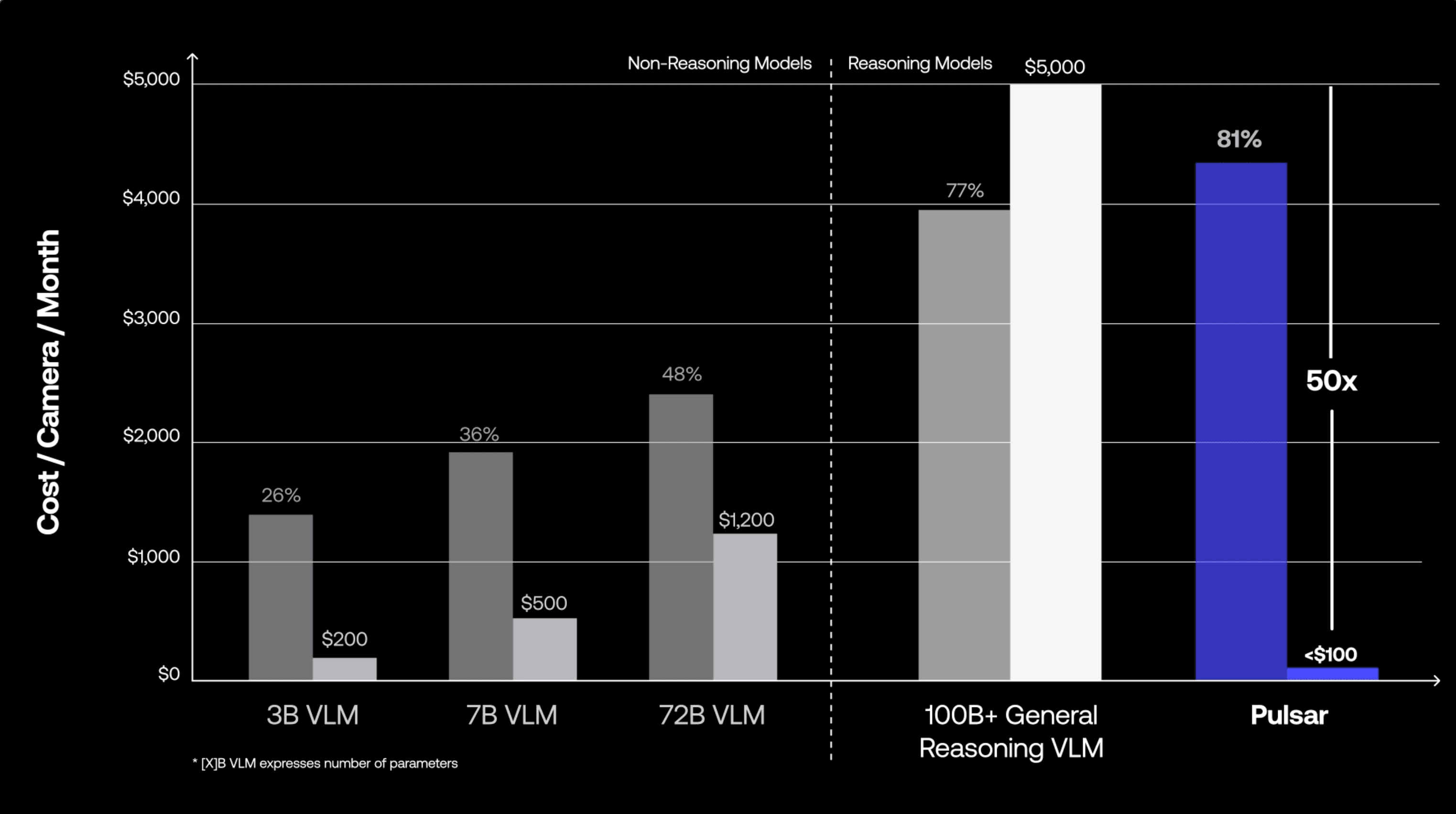
Pulsar delivers frontier-model reasoning performance that exceeds GPT-5 and Gemini 2.5 Pro in physical security use cases, at 50× higher efficiency, bringing true agentic AI to enterprise scale across thousands of cameras running 24/7.
Pulsar represents a major architectural shift for the industry:
- Continuous Temporal Reasoning: Pulsar processes every frame and preserves context across time — something cloud VLMs and event-based systems fundamentally cannot do. It doesn't just see motion; it understands sequences, behaviors, cause-and-effect.
- Trained on Enterprise Reality: Trained from more than one million hours of ethically sourced enterprise video, Pulsar is the largest and most capable purpose-built VLM ever deployed in physical security, processing over 500,000 hours each day. Pulsar looks at video feeds like a physical operator focusing on what matters to the mission of preventing incidents and responding to emergencies.
- Architected for Real-Time Operations at Scale: Pulsar delivers an edge-optimized VLM with reasoning capabilities that exceed frontier models like GPT 5 and Gemini 2.5 Pro while also being 50× more cost effective. Meaning: it actually can scale across global camera fleets without needing a small nation budget.
- Extensible & Continuously Learning: Pulsar is an open-set model that can be easily extended to incorporate an ever growing number of threat signatures and primitives, adapting to each customer's environment and SOPs.
Pulsar is an intelligence breakthrough designed to understand the physical world, it represents the key that unlocks the next evolution of protection.
Defining a New Operational Model: Agentic Physical Security
With Pulsar at the core of the Ambient.ai platform we can shift security from:
**- Watching → Understanding
- Reacting → Anticipating
- Manual triage → Intelligent prioritization
- Reviewing incidents → Preventing them**
From monitoring, to investigation, access control, threat detection and response, physical security operators become exponentially more effective because they are freed from noise, focused on decision making and empowered by real-time comprehension of what's unfolding across your environment.
We call this Agentic Physical Security and believe it is what AI should have always meant for the physical world.
Agentic Physical Security marks the shift from systems that passively record and monitor, to systems that augment security operators with superhuman capabilities to perceive, understand, decide, and act, in real time, at machine speed, and at enterprise scale.
We define this evolution through five stages of autonomy, each building on the last:
- Agentic Monitoring: AI perceives and flags relevant activity in real time, improving situational awareness.
- Agentic Investigation: AI reconstructs incidents and answers investigative questions instantly.
- Agentic Access Control: AI validates access events autonomously, reducing false alarms and improving system trust.
- Agentic Threat Analysis: AI evaluates behavior and context to identify emerging risk with precision.
- Agentic Response: AI initiates containment and escalation workflows at machine speed.
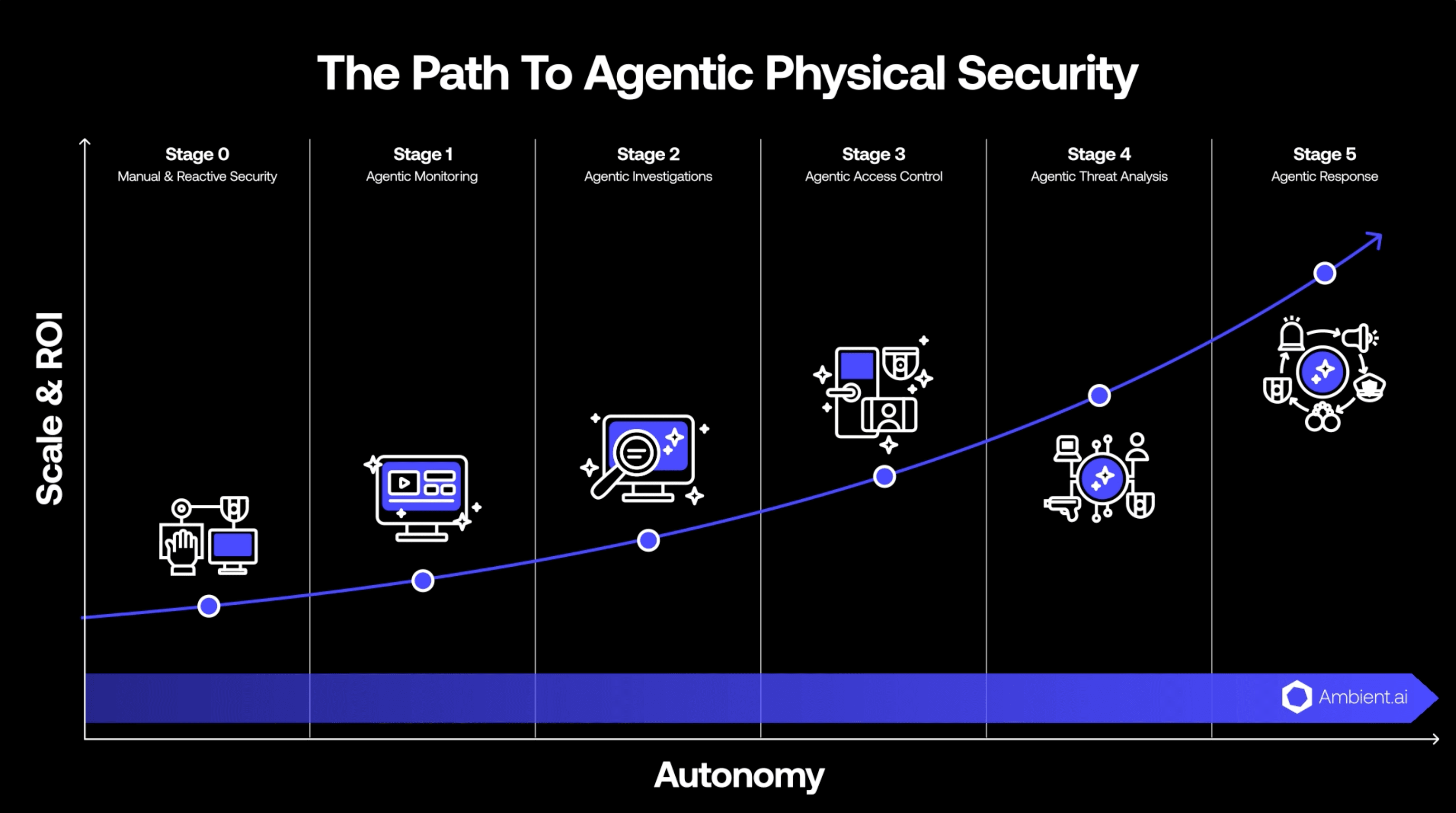
This framework provides a roadmap for how AI will help transform physical security through a structured, operational progression. Each stage builds upon the reasoning capabilities of Pulsar, transforming enterprise security operations into intelligent, adaptive systems that prevent incidents before they occur.
The Future of Security Is Agentic
Pulsar represents an intelligence unlike any before in the realm of physical security. And we are excited about how much more we can empower security operators. Our AI handles the scale, speed, and pattern recognition, so operators can focus on what they do best: action, leadership, empathy and crisis management.
If you want to experience Pulsar in real time, we're making our interactive Playground available to everyone. This is the very same environment you will see Vikesh demo during the online keynote.
This the beginning of a new era in enterprise protection, where safety is powered by reasoning, where human-led operations are assisted by agentic-driven capabilities, and where organizations don't just respond to incidents, but prevent them.