Motion Detection: Why It Breaks at Enterprise Scale
.webp)

It's not a people problem. It's a systems problem.
Motion detection cameras break down at enterprise scale because they answer a narrow question while security teams face a much harder one: which activity matters? As camera deployments expand, simple movement alerts create more information than operators can assess with consistent speed and context. Understanding why this happens, and what can replace it, starts with what the technology was originally designed to do.
The Original Purpose Behind Motion Detection Technology
Motion detection is the technique enterprise security cameras and recorders use to flag frame-to-frame pixel changes as activity without identifying what caused the change.
Motion-triggered recording reduced storage demands by capturing periods with activity rather than continuous footage. Operators also used those flags to decide which feeds to look at, though the technology was never built to judge what it flagged.
The design question was always “Is something moving?”, never “What is happening, who is doing it, and should I care?” The system could detect that something had happened, but human operators still reviewed flagged footage to determine whether it represented a genuine threat.
For facilities running small camera deployments with dedicated monitoring staff, that limitation stayed manageable. Operators applied judgment to each alert and served as the filter between pixel-change detection and genuine threat assessment.
Why Everything Triggers the Same Response
The technical architecture of pixel-change detection creates a fundamental problem: its output does not distinguish what caused the movement. The system registers visual changes between frames, but those changes carry no object identity, trajectory, or scene meaning.
A delivery driver entering through the loading dock during business hours creates pixel changes. An unauthorized individual attempting the same entry overnight creates algorithmically identical pixel changes. Traditional systems generate the same alert for both because they process visual intensity shifts, not authorized access patterns or temporal appropriateness.
Environmental factors compound the problem. Tree shadows darken and brighten pixels as they cross the frame. Headlights sweeping a parking area create dramatic intensity shifts. Rain produces widespread pixel changes, and reflections on wet pavement mimic foreground objects. Each event can generate an alert that enters the same queue as activity requiring security review.
How Motion Detection Cameras Miss Real Activity
False alarms get the attention, but motion detection cameras fail in the opposite direction too. Frame differencing can lose an object when it stops moving, so a person who crosses a perimeter and stands still may disappear from the algorithm’s view. Slow, steady movement toward a camera can produce frame-to-frame differences too subtle to cross the detection threshold. Fog and low light can compress the contrast the comparison depends on, and crowded scenes make it harder to isolate one person’s movement from surrounding activity.
Sensitivity tuning cannot eliminate this tradeoff. Lower the threshold and environmental noise floods the alert queue; raise it and slow or distant activity may pass undetected.
The Manual Verification Burden
Every alert a pixel-change system generates demands the same manual verification sequence: an operator pauses other responsibilities, pulls up recorded footage or the live feed, determines whether the flagged activity is a genuine concern, and either dismisses or escalates. At enterprise scale, alarm volume can overwhelm operators and make timely review harder to sustain.
The cognitive cost runs deeper than the hours. After roughly twenty minutes of watching a single screen, an operator may miss as much as 90% of what unfolds in view. When operators dismiss alert after alert that turns out to be a shadow or a headlight sweep, alert fatigue sets in: vigilance declines because experience teaches that alerts rarely indicate genuine threats. That decline reflects the volume of noise the technology produces, not operator skill or dedication.
Understanding Behavioral Patterns Makes All the Difference
Effective security requires knowing not just that movement occurred but what the movement means. A person sprinting across a lobby during business hours might be late to a meeting or responding to a medical emergency. The same sprint overnight demands a different response priority, a distinction pixel-change algorithms cannot make.
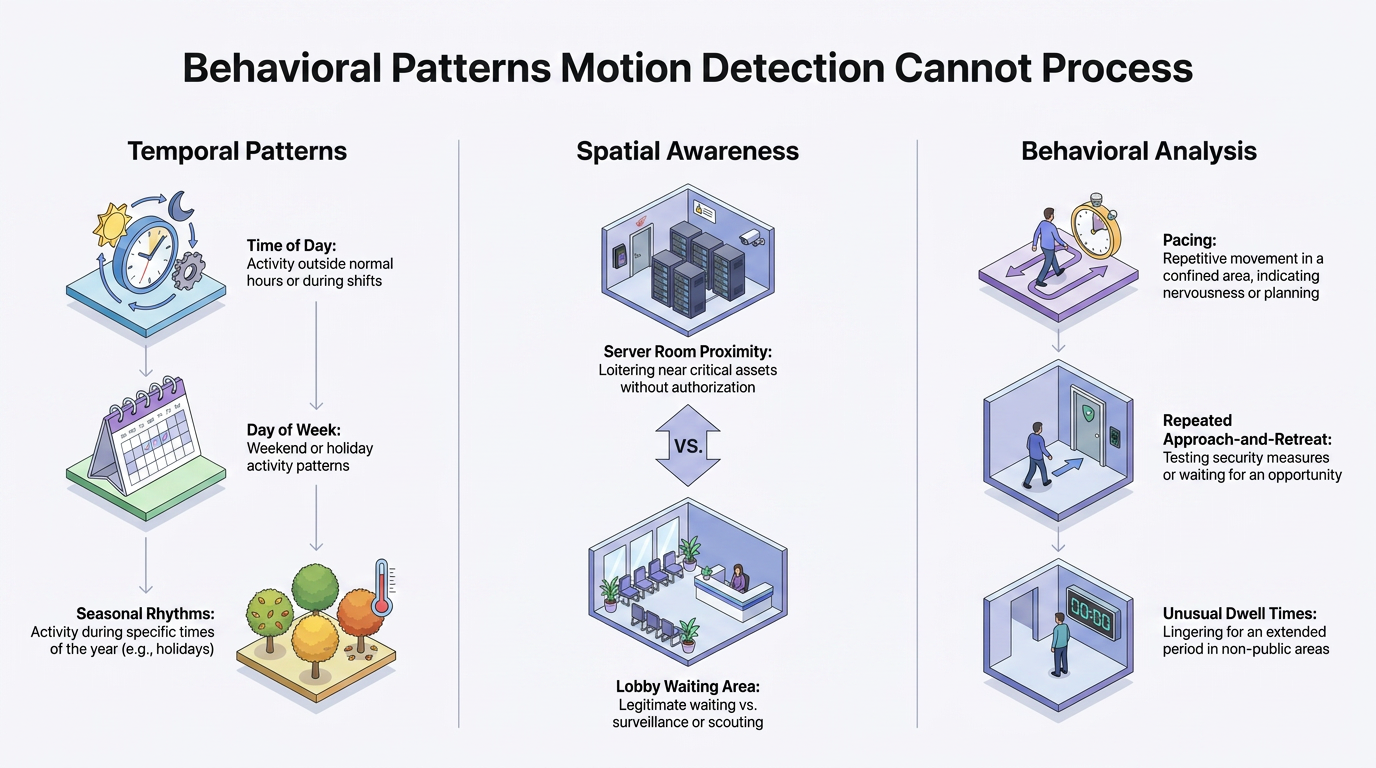
Context spans several dimensions that motion detection technology cannot process:
- Temporal patterns: time of day, day of week, and seasonal rhythms define what counts as normal for each camera view.
- Spatial awareness: lingering near a secure server room warrants different assessment than standing in a lobby waiting area.
- Behavioral analysis: pacing, repeated approach-and-retreat near restricted areas, or unusual dwell times can indicate reconnaissance preceding a more serious incident. Crowding that may lead to an altercation, a person falling, or a brandished firearm are all events a pixel-change alert cannot distinguish from a passing shadow.
That third category carries the highest stakes. The Cybersecurity and Infrastructure Security Agency (CISA) describes a pathway to violence that moves through grievance, planning, preparation, and probing before an attack. The Department of Homeland Security (DHS) lists observable indicators such as prolonged interest in facilities, testing or probing of security, and attempted intrusion into restricted areas. These behaviors play out on camera.
A contractor photographing a data center’s cooling infrastructure during a scheduled audit is routine; the same photography from outside the perimeter fence at dusk matches the surveillance indicators organizations are advised to watch for. Pixel-change detection registers both as identical movement, or misses them entirely if the person stands still. What separates a routine delivery from a trespass is timing, dwell, and approach pattern, none of which pixel-change detection can process.
How Computer Vision Improves Threat Assessment
Computer vision refers to AI that identifies what appears in video, including people, vehicles, objects, and actions, rather than measuring raw pixel intensity. Reasoning Vision-Language Models (VLMs) build on that perception layer by combining visual detection with language understanding, which lets the technology interpret scenes and behaviors instead of outputting a changed-pixel mask. The shift moves the baseline of detection from pixel intensity changes to object-based classification, with people and vehicles treated as first-class categories the system reasons about directly.
Reasoning approaches can establish behavioral baselines for a given location, measure how long a person lingers, and flag deviations such as repeated approaches to a restricted area or prolonged loitering. Rather than binary “motion detected” alerts, they generate assessments of how far observed behavior deviates from normal patterns for that place and period.
They can also reason across more than video. When a physical access control system (PACS) logs a badge swipe, visual verification can confirm that one authorized person entered rather than several tailgating through, an event door sensors alone cannot see.
Processing may occur in the cloud, on edge appliances, or through a hybrid architecture. Cloud processing can reduce on-site infrastructure but increase bandwidth use, while edge processing can reduce latency and keep more video local. Hybrid designs divide workloads according to latency, bandwidth, data privacy, and infrastructure cost requirements. In edge and hybrid models, separate edge appliances provide the intelligence; cameras remain video inputs.
Comparing Motion Detection and AI Video Analytics
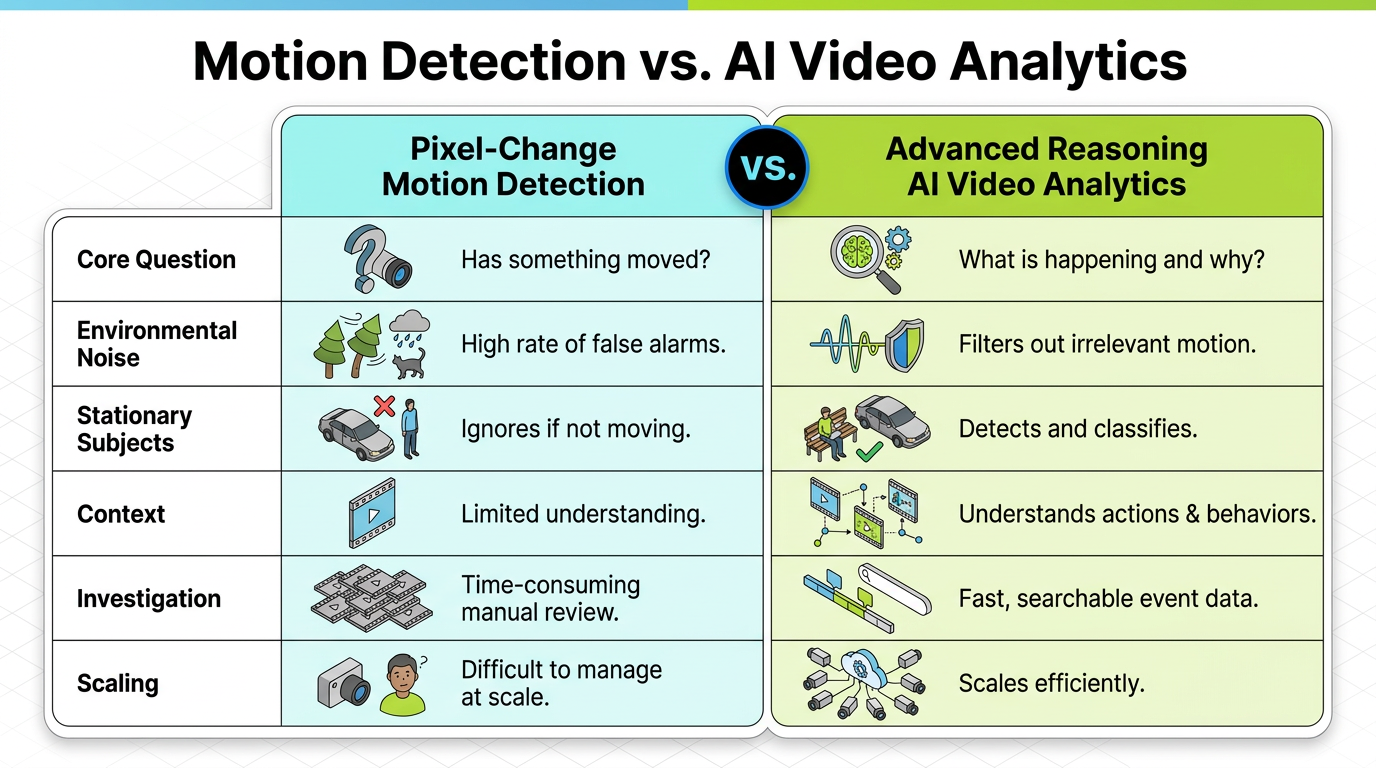
Motion detection and reasoning AI video analytics answer different questions.
| Dimension | Pixel-Change Motion Detection | Advanced Reasoning AI Video Analytics |
|---|---|---|
| Core question | Did pixels change between frames? | Can assess what is happening and whether it matters |
| Environmental noise | Shadows, rain, and headlights all trigger alerts | Can classify non-threat activity and filter it |
| Stationary subjects | Lost the moment movement stops | Can maintain presence when movement stops and measure dwell time |
| Context | Business hours and overnight activity are identical | Can use time, location, and behavioral baselines to shape assessment |
| Investigation | Manual footage scrubbing | Can support natural language search across indexed feeds |
| Scaling | Verification workload grows with camera count | Can surface validated events while all feeds stay monitored |
The investigation row changes daily work most visibly: an operator can type “person near the loading dock after midnight” and use natural language search to retrieve matching footage quickly instead of scrubbing long recordings. Because standards such as Open Network Video Interface Forum (ONVIF) Profile M define how analytics metadata flows between cameras and management systems, behavioral analytics can be layered onto installed camera infrastructure rather than requiring replacement.
The Scale Problem No Amount of Headcount Can Solve
Camera deployments scale faster than human attention. A camera-monitoring review explains that the effective number of feeds an operator can monitor declines as scene activity increases. There are too many feeds for any operator to absorb simultaneously, regardless of skill or dedication, so in practice the vast majority of feeds go unwatched.
The gap between deployment size and operator capacity is the enterprise problem. Security operations have to work as force multipliers, where technology lets small teams monitor and protect large, complex environments. When the detection layer cannot separate routine activity from genuine threats, verification demand exceeds human capacity at any team size, and the technology foundation itself has to change.
Moving From Detection to Understanding
The industry’s direction is explicit. AI-driven platforms are absorbing labor-intensive work such as monitoring video feeds, ranking alarms, and managing visitor access, and that shift is expected to extend across the monitoring stack from video analysis to dispatch.
For security leaders evaluating the shift, a few requirements separate real behavioral intelligence from repackaged motion detection:
- Pilot on your own cameras across day, night, and weekend conditions, with acceptance criteria set before the trial starts.
- Ask vendors for false-positive and missed-detection rates in deployments similar to yours, and which field conditions can nullify the analytics.
- Require integration with existing cameras, video management systems (VMS), and PACS rather than infrastructure replacement.
- Keep humans in the loop: the technology should filter and assess, while operators judge and respond.
The Security Industry Association’s SPARC report on evaluating AI vendors includes a questionnaire covering technology, data practices, and compliance that maps directly onto these questions. Motion detection did the job it was built for; protecting a modern enterprise takes behavioral intelligence.
AI-Native Video Management at Enterprise Scale
Trusted by Fortune 100 enterprises, Ambient.ai applies this shift through an AI-native platform where video management is built in and a reasoning Vision-Language Model (VLM) provides continuous contextual understanding across every connected feed.
The approach supports a progression toward Agentic Physical Security, where AI handles continuous observation and assessment while operators remain in the loop for oversight and critical decisions. Security leaders can request a demo to evaluate the approach on their own cameras.
Frequently Asked Questions
How do AI-powered video analytics handle edge cases like fog, low light, or crowded scenes where traditional motion detection fails?
AI-powered analytics use adaptive image enhancement and temporal modeling to track objects across lighting changes. Object segmentation separates individual trajectories and assigns persistent identifiers, isolating suspicious behavior even when multiple people move simultaneously through crowded scenes.
What infrastructure changes are required to implement reasoning Vision-Language Models on an existing enterprise camera network?
Reasoning VLMs integrate with existing ONVIF-compliant cameras without hardware replacement. Processing occurs on separate edge appliances that connect to current infrastructure, so organizations preserve camera investments while adding behavioral intelligence through a software and edge computing layer.
How can security teams measure the reduction in false positives and missed detections when transitioning from motion detection to AI-based behavioral analytics?
Establish baseline metrics tracking alert volume, operator verification time, and missed events from current motion detection systems. Run controlled pilots comparing both systems on identical camera feeds, measuring precision, recall rates, and investigation time-to-insight improvements.