Volt AI vs Ambient.ai: Side-by-Side Comparison (2026)
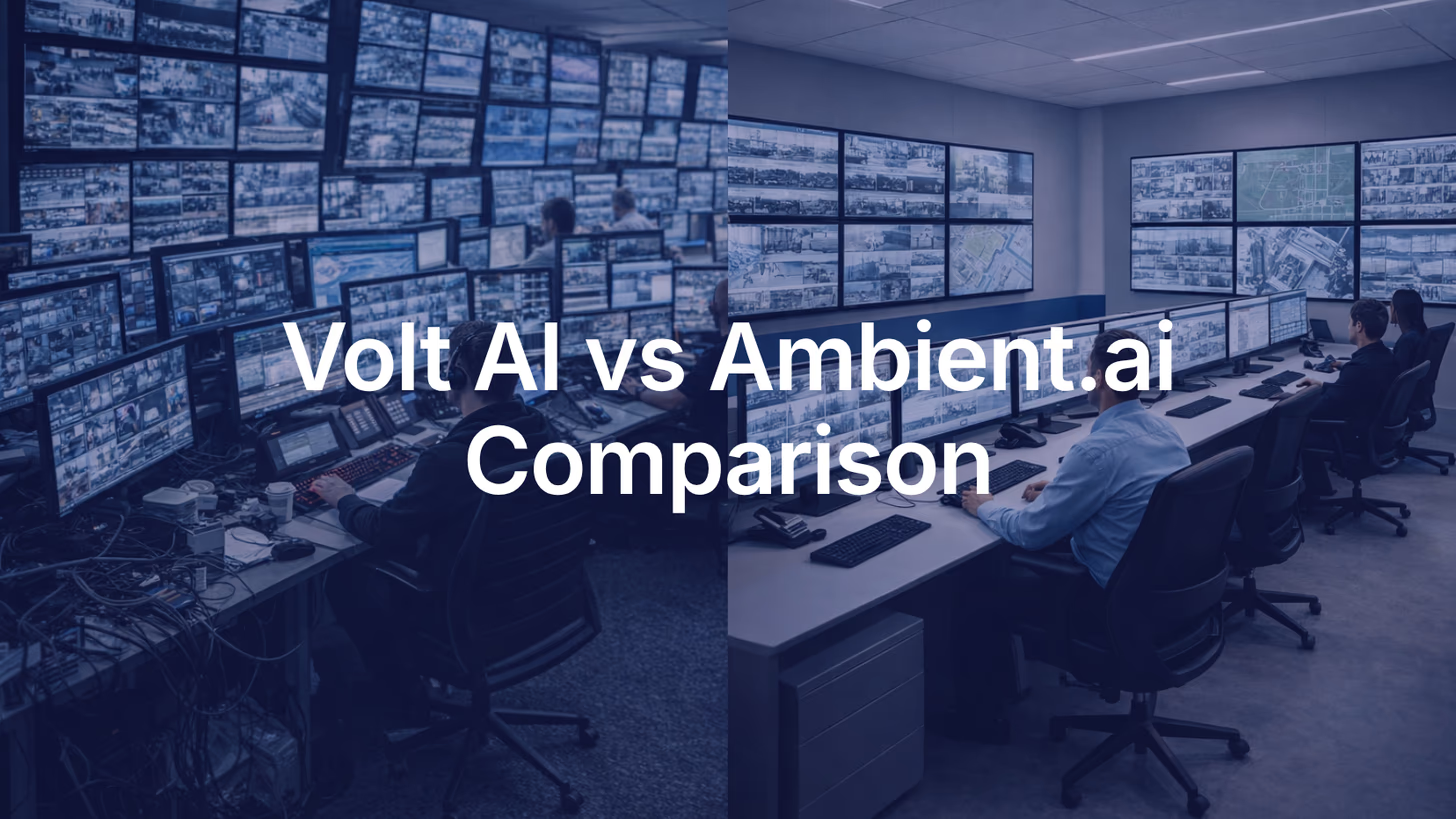

10x faster response. Same cameras. Same team.
Volt AI vs. Ambient.ai: Object Recognition Plus a Human Reviewer Is Not Agentic Physical Security
Security leaders evaluating AI for physical security are facing a market that increasingly looks the same on the homepage. Every vendor claims real-time detection. Every vendor claims to use AI. Every vendor claims to reduce alarms. The most consequential question almost never appears in the feature list: where does the intelligence actually live, and how much of the work does the AI do before a human ever sees an alert.
That question separates a category. On one side are platforms built on object recognition models that hand every alert to a human reviewer for assessment. On the other side are reasoning systems that interpret scenes, weigh context, and adjudicate events autonomously, escalating only what genuinely warrants a human decision.
Volt AI and Ambient.ai both apply AI to video, but they sit on opposite sides of that line. Volt AI delivers object recognition plus human verification, a meaningful step beyond legacy video analytics but within the same generation as point detection tools that came before it. Ambient.ai is the category creator and leader in Agentic Physical Security, with a single platform powered by Ambient Pulsar, the first always-on, edge-optimized reasoning Vision-Language Model purpose-built for physical security. The architectural gap shapes everything that follows: detection breadth, alert quality, integration depth, operator workload, and total cost of ownership at enterprise scale.
If reasoning happens only at the human reviewer, you are buying object recognition with a service wrapper.
The Architecture Question: Object Recognition Plus a Human, or Reasoning at the AI Layer
Volt AI describes its platform as providing AI-powered threat detection from camera feeds, including weapons, violence, medical emergencies, and security breaches. Public materials describe transformer-based neural networks, vision transformers, and CNNs for real-time incident recognition. These are object recognition models. They classify what they see frame by frame: a person, a handgun, a bag, a fight. Once classified, every alert is routed to Volt AI's Video Security Operations Center, where a human reviewer assesses whether the detection represents a real threat before it ever reaches the customer.
This is a meaningful evolution beyond legacy analytics, but it sits in the same family as other object detection point solutions in the market today. The AI itself does not reason about context. It matches frames against trained patterns. The reasoning happens at the VSOC, in human heads, after the fact. Run that system without a human reviewer in line, and the alert stream is likely to be noisy. The human is not a quality booster on top of an already accurate AI. The human is the accuracy layer.
Ambient.ai is different in kind, not in degree. Ambient Pulsar, the always-on reasoning VLM at the core of Ambient Intelligence, does not just label objects. It applies continuous temporal reasoning, open-set understanding, and contextual interpretation to the relationships between people, objects, spatial context, and behavior over time. Pulsar is trained on more than a million hours of ethically sourced enterprise video and processes more than 500,000 hours every day, delivering frontier-model reasoning performance at the efficiency required to run at the edge across thousands of cameras 24/7. Pulsar interprets the scene before an alert is ever generated.
The practical difference shows up in a single scenario. A person walks the perimeter of a data center at 2 AM, pauses at multiple camera angles, returns to a parked vehicle, and repeats the sequence twice. No weapon is visible. No fight occurs. An object recognition system can classify the person and the vehicle and confirm no weapon is present. It has no category for the pattern itself, so it does not surface anything. Pulsar interprets the sequence as suspicious reconnaissance, a behavioral precursor, and surfaces it to operators with a location timeline, movement path, and a clear threat assessment. Security responds before any attempt at entry. The platform shifts physical security from reactive notification to proactive prevention.
Human in the Loop, Not in the Bottleneck
Human judgment is essential in physical security, and both platforms keep a human involved. The question is when and why.
Volt AI's VSOC reviews every AI-generated alert. According to Ambient.ai's comparison materials, Volt AI's detections are reviewed by a human before action. At small scale this delivers verified alerts with high confidence, and most buyers want a human verifying high-stakes detections like a weapon sighting in a school before any response is dispatched. At enterprise scale, the throughput economics start to break down. A Fortune 100 campus running thousands of cameras generates a continuous stream of detections routed through a human reviewer queue. Volt AI does not publish VSOC response time SLAs, staffing capacity, or maximum concurrent throughput in its public materials. The human bottleneck is moved from the customer to the vendor. It is not removed.
Ambient.ai inverts the model. Because Pulsar reliably assesses threats at the AI layer, the platform resolves the overwhelming majority of events autonomously and escalates only what warrants judgment. Human review is reserved for high-severity events, where a person sees rich visual context, a threat assessment, and the supporting evidence that informed it. At a large enterprise customer, the platform handled more than 240,000 alarms and auto-resolved 94% without operator intervention. Humans stay in control. They stop being a bottleneck.
Architecture at a Glance
Legend: ● documented capability ◑ partial or generic ○ not documented in public materials
One Platform, Four Modules vs. a Single-Purpose Point Solution
Ambient.ai is one platform with four integrated modules. Each module addresses a distinct operational problem. Together they form an intelligence layer across the existing physical security stack. Volt AI is a video intelligence point solution focused on real-time incident detection with VSOC verification. Comparing the two module by module makes the breadth difference concrete.
Ambient Foundation: The AI-Native Operating Layer
Foundation is the platform's connectivity, intelligence, and operations layer. Edge Connectivity integrates with existing cameras and PACS infrastructure across more than ten leading access control providers, including Brivo, LenelS2, Honeywell Pro-Watch, and Allegion, and with VMS platforms including Genetec and Milestone. Ambient Intelligence runs Pulsar on NVIDIA-accelerated edge appliances in real time. The Cloud SOC delivers a single pane of glass across every site, with AI-driven video walls, natural language search, multi-site management, and operational analytics. Volt AI offers a 3D facility mapping feature for spatial tracking during active incidents. Public materials reference Genetec compatibility but do not document certified VMS partnerships, and the platform does not document a unified multi-site operations console comparable to Cloud SOC. The result is a fundamental difference in operating model: Ambient.ai replaces or upgrades the operational console; Volt AI feeds alerts into whatever console you already use.
Ambient Threat Detection: 150+ Signatures Across the Full Incident Lifecycle
Threat Detection ships with the industry's broadest library of more than 150 validated threat signatures. Coverage spans unauthorized access, alarm reduction, perimeter control, health and safety, IP and asset protection, and high-severity events, across both pre-incident reconnaissance and active threats in progress. Volt AI's public materials describe detection coverage for weapons, violence, medical emergencies, and security breaches. For organizations whose primary concern is real-time weapon detection in controlled environments such as K-12 schools, that scope addresses a real need. In enterprise environments, narrower coverage can leave gaps that are often filled with separate systems or manual monitoring.
Ambient Access Intelligence: A Self-Validating Perimeter
Access Intelligence is a dedicated module built around the PACS Correlation Engine. It correlates door sensor events with live video and access control data, automatically adjudicates Door Forced Open and Door Held Open alarms, verifies tailgating with full context, and auto-clears benign alarms. Enterprise PACS deployments commonly generate more than 98% false alarms from door sensors. Customers see up to 95% reduction in PACS false alarm volume, reducing a major source of wasted operator time. Volt AI does not document an equivalent access control adjudication capability in its public materials.
Ambient Advanced Forensics: Investigations in Plain Language, Not Manual Review
Advanced Forensics turns post-incident investigation from manual scrubbing into natural language search across thousands of feeds. Operators describe what they are looking for, in plain language, and the system retrieves relevant footage in seconds, with multi-camera trajectory reconstruction. Investigations resolve faster. Volt AI's 3D mapping supports real-time spatial tracking during active incidents but does not document natural language semantic search or AI-powered forensic reconstruction across recorded footage.
Platform Breadth at a Glance
Legend: ● documented capability ◑ partial or generic ○ not documented in public materials
The Combined Effect: From Reactive Detection to Agentic Physical Security
Architecture and platform breadth compound. They produce a fundamentally different operational posture.
A point solution built on object recognition plus human review is, by design, a reactive system. It detects what is visible, queues alerts for a human reviewer, and notifies after a person has adjudicated. Within its scope, that workflow performs a useful job, particularly for high-severity scenarios where false positives carry catastrophic cost, such as active shooter detection in a school, where most buyers prefer a human verifying before any response. The tradeoff is structural: throughput, scope, and the inability to act on anything outside the trained detection categories.
A unified platform built on a reasoning VLM is a proactive system. It sees continuously, interprets behavior over time and across modalities, adjudicates routine events without human friction, escalates the events that warrant judgment, and accelerates the investigations that follow. This is the operational definition of Agentic Physical Security, the category Ambient.ai created. Across video, access, and sensor data, Ambient Intelligence runs the loop in real time: see, think, assess, act. The result is a different operating economics for security: more than 90% of alerts resolved in under one minute, the majority of PACS noise auto-cleared, investigations compressed from days to minutes, and the same security team covering more sites and more cameras without proportional headcount growth.
Ambient.ai does not replace existing camera or access control infrastructure. It makes that infrastructure smart. The platform integrates natively with the cameras and PACS providers customers already own, on a single intelligence layer that strengthens the entire stack rather than another silo bolted to the side of it.
Volt AI's platform makes a single workflow faster. Ambient.ai's platform changes how security operates.
Operational Outcomes Across Enterprise Deployments
Ambient.ai's platform is deployed across Fortune 100 enterprises, corporate campuses, data centers, and critical infrastructure. The outcomes are consistent across environments:
- 90% of alerts resolved in under one minute
- Up to 95% reduction in PACS false alarms
- Up to 94% of alarms auto-resolved without operator intervention at multi-site deployments
- Investigations resolved up to 20 times faster than manual footage review
- SOC 2 Type II certified with Privacy by Design and no PII collection
Volt AI's publicly named customer base appears to be concentrated in education and healthcare, with multi-family residential and office environments represented more through use cases and marketing materials, and only limited large-enterprise references rather than a clearly identified Fortune 500 customer list. Public materials do not quantify false positive rates, VSOC response SLAs, throughput capacity, or comparable enterprise-scale operational metrics.
The Right Questions to Ask Any Physical Security AI Vendor
Feature-by-feature comparisons get noisy quickly. A small set of architectural questions cuts through the noise:
- Does the AI reason about scene context, or only classify objects within predefined categories? If reasoning happens only at a human reviewer, you are buying object recognition with a service wrapper.
- Does the platform detect pre-incident behavior, or only incidents in progress? Most serious enterprise incidents have observable precursors. A platform that detects only the active phase concedes the most valuable window for prevention.
- Does the AI adjudicate access control alarms autonomously, or only video events? PACS false alarms are the single largest source of wasted operator time in enterprise environments.
- Can operators search across thousands of feeds in natural language, or do investigations still rely on manual scrubbing? Investigation speed compounds across every incident the organization will face.
- Does the platform scale with cameras and sites without proportional human reviewer cost? At enterprise scale, the economics of mandatory human-in-the-loop review on every alert break down quickly. The bottleneck moves from your team to the vendor's, but it does not disappear.
Object Recognition With a Reviewer, or a Platform That Thinks
Volt AI delivers object recognition plus human verification. It is a real product, useful for organizations with a narrow real-time detection need, a focus on high-severity scenarios such as weapons in a school, and a preference for human review on every alert.
Ambient.ai delivers Agentic Physical Security: a single platform with reasoning at the AI layer, four integrated modules covering connectivity and operations, threat detection, access intelligence, and forensic investigation, deep PACS and VMS integration, and a proven ability to scale across the largest enterprise environments in the world.
Book a demo to see how Ambient.ai performs in your environment, on the cameras and access control you already operate.
Frequently Asked Questions
What is the difference between object recognition and a reasoning Vision-Language Model (VLM) in physical security AI systems?
Object recognition classifies visible elements frame by frame—person, weapon, bag—without understanding relationships or intent. Reasoning VLMs interpret spatial and temporal context, analyzing how objects, people, and behaviors relate over time to distinguish genuine threats from routine activity autonomously.
How does Ambient.ai's PACS Correlation Engine reduce false alarms from door sensors by up to 95%?
The PACS Correlation Engine cross-references door sensor events with live video and access control data to verify whether alarms represent genuine security issues or benign activity, automatically clearing routine events like propped doors or authorized personnel.
Why does a human-in-the-loop review model for every AI alert become a bottleneck at enterprise scale?
Human review limits throughput to available reviewers. As camera counts and sites grow, detection volume scales linearly but human capacity does not, creating queue delays and forcing organizations to accept slower response times or continually expand staff.