Accelerating Initial Response in Physical Security Through AI Technology


Investigations that took days. Now answered in seconds.
Active shooter situations conclude within 10 to 15 minutes, frequently before law enforcement arrives on scene. That narrow window between threat emergence and initial response determines whether incidents escalate or get contained.
For security professionals managing enterprise facilities, the challenge isn't just responding faster; it's detecting threats early enough to respond at all. The question facing security leaders: how do you accelerate initial response when manual processes consume the very minutes that matter most?
Why Traditional Response Timelines Break Down
The familiar sequence creates inherent delays: incident occurs, operator notices activity, assesses the situation, contacts responders, then waits for arrival. Each step consumes critical seconds.
Security teams face an impossible cognitive challenge. Operator effectiveness decreases during extended monitoring periods due to fatigue and cognitive load. Even dedicated operators cannot maintain continuous vigilance across the volume of video feeds modern facilities require.
Response timelines in Security Operations Centers present inherent challenges:
- Detection delays: Operators can't watch every camera simultaneously and threats emerge on unwatched feeds
- Assessment bottlenecks: Manual investigation requires searching footage, reviewing sequences, and piecing together context
- Dispatch friction: Serial notification steps delay response team mobilization
- Context gaps: Guards arrive without knowing threat type, location details, or subject descriptions
Detection and response improvement remains the critical priority, yet organizations face readiness gaps for high-impact incidents. Operator fatigue, burnout, and manual assessment create limiting factors that staffing alone cannot solve.
How Agentic Physical Security Transforms Response
The answer lies in a new approach called Agentic Physical Security: purpose-built AI that observes, detects, assesses, and responds to real-world threats in real time, transforming physical security from passive surveillance to proactive prevention.
Unlike legacy analytics systems that require humans to monitor, verify, and initiate every response, Agentic Physical Security autonomously recognizes a wide range of threat signatures, adapts response to context, and continuously optimizes how threats are detected and handled.
This approach is defined by three core principles:
- Accurate perception at scale: AI continuously analyzes video, sensor, and access control data with superhuman attention
- Contextual understanding: Behavioral intelligence distinguishes real threats from routine activity
- Autonomous response: The system initiates actions based on threat type and severity without waiting for manual intervention
This isn't just automation, it's autonomy with the human still in the loop, but no longer in the bottleneck.
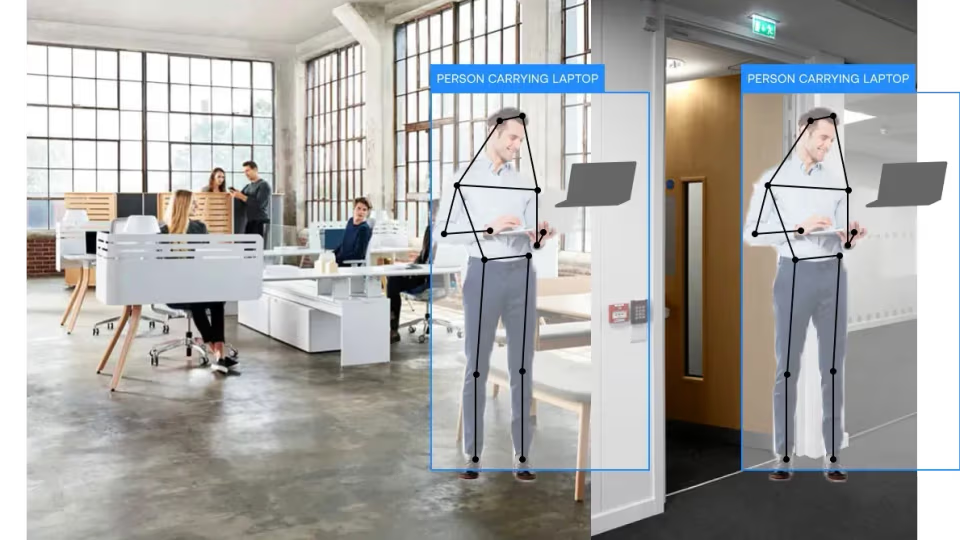
Vision-Language Models represent the technical foundation enabling this transformation. Unlike traditional surveillance analytics that simply identify objects, these systems understand context by integrating visual processing with natural language reasoning. This allows platforms to analyze not just what objects are present but their relationships, behaviors, and temporal context.
Detecting Threats Before They Escalate
The most significant shift occurs in pre-incident detection. Intelligent systems recognize behavioral precursors signaling escalating situations—loitering in restricted areas, crowd formations indicating distress, sudden egress events, and individuals running from specific locations—enabling threat identification before incidents fully materialize.
Contextual analysis distinguishes threats from routine activity by understanding the scene itself: analyzing relationships between objects, environment, and typical behavioral patterns for that specific location and time. A person carrying a crowbar at a construction entrance during business hours represents routine activity; the same object at a secured door after hours triggers investigation.
Modern AI-based weapon detection systems increasingly incorporate contextual filtering that analyzes behavior patterns, location appropriateness, and temporal sequences to reduce false alarms, though reliability still depends on environmental factors and typically includes human verification. Vision-Language Models enable contextual reasoning about behavior through understanding of relationships, context, and intent, rather than isolated object identification.
Investigating in Real Time as Incidents Unfold
Once a potential threat is detected, investigation speed determines whether situations escalate or get contained. Manual workflows require operators to search camera feeds, review footage, and piece together sequences, usually after the incident unfolded: forensic work taking hours or days.
VLM reasoning enables real-time investigation through natural language search across camera feeds. Natural language search allows operators to query video surveillance by requesting "show me all people wearing red jackets near the west entrance in the last 10 minutes" and receive instant results. Similarity search capabilities enable tracking individuals across camera networks without manual review.
Security teams understand threat context before responding, sending response teams with specific intelligence: threat type, exact location, subject description, and behavioral indicators.
Orchestrating Response Without the Bottleneck
The final transformation occurs in response orchestration. Manual workflows require operators to assess each alert, determine appropriate response, contact personnel, and monitor for acknowledgment, serial steps consuming critical time.
Agentic Physical Security orchestrates multi-channel alerts with video context, trigger dispatch protocols based on threat assessment, and escalate automatically. The system initiates actions based on threat type and severity without waiting for manual intervention, while human operators remain in the loop for decisions and ethical judgment.
Guards receive mobile alerts with relevant video clips before arriving at the location, while SOC teams track activity in real time. This enables operational flexibility: during low-traffic hours, a single patrol guard can operate as both responder and SOC, reducing overhead without sacrificing coverage. If primary responders don't acknowledge within defined windows, the system automatically notifies secondary teams. Management escalation triggers automatically for high-severity threats.
What Faster Initial Response Looks Like
The contrast becomes clear in the operational workflow:
Manual Response:
- Generic alerts providing only the location
- Guards dispatch without visual context
- Most alerts prove false, creating hesitation that delays genuine incident response
- Investigation happens after events conclude, if at all
AI-Driven Response:
- Continuous monitoring across all feeds
- Detection of suspicious behavior, verified against multiple data sources
- Alerts only for validated threats
- Guards receive mobile notifications with video context, threat type, and exact location
- Real-time subject tracking across camera networks
- Automated protocols notify additional personnel and authorities when threats escalate
Accelerating Response Time with Ambient.ai
Ambient.ai delivers Agentic Physical Security through its Ambient Platform, built on Ambient Pulsar—an always-on reasoning Vision-Language Model purpose-built for physical security.
The platform addresses each breakdown point in traditional response timelines: detection delays collapse through continuous monitoring across all cameras, assessment bottlenecks disappear through automated contextual analysis, and dispatch friction reduces through orchestrated alerts that mobilize teams with video context before guards arrive.
The system monitors over 150 threat signatures but, more critically, it recognizes behavioral precursors that enable intervention during that narrow window before situations escalate.
When active shooter situations conclude within minutes, the gap between threat emergence and initial response determines outcomes. Ambient.ai collapses that gap.
Key Takeaways
- Response windows are measured in minutes, not hours. Active shooter situations conclude within 10 to 15 minutes, often before law enforcement arrives, making early detection the difference between containment and escalation.
- Traditional response timelines break down at every step. Detection delays, assessment bottlenecks, dispatch friction, and context gaps each consume critical seconds that manual processes and staffing increases alone cannot recover.
- Agentic Physical Security removes humans from the bottleneck, not the loop. Purpose-built AI autonomously detects, assesses, and initiates response based on threat type and severity, while human operators retain control over decisions and ethical judgment.
- Pre-incident detection provides the greatest operational advantage. Behavioral precursors like loitering in restricted areas, sudden egress events, and crowd formations indicating distress enable threat identification before incidents fully materialize.
- Response quality improves alongside response speed. Guards receive mobile alerts with video context, threat type, exact location, and subject descriptions before arriving, replacing the hesitation caused by repeated false alarms with confident, informed action.