Corporate Security: Threats, Challenges & Trends


10x faster response. Same cameras. Same team.
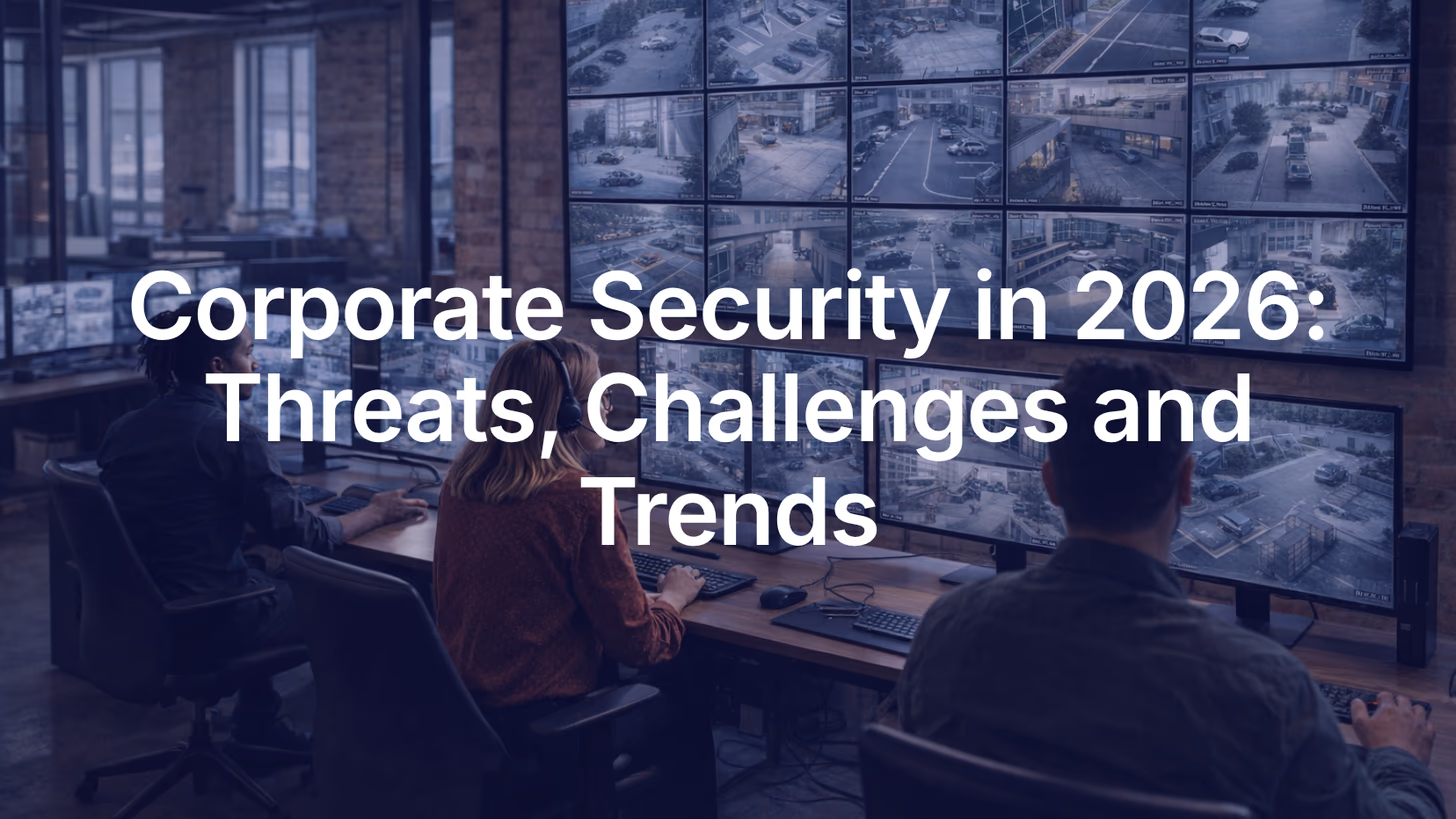
Corporate Security in 2026: Threats, Challenges and Trends
The corporate security landscape is becoming more complex as organizations face a wider mix of physical risks, operational strain, and rising expectations for prevention. Security leaders are being asked to strengthen readiness, improve visibility, and connect fragmented workflows across people, policy, and technology. Those pressures set the stage for the threats, challenges, and trends shaping enterprise security programs.
Corporate Security Threats Reshaping Enterprise Programs
Corporate security is the practice of protecting an organization's people, physical assets, and facilities. The threat environment for corporate facilities has grown more volatile and more complex at the same time. Several categories of physical risk now demand security leadership's attention at the board level.
Workplace Violence
OSHA classifies violence as a leading cause of fatal occupational injuries in the United States. Federal data from the BLS show total fatal work injuries declined, while workplace homicides increased in 2024 after falling from 2022 to 2023. Nonfatal violent acts in private industry also drive significant lost-time injuries each year.
FIU notes that more than 2 million U.S. workers face violence on the job each year, and those are just the reported cases. The pattern is clear: even as overall workplace injuries decline, violence remains a persistent category of concern.
Active Assailant Incidents
The FBI designated 24 active shooter incidents in 2024, a 50% decrease from 48 in 2023. Industry data indicates that credible active assailant threats have affected many organizations in recent years, cautioning against reading a single-year decline as a permanent downward trend.
Unauthorized Physical Access
The ASIS Access Control Research Report ranked tailgating or piggybacking as the leading unauthorized access vector, followed by propped doors, credential sharing, and visitor attempts to reach restricted areas. Traditional PACS devices raise awareness only after the fact. They cannot detect tailgating as it happens.
Insider Physical Threats
Physical insider threats manifest in several forms, including violence, theft of physical assets, sabotage of infrastructure, and unauthorized removal of sensitive material. The topic has reached top-tier enterprise security agenda status, with major industry conferences now dedicating sessions to insider risk.
Targeted Violence Against Executives
A September 2025 survey of corporate security chiefs found that 42% reported a significant increase in threats of violence against executives over the past two years, according to Security Magazine. The same report notes a median CEO security spend of $76,000 in 2025 across S&P 500 and Russell 3000 companies.
Physical Attacks on Critical Infrastructure
The DHS Homeland Threat Assessment states that domestic violent extremists and criminal actors likely will continue to call for and carry out physical attacks against U.S. critical infrastructure, particularly in response to flash point events.
The Economic Weight of Corporate Security Failures
The reactive model, responding to incidents after they occur, appears economical until recovery expenses, liability exposure, and lost assets accumulate.
Workplace Violence Costs
National annual cost estimates for workplace violence range widely. One FIU article notes that researchers have put the cost of workplace violence at as much as $56 billion annually and describes that as likely an undercount, while a separate source cites annual costs of $250–$330 billion to American businesses. Other analyses estimate tens of billions of dollars per year in various categories of losses. Workplace violence can lead to lost productivity and increased turnover among affected employees.
Liability Exposure
Inadequate physical security programs can create direct financial consequences through liability, litigation, and post-incident recovery costs, with negligent security verdicts regularly reaching seven and eight figures.
Guard Force Economics
The BLS reports a median guard wage of about $17.82 per hour, well below many comparable occupational categories. Sustained operational quality remains difficult in major metro areas as annual turnover commonly exceeds 100-300% in contract guarding. The Liberty Mutual Workplace Safety Index puts the bill for all disabling, non-fatal workplace injuries at $58.78 billion per year for U.S. employers. Scaling security through headcount alone carries linear cost increases against a risk environment that grows faster than staffing can match.
Why Corporate Security Needs Reasoning AI
Modern corporate campuses deploy extensive camera networks across multiple facilities, generating continuous footage streams that overwhelm security teams. Human attention limitations create blind spots that leave the vast majority of feeds unwatched until after incidents occur.
The consequences are severe:
- Security discovers perimeter testing and reconnaissance only after forced entry attempts.
- Early warning signs, such as aggressive behavior or unusual pacing outside specific areas, go unnoticed until violence erupts.
- Insider threats accessing sensitive areas with laptops or removing equipment operate undetected until damage surfaces.
- Hard-to-spot actions like tailgating, a person fallen down, or systematic perimeter fence testing go unobserved until the actual breach occurs.
Resource constraints compound these challenges. A single GSOC operator may be tasked to monitor dozens of camera feeds across multiple campus locations simultaneously while managing PACS alerts. Budget constraints prevent adequate staffing, leaving teams perpetually reactive rather than preventive.
Security teams overwhelmed by managing various sites cannot correlate incident patterns that only become visible in hindsight.
Reasoning AI becomes the force multiplier for identifying behavioral patterns and acting on them before escalation. AI can process large data volumes at speeds beyond human capacity, recognizing threat patterns that manual review misses entirely. The shift from documenting what happened to preventing it requires systems that understand behavioral precursors and contextual risk factors.
The False Alarm Crisis in Corporate Security Operations
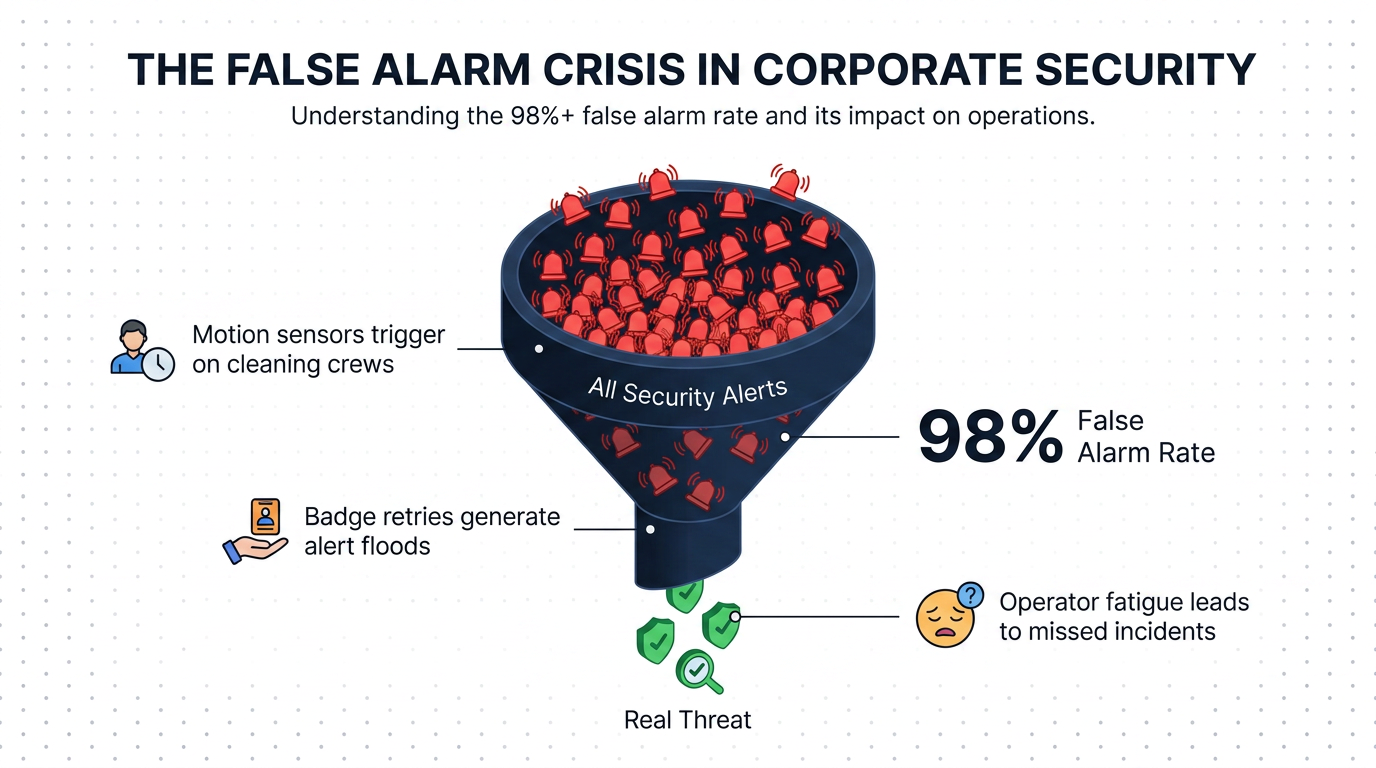
Security teams face an operational reality where false positives consume available resources. Motion sensors trigger on cleaning crews. Door contacts break from wind gusts and environmental factors. Badge readers generate alerts when employees retry failed swipes. Thousands of low-priority alarms inundate operators daily. Each alert requires manual verification: pull up the camera feed, review the footage, confirm it's benign, close the ticket.
The DOJ COPS Program found that most police alarm calls are false. The DOJ COPS report also finds commercial properties generate false alarms at notably higher rates than residential properties because more people share responsibility for system operation and the systems themselves are more complex.
Video motion detection compounds the issue. Industry sources note that automated camera alerts from motion detection are often false and can overwhelm security teams with alert volume.
The Human Cost of Alert Fatigue
This cycle repeats hundreds of times per day. The cumulative time spent validating non-threats buries genuine security events in noise. Teams become desensitized to alerts, response times slow, and the probability of missing real incidents increases.
Security teams are drowning in video feeds and alarms with a more than 98% false alarm rate, leading to operator fatigue and missed critical incidents.
GSOC and security operations turnover rates are extraordinarily high, with training new operators taking weeks or months to reach full operational capability. Breaking this cycle requires systems that understand context rather than simply flagging motion or contact changes, mapping how people normally move through each space and surfacing only deviations that suggest genuine security concerns.
How Behavioral Intelligence Enables Predictive Corporate Security
The shift from reactive to predictive security requires understanding behavior and context rather than simply detecting presence. Behavioral intelligence analyzes how people move, what they interact with, and when their actions deviate from established patterns to distinguish genuine threats from routine activity.
Beyond Object-Focused Analytics
Traditional video analytics detect objects and generate alerts. A person appears, the system flags it. A door opens, the system logs it. This object-centric approach creates the noise problem security teams face daily.
More sophisticated approaches analyze behavioral patterns by layering contextual intelligence. Location determines threat level: someone loitering near a data center entrance during off-hours carries different implications than waiting in a lobby during business hours. Someone repeatedly testing perimeter fencing suggests reconnaissance for future breaches, while the same person waiting in a parking lot might simply be early for an appointment.
Time-based context adds another layer. Badge swipes at unusual hours, movement during facility closures, or repeated presence during specific windows all contribute to threat assessment. An authorized cleaning crew during scheduled hours differs completely from masked individuals in identical areas after hours, even though both might trigger the same motion sensors.
The most valuable intelligence comes from understanding intent through movement patterns. Someone testing door handles, walking perimeter fences multiple times, or exhibiting hurried movements toward exits reveals planning that static rules miss. The difference between maintenance workers and would-be thieves is how they move, what they interact with, and the sequence of their actions.
Tracking Threat Progression Through Behavioral Phases
Advanced approaches aim to track threat progression through distinct phases. Initial surveillance manifests as repeated presence or systematic scouting. Testing behavior includes probing locks, checking for camera coverage, or attempting unauthorized access. Execution follows with forced entry, asset removal, or aggressive action.
By concentrating on actions rather than identities, such systems can operate without relying on privacy-invasive techniques. They deliver actionable intelligence based on observable behavior alone.
When spatial, temporal, and behavioral indicators align, they create high-confidence alerts that justify immediate response. This concentration on genuine risk factors reduces false positives while surfacing threats that traditional systems miss.
A scenario: an individual loiters near a restricted loading dock for fifteen minutes, tests a side door twice, then returns with a vehicle backed up to the entrance. The pattern of loitering escalating to trespassing, then to potential theft becomes visible during the loitering phase when prevention is still possible.
Workplace Violence Prevention and Regulatory Pressure on Corporate Security
Workplace violence prevention has moved from a best-practice recommendation to a regulatory mandate across multiple U.S. states, with direct consequences for corporate security program design.
Federal Requirements
OSHA's Enforcement Directive CPL 02-01-058 is an enforcement guidance document that directs inspectors to review an employer's written workplace violence plan or related policies and procedures, employee training, and incident records.
California SB 553
California's SB 553, enforceable since mid-2024, is the broadest general-industry workplace violence prevention law in the U.S. It requires a written WVPP, a Violent Incident Log, annual training, hazard assessments, and emergency response procedures. Cal/OSHA penalties for serious violations reach substantial levels.
Expanding State Legislation
New York's Retail Worker Safety Act became effective on June 2, 2025. Virginia mandated healthcare workplace violence reporting systems by mid-decade. Washington State requires healthcare violence investigation and annual plan updates. Massachusetts has pending legislation requiring annual risk assessments. Fortune 500 companies operating across multiple states face a patchwork of compliance obligations that demand standardized program infrastructure.
Threat Assessment Teams
Industry guidance recommends Threat Assessment Teams assembled from multiple disciplines. Physical security infrastructure plays a direct role in compliance. Video surveillance, PACS logs, and behavioral detection systems provide the documentation, early warning, and incident reconstruction capabilities that regulatory programs require.
Executive Protection as a Rising Corporate Security Priority
Corporate security investment continues to evolve as organizations respond to changing physical and operational risks. ASIS 2025 Executive Protection research found that 42% of organizations reported significantly more emphasis on executive protection compared to eighteen months prior.
The physical security dimensions of executive protection extend across corporate campuses: controlled access to executive floors, parking structure monitoring, behavioral detection for loitering or surveillance near executive entrances, and visitor management protocols for high-risk visitors. The release of the first-ever industry Executive Protection Standard in September 2025 established formal program design criteria.
GSOC Modernization and the Shift to Proactive Corporate Security
The traditional GSOC model, defined by massive video walls where operators monitor more feeds than any team can reasonably track, is under direct pressure from staffing constraints and operational inefficiency.
The Staffing Reality
The 2026 Security Megatrends report highlights shifts in security delivery models, including greater adoption of automation, cloud, and hybrid approaches. With operator turnover rates far exceeding industry norms and onboarding stretching weeks to months, the labor model underlying traditional GSOCs is structurally unsustainable.
Organizational Silos as a Security Threat
Internal fragmentation, when physical security, HR, communications, and compliance operate in silos, compounds security risk across the organization. The convergence agenda requires unified data from cameras, PACS, and sensors feeding a single intelligence layer rather than separate event streams.
The Operator Role Transition
Alarm management has traditionally been one of the most time-consuming aspects of security operations. AI-driven technology filters and verifies alarms so operators concentrate on the highest-priority incidents. The shift moves personnel from reactive notification-watching to proactive risk analysis, creating more engaging career paths.
AI Adoption Trends in Corporate Security Operations
The security industry has entered a new era where automation and agentic AI redefine how systems operate and decisions are made. Some vendors describe the destination as autonomous physical security operations, where AI systems perceive, assess, and act on physical threats in real time. Agentic AI is already deployed across monitoring centers, enterprise campuses, and government sites.
Practitioner Adoption: Measured Optimism
Practitioner research frames the perspective candidly: corporate security is curious about AI, but not yet fully convinced of its end-user value. A separate survey of security chiefs found that 47% expect their physical security budgets to increase in the next 12 months.
From Visual Surveillance to Visual Intelligence
A maturity progression is underway: from analytics applied to recorded video for post-incident search, toward real-time analysis of all video at the point of capture. The AI in video surveillance market is projected to grow rapidly between 2026 and 2032.
Building the ROI Case Under Financial Scrutiny
Forrester's 2026 predictions report that few decision-makers can yet tie AI value to financial growth. Security leaders who can connect AI investments directly to reduced false alarm costs, lower guard force overtime, and faster incident resolution will be better positioned for budget approval.
Frameworks for Corporate Security Program Design
The Enterprise Security Risk Management (ESRM) Guideline provides the strategic foundation for corporate security programs. ESRM ties security practice to overall organizational strategy using established risk management principles. ISO 31000 provides a complementary risk management structure applicable to converged physical security environments.
From Reactive Documentation to Proactive Intervention
Ambient.ai addresses the gap between fragmented security workflows and proactive threat detection through the Ambient Platform, the leader in Agentic Physical Security. Ambient Intelligence, powered by Ambient Pulsar, is an always-on, edge-optimized reasoning VLM designed for physical security.
For organizations dealing with alert fatigue, behavioral blind spots, and fragmented monitoring, request a demo to explore how the platform helps security teams reason across video, PACS, and sensor data in real time.
Frequently Asked Questions
How does reasoning AI differ from traditional video analytics in detecting physical security threats like tailgating and insider threats?
Reasoning AI analyzes behavioral context, spatial relationships, and intent rather than flagging objects alone. It is designed to distinguish routine activity from potential threats by analyzing movement patterns, interactions, and deviations from normal behavior.
What specific regulatory requirements does California SB 553 impose on corporate workplace violence prevention programs, and how do other states compare?
California SB 553 requires employers to implement written workplace violence prevention plans, maintain violent incident logs, provide training, conduct hazard identification and assessment, and include procedures for responding to workplace violence emergencies. Other states focus more narrowly on retail workers or healthcare settings rather than broad industry coverage.
How can corporate security leaders build a quantifiable ROI case for AI-powered security systems to justify budget approval from CFOs?
Connect AI investments to measurable operational metrics like reduced guard overtime, false alarm validation time savings, and faster incident response. Demonstrate avoided litigation costs through enhanced documentation and frame security spending as enterprise risk mitigation rather than isolated technology expense.