Are There Security Cameras That Can Detect Weapons?


90%+ alerts resolved in under a minute. See how.
Security cameras that can detect weapons are now deployed across schools, corporate campuses, and critical infrastructure. But the answer depends less on the camera itself and more on where the AI runs. Three competing architectures have emerged, each making fundamentally different tradeoffs across detection depth, cost, and scalability.
This guide explains the AI technology behind weapon detection, compares the three architectures that deliver it, and gives security professionals a practical framework for implementation and vendor evaluation.
Key Takeaways
- Security cameras detect weapons through AI software, and where that software runs determines detection quality, cost, and scalability
- On-camera AI chips handle simple object recognition but lack the compute power for contextual reasoning, behavioral analysis, or continuous multi-frame understanding
- Cloud-connected systems enable powerful models but rely on sub-sampled frames and introduce latency, bandwidth costs, and network dependency at scale
- An edge-plus-cloud architecture pairing commodity cameras with dedicated edge appliances and cloud management delivers continuous, always-on reasoning across all streams at the strongest price-performance ratio
- Human operators remain essential for verifying alerts and coordinating responses, with AI functioning as a decision-support tool that augments rather than replaces security personnel
How AI Weapon Detection Works
Weapon detection starts with AI software trained to recognize firearms, knives, and other threats in video feeds. While some cameras now include embedded AI chips capable of basic detection, most advanced weapon detection relies on software running outside the camera hardware. This distinction matters for infrastructure planning since existing cameras can often be upgraded with an intelligence layer rather than replaced entirely.
The detection capabilities available to any organization depend on three layers of AI technology, each more computationally demanding than the last. Understanding these layers explains why the choice of processing architecture is consequential.
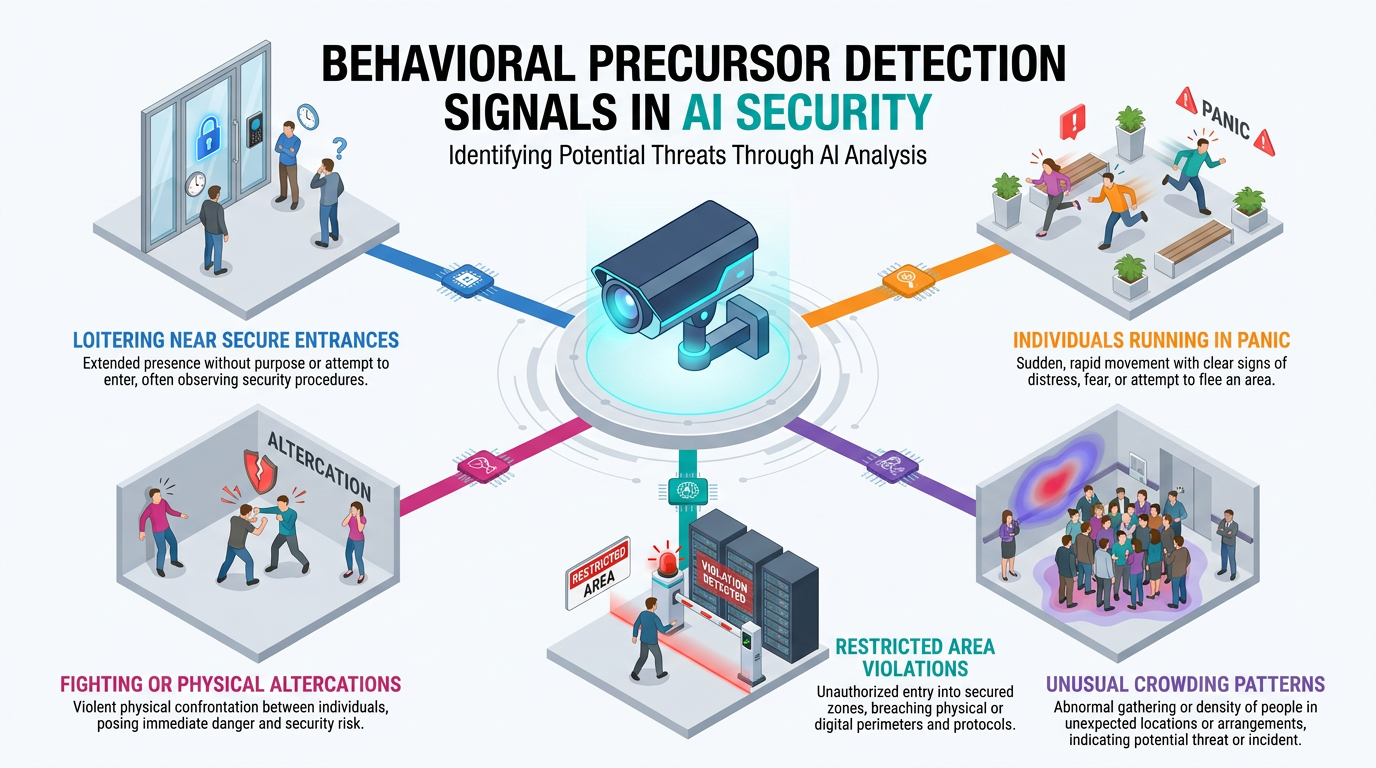
Computer Vision and Object Recognition
At the foundation of weapon detection lies computer vision, technology that enables machines to interpret visual information the way humans do. For security applications, this means training algorithms on thousands of images showing weapons in various positions, lighting conditions, and environments. Modern deep learning approaches have significantly advanced detection accuracy, achieving reliable performance even in complex real-world conditions with crowd density, obstructions, variable lighting, and weather.
Object recognition is the least computationally demanding layer. It identifies shapes and classifies them against known categories: firearm, knife, blunt object. Even the most resource-constrained processing architectures can support this.
Vision-Language Models and Contextual Threat Analysis
The most significant recent advancement involves vision-language models, or VLMs. These systems don't just identify objects; they interpret scenes by fusing visual perception with language-based reasoning.
This capability enables contextual threat analysis. VLMs can distinguish normal activities from genuine threats by understanding relationships among objects, environments, and typical behavioral patterns for specific locations. A VLM might recognize routine movement in a secure facility while flagging the same behavior in a restricted area as requiring immediate attention.
VLMs are among the most computationally demanding AI models used in security. Running them continuously across multiple video streams requires substantially more processing power than basic object classification, which limits which architectures can support them at enterprise scale.
Behavioral Precursor Detection
While detecting a brandished weapon represents a critical capability, the greater value lies in identifying behavioral precursors that often signal an incident before it escalates. Reasoning AI can recognize patterns that human operators monitoring multiple feeds might miss, including loitering near secure entrances, individuals running in panic, fighting or physical altercations, unusual crowding patterns, and restricted area violations.
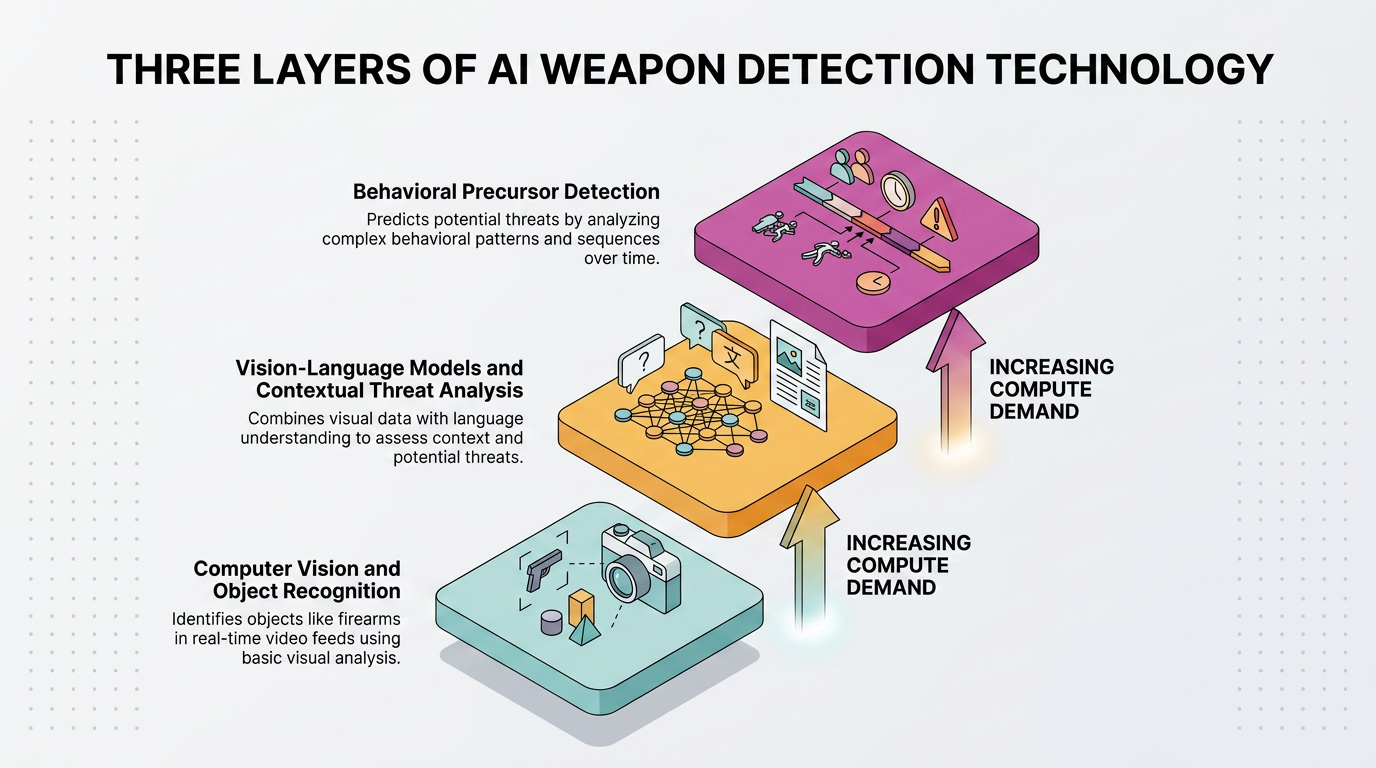
These pre-incident behaviors provide early warning, enabling intervention before situations escalate into active threats. By detecting behavioral anomalies, security teams gain precious time to assess situations and coordinate responses rather than reacting only after a weapon becomes visible.
Behavioral precursor detection requires continuous multi-frame analysis, tracking how a scene evolves over seconds and minutes rather than classifying individual snapshots. A person pacing near a secured entrance only registers as anomalous when the system observes the pattern over time. This capability is also most constrained by where processing happens, which is why architecture selection matters so much.
Three Architectures for Weapon Detection Cameras
The AI capabilities above span a wide compute spectrum, from basic object classification to continuous contextual reasoning across multiple streams. Where that processing happens determines which capabilities are actually achievable. Security teams evaluating weapon detection will encounter three primary architecture approaches.
On-Camera AI Chips
Some camera manufacturers embed AI chips directly into camera hardware and run detection algorithms on the device itself. The appeal is straightforward: simpler deployment with no extra hardware, minimal bandwidth use, and low latency for basic detections.
However, camera-embedded chips deliver limited compute power, enough for lightweight classification models but far below what VLMs or continuous behavioral reasoning require. The system can recognize the shape of a firearm in a single frame, but it cannot reason across time, track behavioral escalation, or understand why an object in one context represents a threat while the same object in another context does not.
These systems are firmware-dependent, with upgrade paths tied to the camera manufacturer's hardware cycle. When better detection models emerge, organizations must replace cameras rather than update software. Ambient.ai's documentation describes cross-camera analysis, including tracking appearances across a camera network and correlating threats across cameras for site-level intelligence. On-camera AI introduces object recognition into security workflows, but remains fundamentally constrained to the first layer of detection capability described above.
Cloud-Connected Systems
Cloud architectures stream video from cameras to remote data centers where powerful GPU clusters run AI models. This enables more sophisticated detection than on-camera processing, including reasoning VLMs with contextual understanding.
Real-world constraints, however, limit what cloud-connected systems deliver in practice. Continuous video streaming drives significant bandwidth consumption and cost across large deployments. Inference latency introduces delays that matter in weapon detection scenarios where seconds count.
To remain deployable at scale, many cloud-connected systems default to sub-sampling, analyzing selected frames at intervals rather than processing the full continuous stream. This means that brief or transient actions, like tailgating, someone quickly brandishing and then concealing a weapon, or rapid behavioral shifts, can be missed entirely. Some cloud-connected systems can describe what is visible in a given moment, but sub-sampling prevents them from tracking the behavioral sequences that precursor detection depends on.
Cameras with Edge Appliances and Cloud Management
An edge-plus-cloud architecture separates three functions: cameras capture video, dedicated edge appliances handle real-time AI processing, and a cloud layer provides centralized SOC management, analytics, and multi-site oversight.
This approach uses existing cameras as passive sensors and feeds video to purpose-built edge computing devices. Organizations keep their current camera infrastructure with no rip-and-replace requirement. Edge processing reduces latency and bandwidth costs compared to cloud-only approaches because video is analyzed locally, and only alerts, metadata, and relevant clips travel to the cloud.
The architecture supports all three detection layers: object recognition, VLM-powered contextual analysis, and continuous behavioral precursor detection across every stream. Edge appliances equipped with GPU-class processors can run advanced reasoning models locally at the speeds that real-time detection demands, without the bandwidth penalties or sub-sampling tradeoffs of cloud-dependent approaches. This is the architectural approach that Ambient.ai uses for its edge-optimized deployment model.
Real-World Accuracy and Performance
Detection accuracy has improved dramatically as AI models mature and training datasets expand. But laboratory benchmarks don't always translate to operational environments. Multiple factors influence real-world performance.
Camera quality. Effective AI weapon detection requires high-resolution cameras operating at sufficient frame rates. Many existing analog or low-resolution IP cameras lack sufficient image quality for reliable detection, sometimes requiring upgrades at specific positions.
Environmental conditions. Crowd density, lighting variability, reflective surfaces, and weather conditions can all degrade detection accuracy. Low light, glare, and shadows significantly affect algorithm performance.
Weapon visibility. AI systems excel at detecting visible weapons but struggle with fully concealed threats. The technology functions best as part of layered security strategies with human operator oversight rather than as a standalone solution.
Why Organizations Are Investing in AI Weapon Detection
The AI gun detection system market reached $1.34 billion in 2025 and is projected to reach $2.28 billion by 2030, reflecting accelerating enterprise confidence in the technology's operational readiness. That growth is driven by a threat environment that continues to demand proactive security investment.
The Bureau of Labor Statistics recorded 470 workplace homicides in 2024, of which 379, or 80.6%, were caused by shootings by another person. The American Hospital Association estimated the total annual financial cost of violence to hospitals at $18.27 billion in 2023, spanning security staffing, facility modifications, medical treatment, legal expenses, and staff replacement. These figures represent the cost of reactive security. Organizations investing in weapon detection are seeking to shift that equation toward earlier intervention and incident prevention.
Industry surveys suggest that first-generation rule-based video analytics can recover costs within the first year, though independent validation of ROI claims remains limited. Current-generation reasoning AI, with its ability to interpret behavior and context continuously across every feed, can deliver significantly more operational value from the same camera infrastructure.
Implementing Weapon Detection Cameras
Deploying AI weapon detection requires planning that extends well beyond choosing an architecture. Once you select the processing model, implementation success depends on infrastructure readiness, operational change management, and realistic timeline planning.
Assessing Camera Infrastructure Readiness
Before deployment, security teams should audit their existing camera environment position by position. Key questions include whether each camera meets the minimum resolution and frame rate for reliable detection, whether mounting angles and fields of view align with the most important detection zones, and whether network connectivity at each position can support the chosen architecture's data-flow requirements.
Organizations with modern IP infrastructure can often deploy edge appliance architectures without camera changes. Legacy analog environments require a phased upgrade plan. In either case, prioritize high-risk positions first: main entrances, perimeter access points, lobbies, and areas with historically elevated threat profiles. A full facility audit typically takes two to four weeks for mid-size campuses and can be conducted jointly with the vendor during scoping.
SOC Workflow Integration and Change Management
The most common implementation failure is operational, not technical. Weapon detection introduces a new alert stream into existing SOC workflows, and operators need clear procedures for handling it.
Before go-live, teams should define alert triage protocols that specify who receives weapon detection alerts, what confidence thresholds trigger escalation versus monitoring, and how weapon alerts interact with existing access control and intrusion alarm workflows. Operators accustomed to managing door alarms or perimeter sensors need training to interpret visual threat alerts, understand confidence scores, and follow verification steps before activating emergency response procedures.
Successful deployments typically run a parallel operations phase of two to four weeks, where weapon detection alerts flow to operators alongside existing systems without replacing any current procedures. This allows teams to calibrate alert thresholds, build familiarity with the interface, and refine response protocols based on real alert patterns in their environment before cutting over to full operational reliance.
Network and Infrastructure Planning
Network requirements vary by architecture. Regardless of model, security teams should plan for dedicated network segments that isolate security video traffic from general enterprise traffic, redundant connectivity at critical positions to prevent detection gaps during network events, and sufficient power and physical space at edge appliance locations.
Engage IT and facilities teams early. Weapon detection deployments that treat network and physical infrastructure as afterthoughts often encounter delays that could have been resolved during planning.
Privacy, Data Handling, and Compliance
Privacy is both a design decision and an architecture decision. Privacy-by-design principles emphasize collecting only the data necessary for security functions, implementing appropriate retention policies, and providing transparency about what the system captures and how it uses that data.
Architecture directly shapes an organization's privacy posture. Systems that process video locally on edge appliances keep raw footage on-site, with only alerts, metadata, and relevant clips reaching the cloud. Cloud-dependent architectures stream continuous video to external infrastructure, introducing additional considerations around data residency, third-party access, and compliance with regulations governing where video data can be stored and processed. For organizations operating across multiple jurisdictions, or in sectors with strict data handling requirements like healthcare, finance, or government, the processing architecture can determine whether the deployment meets compliance standards or creates new regulatory exposure.
Best practices include selecting platforms that detect threats without collecting personally identifiable information, defining retention policies before deployment rather than after, and ensuring data-handling procedures are documented and auditable. Address privacy during vendor evaluation and architecture selection, not as a post-deployment policy exercise.
Evaluating Weapon Detection Vendors
With the architecture tradeoffs understood, security professionals need a practical framework to compare vendors and structure proof-of-concept evaluations.
Questions to Ask Every Vendor
Start by establishing what the system actually does under realistic conditions and probing the depth of its detection library. Key questions to ask every vendor:
- What percentage of the video stream does the system analyze, and does it process every frame or sample at intervals?
- What is the effective detection latency from event occurrence to alert delivery?
- Can you share documentation of false positive rates measured in operational deployments, not laboratory environments, along with reference contacts at organizations with comparable camera counts and environmental conditions?
- What does the system do when it encounters a scenario outside its trained signatures, and how broad is the threat library beyond firearm shapes (loitering, fighting, restricted area violations)?
- Is the detection library static, or can it be updated with new signatures without hardware changes?
Structuring a Proof of Concept
A well-designed POC should run for at least 30 days across a representative sample of camera positions, including high-traffic and low-traffic areas, indoor and outdoor environments, and positions with challenging lighting conditions. Define success criteria before the POC begins, focusing on detection rate for test scenarios, false positive volume per camera per day, alert-to-resolution time for operators, and system uptime and reliability.
During the POC, introduce controlled test scenarios at varied times of day to measure detection consistency. Track how operators interact with the system and whether alert volume is manageable within existing staffing. A POC that performs well during business hours but generates unmanageable alert volume during off-hours reveals a system that will create operational problems at full deployment.
What to Measure Before Committing
Beyond detection accuracy, evaluate total cost of ownership across a three-to-five year horizon. Factor in per-camera licensing or subscription costs, hardware lifecycle and replacement timelines, bandwidth and cloud compute charges that scale with camera count, and the operational cost of managing false positives (operator time per alert multiplied by daily alert volume). Compare these against the integration with existing systems, including video management systems, access control platforms, and incident response workflows. Systems that require operators to monitor a separate interface add hidden labor costs that rarely appear in vendor pricing.
How Ambient.ai Approaches Weapon Detection
For organizations seeking to implement the capabilities discussed throughout this guide, Ambient.ai addresses these challenges through Agentic Physical Security, where AI systems autonomously observe, detect, assess, and respond to real-world threats in real time, delivered through the AI-native video management platform, Ambient Foundation.
With threat detection capabilities that include brandished firearm detection alongside 150+ additional threat signatures, the Ambient platform integrates with existing cameras, sensors, and access control systems rather than requiring infrastructure replacement.
This edge-plus-cloud approach turns current camera investments into a unified intelligence layer, enabling security teams to detect both active threats and the behavioral precursors that often signal danger before weapons become visible. For organizations evaluating AI threat detection, request a demo to see how contextual threat analysis works in practice across enterprise environments.
What are the minimum camera resolution and frame rate specifications needed for reliable AI weapon detection in real-world environments?
AI weapon detection typically requires minimum 1080p resolution cameras at 15-30 frames per second. Adequate resolution and camera placement help keep weapons large enough in the image at distance, while lower frame rates may miss brief presentations. Optical quality, lens focal length, and sensor sensitivity matter as much as raw specifications.
How does an edge-plus-cloud architecture handle weapon detection when the network connection to the cloud goes down?
Edge appliances continue processing video and detecting threats locally using onboard compute resources during network outages. Edge processing can maintain local threat detection during connectivity interruptions and forward relevant alerts and metadata to the cloud when connectivity is available, reducing the impact of temporary infrastructure failures.
What is the typical false positive rate for AI weapon detection systems in operational deployments, and how does it vary across the three processing architectures?
False positive rates vary by vendor and implementation, not architecture alone. Request operational metrics from comparable environments. Edge-plus-cloud architectures typically achieve lower rates through continuous multi-frame analysis, enabling contextual reasoning that distinguishes genuine threats from routine activities.