Floor Plans for Physical Security: How Spatial Awareness Transforms SOC Response


Investigations that took days. Now answered in seconds.
When an alert fires at 2 a.m., the first question isn't “what happened?” Most modern video management systems can answer that. The question that actually determines response speed is: where exactly did it happen, and what’s nearby?
This is the gap that separates reactive security operations from a truly informed response. A door-forced-open alarm tells you a perimeter was breached. But without spatial context, the operator doesn’t know which hallway that door opens into, which cameras have line-of-sight, or whether the nearest patrol is thirty seconds away or three minutes. Such issues are amplified at an organization using a global SOC to monitor multiple sites where the operator does not have first-hand information about the remote structures and sites.
It’s not a people problem. It’s a systems problem. Legacy tools were designed to display video feeds and log access events in parallel silos. They were never built to answer spatial questions in real time, and they certainly weren’t built to unify video, access control, and situational context into a single operational view.
This is one of the many challenges Ambient Foundation was designed to solve. As the operational layer for all Ambient.ai applications, Ambient Foundation unifies data from existing cameras, access systems, and sensors and applies Ambient Intelligence, powered by Pulsar’s always-on reasoning Vision-Language Model, to understand activity, context, and risk as events unfold. It transforms the SOC from a passive monitoring environment into an intelligent, adaptive command center capable of overseeing all locations from a single pane of glass. From Agentic Monitoring that dynamically surfaces the most relevant camera feeds, to access event correlation, Ambient Foundation addresses the systemic gaps that legacy tools were never designed to close. The spatial awareness gap, knowing where an incident is happening and what’s nearby, is one of those gaps.
The Spatial Awareness Gap
Enterprise physical security environments have grown exponentially more complex. A mid-size campus might operate 500 cameras, dozens of badge readers, and multiple buildings, yet the SOC operator investigating an incident is still toggling between a flat camera grid and a separate access control dashboard. There’s no map. No spatial relationship between the alarm that just fired and the three cameras that could verify it.
This gap has real consequences. Investigation time increases because operators have to mentally reconstruct the physical layout while reviewing footage. Response coordination suffers because dispatchers can’t point a guard to the right location with visual confidence. And for access alarms without an associated camera, like a door-forced-open event at an unmonitored entry point, verification was historically impossible without physically sending someone to check.
Floor Plans: Spatial Context Meets Real-Time Intelligence
Floor Plans in Ambient Foundation, our AI-native video management platform, bridges this gap by letting security teams pin cameras and access readers directly onto building maps within the Ambient.ai platform. The result is a visual, spatial layer that connects where devices are to what they’re seeing, all within the same unified interface.
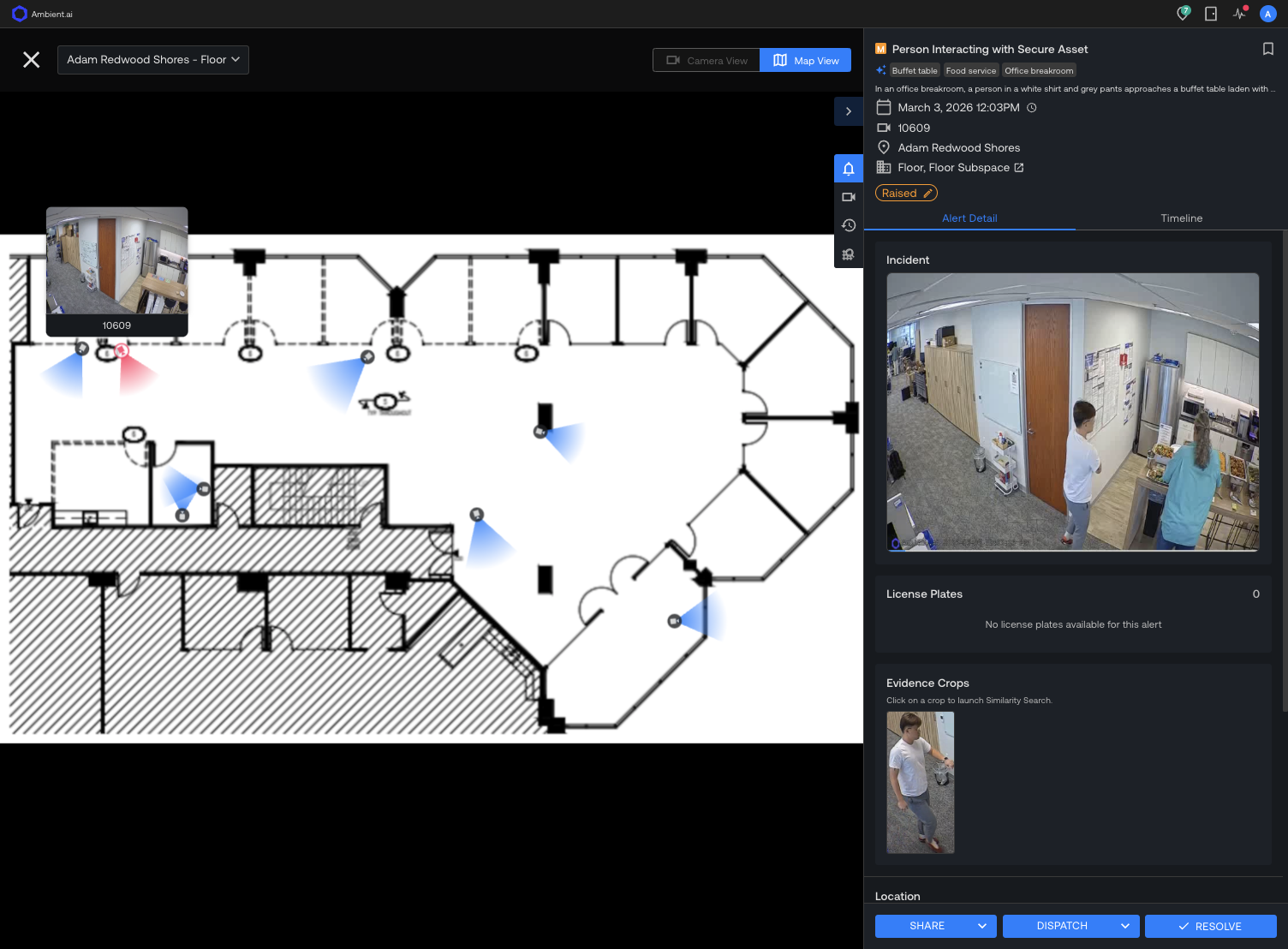
Setup is a simple step in the onboarding process. Upload an image or PDF of your building layout, or even a Google Maps screenshot for outdoor campuses, and drag your cameras and readers onto their physical locations. Adjust each camera’s field-of-view cone to reflect real-world coverage. Changes save automatically. No integrator required.
Once configured, Floor Plans becomes an active intelligence surface:
- When a camera alert fires, switch to Map View to see the triggering camera highlighted in red on the floor plan. Hover over nearby cameras for static previews. Click any camera icon to open its live stream in a popover, pull up multiple feeds simultaneously to build a complete picture of what’s happening around the incident.
- When an access alarm triggers, such as a door forced open, a fire alamr, or a badge anomaly, the involved reader pulses on the map with a highlighted gradient. Even if there’s no camera directly at that door, operators can identify and open nearby camera streams to visually verify the event. This turns previously unverifiable alarms into actionable intelligence.
- A space selector lets operators jump between floor plans across the same site without leaving the alert view, maintaining context while expanding their field of awareness.

Why This Matters for Enterprise Security Teams
Floor Plans isn’t a standalone add-on; it’s an embedded capability within Ambient Foundation that makes every other Ambient.ai product more effective. When Ambient Access Intelligence cuts 95% of false alarms from door events, Floor Plans shows operators exactly where the remaining verified threats are happening. When Ambient Threat Detection identifies a brandished weapon or tailgating event, Floor Plans gives the SOC spatial context to coordinate response across guards, cameras, and adjacent areas.
This is what a unified Cloud SOC looks like in practice: detection, verification, spatial awareness, and response coordination happening in a single interface, not across three disconnected tools.
Getting Started
Floor Plans is available within Ambient Foundation. If you’re an existing customer, navigate to Admin → Configuration → Maps and Spaces, select your site, add a physical space and upload your first floor plan. For organizations evaluating how Ambient.ai transforms physical security operations, request a demo to see Floor Plans working alongside Agentic Monitoring, Access Intelligence, and Threat Detection.
Because the next time an alarm fires at 2 a.m., your operators should know exactly where to look and which cameras to pull up, before they even reach for the radio.


