The Complete Guide to Implementing AI for Workplace Safety



95% fewer false alarms. Zero changes to your infrastructure.
Traditional workplace security wasn't built for today's threats. Guards patrol on fixed schedules. SOC analysts juggle dozens of camera feeds, more than anyone can realistically monitor. Legacy systems flood operators with alerts that lack context, making it hard to distinguish real dangers from routine activity.
The result? Organizations respond and document incidents after they occur rather than prevent them.
AI for workplace safety changes this equation. Intelligent, continuous monitoring across every camera helps security teams protect employees, reduce liability, and fulfill duty-of-care obligations before situations escalate.
This guide covers everything you need to successfully implement AI-powered workplace safety.
Key Takeaways
- AI for workplace safety shifts security from reactive documentation to proactive intervention by detecting behavioral precursors before situations escalate
- Implementation success depends on phased deployment, starting with the highest-risk areas to validate performance and build operator trust before scaling
- Stakeholder alignment across security, IT, legal, and HR early in planning prevents the friction that delays or derails most deployments
- Baseline metrics established before deployment are essential for demonstrating ROI and guiding ongoing optimization decisions
AI Applied to Workplace Safety
Traditional security monitoring relies on human operators watching video feeds and responding to alerts. But the scale of modern enterprise environments, with hundreds or thousands of cameras across multiple facilities, exceeds what any team can effectively monitor in real time. AI for workplace safety addresses this gap by adding an intelligence layer to existing camera infrastructure.
From Pixels to Understanding
At the foundation is computer vision, which processes video feeds to detect and classify people, objects, and movement within a scene. Computer vision can identify that a person is present, that they're holding an object, or that they've entered a specific area.
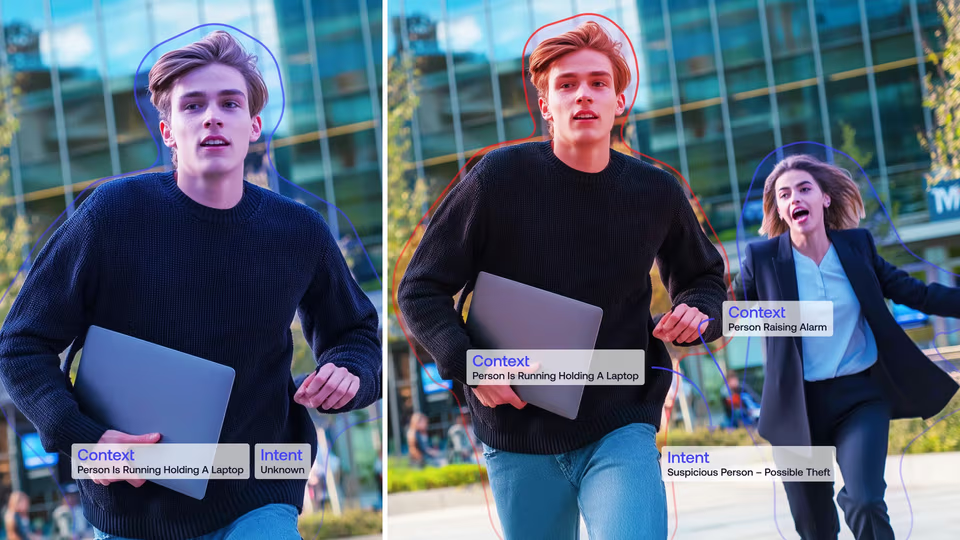
Vision-Language Models (VLMs) build on this foundation by adding contextual understanding. Where basic computer vision identifies objects, VLMs interpret meaning. They analyze the relationship between what's detected (a person, their behavior, the environment, and typical patterns for that location and time of day) to assess whether activity represents a genuine concern or routine behavior.
This contextual layer is what distinguishes a delivery driver carrying a package through a loading dock from someone carrying the same package out of a secure server room. Both scenarios involve the same object and movement, but context determines the appropriate response.
Detecting Precursors, Not Just Incidents
The greater value lies in recognizing behavioral precursors to violence rather than waiting for weapons or altercations to appear on screen. Patterns like loitering near secure entrances, individuals moving against the flow of a crowd, or escalating confrontations between people can signal developing situations before they become critical incidents. Early detection creates the intervention window that reactive systems miss entirely.
Real-Time Processing at the Edge
For threat detection to enable intervention, analysis must happen in real time. Edge-based processing, where AI analyzes video on dedicated appliances at or near the facility rather than sending footage to distant servers, delivers the speed required for meaningful response. When the system identifies a concern, it delivers alerts with visual context so operators can assess and act within seconds rather than discovering incidents after the fact.
Augmenting Human Judgment
Rather than replacing security personnel, this technology multiplies team effectiveness. AI can monitor every camera feed simultaneously with consistent attention, surfacing only the situations that warrant human judgment. Operators shift from the impossible task of watching dozens of screens to the focused work of evaluating validated alerts and coordinating response. The system handles scale; the team handles decisions.
Core AI Capabilities for Workplace Safety
Modern VLM-powered AI delivers 24/7 continuous monitoring across all cameras, detecting a broad spectrum of workplace safety concerns across several operational categories.
Signal Intelligence and Access Control
AI correlates access control signals with visual verification to detect unauthorized entry attempts. This includes identifying tailgating at secure doors, invalid badge attempts followed by forced entry, multiple invalid badge reads, and door forced open events. By linking access control data with camera footage, the system verifies whether alerts represent genuine security concerns or routine activity that can be cleared automatically.
Perimeter Control
For facilities with defined boundaries, AI monitors for breaches and suspicious activity. Detections include people or vehicles entering restricted perimeters, individuals between fence lines, loitering near entry points at various duration thresholds, and crowd formation. The system can distinguish between a delivery vehicle following normal routes and an unauthorized vehicle in a restricted zone.
Asset and Intellectual Property Protection
AI monitors for unauthorized removal of sensitive equipment or materials. Detections include people exiting secure areas with packages, laptops, computers, or bags, as well as people removing items from secured locations or interacting with protected assets.
Health and Safety
Workplace safety extends beyond security threats. AI detects falls and person-down scenarios that may indicate medical emergencies, enabling faster response when seconds matter. Additional detections include people running (which may signal distress) and unauthorized activity in restricted zones.
High Severity Threats
Immediate danger detections alert security teams to active threats: a person brandishing a firearm, individuals jumping fences or perimeter barriers, and person falling down events that require urgent response.
Step-by-Step Implementation Framework
Successful AI workplace safety deployment follows a structured approach that minimizes risk while maximizing adoption.
Phase 1: Assessment and Planning
Begin with a comprehensive security assessment of your current state:
- Audit existing infrastructure: Document current camera locations, VMS platforms, network architecture, and integration points
- Identify highest-risk areas: Map locations with the greatest safety concerns (entrances, parking facilities, high-traffic zones, and areas with historical incidents)
- Define success metrics: Establish baseline measurements for incident rates, response times, and investigation duration before deployment
- Assess organizational readiness: Evaluate security team capabilities, IT support availability, and stakeholder alignment
Phase 2: Pilot Deployment
Start with a controlled pilot to validate performance and refine workflows:
- Deploy in 2-3 highest-priority locations to test real-world performance
- Run parallel operations with existing security processes during the pilot period
- Gather feedback from security operators on alert quality and workflow integration
- Document false positive rates and tune detection thresholds for your environment
- Typical pilot duration: 30-60 days
Phase 3: Full Deployment
Scale based on pilot learnings:
- Expand to additional facilities following the prioritization established in the assessment
- Implement standardized workflows and response protocols across all locations
- Train security personnel on new capabilities and alert handling procedures
- Establish ongoing monitoring and optimization processes
Phase 4: Optimization
Continuously improve performance post-deployment:
- Review detection accuracy metrics monthly and adjust thresholds as needed
- Analyze incident data to identify coverage gaps or emerging threat patterns
- Update threat signatures and detection rules based on evolving security requirements
Vendor Evaluation Criteria
When evaluating AI workplace safety solutions, assess vendors against these critical factors:
Technical Capabilities:
- Type of AI technology utilized
- Detection accuracy and false positive rates in environments similar to yours
- Number and breadth of threats supported
- Integration compatibility with your existing cameras, VMS and access control systems
- Edge vs. cloud processing options and bandwidth requirements
Enterprise Readiness:
- SOC 2 certification and security compliance certifications
- Privacy-focused architecture that protects employee privacy
- Scalability to support your facility count and camera volume
- Customer references in your industry vertical
Implementation Support:
- Professional services for deployment and integration
- Training programs for security teams
- Ongoing customer success and technical support
- Product roadmap alignment with your security strategy
Key Questions to Ask:
- How do you handle bias mitigation and ensure consistent detection accuracy across diverse populations?
- What is the typical deployment timeline for organizations of our size?
- How does your solution integrate with our specific VMS platform?
- What ongoing tuning and optimization support do you provide?
Stakeholder Alignment and Internal Buy-In
Successful implementation requires alignment across multiple organizational stakeholders:
Security Leadership: Position AI as a force multiplier that enhances team effectiveness rather than a replacement. Emphasize how the technology handles routine monitoring so personnel can focus on response and judgment-intensive tasks.
IT and Infrastructure Teams: Address integration requirements, network bandwidth considerations, and data security implications early. Engage IT stakeholders in vendor evaluation to ensure technical compatibility.
Legal and Compliance: Involve legal counsel in privacy policy development, employee notification requirements, and regulatory compliance review before deployment.
Human Resources: Partner on employee communication strategies that build trust through transparency about monitoring scope, privacy protections, and data handling practices.
Executive Sponsors: Frame the business case around duty-of-care obligations, liability reduction, and operational efficiency gains to secure budget approval and organizational commitment.
Establishing Success Metrics and KPIs
Define clear metrics before deployment to demonstrate ROI and guide optimization:
Safety Impact Metrics:
- Incident reduction rate (workplace violence events, safety violations, security breaches)
- Time to intervention (from threat detection to security response)
- Incidents prevented through early intervention on behavioral precursors
Operational Efficiency Metrics:
- Alert volume and actionable alert ratio
- Investigation time reduction (baseline vs. post-deployment)
- Security operator productivity (incidents handled per shift)
System Performance Metrics:
- Detection accuracy by threat type
- False positive rate by location and time period
- System uptime and availability
Business Value Metrics:
- Insurance premium impact
- Workers' compensation claim trends
- Liability exposure reduction
Common Implementation Pitfalls to Avoid
Learn from organizations that have deployed AI workplace safety solutions:
Deploying Too Broadly Too Fast: Starting with full facility coverage often overwhelms security teams and generates alert fatigue. Begin with highest-priority locations, refine workflows, then scale.
Neglecting Change Management: Technology deployment without adequate training and communication leads to underutilization and resistance. Invest in security team enablement and ongoing support.
Setting Detection Thresholds Too Aggressively: Prioritizing sensitivity over precision generates excessive false positives that erode operator trust. Balance detection rates against operational burden.
Insufficient Stakeholder Alignment: Deploying without legal, HR, and IT alignment creates friction that delays or derails implementation. Engage all stakeholders early in the planning process.
Failing to Establish Baselines: Without pre-deployment metrics, demonstrating ROI becomes difficult. Document current state performance before implementation.
Underestimating Integration Complexity: VMS integrations, network configurations, and access control system connections require technical expertise. Ensure adequate IT resources and vendor support.
Navigating Privacy, Compliance, and Implementation Challenges
Balancing Security with Privacy
AI threat detection balances security with employee privacy through architectures that identify behaviors without collecting personally identifiable information. Systems focus on behavioral analysis rather than biometric identification. Leading solutions maintain SOC 2 certification to demonstrate enterprise-grade security controls and compliance standards.
Employee transparency builds trust. Facilities should communicate clearly about monitoring, privacy protections, and data collection. Engaging employees early in deployment planning reduces resistance.
Ensuring Detection Accuracy and Managing Bias
Bias mitigation requires ongoing monitoring to help ensure detection accuracy remains consistent across different demographic groups, lighting conditions, and environmental contexts. Security teams should establish validation protocols that test performance across diverse scenarios.
Ongoing monitoring and tuning strategies that adjust detection thresholds based on specific locations, times, and threat types optimize accuracy while balancing sensitivity against operational burden.
Security and Compliance Requirements
Data security requires encryption both in transit and at rest, access controls limiting who can view video and alerts, and retention policies defining how long video data remains stored.
Regulatory compliance spans workplace safety regulations, data protection laws, and industry-specific requirements that vary by jurisdiction and sector. Consult legal counsel before deployment.
Measuring AI Safety Program ROI
Measuring AI safety program ROI requires tracking metrics before and after implementation. Incident reduction rates provide direct safety impact measurement: workplace violence events, safety violations, and security breaches prevented. The investment pays off quickly: 86% of end users see ROI from video analytics within one year.
Response time improvements demonstrate efficiency gains from incident detection to response. Investigation acceleration provides another key metric; AI forensics with natural language search can reduce investigation times from days to minutes. Insurance benefits include premium reductions, fewer workers' compensation claims, and decreased liability exposure from demonstrable duty-of-care improvements.
Taking the Next Step
The future of AI for workplace safety points toward Agentic Physical Security; intelligent systems that don't just detect and alert, but understand context, reason about threats, and take autonomous action within defined parameters to protect people and facilities.
Ambient.ai is pioneering this evolution with its Ambient platform, purpose-built for enterprise workplace safety. With SOC 2 certified infrastructure, Privacy by Design architecture, VLM-powered threat detection with 150+ threat signatures, and trusted by leading enterprises, Ambient.ai helps security teams prevent incidents rather than just document them.
Request a demo to discover how Ambient.ai can transform your facility's safety posture.