AI Workplace Violence Prevention: Proactive Detection


It's not a people problem. It's a systems problem.
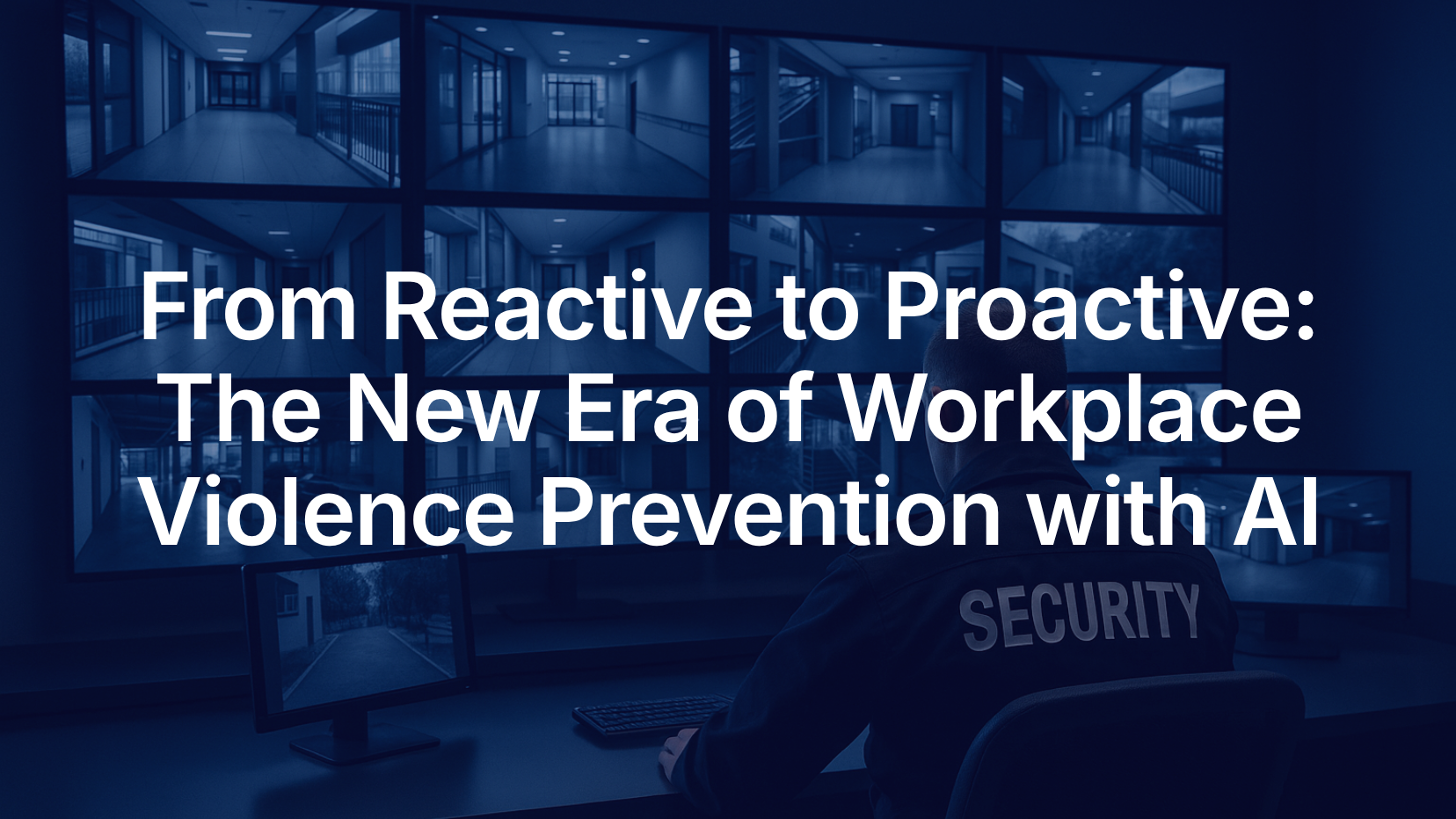
Workplace violence prevention demands identifying threats before they escalate. Your GSOC monitors hundreds of cameras, but operators can't watch every feed simultaneously. When incidents occur, your team reviews footage to understand what happened. That reactive gap costs lives.
Computer Vision Intelligence closes this gap by analyzing behavioral patterns across your camera network in real time and detecting precursor behaviors that signal violence before it erupts. Security teams get actionable warnings while intervention remains possible.
Key Takeaways
- Security teams can use AI video analytics to surface observable warning behaviors across existing camera networks
- Contextual analysis helps reduce false positives and gives operators verified visual evidence
- Human review and multidisciplinary threat management remain central to intervention decisions
- Organizations get the best results from AI within a broader prevention program that includes reporting, training, access control, and response planning
Why Traditional Monitoring Creates Dangerous Gaps
The fundamental problem with reactive security isn't a lack of technology: most enterprises have extensive camera networks already deployed. The problem is that traditional cameras and monitoring systems operate passively. They capture footage, but they don't understand what they're seeing.
Human operators face an impossible task: monitoring dozens or hundreds of video feeds simultaneously while maintaining the attention necessary to catch genuine threats. Notification fatigue compounds this challenge.
Traditional motion sensors and detection systems generate constant alerts, most of which represent normal activity misclassified as threats. Operators become desensitized and dismiss alerts that might signal genuine danger.
Preventing workplace violence requires detecting behavioral warning signs before incidents occur. Workplace violence planning commonly addresses threats such as:
- Physical assaults between employees
- Threatening behavior during terminations or disciplinary actions
- Domestic violence situations that spill into the workplace
- High-severity scenarios such as active shooters
- Stalking or harassment by former employees or external individuals
Precursor behaviors signal these threats while intervention remains possible. Aggressive confrontations between staff members, individuals loitering near executive offices or HR departments, unauthorized persons following employees through parking structures, repeated unauthorized access attempts at restricted entry points, and individuals exhibiting agitation during high-stress interactions all represent warning signs that traditional systems miss.
Traditional systems offer no way to identify these patterns automatically, operating in a fundamentally reactive mode and requiring human operators to monitor feeds or review footage only after incidents occur.
AI for Workplace Violence Prevention
Organizations should use AI for workplace violence prevention as one layer within a formal workplace violence prevention program, not as a substitute for policy, employee reporting, training, de-escalation, access control, or emergency response. Federal OSHA does not have a standard specific to workplace violence, but the General Duty Clause may create obligations for employers, and prevention-program guidance covers identifying and controlling recognized hazards.
OSHA's workplace violence prevention framework for healthcare and social service workers includes management commitment and employee participation, worksite analysis, hazard prevention and control, safety and health training, and recordkeeping and program evaluation. Security teams can use AI-generated alerts and incident evidence to support worksite analysis, hazard controls, and program evaluation, while organizational leaders remain responsible for the broader program.
The NIOSH violence typology has four categories:
- Criminal-intent incidents
- Client-on-worker violence
- Worker-on-worker violence
- Personal-relationship violence that enters the workplace
Each type creates different detection requirements. Cameras and access records may surface site probing, loitering, unauthorized entry, confrontations, or the return of a former employee, while grievances, threats, fixation, and other nonvisual warning signs depend on reports from employees, supervisors, family members, or other people.
Technology should therefore feed a multidisciplinary threat-management process. A Threat Management Team is central to the ASIS workplace violence standard, with video surveillance, access control records, intrusion detection, alarm monitoring, and emergency buttons serving as relevant physical-security and threat-assessment inputs. Security, HR, legal, employee assistance, and other specialists can combine those inputs, assess the circumstances, select interventions, and continue monitoring until they can close a case responsibly.
State requirements can add specific program and documentation obligations. California's workplace violence prevention requirements require covered employers to maintain a written, site-specific plan, record violent incidents, train workers, and preserve specified records.
Employers can use AI to organize time, location, video, and response information, but they must configure workflows around applicable legal, privacy, retention, and employee-access requirements.
How Real-Time Behavioral Analysis Identifies Threats
Computer Vision Intelligence turns passive cameras into active threat-detection systems through continuous behavioral analysis. Rather than simply recording video, these systems apply Vision-Language models that understand human behavior and environmental context.
The technical architecture operates through multiple processing stages. Neural networks extract features from video frames, identifying objects, people, and weapons in complex visual environments while maintaining temporal state information to analyze action sequences over time. This temporal analysis capability enables systems to recognize behavioral patterns: pacing, aggressive gestures, unusual gathering patterns, and escalation indicators that signal threats before weapons appear.
Processing occurs at the edge where cameras operate using dedicated servers, minimizing latency between detection and notification. This distributed architecture maintains rapid response times in operational environments, providing security teams with actionable intelligence while intervention opportunities remain open.
Behavioral analysis goes beyond identifying what's present to understanding how situations evolve. Systems distinguish between normal walking patterns and suspicious loitering. They differentiate routine vehicle parking from unauthorized stopping in restricted areas. They recognize concerning behaviors that deviate from baseline patterns for specific locations and times.
When an individual repeatedly returns to the same restricted area over multiple days, follows employees through parking structures, or exhibits escalating agitation during interactions with staff, these systems flag the behavioral sequence before physical violence occurs.
A structured warning-sign workflow helps teams distinguish camera-observable activity from behavior that requires human reporting. Under the CISA guidance, activities such as testing security, increasingly aggressive behavior, and other preparations may indicate movement toward targeted violence.
Correlation and escalation remain essential. In the underlying study, three-quarters of attackers exhibited concerning behaviors or communications beforehand. Security teams should combine visual alerts with access events, incident reports, HR information, witness observations, and other authorized records rather than treating any single behavior as proof that violence will occur.
Why Contextual Understanding Eliminates Notification Fatigue
The most significant operational advancement in modern threat detection isn't sensitivity; it's specificity. Systems that detect weapons or concerning behaviors without contextual understanding generate constant false positives that undermine GSOC effectiveness. Contextual understanding integrates three critical data dimensions that transform detection reliability:
- Spatial context analyzes location and relationships within the environment
- Temporal context examines the sequence and timing of events
- Behavioral context identifies patterns of actions over time
Spatial context analyzes location and relationships within the environment. A knife in a commercial kitchen represents normal activity, while the same knife in a lobby represents a potential threat. Security personnel carrying firearms represent authorized weapon presence, while the same weapon carried by unauthorized individuals represents a potential threat requiring immediate response.
Temporal context examines timing and sequence of events. Certain activities are routine during business hours but suspicious at night. Employees accessing facilities outside normal schedules may raise security concerns or be working late on urgent projects. An individual appearing in parking structures during multiple shift changes over several days exhibits different threat characteristics than someone parking once. Temporal analysis correlates activity with expected patterns for specific times, dramatically reducing false threat signatures.
Behavioral context identifies action patterns over time. An individual passing through an area once behaves differently than someone loitering for extended periods. Groups gathering near entrances during shift changes represent normal patterns. Similar gatherings at unusual times warrant attention. Contextual systems learn baseline behaviors for each specific environment, then identify meaningful deviations rather than flagging all activity as potentially concerning.
This multi-dimensional contextual integration reduces false positives that cause fatigue while improving detection of genuine threats with contextually inappropriate characteristics.
Delivering Verified Incidents with Visual Context
The architectural distinction between traditional detection systems and modern threat detection platforms lies in what reaches GSOC operators and how quickly they can act. Traditional systems send raw sensor triggers requiring manual investigation, with operators manually locating camera feeds and reviewing video, a process consuming several minutes per alert. Modern platforms deliver pre-verified threat intelligence with complete visual context.
The verification workflow operates between detection and notification. Computer Vision Intelligence algorithms continuously analyze video streams, identifying and classifying detected objects with confidence scores. Behavioral analysis evaluates actions and patterns. Contextual verification applies temporal and spatial context to validate threats. Only after this multi-stage verification does the system notify operators, delivering comprehensive intelligence packages rather than simple signals.
Operators receive complete threat assessments, including:
- Video clips showing the specific behavior that triggered detection
- Annotated frames with identified objects and threat indicators highlighted
- Structured metadata including threat classification and confidence scores
- Precise location data with facility map overlays
- Event timelines showing related activity from adjacent cameras
This context delivery transforms operator workflows. Instead of spending minutes locating camera feeds and reviewing video to determine whether alerts represent genuine threats, operators immediately see verified incidents with the visual evidence needed for rapid decision-making.
Human oversight remains essential. Computer Vision Intelligence handles routine verification and pattern recognition at machine speed, but operators maintain decision authority for response actions. This human-in-the-loop architecture balances automated efficiency with human judgment for contextual nuance, legal and policy compliance, ethical considerations, and accountability.
Define, assess, and document human-oversight processes under the NIST AI Risk Management Framework. For physical security operations, that means establishing operator authority, escalation thresholds, evidence-review procedures, audit records, and methods for identifying false positives and false negatives before automated outputs influence high-stakes decisions.
The Path Forward
The shift from reactive to proactive security operations isn't about replacing human judgment with automation. It's about providing security teams with the technological force multipliers necessary to identify threats before violence occurs. Real-time threat detection enables this transformation by analyzing behavioral patterns at scale, verifying threats through contextual understanding, and delivering actionable intelligence that supports rapid, informed decision-making.
A mature deployment connects detection to a documented prevention process. Organizations should define reporting channels, assign responsibility for threat assessment, train employees and operators, coordinate with access-control and emergency-response teams, and evaluate incidents for recurring hazards. Security teams can use AI to accelerate the first signal and organize relevant evidence, but prevention depends on people who can interpret context and select lawful, proportionate interventions.
Ambient.ai's Agentic Physical Security platform brings this capability to enterprise operations through a hybrid edge-cloud architecture with a Cloud SOC for remote monitoring, multi-site management, and analytics. The platform processes video from existing camera infrastructure, applying behavioral analysis powered by Ambient Intelligence to identify weapon-related threats and precursor behaviors.
The platform integrates with existing VMS deployments from Genetec, Milestone, and other enterprise systems, overlaying intelligence on current infrastructure rather than requiring replacement. Security teams receive alerts through their existing operational workflows, with verified incidents delivered directly to GSOC operators, along with the video evidence and structured metadata needed for immediate response coordination.
For physical security leaders evaluating real-time threat detection capabilities, Ambient Threat Detection provides the proven, enterprise-scale platform to transform operations from reactive incident response to proactive threat detection.
Frequently Asked Questions
How does Computer Vision Intelligence distinguish between legitimate activities and genuine threats in environments where potentially dangerous objects like knives or firearms are part of normal operations?
Spatial context analyzes location relationships to determine if objects belong in specific areas, while temporal context evaluates timing against expected patterns for shifts and zones, distinguishing authorized tool use from contextually inappropriate presence that warrants security response.
What steps should organizations take to integrate AI-based threat detection into an existing workplace violence prevention program that includes HR, legal, and threat management teams?
Organizations should establish protocols defining which AI alerts escalate to threat management teams, document decision authority at each stage, create audit trails for compliance, and train stakeholders on interpreting AI intelligence within existing workflows while maintaining privacy boundaries and legal protections.
What are the privacy and legal considerations organizations need to address before deploying AI video analytics for real-time behavioral monitoring of employees and visitors?
Organizations must establish data retention policies, employee notification requirements, and access restrictions complying with surveillance laws. Define permissible use cases, prohibit biometric identification where restricted, document AI decision authority under frameworks like NIST AI RMF, and ensure escalation protocols preserve due process rights.