What the New SIA + ALERRT Research on Doors Means for Every Access Control Program
.webp)

95% fewer false alarms. Zero changes to your infrastructure.
Last week, the Security Industry Association (SIA) and the Advanced Law Enforcement Rapid Response Training (ALERRT) Center at Texas State University published the results of a 25-year analysis of school-based active shooter incidents. The two headline findings deserve to be read together.
First, nearly 70% of successful perpetrator entries occurred through unsecured doors.
Second, casualty risk was three times higher when doors were unsecured during the incident.
The press framing has, understandably, been school safety. The underlying pattern is broader. It applies to every physical security program that depends on doors as a primary access control, which is to say, essentially every program.
The problem is not that doors are not secured. It is that they fail to stay secured. In the corporate environments our platform monitors, the average unsecured access-controlled door actually stays open 14.5 hours. In every building Ambient deploys into, the same pattern shows up. Doors that were secure at the start of a shift become unsecured during it. Three failure modes account for most of it.
The first is operational use. Doors get propped open during deliveries, vendor visits, large equipment moves, and any time an employee holds a door for a colleague. Each of these is operationally normal. Each opens a window of exposure that no badge log will record, because the door simply stayed open longer than expected. Door-Held-Open alarms exist in most access control systems but are routinely ignored or suppressed because the rate of operational false positives is high.
The second is hardware degradation. A bumped sensor that no longer reads the door state accurately. A worn strike that lets a door appear closed when it has not fully latched. A magnetic lock that has drifted out of alignment. A wireless lock with a dying battery. The Physical Access Control System (PACS) reports the door as secured because no alarm condition was tripped. The facility team sees nothing wrong because the door still closes. Until an entry occurs.
The third is the absence of continuous observation. Most Security Operations Centers (SOC) cannot dedicate human attention to every camera feed for door state on an ongoing basis. PACS systems do an excellent job of reporting badge events. They were never designed to assess door conditions in real time. The gap between the state the PACS reports and the state of the door in reality is the gap the new research has now quantified.
This is the gap Ambient Access Intelligence was built to close. Access Intelligence is the part of our agentic physical security platform purpose-built for access control operations. Its foundational capability, Alarm Auto Clearing, resolves over 95% of PACS false alarms by correlating each alarm against live video and clearing the operational noise before it ever reaches an operator.
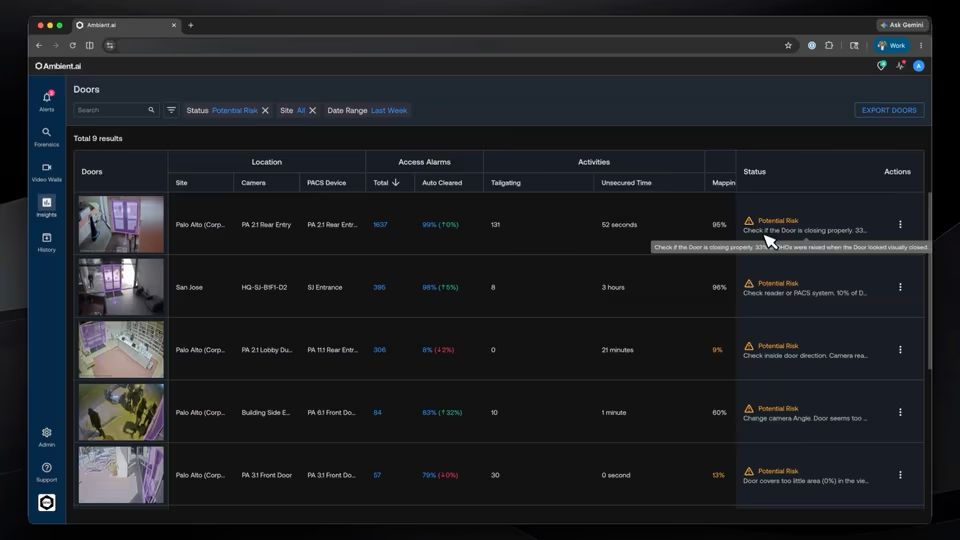
Last week we released the next chapter. Two new capabilities, Doors Unsecured and Doors with Issues, extend the platform from clearing reactive alarms to surfacing the conditions that create incidents in the first place.
Doors Unsecured is a continuous verification layer. It tracks every door that has not returned a door-restored signal to the PACS and surfaces the unsecured doors across every connected site in a single real-time view. Before this capability, the 14.5-hour average duration of an unsecured-door event was invisible to the security team. Now it is a live operating picture.
Doors with Issues applies AI-driven visual analysis to the access control infrastructure itself. It identifies door and alarm behavior anomalies (noisy alarms, duplicate alerts, false patterns), camera health problems (degraded feeds, blurry images), and camera-to-reader mapping issues (coverage gaps, orientation problems). These are the silent hardware failures that legacy detection tools cannot catch because no threshold has tripped.
For schools, this matters because the new research has named the specific operational gap that costs lives. For every other enterprise, the same gap exists. The cost shows up differently: breach incidents, theft, insider events, and the slow erosion of confidence in the access control program itself.
The SIA and ALERRT study did the field a service by putting a number on what every security operator already knew. The technology to close the gap exists. The next move belongs to the operators and the programs that fund them.
Read the full SIA + ALERRT study: https://alerrtresearch.org/resources/reports/report_2026_sia_locked_doors.pdf
Read more about the latest release of Ambient Access Intelligence: https://www.ambient.ai/blog/ambient-access-intelligence-doors-with-issues-doors-unsecured

Key Takeaways
Nearly 70% of successful active shooter entries into schools occurred through unsecured doors, and casualty risk was three times higher when doors were unsecured during the incident, according to a 25-year analysis published by the Security Industry Association (SIA) and the ALERRT Center at Texas State University.
The average enterprise access-controlled door stays unsecured for 14.5 hours when it fails to re-secure. A gap created by three failure modes: operational use (propped doors during deliveries and tailgating), hardware degradation (worn strikes, drifted maglocks, dying wireless lock batteries), and the absence of continuous visual verification of door state.
Ambient Access Intelligence closes this gap with three layers: Alarm Auto Clear (which resolves over 95% of PACS false alarms by correlating each alert against live video), Doors Unsecured (a continuous verification layer that surfaces every door without a restored signal across all connected sites), and Doors with Issues (AI-driven detection of door, alarm, and camera-health anomalies that legacy threshold-based monitoring misses).