What's New in Ambient Access Intelligence: From Alarm Reduction to Agentic Access Control


95% fewer false alarms. Zero changes to your infrastructure.
Today we are releasing the next chapter of Ambient Access Intelligence, the part of our agentic physical security platform purpose-built for access control operations. The first chapter took on the most visible problem in the category: the relentless volume of false alarms that consumes operator time, drives unnecessary dispatches, and erodes confidence in the system itself. That work continues, and the impact compounds as more enterprises deploy it. But solving the false alarm problem is the beginning of the story, not the end of it. The harder and more valuable question is what happens when the system stops treating every signal as work to be triaged and starts deciding which events deserve a response at all.
That is the arc this release advances. Alarm Auto Clearing remains the foundation, the layer that eliminates the work that should never have entered the operator queue in the first place. The two new capabilities we are introducing today, Doors with Issues and Doors Unsecured, extend that foundation into prevention and verification. Together they move access control beyond reacting faster to a different operating model entirely, one that eliminates the work that should not exist, prevents the events that should not happen, and focuses operator attention on what actually matters.
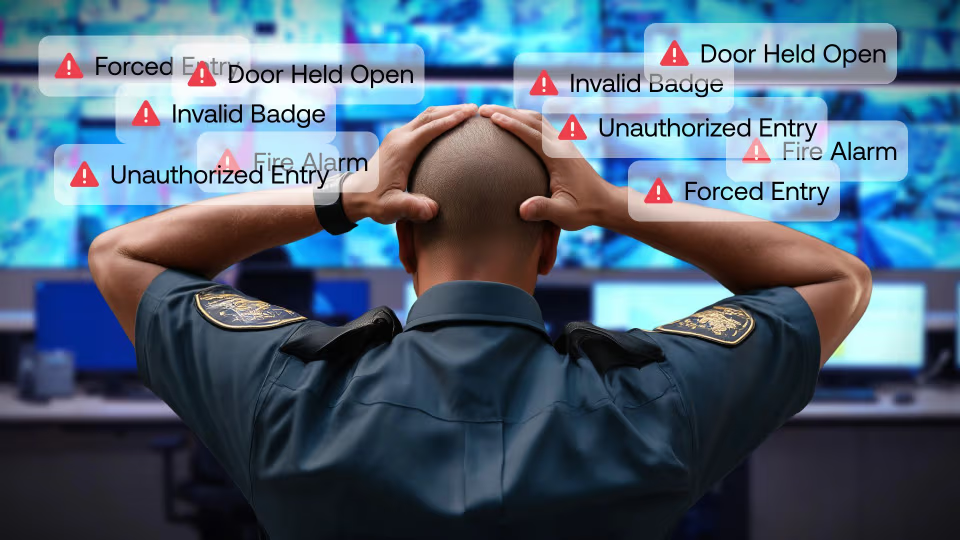
To understand why that progression matters, it helps to start where most conversations about physical access control still begin: false alarms. Large enterprises with mature PACS deployments can generate millions of Door Forced Open and Door Held Open events annually, thousands per day across a single campus. Each one triggers a workflow in which an operator pulls up the video, evaluates the context, and either dispatches a response or clears it as a false positive. In the overwhelming majority of cases it is the latter, and the math eventually breaks down.
That is the problem Ambient Access Intelligence was built to solve, and it remains the most important problem in access control operations. Ambient Access Intelligence addresses it at the source: every PACS alarm is correlated with live video in real time by our PACS Correlation Engine, which evaluates what actually happened at the door before the event ever reaches an operator. Common false positives, a person exiting, someone interacting with the inside of a door, a door that restored itself, are resolved automatically. Only verified incidents surface for review, as named Ambient alerts with a GIF preview, live video feed, and floor plan context already attached. The result: 95%+ of alarms cleared without human intervention. At ServiceNow, that translated to 240,000+ alarms processed, 94% auto-cleared, and more than $500K in avoided costs.
The framing behind those numbers matters as much as the numbers themselves. Alarm Auto Clearing is not faster handling yesterday's workflow. It is the systematic removal of events that should never have entered the queue in the first place, so that every auto-cleared alarm becomes a dispatch avoided, a patrol minute recovered, and an operator decision that never had to be made. As those events stop reaching the operator at all, the operational savings compound and the team is freed to focus on the smaller set of incidents that genuinely warrant a response.
Alarm Auto Clearing is the core of what Ambient Access Intelligence does, and it is where the most immediate, measurable impact lands. But two gaps remain that alarm management alone does not close:
- 14.5 hours per week is the average time that unsecured access-controlled doors actually remain open in corporate environments. Why? Because acknowledging and clearing an alarm in the system is not the same as someone closing the door.
- 34% of access points on a typical enterprise campus have underlying infrastructure problems that generate chronic alarm noise.
Today, we are completing that picture with two new capabilities in Agentic Access Control: Doors Unsecured and Doors with Issues.
Why PACS Alarms Keep Coming Back: The Infrastructure Problem Security Teams Can't See
Alarm reduction solves the volume problem. But two questions sit behind it that no access control tool has fully answered until now.
The first: what does actually physically happen with an unsecured door after an operator clears an alarm? Unsecured access-controlled doors (after the alarm goes off) stay physically open an average of 14.5 hours per week. That is because a door can trigger an alarm, have that alarm cleared by an operator, and still be standing open because no one was physically dispatched to close it. The PACS records alarm state, not physical state. Clearing the alert does not close the door.
The second: why do the same doors keep generating noise? 34% of access points on a typical enterprise campus have infrastructure problems quietly driving chronic PACS alarm noise. Doors generating repeated or consecutive DFO or DHO alarms with no person present. Duplicate or runaway alarms from the same reader. DFO alarms consistently caused by a person exiting rather than forcing entry. These are not security events. They are maintenance failures. Without AI-driven visual analysis, there is no reliable way to find them, diagnose them, or prioritize the work to fix them.
Both are invisible in a traditional access control environment, not because the data does not exist, but because no system has been reasoning over it continuously, at scale, and surfacing what matters. The two new capabilities introduced today are built to change that.
Doors Unsecured: The Verification Layer for Agentic Access Control
Doors Unsecured is the verification layer that closes the loop between alarm clearance and physical reality. In an agentic operating model, every autonomous decision needs a verified ground truth. A cleared alarm tells you the system has been acknowledged. It does not tell you the door is closed. Doors Unsecured replaces that assumption with continuous physical state monitoring, and gives SOC operators and security managers the perimeter picture they need to operate at the system level rather than the incident level.
In an agentic operating model, every autonomous decision needs a verified ground truth.
The stakes of that gap are not only operational. New research from the Security Industry Association and the ALERRT Center at Texas State University puts a number on them. Their 25-year analysis of active shooter incidents found that nearly 70% of successful entries by perpetrators went through unsecured doors. Casualty risk was three times higher when a door was unsecured during the incident. The research is framed around schools, but the pattern holds for any program that relies on doors as a primary access control. The problem is rarely that a door was never secured. It is that it failed to stay secured. That is the gap Doors Unsecured was built to close. We covered what these findings mean for enterprise access control in a companion analysis.
The capability listens for the door-restored signal from the PACS, the signal that confirms physical closure rather than just alarm clearance, and surfaces every door that has not returned that signal. The result is a live video wall scoped to access operations: a real-time feed of every unsecured door across all connected sites, continuously updated and available to the full team.
The operational difference is significant. In a traditional environment, when multiple doors are open simultaneously, each one generates its own incident, dispatching individual responses with no awareness of each other. Operators are chasing events in isolation. Doors Unsecured changes the model entirely. Security managers can see the full perimeter picture at once, consolidating what might have been ten separate dispatches into a single coordinated sweep.
It also closes a gap that most organizations do not know they have. The assumption that a cleared alarm means a secured door is built into the workflow. It is how the system has always worked. But it is an assumption, not a confirmation, and Doors Unsecured replaces it with a verified signal.
Doors with Issues: From Reactive Alarm Handling to Preventive Posture
Doors with Issues is the capability that shifts access control from reactive alarm handling to preventive posture. Every alarm that never fires again is a workflow that disappears. The same broken hardware that drives chronic noise today is the same hardware your team will spend the next month responding to, unless you find it, fix it, and remove the alarm pattern at its root. This is process elimination, applied to access control infrastructure.
Every alarm that never fires again is a workflow that disappears.
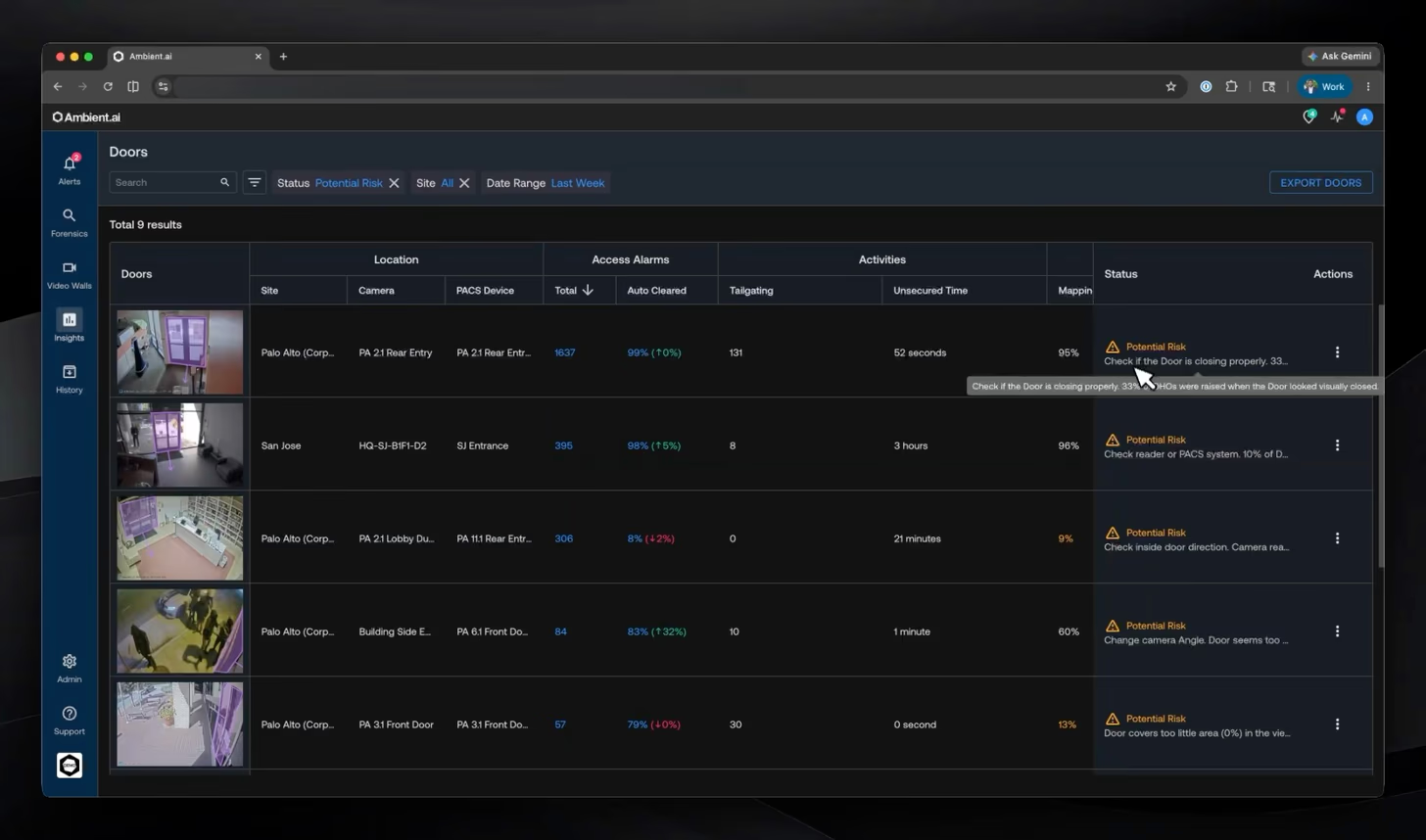
Doors with Issues applies AI-driven visual analysis across every access point in the environment and surfaces a continuously updated, prioritized list of doors with underlying infrastructure problems, each one categorized, diagnosed, and backed by the visual evidence that produced the finding.
The diagnosis covers three categories:
| CATEGORY | EXAMPLES |
|---|---|
| Door & Alarm Behavior | Door visually closed but registering as unsecured during a DHO event Noisy consecutive DHO alarms from the same door Duplicate or runaway DHO alarms DFO alarms consistently caused by a person exiting rather than forcing entry Duplicate or runaway DFO alarms |
| Camera Health | Camera feed unhealthy for an extended period Camera image degraded or blurry Camera field of view too wide or too narrow to meaningfully evaluate alarms at the door |
| Camera-Reader Mapping | Low camera-to-reader match score, indicating the camera may not be covering the right access point Entry direction mapping appears flipped relative to actual door orientation Door coverage area outside expected bounds, too small or too large for reliable analysis Door angle too narrow for adequate visual coverage |
The output is designed to be acted on, not just reviewed. Every issue comes with a specific door, a diagnosed root cause, and supporting visual evidence, ready to route as a maintenance ticket or hand directly to a facilities team. No more monthly manual assessments that cover a fraction of the campus and leave the rest to guesswork. No more knowing there is a problem somewhere without being able to say where, what, or why.
Three Capabilities, One Operating Model: How Alarm Auto Clearing, Doors with Issues, and Doors Unsecured Work Together
Alarm Auto Clearing removes the work that should not exist. Doors Unsecured verifies the physical state that actually matters. Doors with Issues prevents the events that should not happen. Each one solves a distinct layer of the access control problem. Together they give security teams something no combination of legacy PACS solutions has ever provided: complete command of the access control environment, covering what is alarming, why it is alarming, and what is actually happening at the door.
This is what Agentic Physical Security looks like in practice for access control. Not a dashboard that reflects what the PACS already knows, but a reasoning layer that sees what the PACS cannot.
The Metrics That Matter Are Changing
Alarm volume and alarms cleared are necessary but not sufficient. The capabilities introduced today produce a new set of operational metrics that map directly to budget and risk:
| METRIC | WHAT IT MEASURES |
|---|---|
| Dispatches avoided | Verified events that would have triggered a guard response, but did not need to. |
| Patrol minutes recovered | Operator and field-team time returned to higher-value work. |
| MTTA and MTTR on verified threats | Response speed on the events that actually matter. |
| Infrastructure issues resolved | Doors fixed at the root cause, removing repeat alarm patterns permanently. |
| Doors physically secured | Percentage of access points returning the door-restored signal within target thresholds. |
| Early interventions | Suspected unauthorized entry surfaced and addressed in real time, not reconstructed after the fact. |
These are the metrics where AI transforms access control from an operational burden into a ROI budget conversation finance can approve.
Is Ambient Access Intelligence Right for Your Enterprise Security Program?
If your team is spending meaningful time clearing false alarms, Alarm Auto Clearing handles that before events ever reach an operator. If you have ever cleared an alarm and wondered whether the door was actually secure, Doors Unsecured answers that question continuously, across every site. If you suspect infrastructure issues are driving chronic alarm noise but cannot prove it, Doors with Issues surfaces exactly which doors, diagnosed with evidence and ready to route to maintenance.
Ambient Access Intelligence integrates with the PACS systems you already have: LenelS2, Honeywell Pro-Watch, Genetec, Milestone, Allegion, Software House C-CURE 9000, Avigilon, Brivo, Kastle, Genea, and others. No rip-and-replace. Agentic capabilities layered on top of existing infrastructure, operational from day one.
This Is the Beginning, Not the End
We are not making your access control faster. We are rethinking what you should respond to.
We are driving the shift for access control from a reactive workflow into the first layer of an agentic operating model: detection, decision, and verified action, with the human always in the loop where it counts.
What comes next is preventive signatures, guard-force augmentation, and response orchestration across the broader security stack. That future-state operating model only works if the foundation is in place. The capabilities released today are that foundation. To learn more or request a demo, contact us.