10 Features to Consider in Weapons Detection Systems for Schools
.webp)

90%+ alerts resolved in under a minute. See how.
School security leaders face a paradox. Districts invest heavily in security infrastructure, yet violent incidents continue to increase year over year. Research shows that schools with armed guards experienced higher rates of deaths during violent incidents. Meanwhile, false reports and swatting attempts have decreased, but the fundamental challenge remains: how do you detect threats before violence begins?
This reality has pushed districts toward gun detection systems that identify warning signs before weapons appear. The challenge? Vendors may make similar claims about speed and accuracy, making it hard to understand real capabilities. These ten features cut through the noise and help you evaluate what actually matters.
1. Does It Detect Danger Before Guns Appear?
Platforms analyzing behavioral precursors save lives. Platforms detecting only drawn weapons respond to violence already underway. Someone loitering near exits for 20 minutes, a person in a mask checking where your cameras can't see, students suddenly running in panic, doors propped open when they shouldn't be. These behavioral precursors happen minutes before violence, giving you time to intervene. That's when you can lock doors, alert staff, and call police while there's still time to stop what's coming.
Behavioral intelligence separates advanced security incident detection from simple object recognition. A maintenance worker isn't a threat. A masked person scouting blind spots is. Systems that analyze only motion triggers or perform only basic object recognition flood you with false alarms until your staff stops believing the alerts. Understanding context and intent, not just identifying objects in a frame, makes the difference between prevention and reaction.
2. How Do They Stop False Alarms From Destroying Trust?
Every unnecessary lockdown erodes what you've built. Staff stops believing alerts. Parents question your judgment. Students lose learning time. After enough false alarms, your team starts ignoring the system entirely, defeating the entire purpose of your investment.
Most platforms trigger on anything that might possibly look concerning. Your staff learns to dismiss alerts because most are false. Advanced platforms verify threats before alerting you, whether through human analysts reviewing footage or multi-stage AI verification that filters out false positives before anyone gets notified. This verification layer preserves trust in your security protocols.
Districts need systems that understand the difference between a student's cellphone case and an actual weapon, between a teacher's laptop and a concerning object. Without this intelligence built into the platform, you're training your team to treat every alert as noise.
3. Can It Work With What You Already Have?
You've spent years building your camera infrastructure, with hundreds of cameras at thousands of dollars each. A solution that demands you replace everything isn't selling better security; they're selling new hardware.
Software-based platforms add intelligence to your existing system, connecting to your current Video Management System, door locks, and mass notification tools. When a real threat appears, everything responds together: doors lock, lights activate, and alerts go out. No operator frantically switching between separate systems while seconds tick away.
Hardware replacement also means deployment delays. Software-based platforms can be operational within weeks, not months. Your district gets protection faster without the budget impact of an infrastructure overhaul.
4. What Are the Privacy Practices?
The moment a parent asks, "Is this system watching my child?" you need a real answer. Written guarantees backed by policy documentation.
Does it use facial recognition? Does it capture personally identifiable information? Where is data stored? How long is it kept? Who can access it? What happens when a parent demands their child's data be deleted?
You need answers that satisfy FERPA requirements and concerned parents. Systems analyzing behavioral patterns without identifying individuals maintain compliance while detecting threats. Someone is loitering; the system doesn't know or care who. That stays compliant while protecting students.
Also, systems that process video on your own servers give you control. Parents see you're protecting privacy. Your bandwidth doesn't get crushed uploading video. And when parents or board members ask tough questions, you have answers.
5. Does It Actually Respond, or Just Alert?
Manual response introduces deadly delays. An operator sees an alert, decides it's real, then manually locks doors, activates lights, and sends notifications through three different systems. Two minutes gone. Maybe three.
Automated response happens in seconds. The system detects a confirmed threat and executes your predetermined plan: locks doors in that zone, triggers strobes, sends location-specific instructions to staff, and opens video feeds directly to 911.
Your team isn't frantically clicking through interfaces while the situation escalates. The system responds instantly while your people focus on protecting students. This distinction between alerting and responding determines whether you're giving staff seconds or minutes to act.
6. Does It Only Detect Guns, or Actually Help You Daily?
You didn't get into school security just to prevent mass shootings. Your team responds to fights every week. Think of situations like students who slip and fall, people wandering in buildings after hours and environmental hazards.
A platform focused solely on firearms gives you one expensive tool you hope to never use while your daily problems remain unsolved. Systems detecting multiple threat types (fights, medical emergencies, unauthorized access, safety hazards) justify their cost every day. One platform. One interface. It offers real ROI from preventing the incidents you actually face, not just worst-case scenarios.
Ambient.ai, for instance, offers comprehensive verified threat libraries that enable proactive safety management rather than reactive crisis response. To validate this fact with the vendor, ask what else the system detects beyond firearms. If the answer is "nothing," keep in mind that there's more intelligence you can get from this investment.
7. Where Does It Process Video, and Why Should You Care?
Systems that only work in the cloud tend to be unreliable in their data analysis, because they subsample to avoid incurring in costly bandwidth. Systems that only work on-premises require constant maintenance visits and manual updates.
The best platforms give you a hybrid architecture that leverages the best of both worlds . Process video on-premises to prioritize privacy and offline functionality. Use cloud processing for management and automatic updates.
Your network, privacy requirements, and internet reliability should dictate deployment, not vendor limitations. This flexibility matters when weather knocks out connectivity or when board policies restrict cloud data storage.
8. Can It Grow With Your Budget Reality?
Security funding arrives in waves. You get a budget for one high school this year, maybe middle schools next year if the levy passes. The year after that? Who knows.
Software licensing should expand as your funding arrives, not require contract renegotiations every time you add a building. Vendors price per camera, per building, or per student. These create wildly different costs when you're covering five buildings versus fifty.
9. Is It Actually Fast Enough and Accurate Enough?
Platforms should detect and alert under seconds. But speed is worthless if alerts constantly fire for non-threats.
Vendors will show you impressive-sounding accuracy rates. Accurate in what conditions? Their clean lab, or your crowded cafeteria? Their well-lit demo room, or your dark parking structure?
Request false positive rates validated by third-party testing, not internal claims. Then pilot in your actual environment. Your cafeteria during lunch. Your parking lot at night. Your outdoor facilities with changing weather and light. Conditions matter more than lab specifications.
10. What Does This Actually Cost You?
Equipment pricing is where evaluation starts, not ends. Build a complete multi-year model:
- Subscription or licensing fees
- Analyst verification services
- Staff training programs
- Integration consulting
- Camera upgrades or replacements
- Annual support and renewals
Some vendors bundle everything into monthly fees. Others separate charges for each component. Total cost per protected student across your timeline is the only fair comparison.
Calculate ROI from implementing an AI layer in your security program. Every eliminated false lockdown saves overtime costs and learning time. That means real money returning to your budget.
Prevent Gun Incidents Before They Escalate
Your evaluation comes down to one question: Does this give you time to prevent violence, or just notify you when it's happening?
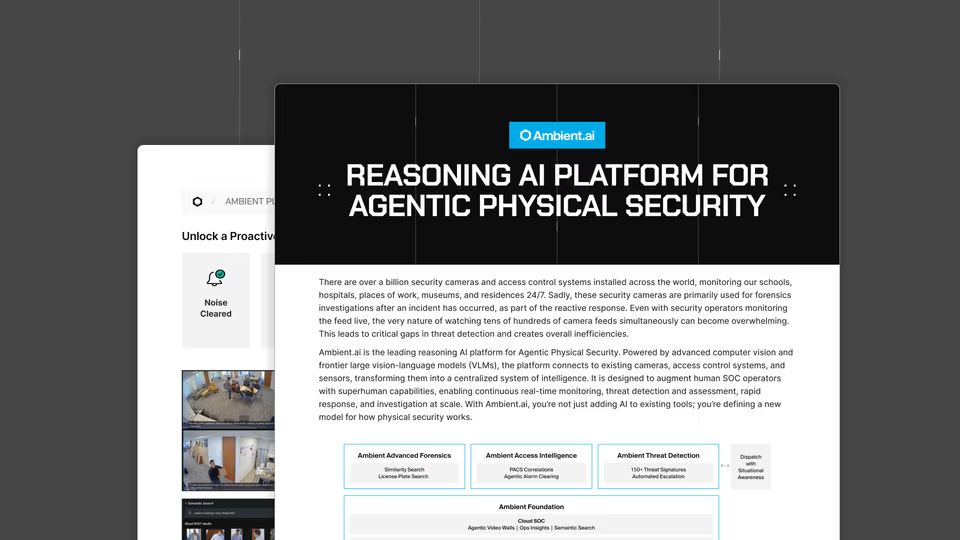
Ambient.ai helps campuses leverage Agentic Physical Security, powered by Ambient Intelligence using frontier Vision-Language Models. The technology analyzes behavioral threat signatures, including loitering, crowd surges, door propping, and weapons brandishing, to detect incidents before violence escalates. This gives teams minutes to intervene rather than seconds to react.
Ambient Threat Detection processes video in real time, understanding behavior through contextual reasoning rather than simple object detection for security incident detection. The platform differentiates a teacher with keys from an intruder propping doors, enabling districts to respond 10x faster.
Ambient Access Intelligence connects PACS data with live camera feeds, reducing false alarms from access control systems by over 95% and returning hundreds of operator hours to proactive monitoring.
Ambient Advanced Forensics enables 20x faster investigations using natural language search.
The platform integrates with existing IP cameras and access control without hardware replacement. When threats are confirmed, doors can be lock automatically, and video is sent to security teams and first responders simultaneously. Privacy stays FERPA-compliant without facial recognition.
Trusted by Fortune 100 companies to protect campuses, data centers, and critical infrastructure, Ambient.ai transforms passive camera infrastructure into an early-warning network that detects intent before weapons appear. Book a demo to learn more.