Access Control as a Service: What It Is and How It Works
ACaaS moves access control management to the cloud while keeping door decisions local. Learn how it works, what breaks offline, and how to evaluate providers.
Access control as a service (ACaaS) applies the software-as-a-service delivery model to physical access control. For facilities managers and security directors responsible for multi-site operations, the shift matters because it changes how access control systems are administered, supported, and evaluated.
Key Takeaways
- ACaaS moves system administration into the cloud while keeping critical door functions dependent on local field hardware.
- The operational value of ACaaS depends heavily on how well the system continues to function during connectivity disruptions.
- Reader, controller, and integration choices still shape security outcomes even when management moves off-site.
- A strong provider evaluation focuses on resilience, interoperability, data ownership, and contract terms before deployment.
How ACaaS Architecture Differs from On-Premise PACS
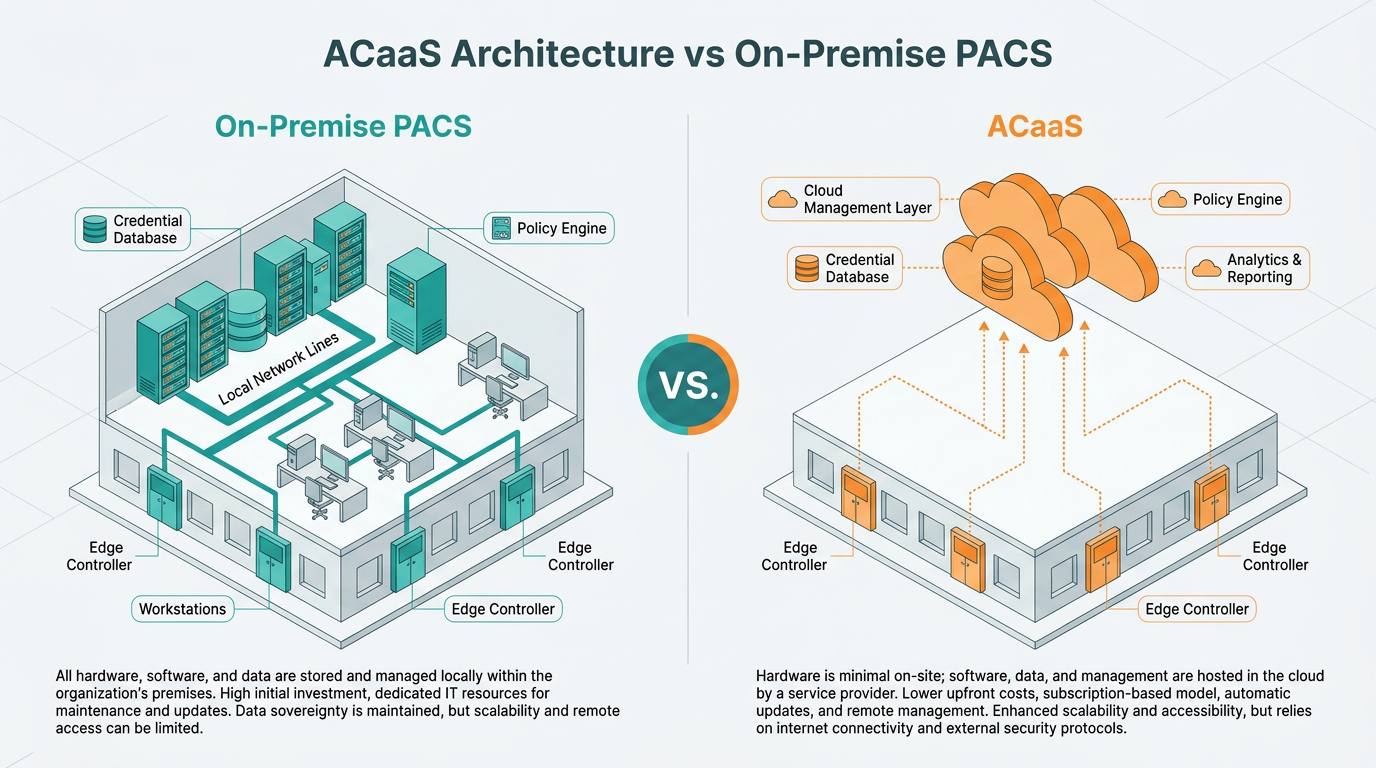
Traditional on-premise physical access control systems (PACS) rely primarily on on-premises infrastructure. Access control software, credential databases, policy rules, and audit logs reside on servers physically located on the organization's internal network. Administrators manage the system through client software running on workstations connected to that local server environment.
That server stack carries a direct cost burden: dedicated hardware for the application, a separate database server, and additional servers for redundancy or high availability, each with a replacement cycle.
ACaaS relocates the management layer. The credential database of record, the policy and rule engine, audit logs, reporting, and the administrative interface all move to cloud-hosted data centers. Administrators access the system through a browser or mobile application from any internet-connected device rather than a workstation tethered to the local network.
The Edge Layer and Why It Matters
ACaaS does not eliminate local hardware intelligence. Door controllers at the edge retain a cached copy of access rules and credentials sufficient to make door-open or door-deny decisions autonomously.
Physical door hardware also remains necessary in every deployment model. Controllers, readers, electric strikes, magnetic locks, request-to-exit devices, door position sensors, and wiring are all required at the physical layer. The cloud removes the server room, not the field hardware.
True ACaaS Versus Hosted Access Control
Relocating an on-premise server to a third-party data center is not the same as ACaaS. That distinction is operationally significant. A lift-and-shift migration retains software maintenance burdens that still resemble on-premise operations: manual patching, database administration, and version upgrades remain with the customer. True ACaaS uses a cloud-native model in which the provider manages the software lifecycle and pushes updates across the platform.
Deployment models exist along a spectrum from traditional on-premise through hybrid cloud-managed to fully cloud-native. Hybrid on-premise designs with a cloud overlay added to an existing PACS can add complexity and create security challenges at integration points.
The Access Event Sequence from Credential to Door
A single access event in a cloud-managed ACaaS deployment follows a straightforward sequence.
A user presents a credential to a reader at the door. That credential can be a card, fob, or mobile device using BLE, NFC, or a digital wallet. The reader passes credential data to the local edge controller. In OSDP-equipped installations, this communication is bidirectional and encrypted. Legacy installations using Wiegand send the data one-way and unencrypted.
The edge controller checks its locally cached access rules and credential list. If the credential is valid for that door at that time, the controller triggers the door strike or lock. The access event then synchronizes to the cloud management platform.
Administrators add or remove users, change access levels, generate reports, and receive alerts through the cloud-hosted interface. The platform pushes changes down to edge controllers, updating the locally cached rules.
WAN latency is a challenge for cloud-hosted PACS, which is why local processing remains operationally important.
What Happens When Cloud Connectivity Drops
Offline behavior separates ACaaS from pure cloud applications where a connectivity loss means a full service interruption. Because edge controllers hold cached credentials and schedules, several functions continue during an internet outage. Existing credentials continue granting or denying access. Door schedules keep executing. Event logs accumulate locally and synchronize to the cloud when connectivity returns.
Other capabilities pause until the link is restored. Provisioning a new credential requires cloud synchronization to reach the edge, and credential revocation cannot propagate to controllers without connectivity. Remote lock and unlock commands also depend on the cloud connection.
The Credential Revocation Gap
The inability to push credential revocations during an outage is a defined operational risk. Federal PACS guidance addresses offline certificate validation and manual-loaded revocation procedures. Enterprise security teams operating in regulated environments should maintain a written procedure for manual revocation during extended outages.
Fail-safe versus fail-secure configuration also becomes relevant during outages. Fail-safe defaults doors to unlocked for life safety compliance. Fail-secure defaults doors to locked for security. This is a hardware configuration decision made at installation time, not a cloud platform setting.
Credential Provisioning and Lifecycle Management
In traditional on-premise deployments, IT teams input credentials separately into both the identity management system and the access control system. ACaaS reduces that parallel data entry through integrations and centralized administration.
The operational impact scales with organization size. Automated credential provisioning and access level assignment becomes material for organizations managing large cardholder populations across campuses or distributed locations.
Temporary and contractor credential management is a common use case associated with cloud access control adoption, alongside visitor management workflows.
Integrated visitor management can materially change how organizations evaluate overall access control effectiveness, especially where manual credential tracking is still common.
OSDP as the Reader-to-Controller Security Standard
Legacy Wiegand protocol transmits credential data from readers to controllers in one direction, unencrypted and unsupervised. The Open Supervised Device Protocol (OSDP) is a newer access-control communications standard that provides bidirectional, encrypted, supervised communication.
OSDP and ONVIF operate at different architectural layers, a distinction that matters for procurement. OSDP governs the edge layer between readers and control panels. ONVIF profiles govern the network layer between access control systems and video management or network-based security management platforms. No single standard covers the full stack from reader to cloud.
Many OSDP implementations reuse the same physical wiring format as legacy Wiegand. Existing conduit infrastructure may be reusable, but the wire itself must meet RS-485 data communication specifications.
Evaluating an ACaaS Provider
Offline Behavior and Operational Resilience
Offline capability is frequently underweighted in initial evaluations. Require explicit, contractually documented answers: do on-site controllers continue to grant and deny access based on cached credentials when internet connectivity is interrupted? For how long? What is the cache update frequency under normal operation? Recovery time objectives and recovery point objectives must be contractually defined, not stated informally.
Open Architecture and Hardware Lock-In
Proprietary lock-in is a primary procurement risk. Proprietary platforms can limit interoperability and portability. Verify that the provider's platform supports OSDP-certified hardware from multiple manufacturers, not only hardware the vendor sells. Require documentation of published, versioned APIs for integration with identity providers, video systems, and HR platforms.
Data Portability and Contract Terms
All access event logs, credential records, and audit data should be contractually owned by the customer. Data must be exportable in structured, machine-readable formats. Proprietary export formats that require the vendor's software to interpret are functionally equivalent to no export capability. Specify a complete data export window in the contract following termination.
Total Cost of Ownership
ACaaS typically shifts physical security spending from capital expenditure toward operating expenditure. That shift affects which departmental budget owns the cost, which approval process applies, and how the investment is reported. A multi-year comparison horizon is appropriate given hardware refresh cycles. At higher door counts, per-door monthly subscription fees can become material relative to the amortized cost of on-premise infrastructure within the comparison period.
The break-even point varies by deployment scale, and calculating it at the organization's specific door and user counts is a prerequisite to an informed decision.
Choosing for Reliability
ACaaS centralizes administration in the cloud while leaving critical access decisions dependent on local controllers, hardware choices, and outage procedures. Provider evaluation should focus on offline continuity, hardware interoperability, data portability, and clear responsibility boundaries before deployment begins.
The strongest deployments pair cloud-managed administration with edge resilience and open hardware standards, then layer contextual awareness onto access events so that credential activity is interpreted alongside the behavior surrounding each door. That combination is what turns access control from a transactional system into a decision-support layer for the security program.
Frequently Asked Questions
What happens to access control when the internet goes down with an ACaaS system, and how long can edge controllers operate offline?
Offline duration depends on controller memory and credential database size. Modern edge controllers operate autonomously for weeks or months until memory fills. Battery backup can provide anywhere from minutes to multiple days during outages, depending on system size and load.
What is the difference between true ACaaS and hosted access control, and why does it matter for long-term maintenance costs?
True ACaaS uses cloud-native architecture where the provider manages software updates, patches, and upgrades automatically. Hosted access control relocates your server to a data center, changing the operational cost profile compared with vendor-managed ACaaS offerings.
How do you calculate the total cost of ownership break-even point between ACaaS and on-premise access control systems?
Compare upfront hardware, server, and licensing costs against ACaaS subscription fees over contract length. Include refresh cycles, maintenance, IT labor, and power costs. Calculate at your door count and user volume to identify the crossover year.
