Physical Access Control: What It Is and How It Works
Learn how physical access control systems work, from credentials and readers to controllers and protocols, plus what's changing in 2026.
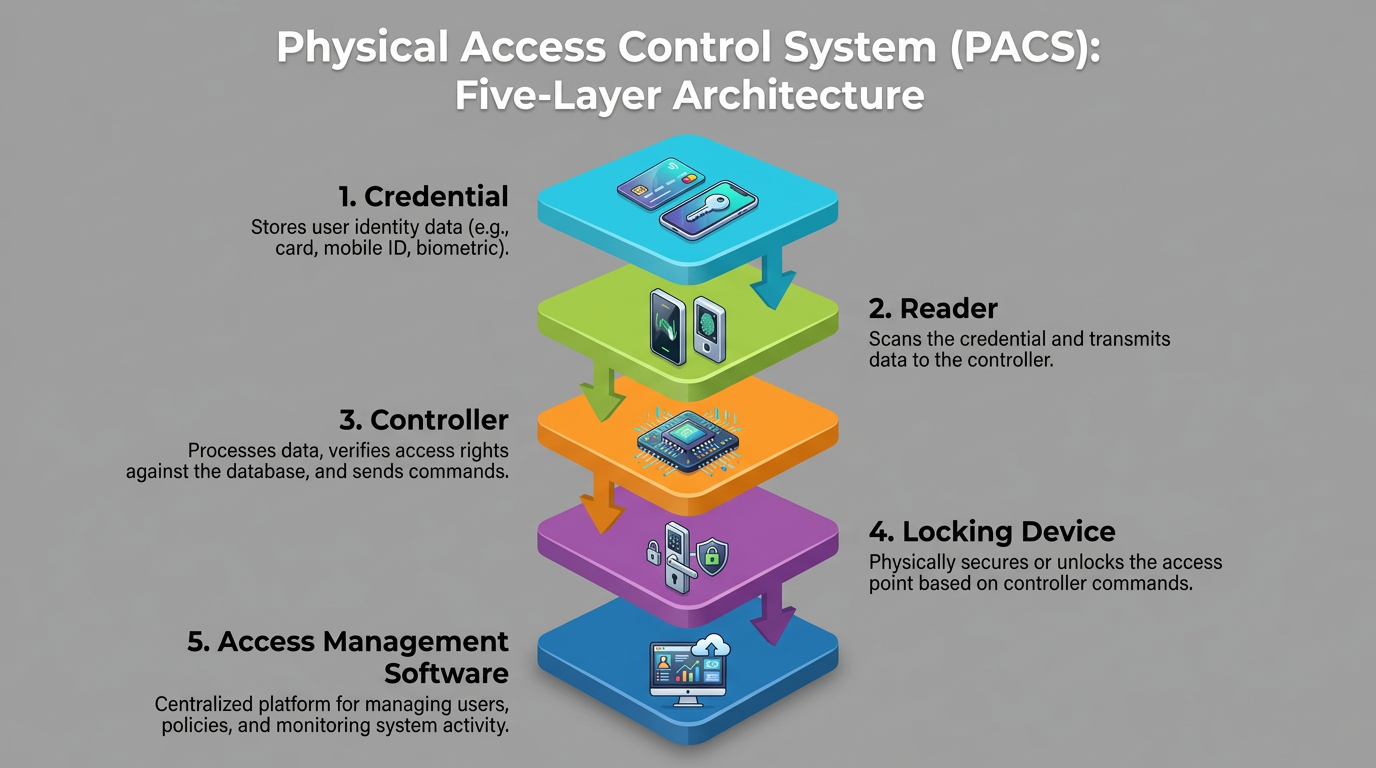
A physical access control system (PACS) is an electronic system that authenticates identity and authorizes entry at access control points. The baseline architecture is the same at every scale: a credential, a reader, a controller, a locking device, and access management software that logs each event. Understanding PACS means understanding both the architecture and the specific transitions it undergoes.
In this security context, PACS means physical access control system rather than the picture archiving and communication system used in medical imaging. Its scope is physical entry to buildings, rooms, and protected areas.
Key Takeaways
- The same five-layer architecture of credential, reader, controller, locking device, and management software underlies every physical access control deployment, regardless of scale
- The wiring protocol between the reader and the controller sets the effective security ceiling for every credential read in a physical access control system
- Authentication and authorization function as two sequential checks rather than a single combined access decision
- Credential formats, wiring standards, and management delivery models are all shifting in parallel, and upgrade sequencing should follow end-of-life at each layer
Core Components of a Physical Access Control System
Every PACS builds on the same hardware and software layers, regardless of site size or industry. Common physical access control examples include badge readers at lobby turnstiles, biometric scanners on data center doors, keypad entry on stockroom doors, and mobile credentials delivered to smartphones for employee entry.
A baseline PACS also includes a door position switch (DPS) and a request-to-exit (RTE) device. Above the hardware, access management software provides the database and administrator GUI used to configure permissions, monitor events, and generate audit trails.
Credentials
Credentials are the physical or digital items presented to verify identity. They fall into three types: credential devices (cards, fobs, mobile phones), coded devices (PINs and keypads), and biometric devices (fingerprint, iris, facial scanners). Many deployments layer two or more, such as a card plus a PIN, or a card plus a biometric, depending on the security classification of the area being protected.
Organizations comparing key card systems should evaluate both the credential technology and the reader-to-controller path, because a stronger card does not secure an unencrypted downstream interface.
Readers
Readers gather information from a presented credential and transmit it to a controller. Regardless of the credential format, the reader converts what it captures into a string of ones and zeros and sends it downstream. Reader form factors range from simple proximity readers and keypads to multi-factor readers that combine card, PIN, and biometric inputs in a single device.
Controllers
Controllers make the access decision. They receive credential data from readers, check it against a local access control database, evaluate permissions and time schedules, and issue a grant or deny. A single controller can manage one or multiple sets of door components and enforces policies including user permissions, time-based restrictions, and visitor rules in real time.
Access Management Software
Access management software ties everything together. Administrators use it to assign access levels, configure schedules, enroll and revoke credentials, and monitor system events. Those events, logged as transactions like "Access Granted," "Access Denied," or "Door Forced Open," provide the system record of access activity.
Those records can also become evidence for physical security compliance. HIPAA, PCI DSS, NERC CIP, and the NIST physical controls impose different requirements for physical entry, visitor records, monitoring, access reviews, and retention. Administrators should therefore align event categories, retention periods, review frequency, and export procedures with the frameworks that apply to each site.
Authentication Versus Authorization
Authentication and authorization are distinct sequential processes in PACS: authentication establishes identity, and authorization checks whether that identified person is allowed through a specific door under current conditions.
PACS also differs from logical access control systems (LACS). PACS controls entry through physical portals, while LACS governs access to digital systems and information. PIAM and identity-management integrations can connect the two domains, but successful badge authentication does not, by itself, authorize access to a network resource, and a valid network login does not authorize entry through a secured door.
Authentication
Authentication is the identity check. In PACS, the system evaluates the presented credential or factor set against enrolled identity data. Authentication strength is linked to protected-area classifications: Controlled areas require at least one factor, Limited areas require two, and Exclusion areas require three.
Authorization
Authorization determines permissions. A basic check validates the right to pass through a specific door at a specific time. Checks can include anti-passback status, credential expiration, holiday schedules, and use-count limits.
How a Physical Access Transaction Works End to End
A physical access transaction follows a fixed sequence from credential presentation to door hardware response and event logging.
Credential Presentation and Capture
A user presents a credential by tapping a card, holding up a phone, or placing a finger on a scanner. The reader captures the credential data. For a legacy 125 kHz proximity card, an RF field energizes the card, which reflects back a static, unencrypted facility code and card number.
Reader-to-Controller Transmission
The reader transmits the credential data to the controller over one of two wire protocols: Wiegand or OSDP. In a Wiegand installation, the data travels as a one-way, unencrypted bit string. In an OSDP installation, data moves bidirectionally over RS-485 and can be secured with AES-128 encryption, while the protocol also supports supervision and device status monitoring.
Authorization Decision
The controller runs authorization logic against the credential identifier and current conditions. It checks whether the credential is valid for that door and whether current conditions permit entry, including schedules and any active overrides such as lockdowns, extended unlocks, or anti-passback violations. If all conditions are met, the controller issues a grant. If any condition fails, it issues a deny. The controller must log the specific reason for any denial alongside the event.
Door Hardware Response
On a grant, the controller sends a relay output to the door hardware. For an electric strike, the keeper pivots to release the latch bolt. For an electromagnetic lock (maglock), the controller cuts power to the electromagnet, releasing the armature plate. The door remains unlocked briefly, then re-secures.
The selection and configuration of door systems must also account for egress and life-safety behavior. Locking hardware cannot be evaluated only by how it responds to a normal grant; designers must document its behavior during fire alarms, power loss, lockdowns, and controller or network failures.
Door Position Monitoring
The door position switch distinguishes between forced entry and a legitimate access event that remains open too long. If the door opens without any valid access grant, the switch triggers a Door Forced Open (DFO) alarm, typically meaning the door opened without a preceding valid badge read. If the door opens on a valid grant but stays open past the administrator-configured time window, it triggers a Door Held Open (DHO) alarm.
Request to Exit
On the exit side, a REX sensor, usually a passive infrared motion detector, detects someone approaching from the secure side and signals the controller to shunt the DFO alarm so the egress doesn't register as a breach.
Event Logging and Policy Sync
The controller transmits every event in this chain, including grants, denials, alarms, and door state changes, to the access management server, which logs them. The head-end server pushes policy updates in the opposite direction, sending new enrollments, revocations, and schedule changes down to controllers. Controllers store a local copy of the database so operations continue during network outages.
Wiegand, OSDP, and Why the Protocol Matters
The protocol between reader and controller sets the security ceiling for every credential read. That link is the most operationally significant communication path in a PACS.
Wiegand
Wiegand takes its name from a hardware effect where specially treated ferromagnetic wires embedded in a card generated a distinctive pulse as they passed a reader head. The industry standardized the resulting bit pattern into a common wiring interface that has dominated reader-to-controller communication since the 1980s, and the name stuck long after proximity, smart card, and mobile credentials replaced the original card technology.
In operational terms, Wiegand is a short-range, point-to-point wiring standard that carries credential data as an unencrypted, one-way bit string, typically a 26-bit frame with a facility code and card number. It has no line supervision, so a cut or shorted cable looks the same to the controller as an idle reader.
OSDP
OSDP, approved by the IEC as IEC 60839-11-5 in 2020, addresses the structural flaws of Wiegand. OSDP provides bidirectional communication over RS-485, AES-128 encryption via Secure Channel, and supervised-line detection that alerts the controller if the communication line is cut or tampered with. OSDP does not eliminate reader-controller security concerns on its own, however. Secure Channel is a necessary but not sufficient control.
Key PACS Concepts for Practitioners
Beyond the transaction flow, a handful of concepts shape how a PACS is configured and how operators respond when something goes wrong. Each addresses a specific gap the basic grant-or-deny logic does not cover on its own, from preventing credential misuse to accounting for people during an emergency.
Anti-passback
Anti-passback prevents a single credential from granting entry and then being passed back to another person. If the system does not clear anti-passback status through the expected sequence of entry and exit events, it can deny the next attempted use of that credential.
Mustering
Mustering uses in/out tracking data to account for personnel during an emergency. Access management software can query which credentials have badged in but not out to produce a real-time occupancy roster for evacuation accountability.
Tailgating and Piggybacking
Tailgating is an unauthorized person slipping through a controlled door behind an authorized user without presenting a credential. Piggybacking covers the variant where the authorized user knowingly holds the door for someone else. Both defeat the credential check the rest of PACS is built on, because the grant and the door-open sequence read as a legitimate event in the log.
Countermeasures live at the door rather than in the software: optical turnstiles, speed lanes, and mantraps restrict passage to one person per credential, and anti-tailgate sensors at the threshold can flag multi-entry events for review. Video correlation at the access point is increasingly used to spot the pattern after the fact and surface it for operator review.
Visitor Management
Visitor management sits adjacent to PACS. Temporary credentials, time-boxed access windows, and host-approval workflows extend the system to non-employees without enrolling them into the permanent badge population. Many sites still run visitor tracking on spreadsheets or paper logbooks, which breaks the audit trail that the rest of the PACS produces automatically.
Effective visitor management workflows cover prescreening, host approval, identity validation, badge issuance, escort requirements, expiration, return, and deactivation. Integrating visitor access control with PACS also makes it easier to revoke temporary permissions automatically and preserve a consistent record of who entered, when they left, and who authorized the visit.
Physical Access Control in 2026 and Beyond
New deployments are displacing 125 kHz proximity cards with mobile and biometric credentials. Most installed readers still run Wiegand, but new installations are moving to OSDP. Management is following a parallel arc from on-premises servers toward cloud and hybrid models.
Credentials in Transition
Mobile credentials, delivered via BLE, NFC, or UWB to smartphones, are a major growth area in access control. Released by the Connectivity Standards Alliance in February 2026, the Aliro specification establishes the first interoperable mobile credential specification designed for digital wallets and access control systems. Legacy proximity cards remain deployed despite being unencrypted and easily cloned.
Cloud and Hybrid Delivery
Cloud-based SaaS continues to erode on-premises dominance, driven by flexibility and remote access. On-premises configurations still account for a substantial majority of installed access control spending. Hybrid deployments combining on-premises controllers with cloud-hosted management are gaining share in new installations.
The deployment choice affects more than server location:
| Model | Primary operational characteristics | TCO considerations |
|---|---|---|
| On-premises | Local management servers and direct control over update timing | Higher infrastructure and sustainment responsibility, plus planned server and software refreshes |
| Cloud | Provider-hosted management with remote administration and vendor-managed updates | Recurring subscription costs, connectivity planning, data-governance review, and reduced local server overhead |
| Hybrid | On-site controllers combined with cloud-hosted management | Preserves local door operation while distributing management, integration, and support responsibilities |
| Managed or hosted | Site hardware remains in place while a provider operates some or all management functions | Adds service fees but can reduce internal administration and support demands |
An access control service evaluation should compare annualized costs across licensing, support, connectivity, cybersecurity maintenance, integrations, hardware replacement, and internal labor rather than comparing acquisition price alone.
Integration Replacing Silos
Access control, video surveillance, and intrusion platforms historically operated in isolation. Buyers now specify unified platforms with a single-pane-of-glass view across security technologies, identified as a primary growth driver in the 2026 SIA's Security Megatrends report.
Physical Identity and Access Management (PIAM) platforms extend this by integrating PACS with HR and IT identity systems, enabling cross-domain detections like a badge swipe at one facility coinciding with a VPN login from a different city, an anomaly that surfaces only when physical and cyber identity systems are connected.
An identity access management program also supports lifecycle automation: HR events can trigger provisioning, role changes, suspension, and deprovisioning across both physical and logical systems.
Zero-Trust Principles Reaching Physical Space
Zero trust extends no implicit trust to assets or user accounts based solely on physical or network location, directly challenging traditional badge-based access. Physical security infrastructure increasingly requires zero-trust designs to prevent unprotected edge devices from becoming lateral-movement footholds for attackers.
The NIST zero trust architecture also requires protection for all communications. Applied to PACS, that means treating readers, controllers, management servers, and their service accounts as managed computing resources rather than assuming that devices inside a facility are inherently trusted.
AI and Video Correlation Are Emerging Above PACS
In PACS, AI's primary role is correlation and triage: cross-referencing access control events with video feeds, reducing false-alarm loads, and surfacing genuine anomalies, rather than replacing the access-decision logic itself.
In CCTV integration, a door alarm can be paired with footage from the corresponding camera so an operator can assess context without manually searching multiple systems. PACS guidance requires alarm-triggered video display and video equipment at doors for alarm assessment. Correlation therefore sits above the controller's grant-or-deny logic while preserving PACS as the system of record for the access event.
Where This Leaves Practitioners
A PACS selection should begin with a site survey and a documented risk model. Buyer criteria should cover door and locking hardware, credential assurance, reader-controller protocol, network architecture, offline operation, integrations, cybersecurity controls, reporting, retention, life-safety behavior, accessibility, mobile credential strategy, and applicable compliance requirements. An access control design should also assign ownership for implementation, testing, policy administration, incident response, and lifecycle maintenance.
Total cost of ownership extends beyond readers and controllers. Planning should annualize software licensing, subscriptions, support, connectivity, credential issuance, cybersecurity updates, batteries where applicable, administrator labor, training, testing, and hardware refreshes. Requirements also vary by environment: a lobby may emphasize throughput and visitor handling, while data center access may require layered zones, stronger authentication, tighter monitoring, and more restrictive authorization policies.
Any PACS upgrade in 2026 faces a timing problem. The installed base is not where new deployments are heading, and replacement cycles for readers, controllers, and management software run on different clocks. Practitioners should identify which layer at their sites is closest to end-of-life, confirm what the adjacent layers can interoperate with, and sequence the upgrade from there rather than ripping and replacing the full stack at once.
Frequently Asked Questions
What is the difference between Wiegand and OSDP protocols, and why should organizations prioritize migrating from Wiegand to OSDP in their physical access control systems?
Organizations should prioritize migration because Wiegand transmits credential data as unencrypted plaintext over unsupervised wiring, making interception trivial, while OSDP encrypts transmission and alerts administrators to tampering, closing a vulnerability independent of credential sophistication.
How should organizations sequence a PACS upgrade when credentials, readers, controllers, and management software are all on different replacement cycles?
Identify the layer closest to end-of-life first, confirm backward and forward compatibility with adjacent layers, then upgrade outward from that constraint point. This preserves operational continuity while avoiding forced replacements of still-functional components that would otherwise remain viable for years.
How does integrating PACS with video surveillance and identity management systems (PIAM) improve security compared to running these systems in isolation?
Integration surfaces cross-domain anomalies invisible to individual systems, like badge activity at one site coinciding with network login elsewhere. Unified platforms enable automated correlation between access events and video context, reducing operator response time and eliminating manual searches during investigations.
