Financial Institution Physical Security Has the Same Blind Spot in Every Building


Every building. One blind spot. One fix.
TL;DR
Financial institutions run two kinds of buildings at once: headquarters and trading floors, where the risk is who is really behind a badge, and branches, where the risk is what happens between the lobby and the vault. Legacy camera and alarm systems treat every one of these spaces as the same generic stream, so nothing distinguishes a routine moment from the one that matters. This piece looks at what actually breaks down in each kind of building, and what it would take to read normal correctly in all of them.
The Real Risk in a Headquarters Starts Past the Front Desk
A trader badges onto the floor eleven seconds before the opening bell, already late, and holds the door for the colleague right behind him. Nobody on the floor thinks twice about it, because a shared badge swipe during a chaotic open looks exactly like courtesy.
It should still raise a flag. Most mornings, that flag resolves itself in the second it takes to match a face to the badge that opened the door. The morning it does not is the one that matters, and by then, someone needs to already be moving.
A corporate headquarters does not fail at the entrance. The lobby has a receptionist, a badge reader, maybe a guard, and none of that is where the real exposure sits. It sits past the front desk, on the trading floor itself, in the executive suite, in the rooms where the actual work happens: positions, deal terms, personnel decisions, the kind of information worth more to the wrong person than anything a thief could carry out through the lobby.
That changes what a security team is actually watching for. A stranger walking into a corporate office is rare enough to notice on its own.
The harder problem is someone with a legitimate badge doing something a legitimate badge should not be doing, in an area outside their normal pattern, at a time nobody expects them, moving toward information or people they have no reason to be near. This is not a rare worry inside a security team. In one 2019 industry survey of 185 US and Canadian security professionals, 71 percent said they believed their own facility was vulnerable to exactly this kind of breach (Boon Edam, 2019). None of that trips a door alarm, because the door opened exactly the way it was supposed to.
A Branch Lobby and a Vault Are Twenty Feet Apart and Nothing Alike
A hundred miles from that trading floor, a teller waves a coworker toward the back office without checking whether the badge on their belt actually clears for that door today. It is a small kindness, the kind that makes a workplace feel like a workplace.
It should still trigger a check. Almost every day, the badge clears and the check confirms what the teller already assumed. The day it does not is the one a vault cannot afford to find out about after the fact.
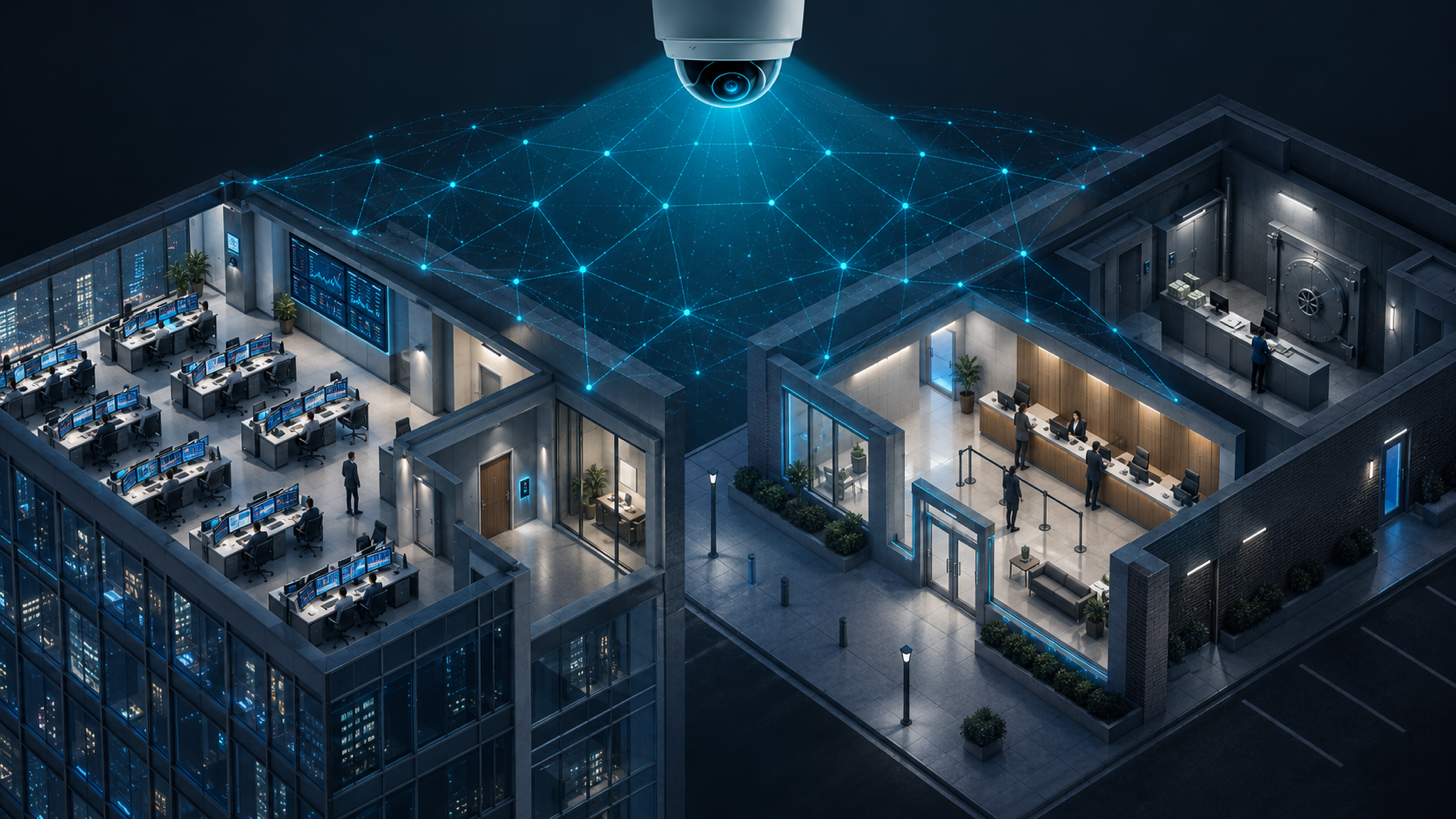
A branch is really two buildings stacked into one address. The front is built to invite people in: a lobby, teller stations, someone at a desk to open an account. The back is built to keep people out: a vault, cash handling, the room where deposits get counted and records get filed.
The two zones sit twenty feet apart, and they run on opposite assumptions. The lobby assumes strangers. The back office assumes it will never see one.
Reduced branch staffing makes both harder to watch at once. Teller staffing fell 14 percent industry-wide between 2019 and 2021 (Curinos, 2022), and the reduction shows up on the floor: the same small staff now covers the lobby and the back office, rather than someone whose job is either zone specifically. A remote operations center may well be watching the camera feed too, but it is watching the same undifferentiated stream from every branch at once, not a lobby-specific signal from this one or a vault-specific one from that one. A tailgating attempt at the vestibule and someone lingering near the cash drawer can happen in the same ten minutes, and on-site, there may be exactly one person positioned to notice either.
Two Different Buildings, the Same Failure
A trading floor and a bank branch do not look like the same problem, and in real ways, they are not. A trading floor runs on information and speed. A branch runs on cash and foot traffic, and the controls that make sense for one do not simply transfer to the other.
Treating the two as interchangeable would miss what actually makes each one hard to secure. But strip away what each building looks like on the surface, and the failure underneath is strikingly similar.
Every one of these buildings has a zone where almost anything is normal and a zone where almost nothing is. A camera and alarm system built before either kind of building had this much activity does not know the difference. It reacts the same way to a badge swipe or a door opening whether that badge swipe happened at the reception desk or on the trading floor, whether that door opened onto the lobby or the vault. Volume goes up, but judgment does not.
The fix, then, is not a better camera or a louder alarm. It is a system that knows which zone it is looking at.
Normal in a Lobby Is Not Normal on a Trading Floor
That system does not require replacing anything already in place. Both kinds of buildings already generate more badge swipes, door events, and camera footage than anyone can watch in real time, and in the zones that matter most, none of it can simply be waved through either. What has to change is how fast a flagged moment gets resolved, and with how much context, not whether it gets flagged at all.
A badge swipe onto a trading floor thirty seconds before the market opens still deserves a look. So does that same badge swipe at 2 a.m. on a Sunday. The difference is what happens next. Reading a zone's own rhythm means the first case can be checked and cleared in the time it takes to match a face to a badge, while the second escalates immediately, with the badge holder's identity, their normal pattern, and the door they used already attached before a person is even looking at it.
That is the shift that actually matters: not fewer alerts, but faster resolution. No alert should sit unresolved while someone tries to figure out, from scratch, whether it is real. What reaches a person already carries the context to act on it, for the moments that genuinely are out of place, and confirms itself in seconds for the moments that are not.
The Same Fix Works in Every Kind of Building
This is what the Reasoning AI Platform for Agentic Physical Security, built by Ambient.ai, is designed to do: correlate camera and access-control events in real time, interpreting each one against that zone's own historical norms and site-specific expectations, on a trading floor and a branch lobby alike, without requiring either kind of building to replace the cameras or access control it already has.
A financial institution does not need a bigger security team as it adds buildings. It needs each building read on its own terms, correctly, the first time.
The trading floor and the branch will keep looking like two different problems from the outside. Underneath, it is the same blind spot.
Key Takeaways
- A corporate headquarters and a bank branch fail the same way: a zone built for outsiders sits next to a zone that assumes it will never see one, and both share a single undifferentiated stream of alerts.
- The real exposure in a headquarters or trading floor is rarely at the front door. It is what a legitimate badge does once it is already inside.
- A branch's real vulnerability sits twenty feet from its lobby, in the zone built to keep people out, not invite them in.
- More cameras and more alarms do not fix this. What is missing is resolving each flagged moment fast, with the context to act on it, instead of applying one threshold to the whole building and hoping someone notices what matters.
Next Step
What would it take to read every building this way, a headquarters, a trading floor, a branch, as one system instead of several? See how Ambient.ai approaches this for financial institutions: Financial Services Security.

Key Takeaways
A corporate headquarters and a bank branch fail the same way: a zone built for outsiders sits next to a zone that assumes it will never see one, and both share a single undifferentiated stream of alerts.
The real exposure in a headquarters or trading floor is rarely at the front door. It is what a legitimate badge does once it is already inside.
A branch's real vulnerability sits twenty feet from its lobby, in the zone built to keep people out, not invite them in.
More cameras and more alarms do not fix this. What is missing is resolving each flagged moment fast, with the context to act on it, instead of applying one threshold to the whole building and hoping someone notices what matters.