What to Look For in a Corporate Campus Security Solution
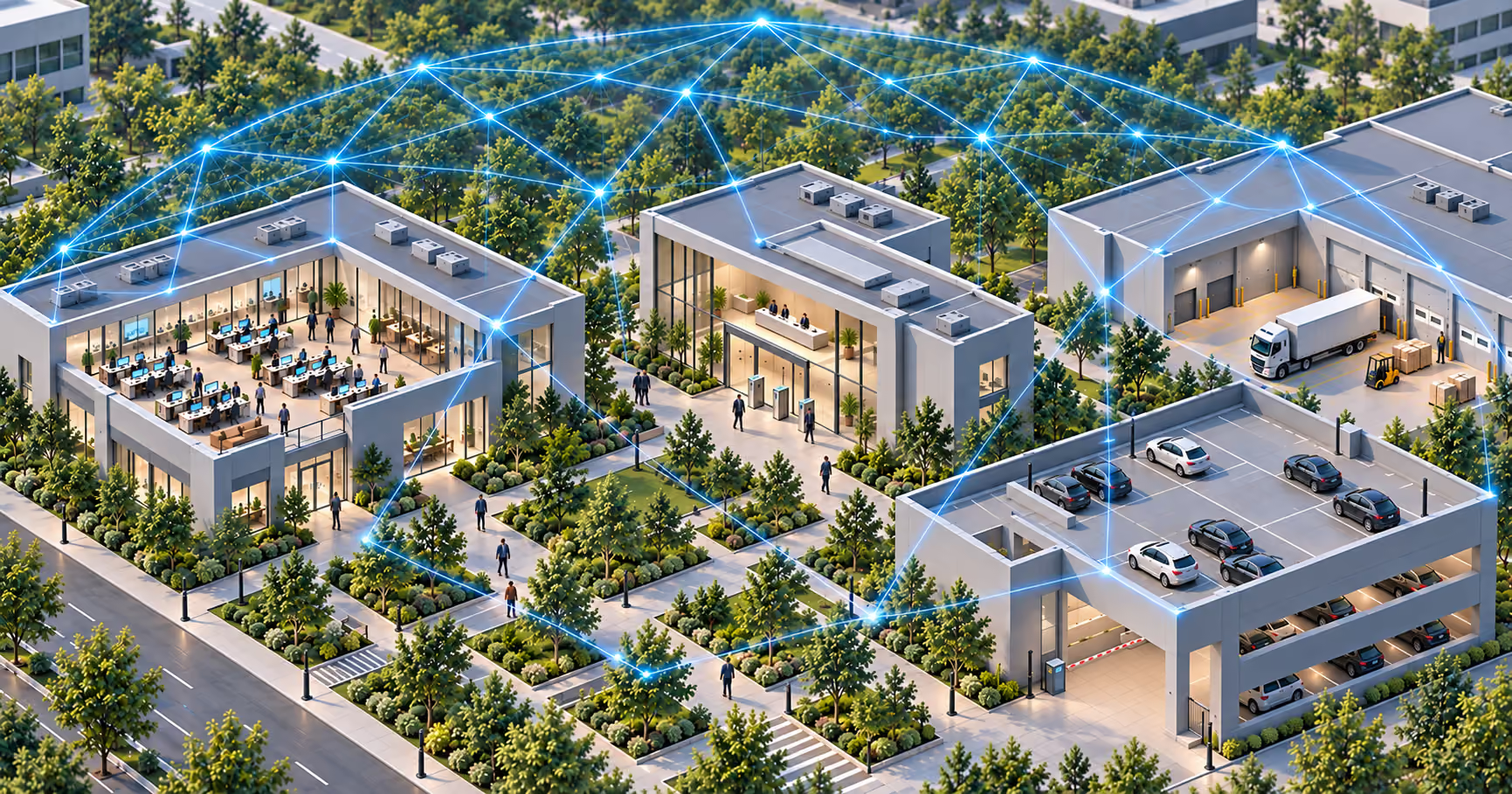


Every building. One system. See it live.
TL;DR
A corporate campus rarely fails because it lacks cameras. It fails because a dozen buildings, a parking structure, and a badge-in lobby each generate their own stream of alerts that nobody is unifying into one picture. This piece lays out what to actually evaluate when you're trying to secure a distributed estate without adding headcount or replacing the infrastructure you already have.
A Distributed Footprint Turns Every Building Into Its Own Blind Spot
More buildings should mean more coverage. That is the assumption most security programs are built on, and for a single site it mostly holds. Add a second building, a parking structure, and a badge-in lobby that a contractor uses twice a week, and the assumption breaks: coverage grows, but the ability to act on it does not.
Each site now produces its own stream of camera footage and access events, watched by whoever happens to be on shift for that location. Picture a tailgating attempt at the east lobby and a propped door at the annex three buildings over. To the person watching either feed, both look like routine activity.
Nothing connects them, so nothing about the pattern across the estate ever surfaces. The problem is not a missing camera. It is that the incident and the operator who could have caught it are in two different places, and no system in between is doing the correlating.
Unified Doesn't Mean Ripping Out What Already Works
The instinct at this point is to treat unification as a replacement project: new cameras, new access control, one vendor, one system. That instinct is usually wrong, and it is worth naming why before it drives a decision.
A security team that has already invested in cameras and access control across a multi-building estate is not starting from zero. What it is missing is a layer that reads across everything it already owns and tells a consistent story about what is happening estate-wide, not site-by-site. There are two legitimate ways to get there, and neither is a compromise.
A team can keep its existing video management system (VMS) and layer intelligence on top of it, preserving every investment already made in hardware and workflow. Or it can consolidate onto a single platform that folds video management into the same layer that reasons about threats, simplifying the stack going forward. Both paths make the existing infrastructure smarter. The right one depends on where a given estate already is: how much has been invested in its current VMS, and how well it already works.
The Alarm Volume Problem Multiplies With Every Building You Add
A single building generating a manageable stream of access alarms becomes an unmanageable one once ten buildings are generating the same stream in parallel. The badge reader at the parking structure does not know that the lobby three buildings away just triggered a door-forced-open alarm. It only knows that a badge was presented, and it raises an alarm exactly as often for a routine after-hours delivery as it would for someone actually attempting unauthorized entry.
What a distributed estate needs is not more alarms. It needs a way to check each access event against the video from the same door in the same moment. That way, a badge event with no matching person on camera gets flagged as worth a look, and a badge event that plainly matches routine activity does not.
The badge reader and the camera both stay exactly where they are. What changes is whether someone has to sit and watch both feeds to make that call, or whether the correlation happens automatically and only the events that actually warrant attention reach a person. That is the difference between an alert, something worth a human's time, and an alarm, something a machine generated because a threshold was crossed.
Investigation Speed Has to Scale With Every Site You Add
When an incident does happen, the question that follows is rarely "what happened at this camera." It is "did this person show up anywhere else on the estate, and when." At a single site, an operator can scrub through footage from the cameras nearby and usually find an answer within an hour. Across a dozen buildings and however many hundred cameras that implies, the same manual search does not scale. It just gets slower in proportion to how much estate there is to search.
The criterion worth evaluating here is whether investigation works the same way regardless of how many buildings are in scope: can an operator search by what someone was wearing, what they were carrying, or which door they used, across every camera on the estate at once, instead of building by building. A search that takes seconds at one site and still takes seconds across twelve is doing the job. One that scales linearly with the number of buildings is not solving the actual problem, only the version of it that fits inside a single building.
A Pattern Across Ten Buildings Looks Like Nothing At Any One of Them
The assumption behind most security programs is that if something suspicious is happening, whoever is watching the right camera at the right moment will catch it. That holds for an obvious threat caught in a single frame. It breaks down for the kind of threat that only shows up as a pattern: the same person loitering near three different loading docks over two weeks, or a badge moving through a sequence of doors that makes sense individually but not together. No single moment looks wrong. The pattern only exists across time and across the estate, and nobody is watching for that, because no one is watching all of it at once.
Recognizing the pattern is only half the problem. A detection that becomes one more alert sitting in a queue has not actually changed the outcome: a person still has to notice it, decide it matters, and figure out what to do next. A real threat does not wait for that sequence to finish.
What changes the outcome is a response that starts moving as soon as the pattern is confirmed: security is notified with the context already assembled, the relevant door can be secured, and an operator arrives to arbitrate a response already underway rather than start an investigation from a cold start. The judgment of what to do still sits with a person. What no longer waits on a person is the clock.
The criterion worth evaluating here is not how many threats a system can flag. It is how much time exists between a pattern being confirmed and a response actually starting, since that gap is exactly where a real threat still has room to escalate.
What This Looks Like When It Works
SentinelOne runs security across sites worldwide, which is exactly the shape of problem this piece has been describing. Brent Kennedy, the company's Director of Security Operations, put it plainly:
"We've got sites all over the world and with the addition of Ambient, I know for me, my stress level has gone down because I have way better visibility."
TikTok USDS reached a similar conclusion from a different angle. Phil Jang, the company's Converged Security Leader, described the shift this way:
"Through our partnership and the use of AI, we have been able to go above and beyond traditional physical security."
ServiceNow reached the same conclusion at a larger scale. Brian K. Tuskan, ServiceNow's Chief Security Officer at the time, put a number on it:
"240K+ alarms processed, 94% auto-cleared, saving over 15,000 labor hours and $500K+ in avoided costs."
The pattern across all three is the same one this piece has been building toward: a distributed estate does not need a security team to get bigger in proportion to how many buildings it covers. It needs the estate to behave, from a security standpoint, like one place instead of many separate ones.
That is what Ambient.ai is built to do: the same layer that reads camera and access events together to cut alarm volume down to what actually warrants a look. It is the layer that lets an operator search across every building at once, recognizes a pattern before it becomes an incident, and gets a response moving the moment that pattern is confirmed. It sits on top of the cameras and access control a team already has, not in place of them. The estate starts behaving like one place. One layer is reading all of it.
Key Takeaways
- More buildings does not automatically mean more security. It means more disconnected feeds unless something is unifying them into one estate-wide picture.
- Unifying security across a campus does not require replacing existing cameras or access control. Layering intelligence on top, or consolidating onto one platform, are both legitimate paths.
- The real test for alarm handling is whether a badge event gets checked against video automatically, so a person only sees the ones that actually warrant a look.
- Investigation speed should not scale with the number of buildings in an estate. If it does, the tool is solving a single-site problem, not the estate-wide one.
Next Step
What would it take to see your own estate this way, as one picture instead of a dozen separate ones? See how Ambient.ai approaches this across a corporate campus: Corporate Campus Security.

Key Takeaways
More buildings does not automatically mean more security. It means more disconnected feeds unless something is unifying them into one estate-wide picture.
Unifying security across a campus does not require replacing existing cameras or access control. Layering intelligence on top, or consolidating onto one platform, are both legitimate paths.
The real test for alarm handling is whether a badge event gets checked against video automatically, so a person only sees the ones that actually warrant a look.
Investigation speed should not scale with the number of buildings in an estate. If it does, the tool is solving a single-site problem, not the estate-wide one.