Retail Gun Detection: AI-Powered Multi-Site Security


90%+ alerts resolved in under a minute. See how.
Retail Gun Detection: AI-Powered Security for Multi-site Retail in 2026
Retail environments face an unprecedented challenge. With 46% of active shooter incidents occurring in commerce and retail environments, the convergence of rising violence during theft incidents, employee safety concerns, and evolving regulatory requirements has pushed retail gun detection to the forefront of physical security strategy.
For security directors and GSOC managers responsible for protecting customers and staff across multiple locations, understanding how AI-powered detection systems work has become essential. This guide examines the current threat landscape, the technical realities of AI gun detection, and the operational considerations that shape successful deployments.
Key Takeaways
- AI-powered gun detection technology in retail enables proactive threat identification before incidents escalate, shifting security operations from reactive response to early intervention
- Successful retail gun detection deployments require integration with existing video management and access control infrastructure, rather than a standalone implementation
- Behavioral precursor analysis and contextual understanding powered by AI distinguish genuine threats from routine activity, reducing false alarms that overwhelm security operators
- Centralized security teams gain consistent visibility across dozens or hundreds of store locations through unified AI monitoring that scales without proportional headcount increases
The Escalating Threat Landscape for Retail Security
The security challenge facing retail operations has intensified significantly. According to the NRF's Impact of Retail Theft & Violence report, retailers reported a 16% increase in incidents involving threats, displays, or use of weapons during theft events. This represents a fundamental shift from property crime to direct threats against retail workers and customers.
FBI data on active shooter incidents has documented multiple confirmed incidents nationally in recent years, and older FBI study materials report that 46% occurred in commerce settings. Critically, many active shooter incidents end in 5 minutes or less, emphasizing why pre-shot visual detection may matter more than gunshot detection systems that only alert after firing has begun.
This pattern reflects a broader escalation over the past five years. Recent incidents at grocery stores, big-box retailers, and shopping centers underscore the urgency facing security professionals tasked with protecting both employees and customers.
Further compelling technology evaluation is the documented crisis in employee retention. 35% of retail workers now report feeling unsafe at work, up from 27% in 2024, while reports of physical assault increased 22% year-over-year and aggressive behavior from past employees and current coworkers jumped 28% and 26%, respectively.
The market for AI-powered gun detection has grown substantially in response, driven by advances in computer vision that make real-time firearm identification across large camera networks operationally viable.
The Multi-Site Visibility Challenge for Retail Security Teams
Retail security teams operating across dozens or hundreds of store locations face a fundamental visibility problem. Centralized GSOC operators cannot simultaneously monitor what is happening at every site, creating coverage gaps that increase risk exposure. Traditional approaches require either accepting blind spots or scaling headcount proportionally with store count, neither of which provides sustainable protection.
The challenge intensifies during high-risk periods. Early morning and late night shifts often operate with minimal on-site staffing, leaving lone workers vulnerable during store opening and closing procedures.
These periods frequently coincide with elevated robbery and assault risk, yet even the most skilled and dedicated security teams face an impossible scale challenge when monitoring multiple locations simultaneously. After twenty minutes of observing a single screen, even trained professionals may miss up to 90% of activity in the monitored area due to inherent cognitive limitations, not lack of effort or attention.
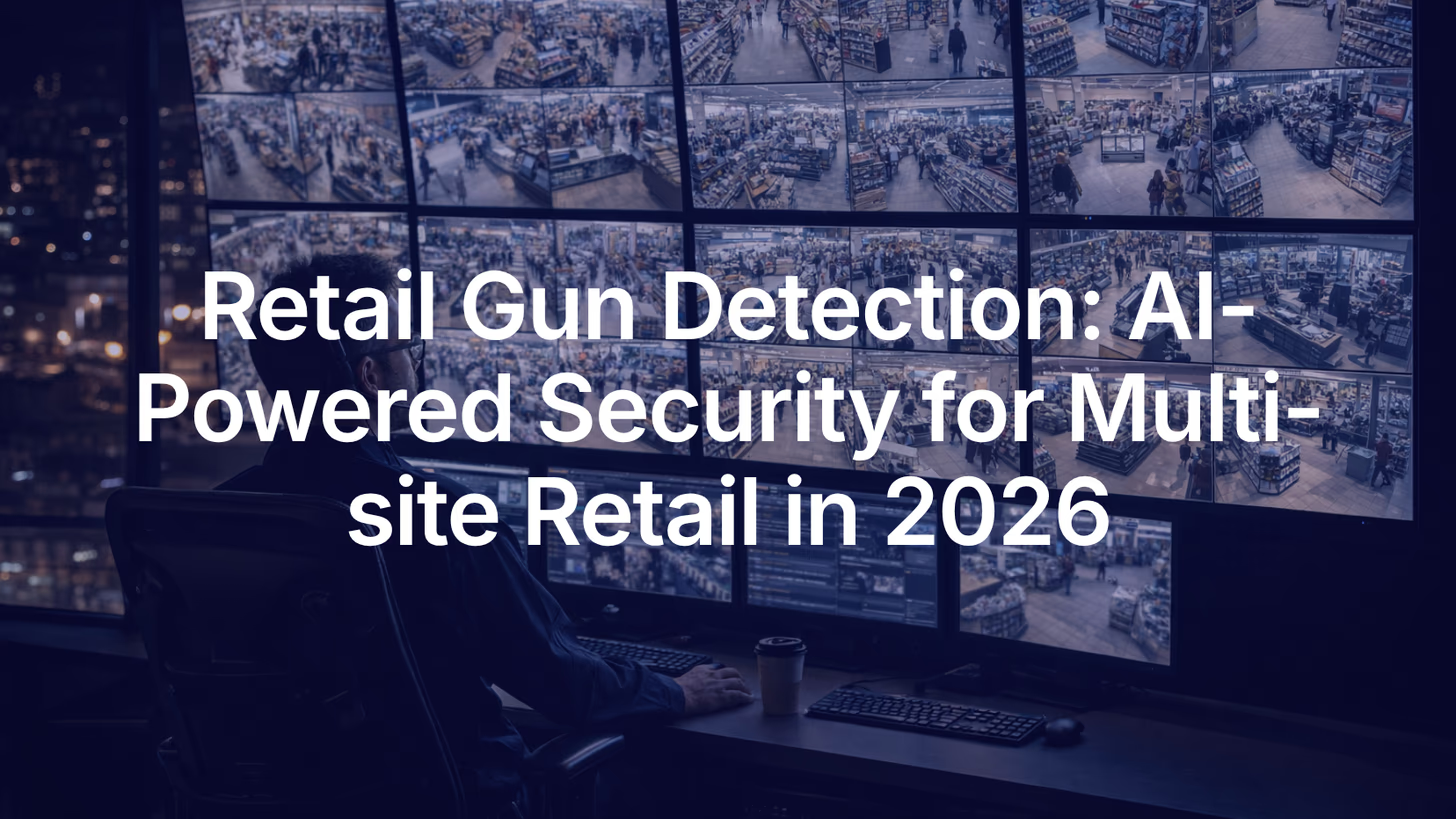
AI gun detection addresses this gap by providing continuous automated monitoring that scales across the entire retail footprint without requiring additional operators per location. Centralized teams gain unified visibility into threat conditions across all stores, with AI surfacing only validated threats that warrant human attention rather than overwhelming operators with feeds from every camera at every site.
How Gun Detection Technology Works in Retail Environments
The most advanced AI gun detection technology integrates with existing camera infrastructure to deliver a unified intelligence layer. Cameras provide video feeds but lack native intelligence; a separate AI software layer analyzes that video in real time using computer vision, identifying firearms and weapon-related behaviors before incidents escalate.
Gun Detection Core Capabilities in Retail
AI-powered systems provide visible firearm detection in video frames, including the critical "Person Brandishing Firearm" threat signature that identifies high-severity situations requiring immediate response. Beyond firearm identification, comprehensive AI detection technology identifies threat signatures specific to retail environments:
- Person Running, Person Falling Down, and Fighting for incident detection
- Large Crowd Forming for situational awareness
- Lone Worker Presence for early morning and late night shifts, when minimal staffing creates elevated vulnerability
These systems also incorporate behavioral precursor analysis that identifies pre-incident behaviors such as loitering near exits, unusual crowding patterns, and people running through the store, which often precede active threat situations.
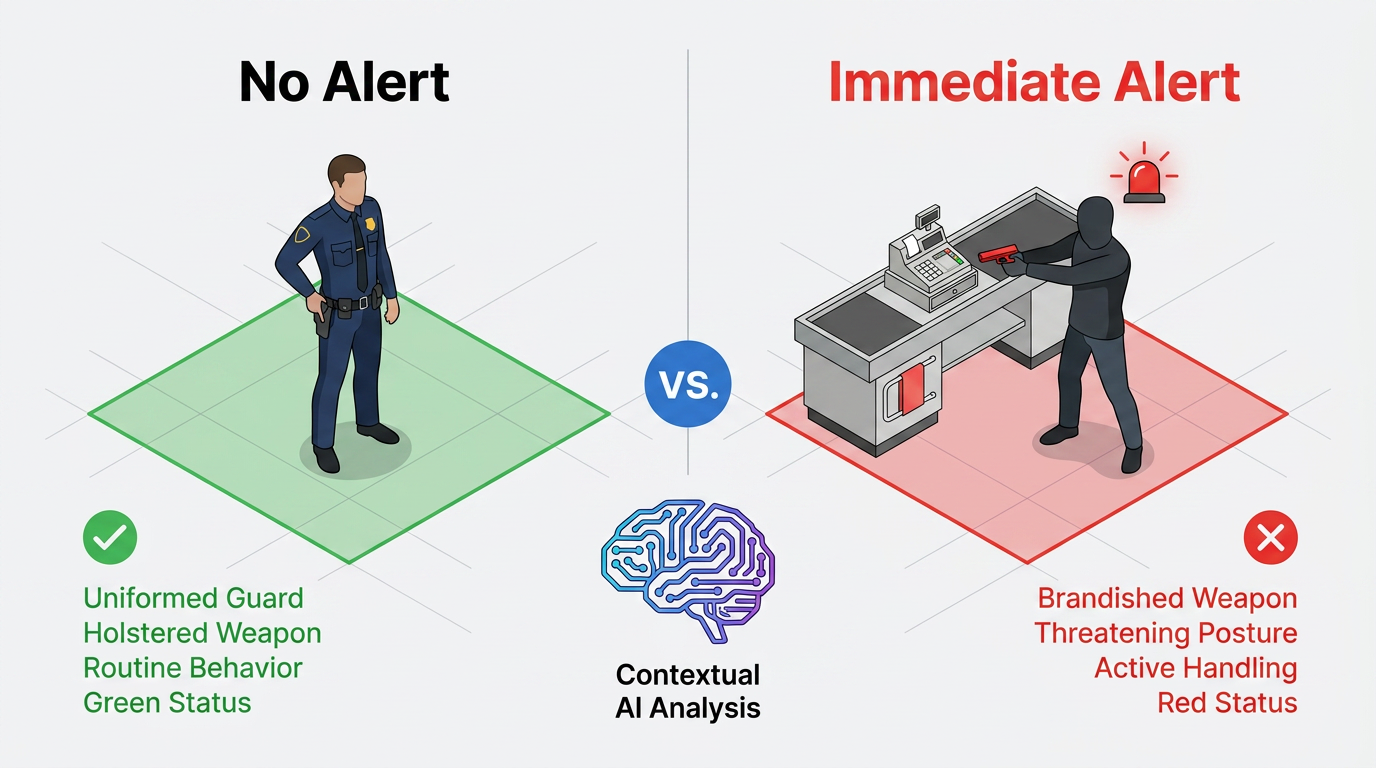
The most capable AI systems recognize that identifying a firearm is only part of the equation; contextual understanding determines whether an alert warrants immediate response. A security guard's holstered weapon differs fundamentally from a brandished firearm in a checkout line.
Deploying Gun Detection in Retail Security Infrastructure
AI-powered gun detection technology delivers the greatest value when integrated with existing systems rather than deployed standalone. These capabilities must connect with video management systems, physical access control systems, and other infrastructure to maximize effectiveness.
Camera and Network Requirements
Retail environments present unique detection challenges that security teams should address during deployment:
- Evaluate camera placement for adequate lighting and minimize glare from windows and fixtures
- Position cameras to reduce occlusion from customer crowds and shelving
- Ensure sufficient resolution at key distances, particularly entry points and checkout areas
- Verify IP camera compatibility with RTSP and ONVIF standards
- Confirm sufficient network bandwidth for continuous high-resolution video transmission
AI gun detection technology can integrate with many existing IP camera networks through software without complete hardware replacement, though organizations should evaluate whether current camera placements provide adequate coverage and viewing angles.
Regulatory Requirements Creating Compliance Drivers
Workplace violence prevention is rapidly becoming a legislative priority across the United States. While no federal OSHA standard for workplace violence currently exists, states are ramping up with their own mandates at an accelerating pace.
As of 2025, California and New York had active workplace violence prevention requirements in place. This legislative momentum signals a clear trajectory: documented workplace violence prevention measures are becoming a baseline expectation for employers, particularly in retail environments where workers interact directly with the public.
Organizations operating across multiple jurisdictions face an expanding patchwork of requirements, making proactive investment in detection and documentation capabilities increasingly important, regardless of where individual stores are located.
Example: California Workplace Violence Prevention Requirements Supporting Retail Gun Detection
According to Cal/OSHA guidance, California's Labor Code section 6401.9 requires employers in general industry, including retail, to establish written Workplace Violence Prevention Plans effective July 1, 2024. These plans must include violent incident logs documenting the date, time, location, and nature of each incident, along with information about involved individuals and response actions taken.
Employee training must address recognition of workplace violence hazards, de-escalation techniques, and emergency response procedures. Critically, plans require hazard identification and correction procedures that AI gun detection technology directly supports by providing early warning capabilities and documented threat detection records.
Example: New York Retail Worker Safety Act and Gun Detection Compliance
According to New York State Department of Labor guidance, New York's Retail Worker Safety Act became effective June 2, 2025, requiring covered retail employers to implement workplace violence prevention policies and training programs. Subsequent amendments will also require employers with 500 or more retail employees in New York to provide silent response buttons by January 1, 2027, further raising the compliance bar for large retail operators.
Building the Business Case for Gun Detection Investment
The ROI case for AI gun detection in retail rests on converging cost pressures that compound when left unaddressed.
Employee Retention as a Measurable Cost Driver
With more than one in three retail workers now reporting they feel unsafe at work, safety-driven turnover has become one of the highest controllable costs in retail operations. Each departure carries recruiting, training, and lost productivity expenses that accumulate across a multi-site footprint.
Security investments that demonstrably improve workplace safety can be directly quantified against these turnover costs, giving security leaders a concrete financial argument that resonates beyond the security department.
Regulatory and Liability Exposure
California now requires documented workplace violence prevention measures, and New York requires them for public employers.
AI gun detection technology addresses both sides of this equation: it provides early warning capability that can help prevent escalation, and it generates documented threat detection records that demonstrate proactive compliance.
Operational Efficiency Through AI-Driven Alert Reduction
Traditional monitoring approaches require scaling headcount with store count. AI gun detection breaks that dependency by filtering high-traffic noise and surfacing only validated threats, allowing centralized teams to cover more locations without proportional staffing increases. What once required dedicated operators per site becomes manageable from a single GSOC.
The Compounding Return
These value streams do not operate in isolation. Reduced turnover lowers staffing costs. Fewer false alerts free operator capacity. Documented compliance reduces legal exposure. Together, they create a compounding return that accelerates over time.
Supporting this, 86% of end users report seeing ROI from video analytics within one year. For retail security leaders evaluating AI gun detection, the question is less whether the investment pays for itself and more how quickly.
Achieving Proactive Threat Detection in Retail Security
For retail security teams evaluating AI gun detection technology, the path forward requires matching capabilities to operational requirements, ensuring integration with existing infrastructure, and establishing clear response protocols.
Ambient.ai approaches this challenge through Agentic Physical Security, with its platform integrating with existing cameras and sensors to deliver a unified intelligence layer. The Ambient platform leverages 150+ threat signatures, with gun detection capabilities that combine real-time firearm identification with behavioral precursor detection, including recognition of fighting, crowd formation, and people running, providing contextual threat analysis that distinguishes genuine threats from routine activity.
Rather than adding another alert stream for overwhelmed operators, Ambient Intelligence processes video continuously, filtering out the noise generated by high-traffic retail environments and surfacing only validated threats that warrant response. For security leaders ready to move from reactive to proactive, understanding how AI threat detection integrates with existing retail security infrastructure represents a critical step forward. Request a demo to see how Ambient.ai can enhance your retail security operations.
Frequently Asked Questions
How does AI gun detection distinguish between a security guard's holstered firearm and an actual threat in a retail environment?
AI gun detection analyzes weapon positioning, body language, and environmental context. A holstered firearm on a uniformed guard shows routine behavior, while a brandished weapon exhibits active handling and threatening posture, triggering alerts only when contextual threat indicators align.
What is the average false alarm rate for AI-powered gun detection systems in high-traffic retail stores, and how does it compare to traditional monitoring?
AI-powered gun detection uses contextual analysis to distinguish genuine threats from routine activity, reducing false alarms versus rule-based systems. Advanced platforms filter high-traffic noise in retail environments, surfacing only validated threats rather than overwhelming operators with unverified alerts.
How do AI gun detection systems perform during the high-risk early morning and late night shifts when lighting conditions and camera visibility may be reduced?
Performance depends on camera quality and lighting infrastructure. Modern AI systems compensate for low light through optimized algorithms, but inadequate illumination or poorly positioned cameras degrade accuracy. Retailers should audit lighting at vulnerable entry points and back-of-house areas to ensure detection reliability.