Optimizing Incident Detection and Response in Physical Security with AI

.webp)

Investigations that took days. Now answered in seconds.
Incident detection and response capabilities determine whether security teams prevent threats or merely document them after the fact. The window for effective intervention is razor-thin, with 69% of active shooter incidents ending in five minutes or less. Traditional monitoring approaches create structural limitations that persist regardless of operator skill or dedication.
Detection speed without coordinated response wastes critical intervention windows, while response deployment without accurate threat context sends teams chasing false alarms as genuine threats unfold elsewhere. Physical security operations face an impossible scale challenge that demands a fundamental shift toward proactive incident detection and response capabilities.
Key Takeaways
- Traditional monitoring approaches create fundamental cognitive and operational limitations that compromise security effectiveness, regardless of team skill or dedication
- Delayed incident response generates cascading consequences, including escalation, evidence degradation, financial exposure, and liability risk
- Agentic Physical Security overcomes human attention limitations by processing all camera feeds continuously with contextual threat understanding
- Integration with existing infrastructure protects technology investments while enabling proactive threat prevention rather than reactive incident documentation
Traditional Incident Detection and Response Limitations
Traditional cameras and monitoring systems create structural limitations that compromise operational effectiveness regardless of operator skill or dedication. Large enterprises deploy thousands of cameras across their facilities, yet most security operations centers only actively monitor a few dozen priority streams at any given time. The math simply does not work.
A single operator monitoring multiple camera feeds exceeds human cognitive capacity, and sustained monitoring creates attention degradation that appears during extended shifts, creating blind spots when vigilance matters most. Research shows that after just twenty minutes of observing one screen, operators may overlook up to 90% of activity in the monitored area.
Traditional video surveillance analytics systems generate excessive false alarm rates. Environmental factors trigger alerts constantly: weather changes, shadows, tree branches. Security teams responding to frequent nuisance alarms daily develop alert fatigue that degrades response to genuine threats. When operators face hundreds of false positives, the genuine threat buried among them becomes nearly impossible to identify in time.
Siloed systems fragment situational awareness. Video management systems operate separately from access control platforms. Intrusion alarms trigger without automatically pulling camera feeds. The result is a security infrastructure with thousands of eyes that cannot see and thousands of data points that never connect.
The True Cost of Delayed Response
Every minute between incident initiation and effective intervention creates cascading consequences. Situations escalate, injuries compound, and evidence degrades.
Perpetrators gain time to flee the scene before security personnel arrive, eliminating opportunities for intervention or apprehension. Witness memories become less reliable as time passes, while physical evidence trails grow cold. Security events that could be de-escalated through immediate verbal intervention instead progress to physical confrontations requiring law enforcement response and potential use of force.
Financial and Liability Exposure
Post-incident investigations that could be resolved quickly through real-time natural language search applied to video consume significant security analyst time reviewing extensive footage across multiple camera feeds. Key financial impacts include:
- Security team overtime for extended investigations compounds direct labor costs
- Facility disruptions from evacuations or extended lockdowns translate to measurable productivity losses
- Employees unable to work, deliveries delayed, operations suspended
- Premises liability exposure creates quantifiable financial risk
Negligent security settlements typically reach substantial figures for inadequate response cases. Catastrophic incidents where delayed response contributed to severe injuries or fatalities generate significant verdicts.
Reputational consequences compound these direct costs: media coverage of security failures, stakeholder confidence erosion, and competitive disadvantage in attracting tenants or employees create ongoing impacts that exceed immediate incident costs.
Assessing Your Current Detection and Response Capabilities
Evaluating existing security posture requires honest measurement of detection speed and response effectiveness. Calculate mean time to detect by measuring the gap between when threats become visible and when your SOC receives alerts.
Response time measurement begins when alerts reach security personnel and ends when trained responders arrive on scene with situational awareness.
Facilities with extensive camera networks but limited monitoring staff face significant attention capacity limits. Industry research indicates that less than 1% of all surveillance video is watched live, meaning the vast majority of security footage serves only forensic purposes after incidents occur. Traditional systems generating excessive false alarms create operational noise, obscuring genuine security events.
Reasoning AI-Powered Incident Detection Capabilities
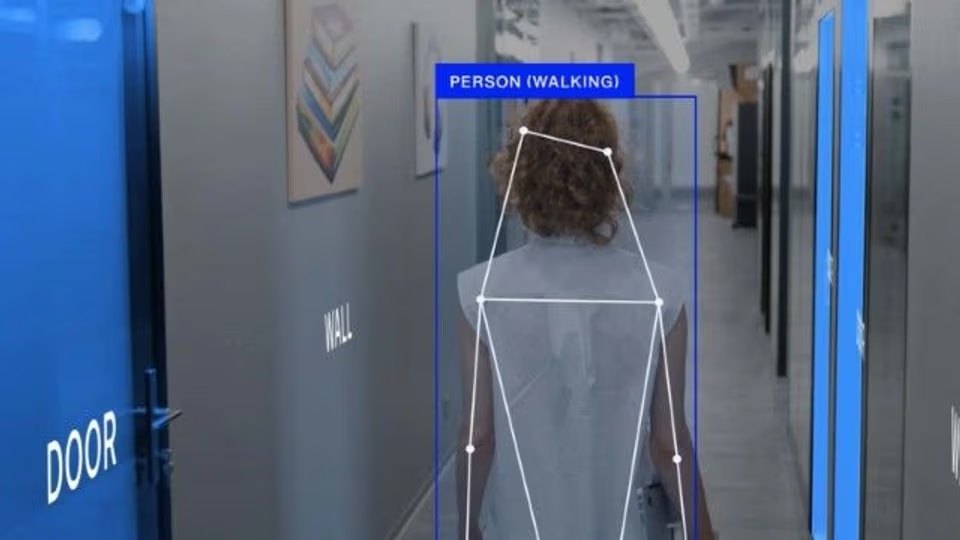
AI-powered Computer Vision can process every camera feed continuously without the attention degradation affecting human operators. Systems analyzing behavioral patterns across entire facilities simultaneously can identify anomalies that human operators would miss. This technological assistance overcomes fundamental human cognitive limitations in maintaining situational awareness across multiple camera views.
Contextual scene understanding through the latest AI reasoning models separates routine activity from genuine threats through environmental awareness. A delivery driver carrying packages near a loading dock generates no alert. The same person lingering near a restricted server room triggers an immediate notification.
Purpose built AI reasoning models detect threats and understand behavioral context while traditional systems struggle with false alarms and missed detections. This difference determines whether security teams receive advance warning or post-incident notifications.
Transforming Response Through Real-Time Context
Detection speed means little if responding personnel arrive without understanding what they're confronting. Real-time visual verification provides security teams with incident context before they reach the scene through alert notifications that include relevant camera footage.
Automated escalation routing directs incidents to appropriate response resources based on threat type and severity. Minor anomalies route to SOCs for virtual verification. Weapons detection or aggressive behavior automatically escalates to on-site security and law enforcement.
Mobile coordination keeps field teams and operations centers aligned throughout incident resolution. Responders receive updated visual context as situations develop. The entire sequence from initial detection through resolution exists in unified timelines rather than fragmented logs across separate systems.
Integrating Artificial Intelligence with Existing Infrastructure
Computer Vision Intelligence deploys on current camera infrastructure without requiring hardware replacement. Edge processing appliances integrate with existing video management systems and Physical Access Control Systems (PACS), analyzing streams in real-time while preserving all existing capabilities. Organizations protect their camera investments while adding intelligence layers.
PACS integration correlates badge events with visual verification. Door alarms automatically pull associated camera footage for instant verification. Deployment follows phased approaches beginning with pilot projects in high-priority areas before expanding to additional facilities.
Measuring Detection and Response Performance
Performance measurement drives continuous improvement through quantifiable metrics. Mean time to detect and mean time to respond represent desired operational outcomes. Organizations should establish detection and response time targets based on their specific risk profiles and facility types.
Alert accuracy rates remain critical. The industry struggles with traditional systems generating excessive false alarms while contemporary Agentic Physical Security systems achieve significantly lower nuisance alarm rates. Resolution time by incident type reveals operational patterns and procedural bottlenecks requiring attention.
Post-incident review processes extract lessons from both successful responses and near-miss scenarios. Regular structured reviews examining detection accuracy, response coordination, and communication effectiveness identify improvement opportunities before similar issues contribute to actual security failures.
Achieving Unified Incident Prevention with Ambient.ai
The physical AI capabilities described throughout this guide represent the technological foundation for transforming security operations from reactive to proactive. Ambient addresses these operational gaps through continuous monitoring that human attention spans cannot sustain, and materializes this approach through a purpose-built platform architecture delivering threat detection capabilities spanning high-severity incidents, alert reduction, perimeter control, health and safety, and unauthorized access.
Ambient.ai is built on Privacy by Design principles, using no facial recognition and no personally identifiable information. This approach addresses common buyer concerns about surveillance technology while delivering comprehensive threat detection capabilities.
Request a demo to see how Ambient.ai enables proactive threat prevention for your security operations.
Frequently Asked Questions about Proactive Security Incident Detection
Why do traditional security monitoring systems struggle with effective incident detection?
Human analysts monitoring multiple camera feeds face cognitive limitations leading to attention degradation during extended shifts. Environmental factors trigger excessive false alarms in conventional systems, causing alert fatigue that degrades response to genuine threats.
How does Computer Vision Intelligence improve security response times?
Computer Vision Intelligence processes every camera feed continuously, analyzing behavioral patterns across facilities to identify anomalies. Real-time visual verification provides responders with incident context, while automated escalation routing directs threats to appropriate resources.
What metrics should security teams track to measure detection and response performance?
Mean time to detect measures the gap between threat visibility and SOC alerts. Mean time to respond tracks from alert receipt to responder arrival. Alert accuracy rates and resolution time by incident type reveal operational patterns requiring attention.