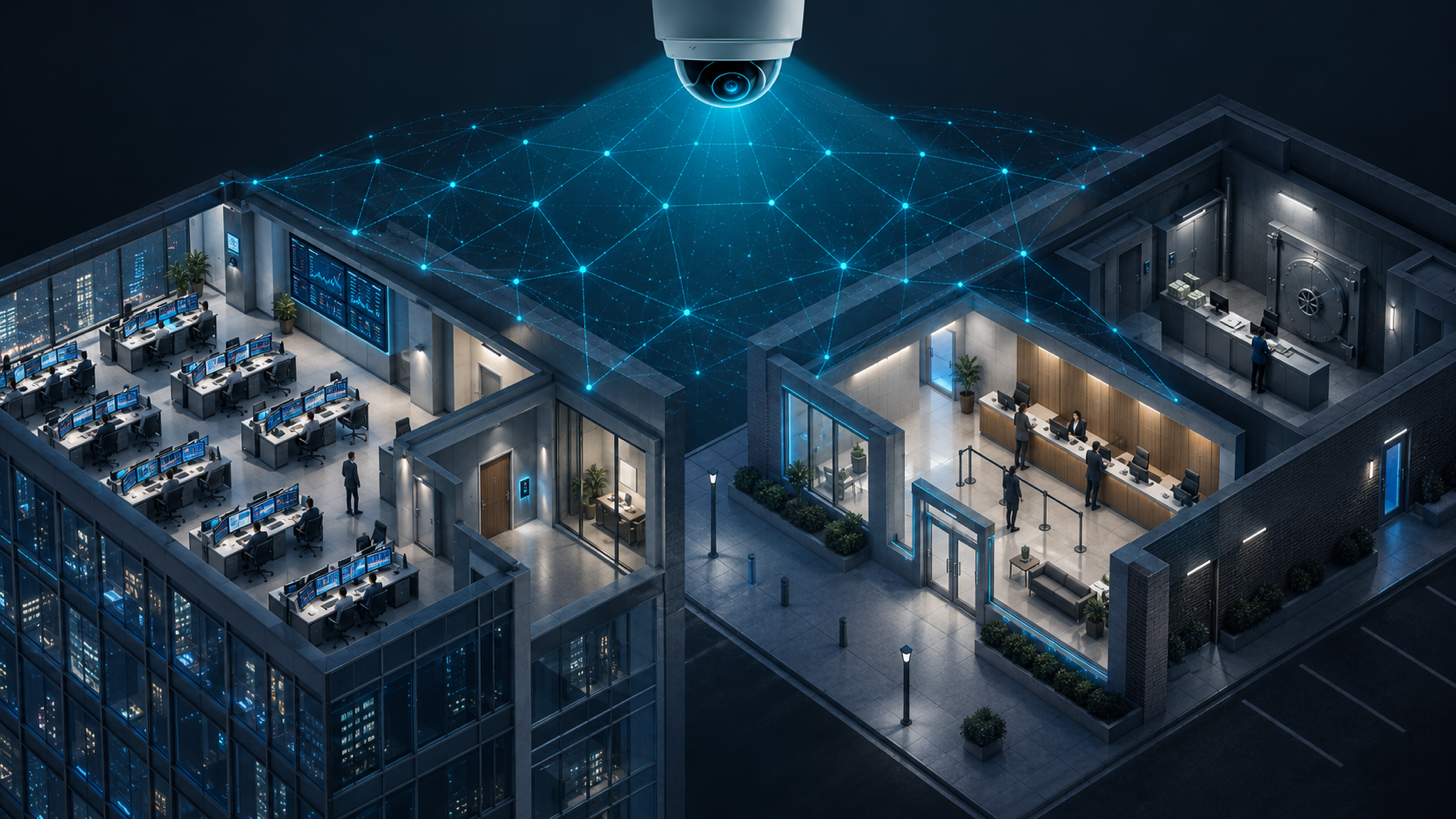
A Physical Security System for Banks Means More Than Cameras
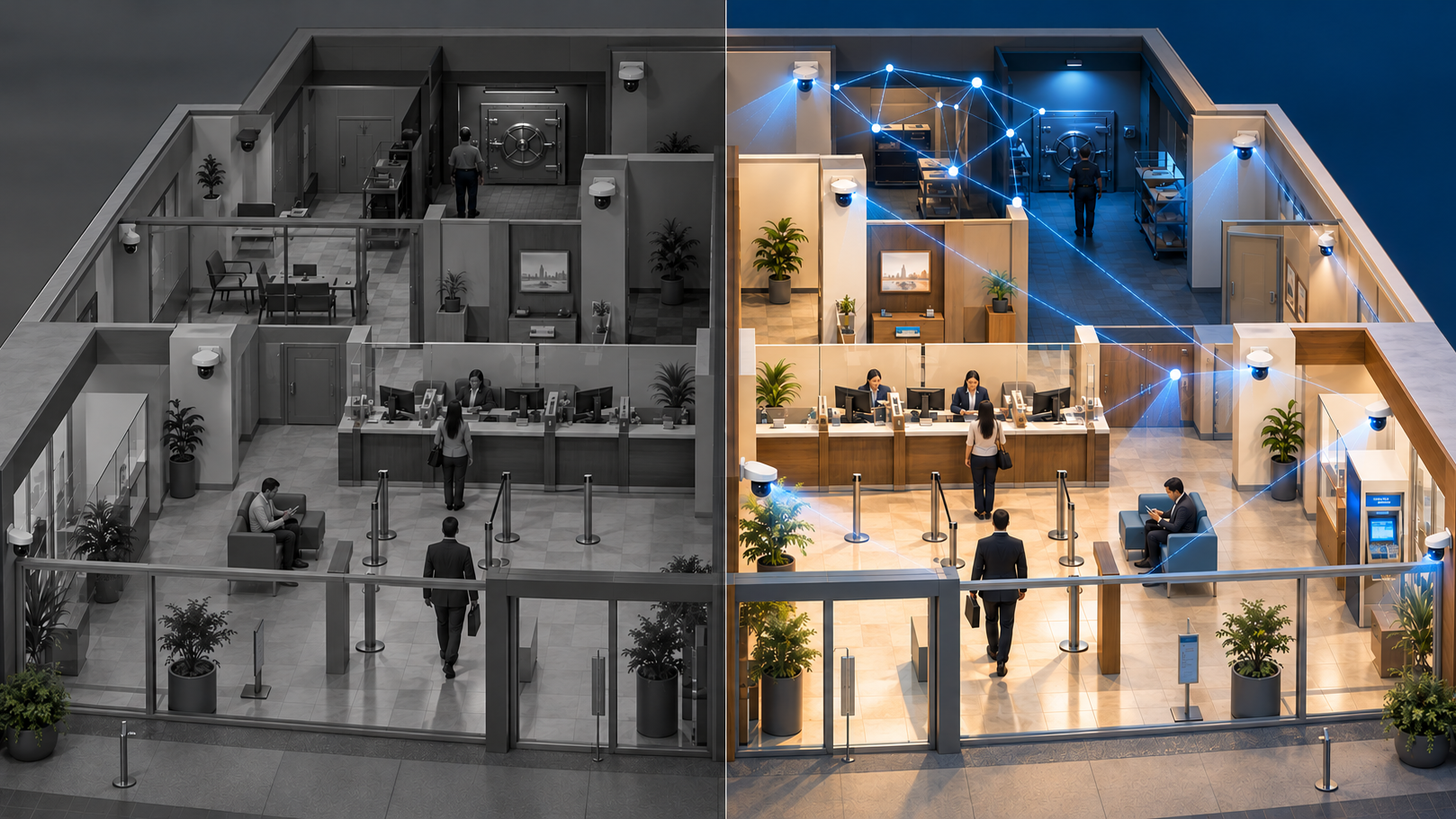


Same hardware. Different judgment. See it work.
TLDR
Most bank and credit union security leaders do not need convincing that a branch network has gaps in it. The harder problem is telling one approach apart from another when they can look nearly identical on paper. This piece sets out the criteria that actually separate them: continuous monitoring against reactive alarm response, what a distributed branch network requires that a single site does not, and where FFIEC and GLBA obligations end and real coverage begins.
Every Branch Already Has a Camera System. That Is Not the Same Claim as a Security System.
Walk into almost any branch and the equipment is already there. Cameras over the teller line, in the vestibule, at the ATM, and along the corridor to the vault. A recorder in a closet, an alarm panel by the back door, and a Physical Access Control System (PACS) on everything past the lobby. By the time anyone asks whether the branch is covered, every line on the equipment checklist is ticked.
That checklist describes what was purchased, but it does not describe what gets seen. A camera system answers a question after the fact, once someone already knows where to look. A security system answers whether anything happening right now needs a response, and if so, from whom and how soon.
The difference shows up precisely at the point of comparison. Two approaches can offer identical hardware and still differ completely on whether a branch is covered on a Tuesday afternoon when nobody is looking at the wall. That is why the useful evaluation is not an inventory. It is a set of criteria about judgment: what gets treated as worth a person's attention, when that decision happens, and what reaches whoever has to act on it.
This piece assumes the gap itself is already familiar, either from your own branches or from the companion look at the blind spot every financial institution building shares. What follows is a list to apply before that conversation begins, not after it has already set the terms.
Cameras Answer What Happened. A Security System Decides What Matters Right Now.
The instinctive answer to a coverage question is a coverage answer. Add cameras, raise resolution, extend retention. Each of those genuinely improves what can be reviewed after an incident, and yet none of them changes who is watching while the branch is open.
The evidence on what happens when the answer is a person is worth reading carefully. A 2015 study in Applied Ergonomics had CCTV operators watch continuous footage and flag target behaviors; roughly half were caught, with a high rate of false alarms alongside. The finding that matters for an evaluation is not that headline number, though. The novice and generalist operators were the ones who showed vigilance decrements, meaning detection falling off over time, while the specialists held their rate or improved on it after the first hour.
Read that against how a branch network is actually staffed. Whoever has eyes on a multi-branch feed is usually a generalist, covering monitoring alongside dispatch and alarm response. That is not a comment on anyone's diligence. It is a fact about the role, and it means the honest monitoring question is what the system does during the hours when nobody is a specialist and nobody is only watching.
That is the question Ambient.ai is built around. Reactive systems wait for a trigger. An alarm fires, someone pulls footage, and the judgment starts from zero at the least convenient moment available. Ambient.ai is an Agentic Physical Security platform that runs purpose-built reasoning vision-language models (VLMs) against the cameras and access control a bank already owns, continuously rather than on request, so the assessment of whether something matters happens before a person is involved, not after.
Armed robbery is where the difference gets concrete. Gun detection identifies a firearm the moment it becomes visible, but by then the incident has already begun. Weapons detection is the broader capability, covering the behaviors that surface before a weapon does. Neither one prevents anything on its own once the moment has arrived. Upstream behavior is what actually gives a branch time to act, whether that is someone loitering outside a secure door after hours, a vehicle parked in a restricted area longer than it should be, or a person loitering near the ATM at an odd hour. A false read on any of those carries real consequences, so whether a human looks at it first matters as much as catching the behavior at all. On Ambient.ai, that is why high-severity detections are routed through human verification in a 24/7 operations center before the bank is alerted.
A Lobby Camera and a Vault Camera Need Different Judgment, Not Just Different Angles
A branch is two buildings at one address, and the second one starts about twenty feet behind the first. The lobby is designed to let strangers in. The cash-handling room, the vault corridor, and the records area are designed to keep them out. Both are covered by cameras that look identical on a rack, which is where conventional analytics quietly go wrong.
Consider a person standing still for four minutes. In the lobby that is somebody reading a rate sheet while they wait, and flagging it would waste a response. In the corridor outside the vault at 6:40 on a Friday evening, the same four minutes is an entirely different fact, because the zone and the hour have changed even though the behavior itself has not. A system that applies one motion threshold per camera cannot separate those two, because the thing that distinguishes them was never an input.
Access control sharpens the point. A door held open on the back-of-house corridor generates an alarm from the PACS, and on its own that alarm says very little. It could be a courier with both hands full. It could be a badge clearing a door it should not clear for today. The event becomes useful only when it is read together with what the camera saw, the zone the door belongs to, the hour, and the pattern that zone normally runs. PACS is one input among several and never the whole picture. Read alone, an access event shows very little; read alongside the camera, the zone, and the pattern, it becomes useful.
So the criterion is not whether an approach covers both zones, since everything already does. What separates one approach from another is whether it reads zone and hour into the behavior at all, or leaves that judgment to whoever eventually looks at the clip. An alert carrying a clip, a location, and a stated reason is a dispatch decision, while an alarm code alone is only the start of a research project. what separates an alert worth acting on from alarm volume
Past a Certain Scale, Consistency Becomes the Whole Problem
According to the FDIC's BankFind institution data, JPMorgan Chase Bank, N.A. operates 5,395 branch offices, the largest branch network of any FDIC-insured institution. Long before a network reaches anything like that scale, it crosses a threshold, the point where no single person can hold every site in their head anymore. A forty-branch regional bank already crosses it; a three-branch community bank may not.
What changes past that threshold is not the security question at each branch. A vault is a vault in a city center and in a strip mall. What changes is everything surrounding the question. Is a policy written once actually running everywhere? Would anyone notice if a site quietly stopped reporting? The tempting fix, pushing that judgment down to branch staff who already know their own floor, adds the least-supported people in the network to the most consequential task. That is a systems problem, and every branch added makes it worse at a rate headcount cannot follow.
Ambient.ai answers this by splitting the job in two. Each site forms its own judgment about what just happened, right there, so a low-connectivity branch is still watched the same way as the flagship downtown. What gets pulled into the cloud is the part that only makes sense at the network level. That is what lets one person see every branch on a single screen, instead of fifty people each looking at one. adding intelligence to existing camera infrastructure rather than replacing it
An FFIEC Exam Checks Whether a Control Exists. It Never Asks Whether Anyone Was Watching.
Compliance pressure is real and arrives on a schedule, which is why it tends to set the agenda for physical security spending. The Gramm-Leach-Bliley Act's Safeguards Rule, per the FTC, requires administrative, technical, and physical safeguards sized to the sensitivity of the customer information a bank holds. Physical is named there alongside the other two, not an afterthought.
The FFIEC is more specific still. Its IT Examination Handbook extends security expectations explicitly to physical controls, covering prevention, detection, and identification of anyone accessing secured areas. Most banks will recognize the substance of that as things they already do. Badging, logging, restricted-area procedure, and camera coverage all map onto it cleanly.
Here is where the two questions come apart. An examination asks whether a control exists, whether it is documented, and whether you can evidence that it operated. Those are answerable with a policy binder and a system report. None of them asks whether anyone saw it happen in real time, while there was still time to act. A branch can hold complete, evidenced, examinable controls and still have had nobody notice a back-door event at seven on a Tuesday evening, because noticing was never what the control was asked to prove.
Keep the two separate in your own evaluation, and notice when an answer merges them. A response that meets a coverage question with a list of frameworks has changed the subject. No platform satisfies FFIEC or GLBA on a bank's behalf. That obligation sits with the institution and does not move. What an approach like Ambient.ai's can change is what actually gets seen inside the branch, which is the separate question, and the one worth carrying into a vendor conversation.
Build the Evaluation List Before You Take a Single Vendor Call
Everything above resolves into a list, and the list is worth more than any single meeting it gets applied to. A good vendor conversation should surface real strengths, and it goes better when you already know which ones matter most to you. A criteria list written beforehand keeps the terms of the evaluation yours, not whoever you happen to be talking to that day.
Six questions carry most of the weight. None of them is specific to one platform, which is the point, because each one scores any approach on a bank's own terms rather than on the vendor's.
- What is assessing the feed when nobody is watching it, and does that assessment happen continuously or only after an alarm has fired and someone has gone looking?
- Does the approach reason about zone, hour, and behavior together, or is each camera configured separately with its own threshold?
- When an alert fires, does it reach a person with a clip, a location, and a stated reason attached, or only a code that starts an investigation?
- Which detections does a human verify before the bank is alerted, and which arrive directly?
- Does adding the fifty-first branch mean rebuilding policy from scratch, or does it join a network that already enforces one policy everywhere, with a single view across all of it?
- Does the approach add intelligence to the cameras and access control already installed, or does it ask the bank to buy them a second time?
Notice what is missing from that list. There is no accuracy figure, no detection rate, and no total of cameras supported, because none of those survive contact with a branch network that behaves differently at seven in the evening than it does at noon. Every one of the six is about judgment, which is the part a specification sheet cannot carry. Take them into your own branches first, and let them guide every conversation that follows. The question worth holding onto is not which approach is strongest in general. It is which of these six a branch network like yours can least afford to get wrong.
Frequently Asked Questions
What is the difference between a bank's camera system and its physical security system?
A camera system records. A physical security system decides. The first tells you what happened once you already know where to look. The second determines whether something happening now warrants a person, and routes it with enough context to act on. A branch can have complete camera coverage and very little security coverage. The equipment list will not show the difference.
What is the difference between continuous monitoring and reactive alarm-based security for bank branches?
Reactive security waits for a trigger, and the assessment starts from zero once an alarm fires. Continuous monitoring reverses the order, assessing activity as it happens so the judgment is already made by the time a person is notified. Ambient.ai works the second way, running reasoning VLMs against existing camera and access control feeds continuously, with high-severity detections routed through human verification in a 24/7 operations center before the bank is alerted.
Do bank branches and back-of-house areas like vaults need the same security approach?
They need the same platform applying different judgment. A person standing still for four minutes in a lobby is a customer waiting; the same four minutes in a vault corridor after hours is not, even though the behavior itself is identical. The zone and the hour are what changed, and a security approach has to treat those as part of the read, not as an afterthought.
What does a multi-branch bank need from a security system that a single location does not?
Consistency and central visibility, neither of which a single site has to think about. A policy written once has to run the same way at the branch nobody visits as at the flagship, and someone has to notice if a site quietly stops reporting. That problem does not exist until there is a network large enough to lose track of a site inside it.
Does complying with FFIEC or GLBA mean a bank's branches are physically secure?
No. The GLBA Safeguards Rule requires physical safeguards sized to the sensitivity of customer information, and the FFIEC IT Examination Handbook extends security expectations explicitly to physical controls. Both ask whether controls exist, are documented, and can be evidenced. Neither asks whether anyone saw a given event, which is why a bank can satisfy an examiner and still have had nobody notice a back-door event on a Tuesday evening.
Key Takeaways
- A complete equipment inventory is a purchasing record, not a coverage statement. Identical camera counts can still differ entirely on whether anything gets seen while the doors are open.
- Human monitoring degrades unevenly. In the 2015 Applied Ergonomics study, vigilance decrements hit novice and generalist operators, not specialists, and branch networks are mostly watched by generalists.
- A lobby and a vault corridor need different judgment applied to identical behavior. Zone, hour, and pattern have to be inputs, not settings on a camera.
- What changes between one branch and fifty is not the security question at each site. It is whether policy stays consistent and whether anyone would notice a site that stopped reporting.
Next Step
The criteria above are worth more inside your own branch network than inside any one meeting. If it helps to see how the argument maps onto financial services specifically before the next conversation, Ambient.ai's approach to financial services covers it in full, and the one-pager covers it in short form.

Key Takeaways
A complete equipment inventory is a purchasing record, not a coverage statement. Identical camera counts can still differ entirely on whether anything gets seen while the doors are open.
Human monitoring degrades unevenly. In the 2015 Applied Ergonomics study, vigilance decrements hit novice and generalist operators, not specialists, and branch networks are mostly watched by generalists.
A lobby and a vault corridor need different judgment applied to identical behavior. Zone, hour, and pattern have to be inputs, not settings on a camera.
What changes between one branch and fifty is not the security question at each site. It is whether policy stays consistent and whether anyone would notice a site that stopped reporting.