Video Surveillance: What It Is and How It Works
Learn how video surveillance works, from IP cameras and NVRs to analytics and cloud storage, and what security teams need to know in 2026.
Video surveillance is a category of physical security technology in which cameras capture, transmit, and store video for deterrence, detection, situational awareness, and forensic investigation. The term covers legacy analog CCTV and networked IP camera deployments managed through software platforms. This article explains the core components, the signal chain from image capture to footage retrieval, and where the category stands in 2026.
Key Takeaways
- IP architecture has become the default for new deployments, reshaping how cameras, recorders, and management software interoperate
- Analytics and AI shift surveillance from passive recording toward proactive detection and faster operator response
- Convergence with access control and other security subsystems is reshaping how video fits into the broader physical security stack
What Video Surveillance Includes
The U.S. Department of Defense Center for Development of Security Excellence discusses Video Surveillance Systems (VSS) as an important component of physical security programs. In practice, "VMS" often refers specifically to the software layer, while "VSS" may be used to describe the complete surveillance system.
A few terms anchor the rest of the category.
CCTV originally described a closed-circuit television system where video signals reached a limited set of monitors rather than being publicly broadcast. Today, the term is used broadly to refer to video surveillance systems, whether analog or IP-based.
Analog cameras send video over coaxial cable to a DVR, where digitization and storage occur.
IP cameras handle digitization at the camera and transmit video over an Ethernet network to an NVR or VMS.
NVR (Network Video Recorder) is a dedicated hardware device or server-based software that receives, records, and stores already-digitized video streams from IP cameras over an Ethernet network. Unlike a DVR, which digitizes analog signals arriving over coaxial cable, an NVR ingests IP streams, writes them to storage, and indexes footage with metadata such as timestamps, motion events, and alarm triggers for later search and retrieval. NVRs are typically part of the on-premises storage model.
VMS is the software platform that ties the system together. It manages recording, playback, live viewing, and integration with other security systems across cameras.
Encoding and Transmission Fundamentals
These variables shape how much data a camera produces and how much infrastructure is required to handle it.
- Resolution is the pixel count of each frame. Higher resolution increases detail for forensic review and also increases storage and bandwidth consumption.
- Frame rate, measured in frames per second, determines motion continuity. Lower frame rates reduce storage and bandwidth compared to higher ones.
- Codec is the compression algorithm applied before transmission or storage. Different codecs change how efficiently video can be stored and transported, which affects retention duration and network load.
- Bitrate is the resulting data rate after compression, expressed in Kbps or Mbps. It can be constant, which simplifies storage planning, or variable, which adapts to scene complexity.
- Bandwidth is the network capacity available to carry these streams simultaneously, and it is often a primary constraint in large IP deployments.
How Video Surveillance Works End to End
The signal chain from image capture to retrievable footage involves distinct stages, each affecting the next.
Image Capture
Every surveillance system begins by converting light into a usable video signal. In IP systems, digitization happens at the camera itself, where an onboard encoder produces a compressed digital stream that travels over the Ethernet network. Moving this processing to the edge enables higher resolutions, richer metadata, and per-camera configuration that analog designs, which rely on the DVR to digitize at the far end, cannot match.
Compression and Multi-Stream Delivery
IP camera deployments often run dual or multi-stream configurations, where one stream is tuned for archival recording at full resolution and a second, lower-resolution stream feeds live operator viewing. This keeps the VMS client responsive across many simultaneous tiles while retaining full-quality footage for later investigation. Modern codecs such as H.264 and H.265 make these parallel streams practical by exploiting spatial and temporal redundancy between frames, producing much smaller files than uncompressed video while preserving the detail needed for forensic review.
Network Transport
Once compressed, video travels across the same IP network that carries other enterprise traffic, which makes network design a core part of surveillance planning. Switch capacity, VLAN segmentation, and quality-of-service policies determine whether streams arrive reliably or drop frames under load.
Power over Ethernet (PoE) sits at this same layer, letting a single Ethernet cable carry both the video data and the electricity a camera needs to run, so installers no longer have to pull a separate power line to every camera location. Because that power comes from the network switch, each switch has a limited total wattage it can supply across all its ports.
VMS Ingestion and Recording
The incoming stream is written to storage and indexed with information such as timestamps, motion events, alarm triggers, and analytics metadata so it can be searched alongside the video.
Recording modes vary by operational requirement.
- Continuous recording captures everything and is common in environments requiring uninterrupted audit trails.
- Event-based recording activates only on motion detection, alarm input, or other triggers.
- Scheduled recording follows time-of-day and day-of-week rules.
- Boost on event maintains a low-frame-rate continuous baseline and automatically elevates to higher quality when an event triggers, balancing storage efficiency with higher-quality capture during incidents.
Retrieval, Search, and Export
Operators access footage through the VMS. Live view renders video in a configurable tile layout. Recorded footage is searchable by timeline, by event type queried against the indexed metadata database, or through multi-camera synchronous playback synchronized to a common timestamp for incident reconstruction.
When footage is exported for investigations or legal proceedings, evidentiary standards such as chain-of-custody logging, cryptographic hash verification, and watermarking help preserve the integrity of the original video and its associated metadata.
Camera Types and Resolution Tradeoffs
Camera selection is driven by the operational task at the installation point: detection, recognition, or identification.
- Fixed cameras mount at a permanent angle and cover a stable field of view. They are often used for chokepoints, corridors, and doorways where scene geometry is known at installation.
- PTZ cameras provide remote-controlled pan, tilt, and zoom for wide-area coverage. Their limitation is sequential coverage: repositioning to follow an incident creates a blind spot in the previous field of view, which is why fixed cameras typically provide primary coverage with PTZ as supplemental.
- Dome cameras are housed in transparent, often tinted enclosures. They are often used where vandal resistance or directional ambiguity is valued.
- Thermal cameras detect heat signatures. They are used for detection and alerting.
- Multi-sensor cameras mount multiple discrete image sensors in a single housing, each with its own lens and processor, providing simultaneous multi-directional coverage without the blind-spot problem inherent to PTZ.
Camera mix and placement also vary by venue, with office buildings and school campuses presenting different coverage geometries, regulatory constraints, and operator workflows.

How Resolution Maps to Operational Requirements
The required resolution at any given camera is a function of the distance to the subject and the operational task. A camera covering a narrow doorway at close range may meet a higher pixel-density requirement than the same camera covering a long approach, unless sensor resolution, field of view, or both are adjusted.
The bandwidth and storage impact scales accordingly. Moving to higher-resolution cameras increases data volume under equivalent compression and frame rate settings, which is why codec support remains important in enterprise deployments specifying higher-resolution cameras.
Storage Architecture
Three storage models appear in video surveillance deployments.
On-premises (NVR/server) stores footage locally on dedicated hardware. The structural limitation is geographic: a physical compromise of the server room, whether fire, flood, or intrusion, can destroy all stored footage with no off-site copy. Many cameras support on-board SD card storage as a buffer against network outages, though capacity is limited.
Cloud (VSaaS) streams footage to cloud data centers.
Hybrid keeps recent footage on local hardware for fast access while replicating it to the cloud for off-site protection and long-term retention.
When AI runs against the cloud copy, processing scales independently of on-prem hardware and avoids the storage-room failure modes described above.
The Role of Video Analytics
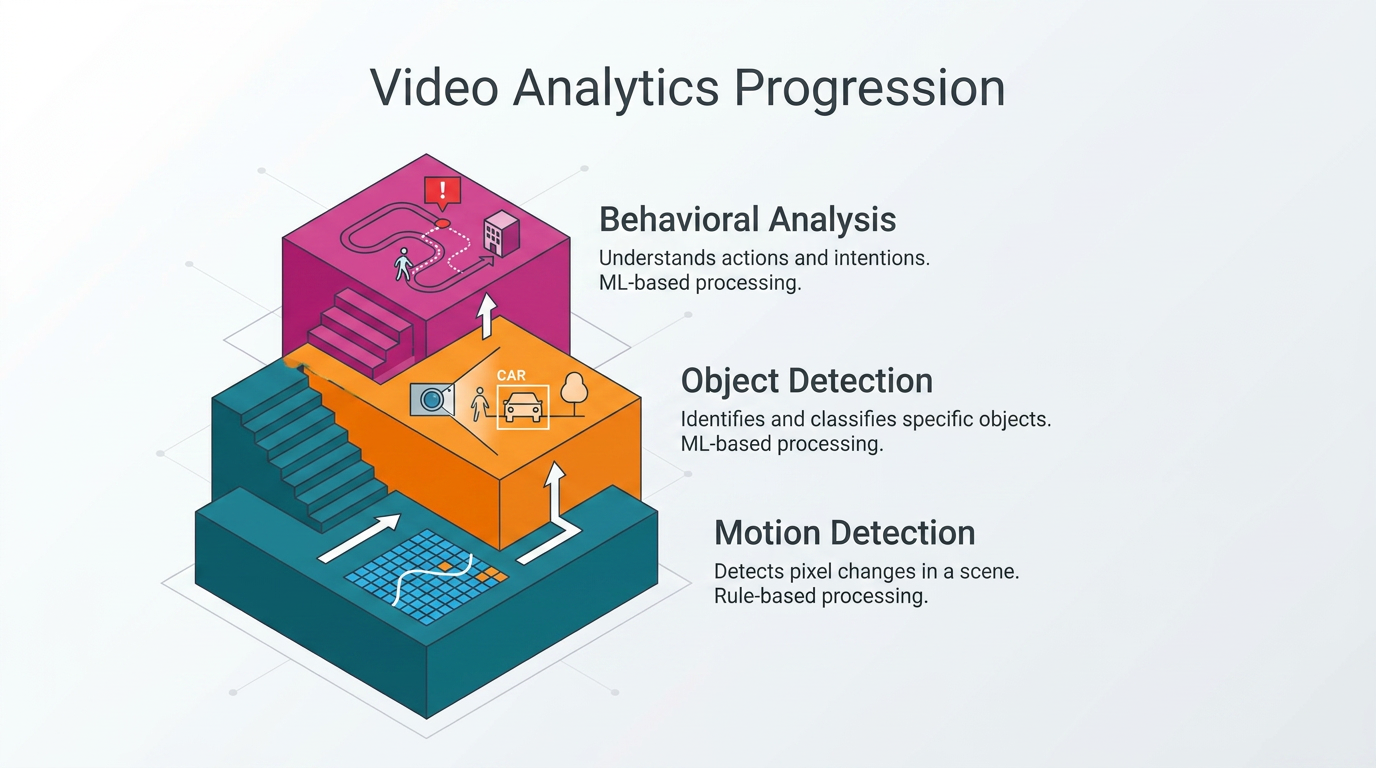
Video analytics layers processing on top of raw capture, progressing from simple pixel-level operations to content understanding. These analytics may run at the edge or on centralized servers.
Motion detection is the most fundamental layer: frame differencing and background subtraction produce a binary flag and a region of interest, identifying that something moved but not what it is.
Object detection identifies what is in the frame and where, producing bounding boxes with class labels and confidence scores. This type of analysis relies on machine learning models that interpret image content.
Behavioral analysis interprets what detected objects are doing over time. Rule-based implementations apply geometric and temporal rules to object tracks: a track remaining in a defined zone beyond a threshold triggers a loitering alert; a track crossing a virtual line triggers a perimeter breach. Machine learning-based approaches flag anomalies based on deviation from established norms.
The ASIS Foundation's AI guidance document frames the operational rationale: AI in security increases the probability and speed of detection, reduces operator workload and fatigue, and helps focus the attention of security personnel to where it is most needed. That rationale carries the most weight in distributed deployments where one team monitors many sites at enterprise scale.
Legal and Privacy Considerations
The signal chain handles what a system can technically capture and keep. Whether it is permitted to do so is a separate question, and the answer shifts from one jurisdiction to the next. Federal rules set a floor, but the constraints that most often shape a deployment come from state surveillance laws. These govern whether audio recording requires one-party or all-party consent, where cameras may legally point, how employers must notify staff of monitoring, and how long footage can or must be retained.
The practical risk is that a system can be well designed on bandwidth and storage and still create exposure on compliance. Capturing audio in an all-party-consent state, or pointing a camera at an area that carries a reasonable expectation of privacy, turns a working installation into a liability regardless of how the footage is stored. Because these rules differ by state, organizations operating across multiple locations cannot apply a single configuration everywhere. Confirming the requirements in each state where cameras run belongs at the planning stage, alongside camera placement and retention policy rather than after deployment.
Video Surveillance in 2026
A few big shifts are shaping where video surveillance stands today.
IP has become the default for new systems. Most new cameras ship with network-first specifications, including ONVIF Profile T support and PoE power delivery, making analog deployments increasingly rare outside of legacy environments.
Cloud and hybrid setups are now mainstream options. The SIA's 2026 Security Megatrends report highlights how SaaS and other service-based delivery models are changing the way organizations buy and run surveillance.
AI analytics are driving growth, even as camera hardware matures. The broader video surveillance market is increasingly shaped by technological transformation, with growing emphasis on software and analytics alongside maturing camera hardware. Teams adding analytics to installed fleets are increasingly looking at how to retrofit AI onto existing cameras rather than rip and replace.
Surveillance is increasingly connected to other security systems. ONVIF Profile M gives analytics applications a common way to share metadata and events, making it easier to tie video into access control, alarms, and other tools.
Cybersecurity is now part of the buying conversation. Teams are looking more closely at firmware updates, vendor practices, and network hygiene before signing off on new systems.
Where This Leaves Practitioners
For security teams specifying, operating, or modernizing a video surveillance system in 2026, the practical work comes down to matching the signal chain to the site. Camera selection should start from the operational task at each location, whether that's detection, recognition, or identification, rather than a catalog preference. Network capacity and storage sizing then follow from the bitrate those cameras produce and the retention window the organization needs to defend.
Analytics belong where they measurably reduce operator workload. With IP architecture, cloud delivery, and subsystem convergence now the baseline rather than the frontier, procurement conversations increasingly turn on integration depth, firmware discipline, and how well a platform will hold up through the next refresh cycle.
Frequently Asked Questions
What is the difference between a DVR and an NVR in a video surveillance system?
DVRs receive analog signals through coaxial cable and perform digitization at the recorder, while NVRs receive already-digitized IP streams over Ethernet. The key difference is where digitization occurs: NVRs rely on cameras to handle encoding before transmission.
How do you calculate the storage and bandwidth requirements for an IP camera deployment based on resolution, frame rate, and codec settings?
Multiply resolution by frame rate and bits per pixel, then apply codec compression ratio to estimate bitrate per camera. Aggregate across all cameras for total bandwidth, then multiply by retention hours for storage capacity. Account for headroom and metadata overhead.
How can AI video analytics be added to an existing camera system without replacing the hardware?
AI analytics can be deployed at the VMS layer or through cloud-based processing that ingests existing IP camera streams. This software-based approach applies machine learning models to video feeds already flowing from installed cameras, requiring no physical changes to endpoints.
