From Days to Minutes: How AI Forensics Transforms Security Incident Investigation
.webp)

Investigations that took days. Now answered in seconds.
Security incident investigation has traditionally been backward-looking. 69% of active shooter incidents end in 5 minutes or less. By the time traditional investigation workflows locate the right footage, the incident is already over. This isn't due to operator shortcomings, but because human attention simply cannot scale to monitor hundreds of cameras simultaneously while also searching historical footage.
But what if an investigation could happen in real time? AI-powered advanced forensics can detect behavioral precursors and surface threats at the earliest signs of escalation, giving security teams the window they need to intervene before a situation becomes a worst-case scenario.
Key Takeaways
- AI forensics transforms security investigation from backward-looking documentation into real-time intelligence that enables intervention during active incidents
- Natural language search and cross-camera tracking eliminate manual footage review and compress investigation timelines from days to seconds
- AI-powered video analysis integrates with existing camera infrastructure to make video instantly searchable without replacing current systems
- The shift from post-incident review to real-time investigation creates intervention windows that can prevent worst-case scenarios
Why Traditional Security Incident Investigation Is Outdated
Manual video review faces a scaling challenge: human attention cannot scale to modern camera infrastructure. Security teams must locate relevant footage without knowing which cameras captured activity or when it happened. Siloed camera systems compound this challenge, requiring separate searches across disconnected platforms. A comprehensive search across multiple cameras and several hours can consume entire shifts.
Traditional systems organize footage by camera and timestamp, but incidents rarely announce precise coordinates. When an incident occurs, security teams face immediate questions: Where did the person enter the facility? Which doors did they approach? Did they interact with others?
Without indexed video, answering these questions demands manual scrubbing through hours of footage from dozens of potentially relevant cameras. This delay means even the most skilled operators cannot overcome the fundamental mismatch between camera scale and human bandwidth.
From Post-Incident Review to Real-Time Security Incident Investigation
Traditional security incident investigation treats traditional cameras and monitoring systems as documentation, a way to understand what happened afterward. AI-powered video analysis can fundamentally shift this paradigm by enabling investigation during active incidents, analyzing video feeds in real time to understand activities, behaviors, and objects.
When a concerning situation develops, forensic search capabilities can track a person's movement across the facility in real time, identifying accessed areas and whether their behavior matches known threat patterns. Responders can arrive with visual context about what they're walking into.
Security teams can identify whether a person is acting alone or with others. The question shifts from "what happened?" to "what's happening and how do we respond?"
How AI-Powered Video Analysis Transforms Security Incident Investigation
The technology foundation that enables this shift centers on real-time video indexing powered by contextual intelligence. Systems can understand video content semantically, processing what's happening rather than just recording it. When an incident occurs, the footage is already processed and searchable with no delay between query and results.
AI-Powered Security Incident Investigation Capabilities
Three core capabilities enable rapid security incident investigation:
Natural Language Search
Searching video using conversational descriptions fundamentally changes investigation workflows. Security teams describe what matters, such as "person in red shirt near loading dock" or "person in construction vest near data center entrance between 6 AM and 10 AM," and receive relevant footage within seconds.
This eliminates the need to remember which specific cameras cover which areas or to manually review footage from each potentially relevant location.
Similarity Search and Cross-Camera Tracking
After identifying a person or vehicle in a single frame, a similarity search finds all appearances across the camera network. An unauthorized individual spotted at one entrance can be instantly traced through their complete journey across the facility, which doors they approached, which areas they accessed, and whether they interacted with other individuals.
This capability proves critical for accomplice identification. When investigating a security incident, teams often need to determine whether the primary individual acted alone or coordinated with others. Similarity search can surface every interaction the subject had throughout their time on premises, revealing potential accomplices who may have provided access, served as lookouts, or coordinated movement patterns. This should be done purely based on shapes and colors, without facial recognition or other types of profiling
Continuous video indexing enables security teams to track an individual's current location during an active incident while simultaneously pulling their complete movement history across the facility, all from a single search query.
License Plate Recognition
Automated license plate recognition transforms vehicle tracking from manual review into an indexed capability. Every vehicle entering or exiting parking areas, loading zones, or perimeter access points is logged automatically with timestamps and locations.
AI systems can also index specific vehicle behaviors that warrant investigation, including vehicles parked for extended periods without occupants exiting, vehicles departing immediately after an incident, and unusual parking patterns in restricted or sensitive areas. These indexed behaviors provide investigators with starting points when vehicle involvement is suspected.
When an incident involves a vehicle, investigators can immediately identify when it arrived, trace its movement through the facility, and determine when it departed. License plate recognition also enables watchlists that alert security teams when specific vehicles of interest appear anywhere across the camera network.
Intercepting Threats During Security Incident Escalation
Real-time investigation capabilities create intervention opportunities that don't exist in traditional post-incident review. Many high-severity incidents include behavioral precursors and escalation phases that unfold over minutes or hours.
When systems surface suspicious behavior, security teams can examine the situation immediately while monitoring its development. Threat detection combined with cross-camera tracking shows where the individuals involved came from and whether others are involved. Investigators can identify patterns that indicate escalating risk, such as someone spending unusual time near restricted areas, repeated attempts to access secured doors, or coordination between multiple individuals.
Connecting Behavioral Precursors to Investigation Triggers
Specific AI detections serve as entry points for forensic investigation workflows. Behaviors like person loitering near sensitive areas, group loitering that suggests coordination, or individuals interacting with gates and fences can trigger immediate forensic searches. When these precursors are detected, security teams can instantly pull the individual's complete activity history to assess whether the behavior represents an isolated anomaly or part of a larger pattern.
Visual Intelligence for Field Responders
Field responders benefit from visual intelligence before arriving on scene. Rather than responding blind to an alert, they understand who they're engaging with, where the person has been, and whether the situation involves multiple individuals. For high-severity threats, gun detection capabilities can provide immediate alerts with visual confirmation. This context supports more informed tactical decisions and coordinated positioning.
The shift from documentation to intervention represents the fundamental value proposition: security operations that can help prevent incidents rather than only record them.
Building Security Incident Investigation Workflows Around AI Forensics
When intelligent video indexing handles search and discovery, security teams can restructure workflows around verification, analysis, and response rather than manual footage review. Alerts link immediately to relevant footage, eliminating the delay between notification and visual confirmation.
Security operations centers and field responders operate from the same real-time visual intelligence. SOC operators direct responders based on current tracking data while simultaneously building situational context through historical searches. When responders arrive, they already understand the incident timeline, involved individuals, and accessed locations.
Automated Evidence Compilation for Security Incident Investigation
Documentation workflows transform dramatically with AI-powered forensics. Instead of compiling footage manually from multiple systems, investigators can auto-generate comprehensive incident documentation with complete timelines, all relevant footage clips, and access control correlations in minutes rather than hours. This automated evidence compilation directly reduces mean time to resolution while producing more thorough documentation packages.
Complete evidence packages support both internal resolution and external coordination with law enforcement when required, with every relevant camera angle and timeline automatically assembled.
Integrating AI Investigation with Existing Infrastructure
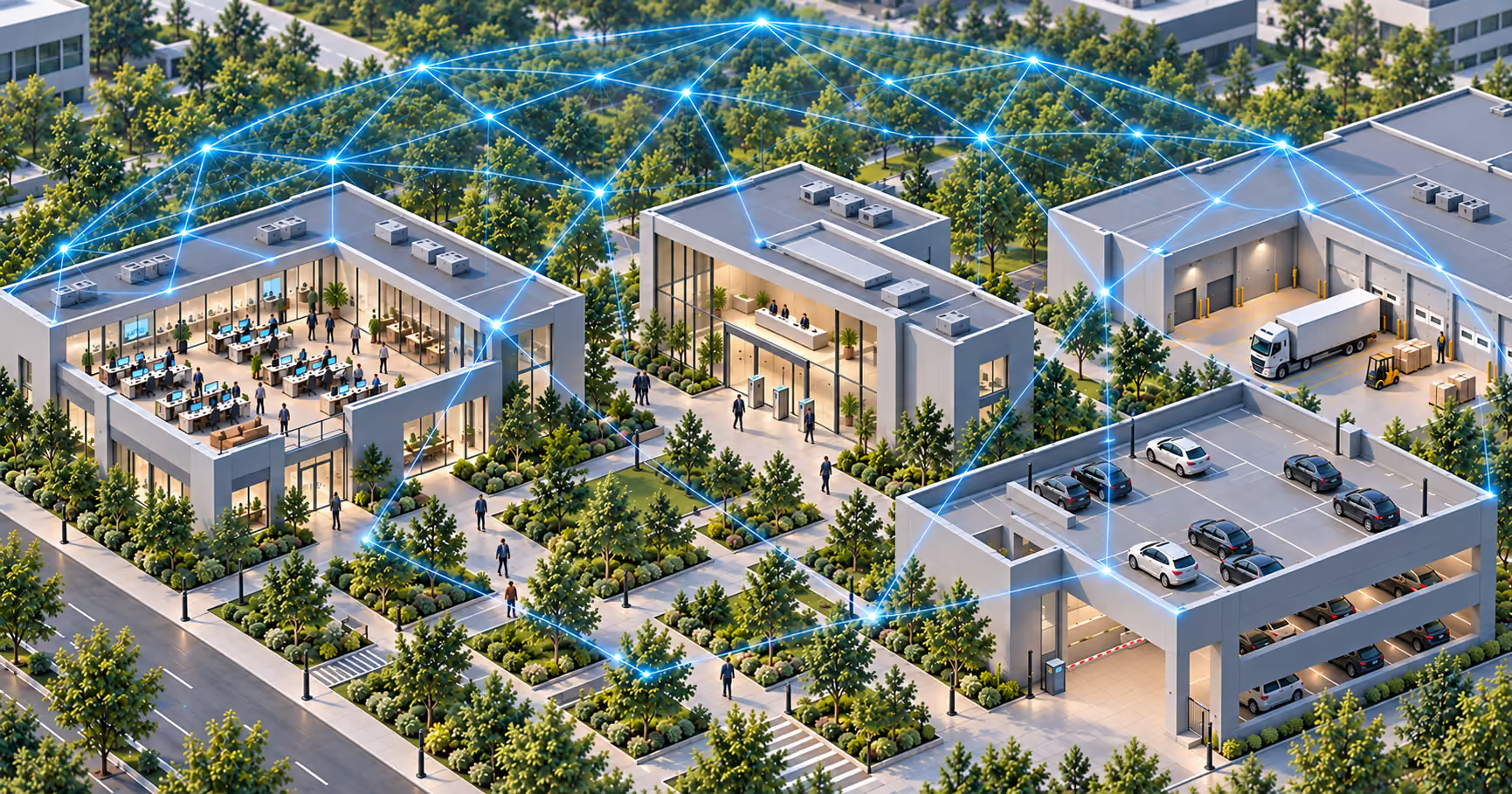
AI-powered video analysis capabilities ideally deploy as an intelligence layer compatible with existing camera networks through separate edge processing appliances that analyze video feeds. In many deployments, compatible cameras continue functioning with their current video management systems while AI processing occurs on edge devices.
Integration with VMS platforms allows security teams to maintain their existing monitoring workflows while gaining intelligent search capabilities. Organizations gain centralized search across multi-site deployments, enabling security teams at headquarters to investigate incidents at any facility location from a unified interface. Combined with access intelligence, teams can correlate video footage with access control events for complete situational awareness.
This architecture approach supports incremental adoption. Security teams can validate forensic capabilities on high-priority camera zones before expanding coverage facility-wide or across multiple locations.
Measuring Security Incident Investigation Performance Improvements
Organizations can measure the impact of forensic searches across three key areas:
Investigation efficiency includes time-to-evidence for locating and compiling relevant footage, as well as investigation closure rates measuring the percentage of incidents fully resolved with identified individuals and complete activity timelines.
Operator productivity improvements manifest as eliminated footage review hours that become available for verification, analysis, and response activities. Security teams can handle higher incident volumes without additional headcount, or reallocate operator time toward proactive security initiatives.
Evidence quality gains are reflected in complete activity timelines with all relevant footage across multiple cameras. Comprehensive evidence packages support both internal resolution and law enforcement coordination while reducing liability exposure from incomplete incident documentation.
The Path to Agentic Physical Security
For organizations building mature, AI-driven physical security programs, advanced forensics represents a critical capability within a broader transformation. Agentic Physical Security unifies threat detection, access control monitoring, and forensic investigation under a single intelligence layer, eliminating the manual correlation required when these functions operate as siloed systems.
Ambient Advanced Forensics makes every camera instantly searchable through real-time Ambient Intelligence. Natural language search, cross-camera tracking, and automated license plate recognition compress investigation timelines from days to seconds. Teams can resolve over 80% of alerts in under one minute and conduct investigations up to 20x faster than traditional methods.
Integrated with the AI-native video management platform, the Ambient Platform unifies threat detection, alert verification, access intelligence, and forensic investigation through a single AI engine.
Deployed across Fortune 100 enterprises, data centers, corporate campuses, and critical infrastructure, edge processing appliances transform existing camera networks into active security tools that enable intervention rather than just documentation.
Request a demo to see how Ambient Advanced Forensics can transform your security incident investigation workflows.
Frequently Asked Questions about AI Forensic Investigation
What makes AI forensic investigation different from traditional video review?
AI forensic investigation uses intelligent video indexing to analyze and search video in real time rather than requiring manual frame-by-frame review. Security teams can search footage using natural language descriptions and track individuals across entire camera networks instantly. This transforms investigation from a time-consuming post-incident process into real-time intelligence that supports active response and intervention.
How does cross-camera tracking work during an active security incident?
Cross-camera tracking uses similarity search to identify every appearance of a person or vehicle across your entire camera network from a single frame. During an active incident, security teams can simultaneously monitor the individual's current location while pulling their complete movement history. This also enables accomplice identification by surfacing every interaction the subject had with other individuals. This provides responders with full situational context before they arrive on scene.
Can AI forensic tools integrate with existing security camera systems?
AI forensic capabilities typically deploy as an intelligence layer that works with existing camera networks through edge processing appliances. Compatible cameras continue functioning with current video management systems while AI processing occurs separately. This architecture supports incremental adoption and allows organizations to validate capabilities on priority areas before expanding coverage.
How does Ambient Advanced Forensics accelerate security investigations?
Ambient Advanced Forensics fundamentally restructures investigation workflows by making every camera instantly searchable through natural language queries. Rather than manually reviewing footage from individual cameras, security teams describe what they're looking for and receive relevant results across the entire network in seconds. The Ambient platform integrates forensic search with threat detection and access intelligence through Cloud SOC, allowing investigators to correlate video footage with access control events from a single interface. This unified approach eliminates the delays inherent in switching between disconnected systems and enables security teams to intervene during active incidents rather than documenting them afterward.