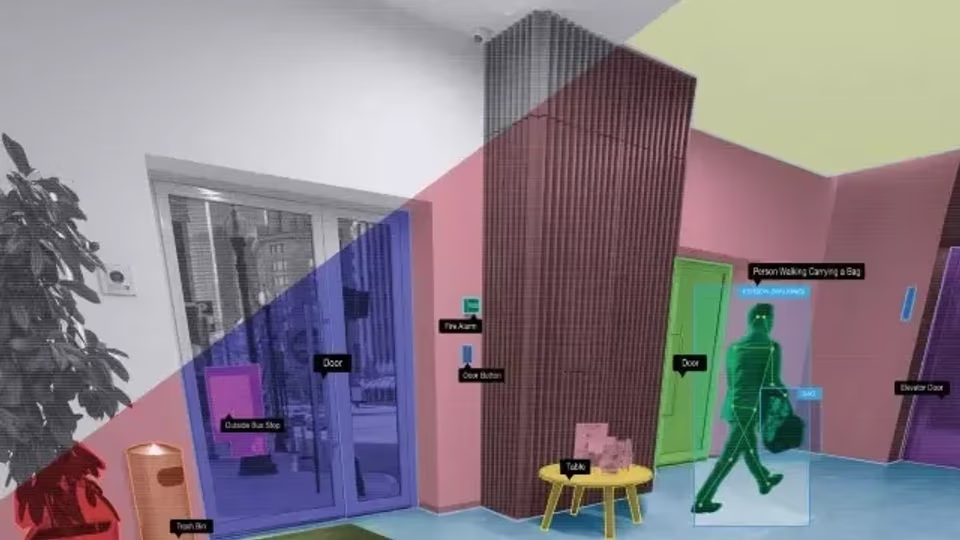
AI Video Analytics for Physical Security: A Buying Guide
.webp)

10x faster response. Same cameras. Same team.
Video Analytics for Physical Security: What's Working and What's Not in 2026
Video analytics has been the security industry's go-to technology for improving camera monitoring, but even AI-enhanced versions of these tools still leave teams stuck in a reactive posture. Alert fatigue from high false alarm rates, cognitive overload from excessive video feeds, and incident response that starts after the fact remain persistent challenges that video analytics alone cannot solve.
The scale problem is significant. Research cited in the security industry suggests that after about twenty minutes of observing a single screen, operators may lose up to 95% of their attentional focus. That means behavioral precursors can go unnoticed until situations escalate into full incidents.
Addressing these pain points requires moving beyond video analytics entirely toward systems that understand context, interpret intent, and act autonomously. This guide explains how traditional video analytics works, where it falls short, and what to look for in the next generation of intelligent security technology.
Key Takeaways
- Traditional video analytics, even AI-enhanced versions, still relies on detection without understanding, leaving security teams reactive and overwhelmed by false alarms
- Reasoning AI that analyzes intent, environment, and behavioral patterns separates genuine threats from routine activity, moving teams from pixel-based alerting to scene-level comprehension
- Enterprise security programs can reduce alarm fatigue and accelerate investigations by deploying AI that goes beyond video analytics to verify threats automatically and enable natural language video search
- Evaluating what works for your program requires assessing contextual analysis depth, false alarm reduction, and seamless integration with existing camera and access control infrastructure
AI Video Analytics Explained
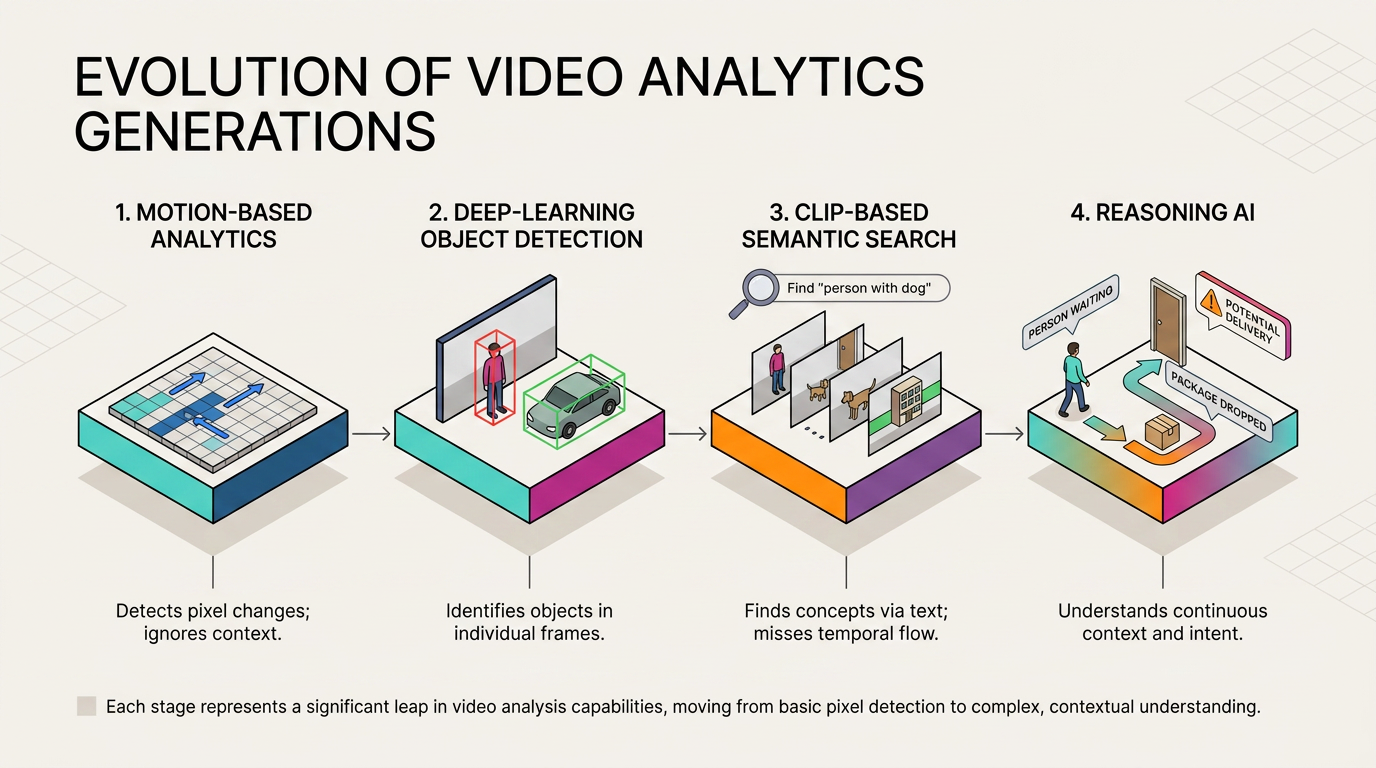
Video analytics refers to the use of software to automatically analyze surveillance video for security-relevant activity. The technology has evolved through several generations, each adding capability but carrying forward fundamental limitations.
The earliest and still most common form is motion-based analytics, which detects pixel-level changes within defined zones and triggers alerts when movement crosses a threshold. These systems are inexpensive and easy to deploy, but have no understanding of what is moving or why it matters. Shadows, lighting shifts, and routine foot traffic generate the same alerts as genuine threats.
Deep-learning detectors improved on this by recognizing specific objects, such as people, vehicles, or weapons, within individual frames. But they still operate on a single-frame basis, detecting that an object is present without interpreting whether the behavior around it is normal or concerning.
More recent CLIP-based analytics associate visual content with text to enable semantic search, while cloud-based VLM approaches can interpret complex scenes within single frames. Both rely on sub-sampling and cloud processing, meaning they capture snapshots rather than continuously monitoring activity. Brief events like tailgating or escalating confrontations are bound to be missed.
According to Mordor Intelligence, the AI video analytics market is projected to reach USD 17.24 billion by 2031. But the critical distinction for security buyers is that all of these approaches are designed to detect, not to understand. They answer "what is here?" but not "what is happening?" or "what might happen next?" Addressing that gap requires a fundamentally different capability: continuous contextual reasoning that interprets intent, assesses risk, and acts autonomously.
Where Video Analytics Ends and Intelligent Threat Detection Begins
The next generation of physical security AI goes beyond what video analytics can deliver by monitoring surveillance video the way a trained security professional would. Human perception centers on context, and context is crucial in security. AI takes in the context of a scene, including location and interactions between objects, to accurately evaluate security threats and automatically trigger actions.
Consider this scenario: an employee propping open a side door during a scheduled delivery is routine activity. That same door held open at 2 AM with no delivery on the calendar is a potential security breach. Contextual AI recognizes the difference by evaluating time of day, location, and behavioral patterns, then automatically escalating only the events that warrant operator attention.
This can create significant benefits for your physical security operations:
- AI can free security personnel from constant video surveillance, allowing them to focus on higher-value response and prevention activities.
- Teams gain real-time situational awareness and early warning signs, enabling proactive intervention before incidents escalate.
- Intelligent alarm verification can substantially reduce false PACS alarms, cutting through the noise that burdens operators.
- Detection of behavioral precursors like loitering, crowding, or individuals testing access points provides early threat indicators that traditional systems miss.
- Actionable intelligence on tailgating hotspots, camera blind spots, and Physical Access Control Systems violations enables smarter operational decisions.
How Intelligent Security AI Solves Physical Security Challenges
Intelligent security AI can serve as the central hub of your security program, constantly monitoring all cameras and alarm endpoints, identifying threats with maximum accuracy, and reducing the cognitive demands on your team.
Moving from Reactive to Proactive Security
Manual video surveillance monitoring, alarms generating thousands of false positives daily, and the inability to have security officers everywhere leave teams in a reactive posture. Advanced AI can extend the human capabilities of your security team by continuously monitoring your security systems.
AI maintains automated monitoring that may enable faster and more accurate threat detection with minimal human intervention, automatically identifying and alerting operators of threats in real-time with contextual information needed for appropriate response.
The shift to proactive security fundamentally changes how teams operate. Rather than responding to incidents after they occur, AI can detect early warning indicators such as loitering near secure entrances, tailgating attempts, unusual after-hours activity, or individuals testing access points.
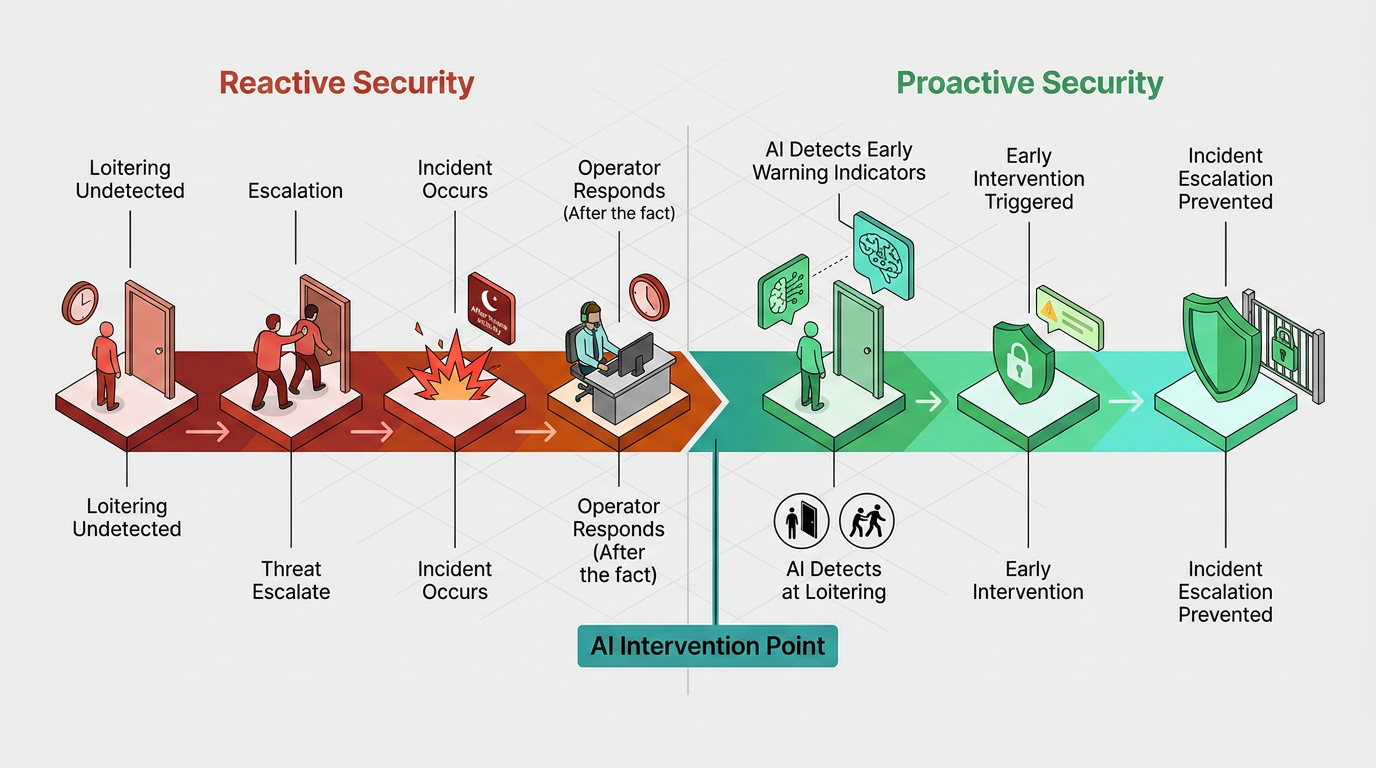
This continuous monitoring approach integrates with PACS and perimeter defenses, creating a unified security posture where potential threats are identified at the earliest possible stage. Security teams can then intervene before situations escalate, transforming their role from incident responders to incident preventers.
Managing Overwhelming Alarm Volumes
The average operator spends countless hours verifying alarms, many of which turn out to be false positives. Control room operators experience cognitive overload from monitoring excessive video feeds and alarm fatigue from high alert volumes, leading to reduced detection rates.
An advanced AI solution can enable automatic verification of nuisance alarms, reducing noise, enabling smarter alarm prioritization, and freeing security teams to investigate actual incidents. AI-driven smart monitoring surfaces only the cameras showing relevant activity, replacing the static video walls that contribute to operator overload. The ability to understand scene context is key to distinguishing false alerts from real threats.
Accelerating Investigations
Today's security video investigations are time-consuming, sometimes taking hours or days to complete. AI-powered forensic search detects complex behaviors and patterns, empowering investigators to search directly for specific events of interest rather than relying on basic person and object detection alone.
Investigators can search for specific behaviors, like a person carrying a bag, to locate desired scenes in minutes. Faster investigations increase the odds of apprehending perpetrators and recovering valuable assets.
Enabling Data-Driven Decisions
Without advanced analytics, raw data from cameras and Physical Access Control Systems generates high alert volumes and false alarms. AI-powered systems can transform that data into actionable behavioral intelligence, identifying loitering hotspots, tailgating events, unauthorized access patterns, and other critical security insights that manual monitoring would miss.
2026 AI Video Analytics Market Trends
The physical security AI landscape continues to evolve rapidly, with several key trends reshaping enterprise physical security capabilities.
Vision-Language Models (VLMs) represent one of the most significant advances, enabling security personnel to search footage using natural language queries. Rather than manually scrubbing through hours of video, operators can potentially ask systems to "show me people who entered through the loading dock carrying packages after 6 PM" and receive relevant results in seconds. This capability may transform investigation workflows and reduce the technical expertise required to leverage video analytics effectively.
Edge computing and Edge AI are moving analytics processing to dedicated edge appliances near camera infrastructure, enabling faster real-time detection with reduced bandwidth requirements. This architectural shift can ensure operational reliability and supports privacy compliance by processing data locally without mandatory cloud transmission.
Multi-sensor AI combines video analytics with PACS events and environmental sensors to create more comprehensive threat assessment. Systems can correlate visual data with access control events and other sensor inputs, requiring multiple confirming signals before escalating alerts. This fusion approach has the potential to dramatically reduce false positives.
Privacy-preserving AI approaches Privacy and compliance considerations are increasingly shaping the adoption of AI approaches. Modern systems increasingly prioritize behavioral analysis over individual identification, using privacy-preserving approaches that avoid facial recognition while aiming to maintain security effectiveness.
Behavioral analytics advancement continues to improve contextual understanding, with systems learning facility-specific patterns to distinguish between normal operations and genuine anomalies. This evolution from rule-based detection to true behavioral understanding can reduce false alarms while catching subtle threat indicators that simpler systems miss.
ROI and Business Impact
For security leaders justifying technology investments, AI video analytics can deliver compelling financial returns. According to ISC West research, 86% of end users see ROI from video analytics within one year.
The operational savings extend across multiple dimensions. Organizations have documented substantial reductions in manual monitoring effort, freeing security personnel from constant screen-watching to focus on higher-value activities. Faster investigation times translate directly to improved case resolution and asset recovery rates.
Beyond direct savings, AI video analytics can address the industry's workforce challenges. More than 40 percent of security service providers selected turnover as their top challenge over alternatives like margins and profitability, wage and labor compliance, accounts receivable, and insurance cost.
Technology that reduces cognitive burden and alarm fatigue can improve retention while enabling smaller teams to manage larger facility portfolios effectively. For budget-conscious decision-makers, these efficiency gains often justify investment within the first year of deployment.
Top AI Video Analytics Tools for Physical Security
Top AI Video Analytics Platforms for Physical Security
Ambient.ai is the category leader in Agentic Physical Security, powered by Ambient Intelligence and reasoning Vision-Language Models purpose-built for physical security. Delivers autonomous threat detection across 150+ threat signatures, real-time contextual analysis, and significant false alarm reduction for Fortune 100 companies.
Verkada offers a hybrid cloud physical security platform combining AI-powered cameras, access control, and environmental sensors with natural language search, real-time alerts, and unified analytics managed through a single console.
Rhombus provides a cloud-managed physical security platform with AI-powered video analytics, access control, and environmental sensors, featuring natural language search and customizable operational analytics through LLM integration.
ZeroEyes specializes in AI-powered gun detection that layers onto existing security cameras, with all detections verified by trained military and law enforcement veterans in an in-house operations center before alerts are dispatched.
Avigilon (Motorola Solutions) delivers enterprise AI video analytics with object detection and classification capabilities, integrating with Motorola's broader security ecosystem, including Physical Access Control Systems and radio communications.
BriefCam (Canon) features patented VIDEO SYNOPSIS technology that condenses hours of surveillance footage into minutes of reviewable content, combining forensic video review with real-time alerting and analytics.
Coram provides a cloud-based video security platform with AI-powered search, gun detection, and access control, designed for education and mid-market deployments.
Ambient.ai Delivers Agentic Physical Security Where Video Analytics Falls Short
Ambient.ai, the category creator and leader in Agentic Physical Security, brings these capabilities together through a unified platform powered by Ambient Intelligence, the industry's first reasoning Vision-Language Model purpose-built for physical security.
Ambient Threat Detection continuously processes live video feeds to identify and assess 150+ threat signatures, from perimeter breaches and tailgating to assaults and brandished firearms. Powered by contextual threat analysis, it distinguishes genuine threats from routine activity in real time, giving security teams the situational awareness to respond to incidents as they unfold rather than after the fact.
Ambient Access Intelligence connects bi-directionally to Physical Access Control Systems and links DFO and DHO alarms with camera footage to verify what actually happened at the door. By automatically clearing 95% of false PACS alarms, it eliminates thousands of hours of manual review and lets operators focus exclusively on validated access violations.
Ambient Advanced Forensics collapses investigative timelines from hours or days to seconds, resolving incidents up to 20x faster through natural language search across thousands of camera feeds.
Together, these capabilities help security teams move from reactive monitoring to proactive, intelligence-driven operations at enterprise scale.
AI Video Analytics Success Stories
Industry leaders using advanced AI video analytics achieve substantial, documented results across threat detection, alarm reduction, and investigation efficiency.
VMware Decreased Alarms by Over 93%
Before implementing Ambient.ai, the physical access control system (PACS) at VMware's Palo Alto campus would generate about a million false alerts per year. The vast majority of alerts were false positives, but operators still had to respond to each one as if it were an actual breach.
Responding to the false alerts burdened their resources and detracted attention from higher-value activities. But with Ambient.ai, the team can automatically verify alerts, filter out the noise, and measure the complete lifecycle of an incident. As a result, VMware reduced false positives and decreased alarms by over 93%.
NorCal Cannabis Cut Down Investigations to Under One Hour
With the risk of theft and their strict regulatory environment, NorCal Cannabis needed to find a way to investigate incidents as fast as possible. But even after investing in cameras and thorough processes, video analysis and forensics still took too long for the team.
That all changed after they used Ambient.ai. The platform both decreased the burden of monitoring hundreds of cameras and streamlined investigations. With Ambient's ability to quickly search for specific scenes in video footage, NorCal Cannabis reduced investigation times from days to under one hour.
Request a demo to discover how Ambient.ai helps Fortune 100 companies see real results from their security operations.
Frequently Asked Questions
How does reasoning AI differ from traditional deep-learning video analytics in reducing false alarm rates for physical security teams?
Reasoning AI applies continuous contextual analysis across multiple frames and environmental factors to interpret behavioral intent, while traditional deep-learning analytics only detects object presence in isolated frames without understanding whether activity represents normal or threatening behavior.
What should enterprise security leaders look for when evaluating AI video analytics platforms for integration with existing PACS and camera infrastructure?
Prioritize platforms offering edge processing for data privacy compliance, documented false alarm reduction rates with customer references, native bidirectional PACS integration rather than middleware dependencies, and vendor support for ONVIF and RTSP standards to help improve compatibility with existing cameras and reduce the need for hardware replacement.
How does edge-based AI processing for video analytics compare to cloud-based approaches in terms of real-time threat detection and privacy compliance?
Edge processing delivers faster detection by analyzing video locally on dedicated appliances near cameras, eliminating cloud transmission latency. It also strengthens privacy compliance by keeping sensitive footage on-premises, avoiding mandatory external transmission while maintaining full operational capability during network disruptions.