Agentic AI in Physical Security: What It Is & How It Works


10x faster response. Same cameras. Same team.
Every camera added to an enterprise network creates more data than any operator can absorb. The math simply doesn't work: security teams tasked with protecting sprawling campuses and distributed facilities cannot watch every feed, verify every door alarm, and catch every threat in real time. The challenge isn't dedication or skill. It's physics.
Agentic AI security represents a fundamental shift in how organizations approach this problem, moving from reactive documentation to proactive threat detection without requiring proportional headcount increases.
What is Agentic AI in Physical Security?
Agentic AI in Physical Security represents a fundamental shift from passive surveillance to autonomous threat detection. Unlike traditional security technology that simply records and alerts on motion, agentic AI operates through intelligent agents\continuously analyzing video feeds, correlating data across multiple sources, and making contextual decisions about potential threats.
This technology enables security teams to move from reactive documentation to proactive incident prevention, acting autonomously to detect, assess, and prioritize security events while keeping humans in control of critical decisions.
At the core of this capability are Vision-Language Models (VLMs)—AI architectures that combine visual understanding with natural language reasoning. VLMs interpret scenes contextually, understanding not just what objects appear in frame but the relationships, behaviors, and intent behind observed activity. This contextual reasoning distinguishes genuine threats from routine operations that would trigger false alarms in traditional motion-based systems.
How Agentic AI Processes Security Intelligence
Visual Perception and Frame Analysis
The technical foundation begins with visual perception engines that decompose video streams into analyzable components. These engines process each frame to identify objects, people, movements, and spatial relationships—building continuous understanding of scene dynamics across all monitored feeds.
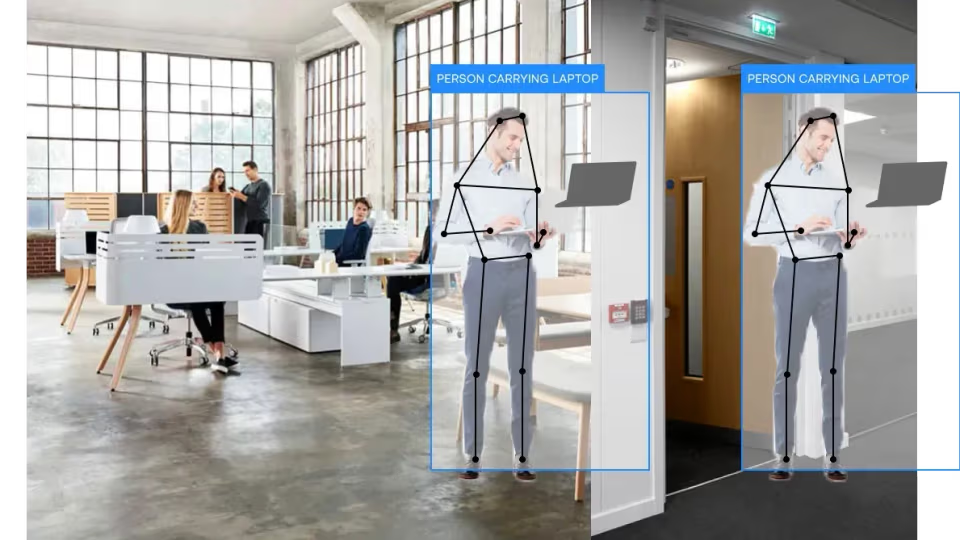
Unlike simple motion detection that flags pixel changes, visual perception extracts semantic meaning: distinguishing a person from a shadow, recognizing carried objects, and tracking movement trajectories.
Real-Time Stream Indexing
Continuous indexing transforms raw video into searchable intelligence. As frames process through the visual perception layer, metadata tags capture detected objects, behaviors, locations, and timestamps. This creates an instantly queryable archive—enabling operators to search hours of footage across hundreds of cameras in seconds.
An investigator searching for "person in red shirt near Building C loading dock between 2pm and 4pm" receives relevant clips immediately rather than scrubbing through hours of footage.
Contextual Threat Analysis
The contextual threat analysis layer synthesizes visual, spatial, and behavioral signals to assess security relevance. This engine evaluates detected activity against environmental context: Is the person in a restricted zone? Does the movement pattern suggest reconnaissance? Does the object profile match a weapon signature?
By analyzing multiple dimensions simultaneously, threat analysis distinguishes genuine security events from benign activity that shares surface-level characteristics.
Agentic Physical Security Capabilities
Behavioral Threat Detection
Computer vision detects precursor behaviors that signal escalating situations before they become critical incidents. Behavioral analysis identifies:
- Loitering in restricted areas
- Unauthorized access attempts
- Aggressive behavior and physical altercations
- Unusual crowd formations and crowding patterns
- Reconnaissance patterns across facilities
- People falling or in distress
- Running or fleeing behavior
All trigger contextual assessment rather than simple motion alerts. An individual testing multiple access points appears routine on a single camera, but cross-facility correlation connects activity patterns to identify reconnaissance behavior across the entire environment.
Access Intelligence and Verification
Door Forced Open and Door Held Open alerts flood SOC operations, yet the vast majority represent legitimate operational activity rather than security breaches. Real-time correlation between video feeds and Physical Access Control Systems (PACS) events distinguishes genuine security threats from benign activity. AI-powered verification dramatically reduces false alarms.
Tailgating detection identifies unauthorized individuals following valid credential holders through secured entry points the moment violations occur, enabling immediate intervention rather than post-incident discovery during audit reviews.
Advanced Forensics with Natural Language Search
Traditional forensic investigations require operators to manually scrub through hours of footage across multiple camera feeds, often with only vague timestamps or descriptions to guide their search. When incidents span large facilities or multiple sites, investigators may spend days reviewing recordings to piece together a complete picture of events—tracking movement patterns, identifying individuals, and establishing timelines.
Vision-Language Models combined with real-time stream indexing fundamentally change this workflow. As video streams process through the visual perception layer, metadata tags continuously capture detected objects, behaviors, locations, and timestamps, creating an instantly queryable archive. Operators can search using conversational language—queries like "show individuals wearing red jackets near the north loading dock yesterday afternoon" return relevant clips immediately rather than requiring manual review of entire recordings.
This capability compresses investigation timelines from days to minutes, enabling security teams to track movement across facilities, identify accomplices, and make faster decisions while events are still unfolding.
Use Cases Transforming Security Operations
Continuous Monitoring and Perimeter Protection
Enterprise campuses expanding to extensive camera networks cannot scale monitoring operations through proportional headcount increases. Continuous AI-driven analysis across all feeds delivers only validated alerts requiring human judgment.
Perimeter security benefits particularly from autonomous monitoring. Computer vision detects fence jumping, unauthorized vehicle approaches, and intrusion attempts while environmental context awareness filters weather events, animals, and routine activity.
Multi-Site Unified Visibility
Organizations with distributed facilities gain centralized threat visibility without proportional staffing increases. Unified intelligence correlates activity patterns across geographically dispersed sites, identifying coordinated threats that would appear unrelated when viewed in isolation.
A single security operations center can monitor dozens of locations with consistent detection standards, while site-specific context ensures alerts reflect local operational patterns.
Off-Hours and Reduced Staffing Coverage
Overnight shifts and weekends present particular challenges: skeleton crews monitor the same camera counts as fully-staffed daytime operations. Agentic AI maintains consistent vigilance regardless of staffing levels, ensuring off-hours incidents receive the same detection quality as peak operational periods.
Active Threat Identification
Weapons detection through existing camera infrastructure provides continuous monitoring of indoor and perimeter areas. Visual perception engines identify brandished firearms in real time by analyzing object geometry, carrying behavior, and contextual threat indicators—then send alerts that may trigger lockdown protocols when configured to do so.
Unlike entrance screening approaches, CVI provides broader facility coverage, though effectiveness depends on camera placement, image quality, and typically requires human verification before initiating critical security actions.
Access Control Intelligence
AI-powered access control verification transforms SOC operations. Rather than investigating hundreds of door alarms daily, security teams focus on the small percentage representing actual security events.
Video-correlated verification combines with behavioral detection to identify unauthorized tailgating and forced or held-open doors with real-time alerts.
Deploying Agentic AI Security in Enterprise Environments
Infrastructure Compatibility and Integration
Successful deployment begins with VMS and Physical Access Control Systems (PACS) compatibility assessment. Integration relies on standardized protocols including ONVIF for IP camera discovery and RESTful APIs for system integration.
Edge-based AI inference delivers low detection latency and maintains operation during connectivity interruptions. Cloud-based processing provides easier scaling and centralized model management. Hybrid architectures combine edge-first detection with cloud-based analytics and forensic search.
Privacy-Preserving Design
Privacy-preserving implementations enable behavioral threat detection without individual identification while maintaining regulatory compliance. Organizations should conduct privacy impact assessments during system design rather than addressing concerns post-deployment.
Operator Adoption and Change Management
Change management determines implementation success. Comprehensive training must position agentic AI as augmentation rather than replacement. Regular feedback sessions allow security teams to refine AI behavior and alert thresholds based on facility-specific operational patterns.
The Agentic Physical Security Solution
Ambient.ai delivers comprehensive agentic physical security to detect 150+ threat signatures across behavioral and active threat detection, including loitering, restricted area violations, brandished weapons, fighting, crowding, people falling, and fleeing individuals. Ambient Pulsar, a purpose-built Vision-Language Model for physical security applications, provides the contextual reasoning capabilities that power these detection features.
Physical Access Control Systems (PACS) operations achieve dramatic false alarm reduction—clearing 95% of door sensor alerts automatically—by correlating events with video verification. Natural language forensic search accelerates investigations from days to seconds, enabling operators to query footage across thousands of cameras and receive relevant clips immediately. Teams resolve more than 80% of alerts in under one minute, with human operators verifying and acting on AI-surfaced insights.
Ambient.ai integrates seamlessly with existing camera infrastructure, VMS solutions, and Physical Access Control Systems, enabling organizations to add intelligence layers without replacing established security investments. From continuous perimeter monitoring to weapons detection and access intelligence, Ambient.ai transforms security operations from reactive surveillance to proactive threat detection and incident prevention.
Key Takeaways
- Agentic AI security shifts physical security from passive surveillance to autonomous threat detection, where AI systems observe, assess, and respond to threats in real time while keeping humans in control of critical decisions.
- Vision-Language Models enable contextual understanding that distinguishes genuine threats from routine activity, dramatically reducing false alarms that overwhelm traditional motion-based systems.
- Security operations cannot scale by adding headcount—agentic AI provides continuous monitoring across all camera feeds without proportional staffing increases.
- Agentic AI platforms integrate with existing cameras, VMS, and physical access control systems through separate intelligence layers, eliminating the need to replace current infrastructure.
- The operational benefits span faster alert resolution, compressed investigation timelines, and consistent detection quality during off-hours and reduced staffing periods.