AI Suspicious Behavior Detection for Physical Security
.webp)

Investigations that took days. Now answered in seconds.
AI-powered suspicious behavior detection identifies threat patterns that traditional video analytics miss. A person lingers near an elevator bank, disappears, then reappears minutes later at a side entrance and watches employees exit. No single frame looks alarming, but the sequence signals reconnaissance that precedes unauthorized access attempts.
This gap between what cameras capture and what constitutes genuinely suspicious behavior is where contextual AI operates.
Key Takeaways
- AI suspicious behavior detection identifies threat patterns through behavioral sequences rather than isolated frame-by-frame analysis
- Contextual intelligence evaluates environmental factors to distinguish genuine security concerns from routine activity
- Temporal reasoning connects observations across extended timeframes to surface reconnaissance and pre-operational surveillance
- Behavioral precursor detection enables proactive intervention before situations escalate into active incidents
What Is Suspicious Behavior Detection in Physical Security?
Suspicious behavior detection is the practice of identifying activity that deviates from normal patterns in a physical environment and warrants closer security attention. It goes beyond spotting objects or motion to interpret how people move, gather, linger, and interact across space and time. In a physical security context, this means recognizing early indicators of reconnaissance, unauthorized access attempts, insider misuse, or escalating aggression, so security teams can intervene before an incident occurs rather than reviewing footage afterward.
Why Suspicious Behavior Is Hard to Define
Most activity captured on security cameras is routine. People walk through lobbies, wait for elevators, carry bags, and move between spaces thousands of times daily. True security incidents are rare. The challenge isn't detecting motion or recognizing objects; traditional analytics handle that adequately. The challenge is determining when ordinary actions become concerning.
Suspicious behavior rarely announces itself in a single frame. A person standing near a door is unremarkable. That same person standing near the same door for twelve minutes, after being observed at two other access points, represents a fundamentally different security posture. The suspicion emerges from the sequence, not the snapshot.
Rule-based video motion detection can generate nuisance alarms from natural environmental movement. These systems detect events in isolation (motion here, a person there, a door opening) without the reasoning architecture to evaluate whether those events, connected over time, indicate genuine concern. Security teams face an impossible filtering task: thousands of technically accurate detections, almost none of which represent actual threats.
Security operations centers cannot solve this through additional staffing. Sustained video monitoring can produce a vigilance decrement, particularly when targets are difficult to discriminate, and the UK NPSA recommends intensive CCTV monitoring in brief shifts of around twenty minutes. The problem isn't attention; it's that human operators lack the tools to connect behavioral dots across hundreds of camera feeds simultaneously.
How AI Security Systems Detect Suspicious Behaviors in Context
AI suspicious behavior detection powered by Vision-Language Models approaches the problem differently than traditional motion detection. Instead of triggering on pixel changes or object presence, contextual AI evaluates the full scene: what's happening, where it's happening, when it's happening, and how it connects to activity observed minutes or hours earlier.
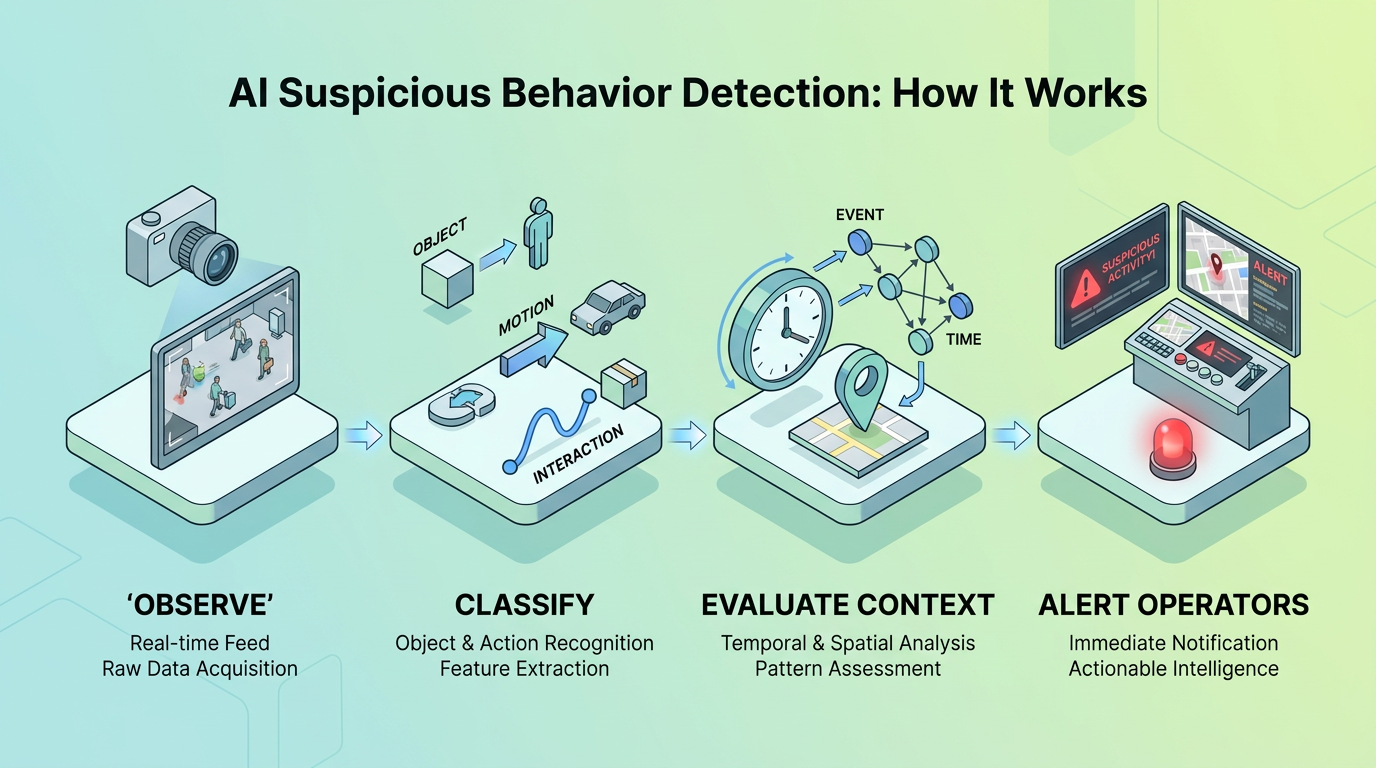
Operationally, a contextual detection workflow follows four connected steps:
- Observe activity through existing camera feeds and integrated access events.
- Classify objects, actions, movement patterns, and interactions within the scene.
- Evaluate context by comparing location, timing, dwell duration, and prior observations.
- Alert operators when the connected evidence meets a meaningful threat threshold.
Scene-Aware Threat Assessment
The same physical action carries different risk depending on environmental context. Consider these paired scenarios:
A knife in view: In a commercial kitchen, this represents routine food preparation. In a corporate lobby, it triggers immediate alerting. The object is identical; the context determines the response.
A person running: In a parking garage at 6pm, someone jogging to their car before a meeting is unremarkable. At 2am in the same location, rapid movement away from a vehicle warrants investigation.
A group forming: Near a stadium entrance before an event, crowds are expected. The same gathering pattern near a loading dock or data center entrance signals potential coordinated activity.
A bag in a lobby: Someone carrying luggage through a hotel lobby is routine. That same bag left unattended near a structural column for eight minutes becomes a security concern.
This contextual understanding enables scene-aware threat assessment that frame-by-frame analytics cannot achieve. Vision-Language Models interpret the full scene rather than isolated objects, establishing baseline behavioral patterns for specific environments and flagging meaningful deviations.
Temporal Reasoning Across Behavioral Sequences
A significant advancement in AI suspicious behavior detection is the ability to track behavioral sequences across minutes, not just frames. Loitering, movement patterns, or access activity may appear harmless in isolation but become concerning when evaluated as part of a connected sequence.
Vision-Language Models can maintain temporal and behavioral context over time, connecting observations into meaningful sequences that traditional rule-based analytics often lack the context to interpret. Consider someone photographing a building exterior who appears inside that lobby twenty minutes later asking about tenant directories.
A separate camera captures a badge read on a restricted floor where the individual exits within two minutes without conducting apparent business, then returns to the same floor via a different entrance. Meanwhile, a vehicle circles the parking structure three times before settling into a space with direct sightlines to an executive entrance. Each observation alone passes standard filters. Connected by temporal reasoning, they surface a pattern that warrants immediate security attention.
This reasoning architecture is why behavioral AI can identify reconnaissance, pre-operational surveillance, and escalating threat patterns that isolated detection misses entirely.
Pre-Incident Behaviors AI Security Systems Detect
The primary value of AI suspicious behavior detection lies in identifying behavioral precursors that enable intervention before situations escalate. This represents the shift from reactive security (responding after incidents occur) to proactive threat identification.
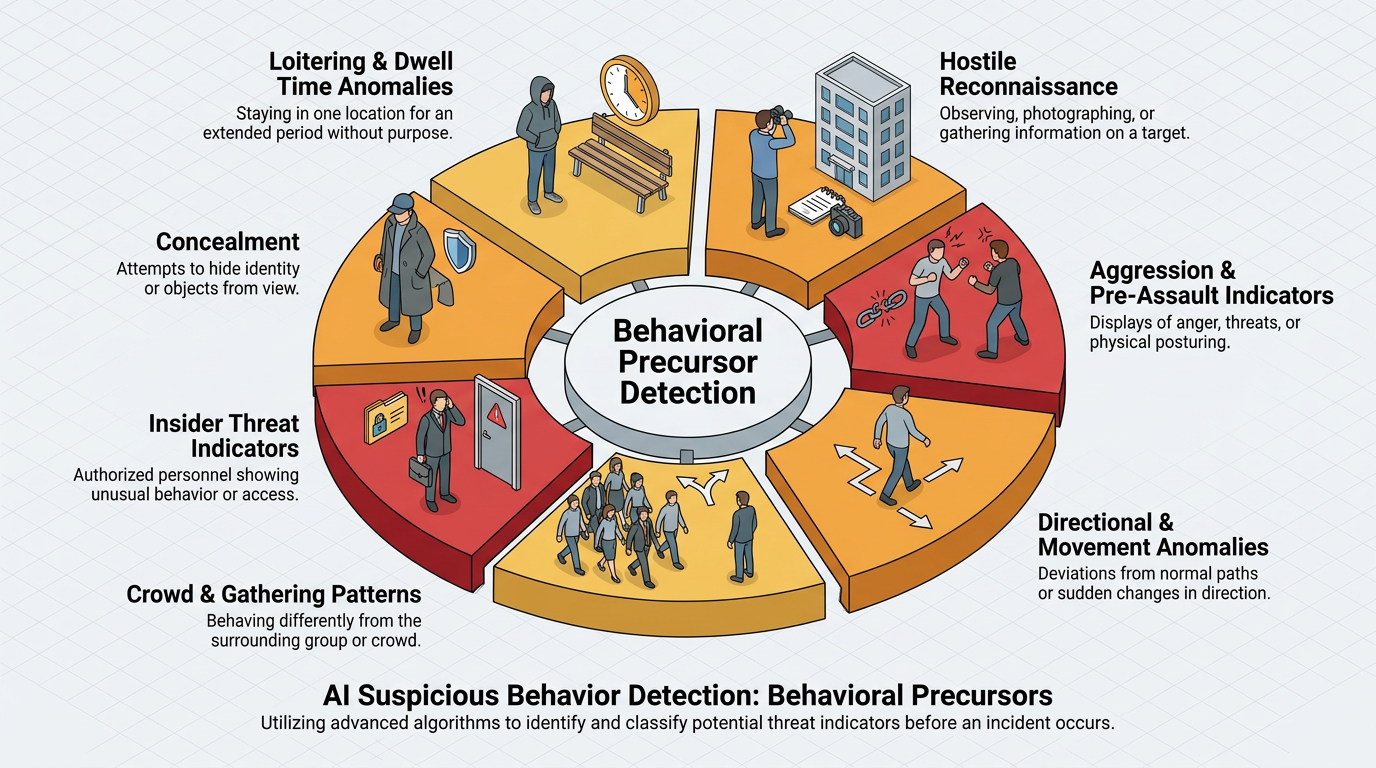
A practical behavior taxonomy includes loitering, unusual running, evasive movement, abnormal crowd dynamics, aggression, concealment, and hostile reconnaissance. These categories become operationally useful only when context distinguishes normal conduct from activity that warrants review.
Aggression and Pre-Assault Indicators: Rapid closing distance, threatening gestures, aggressive postures, repeated confrontational movement, and abrupt changes in interaction patterns can indicate escalating risk. Detection should focus on observable actions and sequences rather than assuming intent from a single posture or expression.
Hostile Reconnaissance: Repeated passes, prolonged observation, unusual photography of security features, attention to entrances or cameras, and testing restricted access points can form a recognizable surveillance pattern.
Loitering and Dwell Time Anomalies: Contextual analysis monitors how long individuals remain in specific zones, comparing observed dwell times against baseline patterns. Someone waiting near a loading dock for two minutes during business hours presents a different risk profile than the same behavior at midnight or sustained for extended periods. AI doesn't just detect presence; it evaluates whether that presence fits the location's behavioral norms.
Directional and Movement Anomalies: Vision-Language Models detect individuals walking against typical pedestrian flow, making unpredictable directional changes, pacing in restricted areas, or exhibiting movement trajectories inconsistent with normal environmental use. A person who reverses direction when approached by security, then reappears at a different access point, triggers escalating concern that no single movement would generate alone.
Crowd and Gathering Patterns: Real-time occupancy analysis identifies abnormal gatherings, crowd flow disruptions, or sudden dispersal patterns. The AI distinguishes between a group forming to greet a colleague and an unusual clustering near a secured entrance during off-hours.
Insider Threat Behavioral Indicators
Suspicious behavior detection isn't only about outsiders. Employees, contractors, and other authorized personnel can generate anomalous activity that never trips a perimeter alert, and in corporate security settings that blind spot often sits at the center of the risk picture.
Behavioral AI surfaces patterns that access control simply can't flag, because no rule has technically been broken. An employee based in Building A keeps showing up in restricted zones of Building C. Someone's after-hours movement no longer matches how their role has historically operated. Badge attempts pile up at doors that have already denied access, hinting at credential testing. Time spent in sensitive areas stretches well past what the job actually requires. The credential is valid. The person is authorized. Only when the sequence is examined as a whole does the pattern reveal itself as something worth a closer look.
From Behavioral Precursors to Active Threat Response
When precursor detection fails or escalation happens too quickly for intervention, AI suspicious behavior detection shifts to real-time active threat response. This represents the endpoint of the behavioral escalation arc, the high-severity events that precursor detection aims to prevent.
When a firearm appears in camera view, the system doesn't generate an isolated alert. It connects the weapon detection to the behavioral sequence observed over preceding minutes: where the individual entered, which areas they passed through, how long they lingered at specific points, and whether their movement pattern matched reconnaissance signatures observed earlier.
Violence and aggression detection works the same way, analyzing movement speed, trajectory changes, and interaction patterns not as standalone triggers but as escalation points in a behavioral timeline. Security teams receive not just a detection but a complete picture of how the situation developed, enabling faster response and coordinated action across integrated security infrastructure.
Integrating Behavioral Detection with Existing Security Infrastructure
AI suspicious behavior detection delivers maximum operational value when integrated with existing VMS and PACS platforms. Infrastructure-agnostic deployment works with existing cameras and access control systems without requiring rip-and-replace.
PACS integration creates unified intelligence by correlating access events with observed behaviors, determining whether someone's presence in a zone matches their credential permissions and historical access patterns, enabling the integrated system to distinguish genuine threats from legitimate activity more accurately than either system could independently.
Privacy governance should be established alongside technical integration. This includes governance, measurement, and management of privacy and harmful bias. Security teams should define approved use cases, document alert-review procedures, limit retention and access, test performance across operating environments, and preserve human review for consequential decisions.
Moving Toward Agentic Physical Security
Suspicious behavior detection represents a foundational capability in the evolution toward Agentic Physical Security, where AI systems move beyond passive detection to actively orchestrate coordinated responses across integrated security infrastructure. The AI-native video management platform at the core of Ambient.ai's offering makes this possible at enterprise scale.
Ambient Threat Detection delivers this capability through continuous analysis of video, access control data, and sensor inputs using a library of 150+ validated threat signatures. The platform is designed to surface validated threats that require operator attention while automatically filtering routine activity.
For organizations managing camera deployments at scale, this approach provides the force multiplication needed to shift from reactive incident response to proactive threat identification across hundreds of sites.
Request a demo to see how Ambient.ai can help transform your security operations.
Frequently Asked Questions about AI Suspicious Behavior Detection
How does AI suspicious behavior detection handle privacy concerns when tracking individuals across multiple cameras and over extended timeframes?
AI suspicious behavior detection addresses privacy through behavioral pattern analysis without facial recognition, event-triggered retention instead of indefinite storage, role-based access controls, clear governance frameworks defining authorized AI actions, and ongoing monitoring or audits that help maintain consistent detection accuracy across demographic groups.
What is the difference between traditional rule-based video analytics and Vision-Language Model-based contextual AI in terms of false alarm rates and threat detection accuracy?
Traditional rule-based systems trigger on isolated motion without context, generating high false alarms. Vision-Language Models reduce false positives by evaluating scene conditions, temporal sequences, and environmental baselines to distinguish genuine threats from routine activity across connected observations.
How long does it typically take to establish reliable behavioral baselines for a new environment, and how does the system adapt to changing patterns like seasonal shifts or new building usage?
Behavioral baselines typically stabilize within days to weeks depending on facility activity volume, with continuous refinement as the system observes normal patterns. The system adapts to evolving patterns through ongoing analysis, adjusting baseline expectations without manual reconfiguration when usage patterns shift.