Data Center Physical Security: What Traditional Systems Miss and How AI Fills the Gap


It's not a people problem. It's a systems problem.
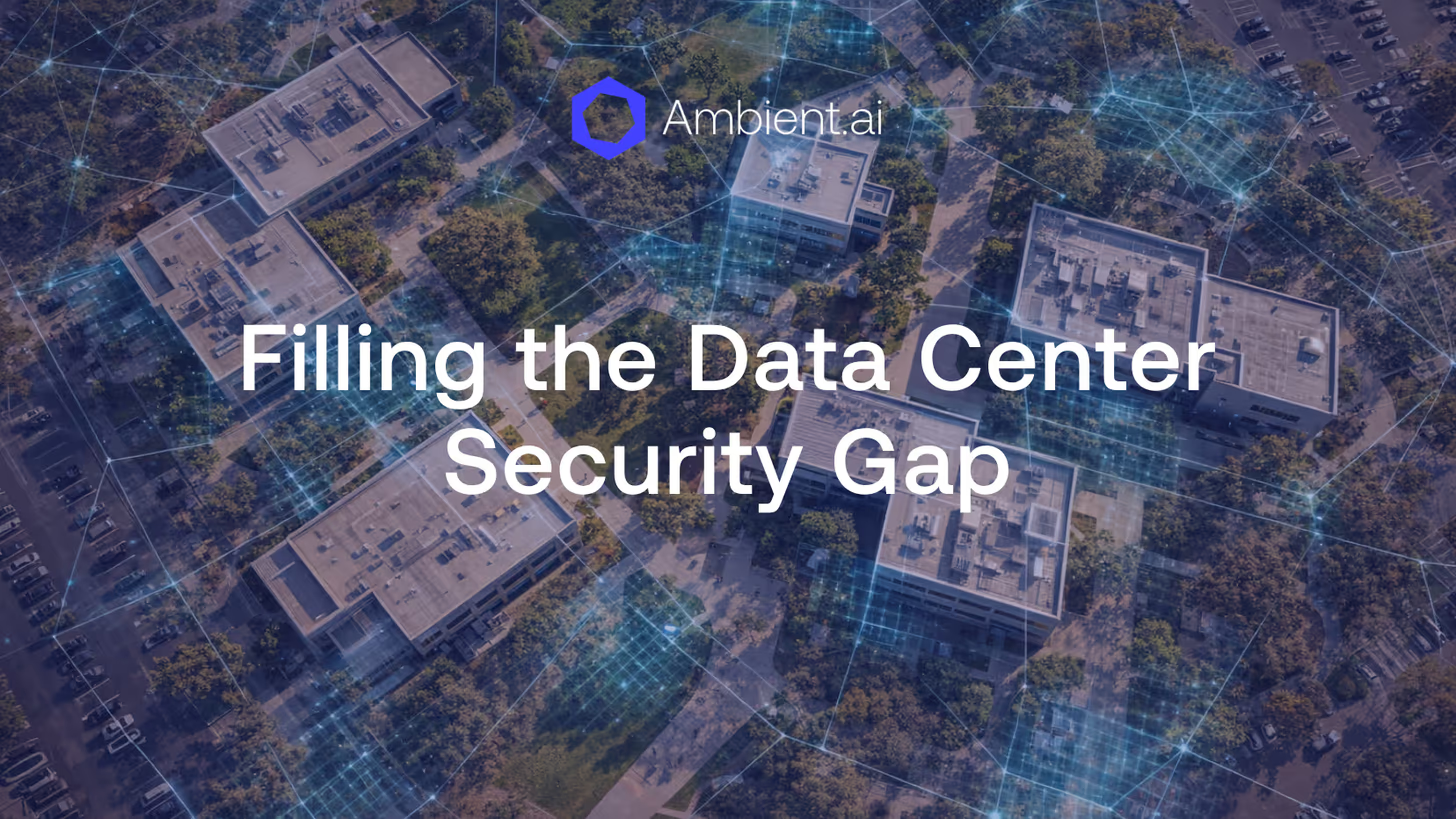
Data center physical security has long relied on layered defenses, including cameras, access control systems, and perimeter barriers to protect critical infrastructure from unauthorized access and tampering. Yet as these facilities have evolved into sprawling campuses with expansive video surveillance infrastructure spanning server rooms, operations centers, and backup power systems, a fundamental gap has emerged.
The sheer scale of modern data center operations creates an impossible challenge: security teams cannot physically patrol every zone or monitor every feed simultaneously. This coverage gap means genuine threats can go undetected in real time, only to be discovered during post-incident investigations when the damage has already been done.
Key Takeaways
- Traditional physical security systems generate overwhelming false alarm volumes that put data center security at risk
- Human operators cannot maintain effective vigilance across large camera networks due to cognitive limitations that cause most surveillance footage to go unwatched
- Contextual intelligence fills the gap by analyzing visual and behavioral context to distinguish genuine threats from routine activity without requiring constant human monitoring
- Reasoning Vision-Language Models enable the detection of physical breaches precursors like loitering and reconnaissance behavior as well environmental hazards such as floods, fires and smoke.
What Data Center Physical Security Encompasses
Data center physical security combines perimeter defenses, access control, video monitoring, environmental protection, and trained personnel to safeguard servers and critical infrastructure from unauthorized access, theft, tampering, and environmental hazards.
Perimeter and Facility Barriers
Physical barriers, including fencing, crash-rated barriers, secured entry points, and mantraps create layered obstacles that slow unauthorized access and give security teams time to respond. Fenceline protection is particularly critical for sprawling data center campuses.
Access Control and Credentialing
Badge readers, biometric scanners, PIN pads, and multi-factor authentication restrict entry to authorized personnel while generating logs of who accessed which areas and when. Multi-tenant colocation environments require granular access segmentation to prevent cross-tenant intrusion, ensuring that personnel from one tenant organization cannot access another tenant's caged areas, server racks, or support infrastructure.
Contextual intelligence enables continuous monitoring of these segmentation boundaries, detecting when individuals approach or enter zones outside their authorized access scope and alerting operators to potential cross-tenant intrusion attempts before breaches occur.
Video Monitoring and Environmental Sensors
Camera networks and environmental sensors provide continuous monitoring of entry points, server rooms, power systems, and perimeters while detecting fire, water, temperature fluctuations, and seismic activity.
Common Threats and Scale Challenges in Data Center Physical Security
Physical threats to data centers range from external intrusion, including tailgating, unauthorized access, and perimeter breaches to insider risks that represent the most costly threat category, alongside environmental hazards such as floods, fires, and power disruptions.
Each threat type requires different detection and response capabilities, yet large data center operations span multiple buildings with server halls, operations centers, power systems, and backup generators spread across extensive campuses. Human attention cannot scale to monitor every zone, especially areas less frequently patrolled.
Perimeter Breaches and Fenceline Intrusion
Attackers attempting to bypass perimeter barriers through fence jumping, cutting, or climbing pose direct threats to facility security. Traditional perimeter systems often generate alerts for wildlife, weather, or debris without distinguishing genuine intrusion attempts, overwhelming security teams with false alarms.
Vision-Language Models can detect Person Between Fences, identifying individuals in the buffer zone between perimeter barriers, as well as Vehicle Outside Gate and Vehicle Loitering scenarios that often precede coordinated breach attempts on data center campuses.
Unauthorized Access and Tailgating
Tailgating remains the most prevalent access control problem, with intruders following authorized personnel through secured doors to bypass access control entirely. Traditional systems remain completely blind to tailgating because door sensors only register badge swipes, not the number of people passing through or whether multiple individuals entered on a single credential. It is important to note that tailgating detection is a distinct capability from Door Forced Open and Door Held Open adjudication.
While contextual intelligence can dramatically reduce false alarms from DFO/DHO events by automatically verifying whether alerts represent genuine security incidents, detecting tailgating requires separate visual analysis to identify when unauthorized individuals follow credentialed personnel through access points.
People in Restricted Areas
Server rooms, power generation facilities, and backup systems require strict access limitations. Unauthorized presence in these zones, whether from outsiders or personnel exceeding their access privileges, creates risk to critical infrastructure. Utility corridors, raised floor spaces, and equipment staging areas often receive less patrol attention, creating blind spots where unauthorized movement goes undetected.
Contextual intelligence can detect Person Interacting with Secure Asset in server rooms and equipment areas, while Lone Worker Presence detection monitors isolated infrastructure zones like backup power systems where personnel may be vulnerable or require safety verification.
Insider Threats and Sabotage
Employees or contractors with legitimate credentials can damage equipment, steal data, or disable security systems. Access logs alone cannot reveal malicious intent or detect when authorized personnel behave abnormally. Documented incidents include telecommunications sabotage where employees disabled critical IT systems and services.
Behavioral precursors to insider threats include Invalid Badge Followed by Tailgate detection, identifying when individuals with denied credentials immediately follow authorized personnel through access points, a pattern that may indicate compromised credentials or coordinated unauthorized access attempts.
Behavioral anomaly detection can also identify when authorized personnel access zones outside their normal patterns, spend excessive time in sensitive areas, or exhibit movement behaviors inconsistent with their documented job functions, providing early warning of potential insider threats before damage occurs.
Alert Volume and Operator Fatigue
Access control systems and perimeter sensors generate constant alerts. When most turn out to be false alarms, operators become desensitized and genuine threats blend into the noise. Traditional systems generate false alarms at rates exceeding the vast majority of all alerts, creating conditions where security teams cannot distinguish routine events from genuine security incidents.
The Limits of Human Attention
Even when operators actively monitor video feeds, research demonstrates that after just 20 minutes of continuous screen observation, operators miss up to 90% of activity. This cognitive limitation means that even well-staffed security operations centers cannot maintain effective vigilance across dozens or hundreds of camera feeds throughout extended shifts.
Industry analysis indicates that less than 1% of surveillance video is watched live, and the vast majority of footage serves only as a forensic resource after incidents have already occurred. The problem compounds in data center environments where critical events may occur in any zone at any time, and the consequences of missed detection can include infrastructure damage, data compromise, or extended downtime.
Why Traditional Data Center Physical Security Detection Falls Short
Motion detection, object classification, and static rules can identify that something happened but cannot interpret whether it matters or requires action. A door held open might indicate a delivery, a maintenance task, or a security breach depending on context. These are distinctions that traditional systems cannot evaluate without human verification.
Door Forced Open and Door Held Open events generate hundreds or thousands of alerts daily in large facilities. Many organizations ultimately disable these alarm features entirely to manage operational burden, effectively eliminating important security controls because the alert volume becomes unsustainable. Contextual intelligence can significantly reduce false alarms for DFO/DHO events by automatically verifying whether these access control alerts represent genuine security incidents or routine operational activity.
Fenceline sensors trigger on movement but cannot distinguish between different types of intrusion attempts and environmental motion. Environmental conditions including wind, precipitation, and vegetation movement create false positives that overwhelm security operations.
What Reasoning Artificial Intelligence Adds to Data Center Physical Security
Vision-Language Models analyze visual, spatial, and behavioral context to understand not just what is happening but why it matters. By continuously processing video feeds against hundreds of threat signatures, contextual intelligence enables instant alerts and rapid response without requiring human operators to watch every camera.
The same action in different contexts carries different risk levels depending on credentials, movement patterns, and whether behavior aligns with expected activities for that zone.
This technology integrates visual context from security cameras with access control data to automatically verify and clear access control alarms, eliminating the overwhelming volume of false alerts like Door Forced Open and Door Held Open that commonly occur hundreds or thousands of times daily in large facilities.
Behavioral Detection and Precursor Recognition
Loitering in restricted areas, testing access readers, unusual movement patterns along fencelines, and reconnaissance behavior often precede breach attempts. Detecting these precursors creates intervention opportunities before incidents escalate.
Contextual analysis distinguishes routine waiting from suspicious loitering by evaluating duration, proximity to sensitive areas, and whether behavior aligns with typical facility activity. Configurable detection variants allow security teams to tune sensitivity based on zone criticality. Person Loitering detections at 15-second, 30-second, and 45-second thresholds provide graduated alerting for different risk tolerances.
For mantrap and secure entry scenarios, Person Loitering Outside Secure Door detections at 15-second and 45-second intervals identify potential access attempts before they occur. Invalid Badge with Loitering detection correlates failed credential attempts with sustained presence, flagging individuals who remain near access points after denied entry. This pattern often indicates reconnaissance or social engineering attempts at data center facilities.
Correlating Video with Access Control and Perimeter Events
Linking what sensors register with what cameras observe enables automatic verification. A perimeter alert paired with visual confirmation of a person at the fenceline triggers immediate response while an alert caused by wildlife gets filtered automatically. Intelligent video analytics dramatically reduce false alarms by automatically verifying legitimate events while surfacing genuine threats.
Compliance Standards for Data Center Physical Security
Data center operators must demonstrate adherence to industry standards including ISO 27001, SOC 1 Type 2, SOC 2 Type 2, NIST 800-53, HIPAA, and PCI DSS. These frameworks require documented access controls, continuous monitoring, audit trails, and incident response procedures.
SOC 2 Type 2 specifically mandates demonstrating operational effectiveness of security controls over defined audit periods. This requires data centers to prove ongoing compliance rather than point-in-time adherence, demanding consistent, verifiable monitoring and documentation throughout the assessment window.
HIPAA physical safeguard requirements include mandatory documentation retention for six years, creating long-term audit trail obligations that manual processes struggle to maintain. NIST 800-53 provides granular specifications through its PE control family for physical access monitoring, visitor management, and environmental protection.
Accelerating Investigations in Data Center Physical Security
When incidents occur, traditional investigations require security teams to scrub footage camera by camera, a process that can take hours or days. Natural language search enables operators to find footage using conversational queries, locate people or objects across thousands of feeds, and reconstruct incident timelines in minutes.
These tools automate metadata generation and enable rapid retrieval of video footage, reducing investigation times from hours to minutes. This capability transforms post-incident response from labor-intensive manual review to rapid forensic analysis, while also shifting operations from reactive to proactive monitoring.
How Ambient.ai Strengthens Data Center Physical Security
Ambient.ai transforms existing cameras and access control systems into a unified intelligence layer through its AI-native video management platform, purpose-built for data center environments where traditional monitoring cannot scale. The platform continuously analyzes video feeds to detect threats, including fenceline intrusions, unauthorized access, and people in restricted areas, while verifying access events to achieve up to 95% reduction in false alarms.
Data center-specific detections include Person Between Fences for perimeter buffer zones, Vehicle Outside Gate and Vehicle Loitering for campus security, Person Interacting with Secure Asset for server room protection, and Lone Worker Presence for isolated infrastructure monitoring.
For data center operators protecting multi-tenant cloud pods, operations centers, and critical power infrastructure across sprawling campuses, Ambient.ai enables comprehensive coverage even in areas less frequently patrolled. TikTok USDS implemented the platform across their U.S. data centers, achieving real-time detection of security incidents with significant reductions in false positives, capabilities validated through successful detection and prevention of intrusion attempts during third-party penetration testing.
This represents the shift toward Agentic Physical Security, where AI systems autonomously observe, detect, and assess threats in real time across entire data center operations.
Frequently Asked Questions about Data Center Physical Security
Why do traditional physical security systems fail to scale for modern data centers?
Traditional systems rely on motion detection and static rules that generate alerts without understanding context. Large data center campuses produce thousands of access control alerts and perimeter notifications daily, most of which turn out to be false alarms. This volume overwhelms security teams, causing operator fatigue and desensitization. Many organizations ultimately disable alarm features entirely because the operational burden becomes unsustainable, effectively eliminating important security controls.
What makes insider threats particularly challenging for data center physical security?
Insider threats are difficult to detect because employees and contractors possess legitimate credentials that grant them authorized access. Traditional access control systems only record badge swipes without analyzing whether behavior patterns indicate malicious intent. Identifying insider threats requires monitoring for behavioral anomalies such as accessing zones outside normal patterns, spending unusual time in sensitive areas, or exhibiting movement inconsistent with documented job functions.
How does tailgating detection differ from door forced open alert verification?
Tailgating detection and door forced open adjudication are distinct capabilities that address different security problems. Door forced open and door held open verification uses visual context to determine whether access control alerts represent genuine security incidents or routine operational activity. Tailgating detection requires separate visual analysis to identify when unauthorized individuals follow credentialed personnel through access points, a scenario that door sensors cannot register at all.
How does Ambient.ai address data center physical security challenges?
Ambient.ai transforms existing cameras and access control systems into a unified intelligence layer that continuously monitors for threats across sprawling data center environments. The platform detects fenceline intrusions, unauthorized access, and people in restricted areas while achieving up to 95% reduction in false alarms from door forced open and door held open events. Data center specific capabilities include perimeter buffer zone monitoring, vehicle loitering detection, and lone worker presence alerts for isolated infrastructure zones.