Manufacturing Facility Security: Agentic Threat Detection from the Plant Floor to the Inventory Cage


See what an operator sees when a threat signature recognizes a behavior
TL;DR
A manufacturing plant's cameras record through every shift, and its interlocks, badge logs and fire panel read normal on a floor too large to see at once. The events that need a person are easy to miss: a technician down on a mezzanine, smoke high above a stopped line, a carton leaving the inventory cage at shift change. Agentic threat detection raises each one as an alert that the security operator and the safety lead can both act on as the moment unfolds.
A little before midnight on a Saturday, the production hall of a mid-sized plant goes quiet for a planned changeover. The packaging line is locked out for maintenance, and most of the crew is on break. Badge logs show who is on site, and the fire panel reads normal. The cameras along the line are recording. Nothing in any system is out of place, because the hall is doing exactly what a production hall does between runs.
Each of those systems was built for one job, which makes manufacturing facility security harder than it looks. None of them can say that one technician is alone above the line, that something is smoldering near the roof trusses, or that a carton has just left the inventory cage. On paper those moments belong to different teams. On the floor they reach the same lean team, which needs a way to notice them, not one more record to check.
What does manufacturing facility security need to detect on a large, quiet plant floor?
Manufacturing facility security answers for people, machinery, inventory and production across several shifts, and much of the published advice starts at the edge of the site, with the perimeter, guard rounds and access control at a factory's gates and doors. That advice works well for keeping the wrong people out at the fence and the front gate. The harder problems are inside the building between production runs, where manufacturing security threats and safety events can look alike from a distance.
Security teams in manufacturing share the plant floor with safety programs, and that shared ground is a big part of how AI is changing manufacturing plant security programs. A night shift thins out the people who might notice something. The plant's cameras already record every line, but that footage usually gets reviewed only after something has gone wrong. AI is useful when it reasons over the same video continuously and in real time, on every shift, and picks out the moments that need a person to look.
Ambient.ai is an Agentic Physical Security platform built to work with the cameras and access control a plant already has. It layers AI on top of the video streams from those cameras and reasons over them using threat signatures, pre-trained detection mechanisms that each recognize a specific behavior. On a plant floor, those behaviors run from an early indicator, such as a technician working alone above a line, to an incident in progress, like a person down. Each match becomes an alert that shows the operator the video moment and where on the floor it happened. With access control integrated, Ambient.ai also correlates signals such as a fire alarm with the same video. For the mechanics, see how a threat signature reads behavior on live video. Every alert gives the team situational awareness, and Ambient.ai can run the response workflows the team has chosen to automate.
Three moments in one plant show how this plays out.
Above the line on a night shift, a technician working alone depends on someone noticing when the work goes still
A little after midnight, a maintenance technician climbs to the mezzanine over the packaging line to service a drive during the changeover. The crew below is on break, and nobody is scheduled to look up. On a manufacturing night shift, lone worker safety comes down to how soon someone learns the technician needs help.
The first part of that moment matches a threat signature, Lone Worker Presence, which notices a person working alone in a space. The operator can look, see someone working above the line, and judge the moment. Later in the changeover, the technician appears to have fallen and lies on the grating without moving. The threat signature for that moment, Person Fallen Down, puts a second alert in front of the operator. One look may show the technician lying flat to reach a drive coupling, which settles the question quickly.
If the technician stays down, the closest responder on site can go straight up the mezzanine stairs. The operator can then call the shift supervisor or the EHS lead about that same alert, so security and safety teams work one incident together from the start. For a technician hurt and alone above a quiet line, being found during the changeover rather than at the end of it can mean getting medical help sooner.
Privacy is built into how Ambient.ai detects: it uses no facial recognition or PII for detection and stores no PII, so the threat signatures read what is happening on the mezzanine.
A Physical Security Site Manager at one manufacturer running Ambient.ai across multiple sites has said:
"Ambient.ai is our new security foundation, enabling us to reprioritize our security staff on more impactful and urgent activities."
Over a stopped line in a high-bay hall, smoke and an alarm tell two parts of the same story
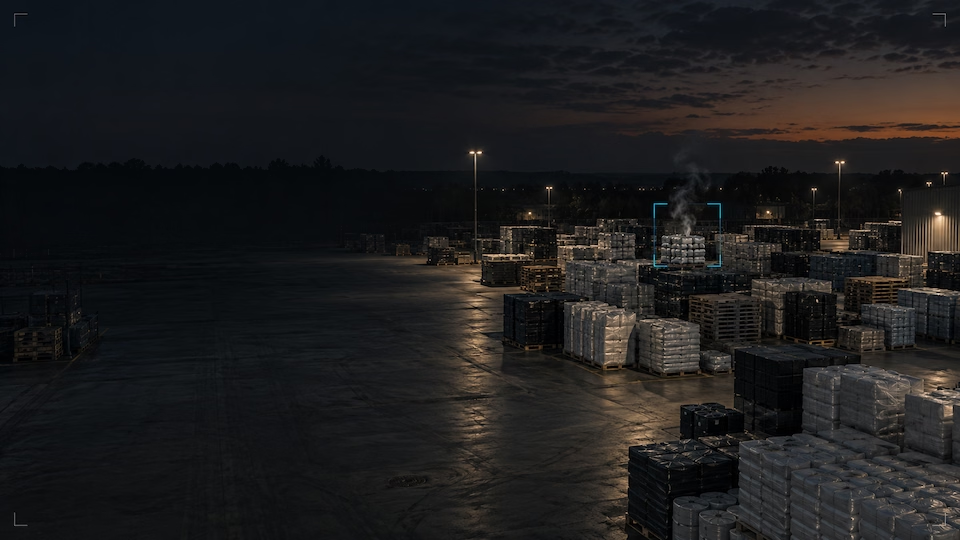
By about five on Sunday morning, the hall is idle and nearly empty of people. High above the stopped line, a thin thread of smoke rises from one of the high-bay light fixtures near the roof trusses, a long way from the nearest ceiling sensor.
That moment has its own threat signature, Smoke or Fire, which adds a complementary layer of early visual detection to the smoke detectors, heat sensors and sprinklers that remain the hall's foundation. It brings the most value in large, open, high-ceiling spaces like this one, where smoke can spread a long way under the roof. It works outdoors as well, which a closer look at how an early fire shows itself in open air explores. The alert carries the video moment and its location, so the operator can check the trusses on screen and decide whom to send.
If the fire alarm panel trips while that smoke is still spreading, responders will want context from inside the hall. In a plant whose access control is integrated with Ambient.ai, the alarm signal reaches Ambient.ai through access control, and Fire Alarm Active with Person Presence pairs it with live video of a person present in the zone. The panel names the zone that tripped, and the video gives the operator context to share with responders about what they may find at the doors.
At the inventory cage, the question is whether a carton heading for the side door is meant to leave
At the morning shift change, the finished-goods cage sits beside a side door that opens onto the employee lot. One person lifts a carton from a shelf inside the cage, and a minute later heads out the side door with it. It may be a lead taking that carton to the quality lab in another building, which is exactly why the operator asks before anyone is sent.
Lifting the carton matches one threat signature, Person Removing Package, which notices a person taking a package from where it sits. Carrying it out the side door matches another, Person Exiting with Package. Once an alert reaches the operator, a call to the shift lead can settle the question early, well before an inventory count would raise it. If the carton is bound for the quality lab, that call costs a minute.
An alert earns a plant's attention when the security operator and the safety lead read the same scene
An operator who opens one of these alerts sees the threat signature, a low, medium or high severity rating, the video moment, the location and an AI-generated account of the scene. Floor plan context shows where it happened on the plant layout, so the operator knows the location before making a call. Because the scene description travels with the alert, the operator can tell a maintenance supervisor, the EHS lead or an on-site officer what to expect.
For the technician on the mezzanine, Ambient.ai suggests next steps, and the operator chooses: escalate with one click, or hand it to a workflow the team built ahead of time, which notifies the people it names. For the smoke in the high bay, targeted dispatch sends the right on-site officer to the hall doors, and each status update lands on the incident timeline the control room is following. Speakers connected to Ambient.ai can also play an audio message that directs behavior on the floor until the shift lead arrives. Ambient.ai supports the response throughout, and the decisions remain the team's.
After the shift, the footage becomes the record. An investigator can search recorded video in plain language, see matching results for each person or vehicle in one group, and pull clips from several cameras into a single case, complete with an AI-generated narrative. Because Ambient.ai is a fully integrated platform, the team runs detection, response and investigation for every connected plant from a single pane of glass, putting a plant two states away on equal footing with the one next door.
What should agentic threat detection do for a lean security team responsible for several plants and every shift?
- It works with the cameras and door controllers already installed at every plant. Get the list of camera and access control models it supports in writing, and find out how detection fits with the smoke detectors, heat sensors, sprinklers and lone worker devices you already run.
- An alert makes sense to security and safety alike. Have the vendor walk you through one alert from detection to response, then ask whether your EHS lead could act on its scene description without a security briefing.
- Detection reaches the far end of the floor on every shift. Ask which detections apply to a mezzanine, an overhead high-bay space, a material cage and a side door, not only the fence line.
- Response runs on your own call tree, safety and security together. Find out whether your existing procedures can become automated escalation and dispatch workflows, with your team writing and owning each one.
A system that clears all four tests gives a lean team a way to notice the handful of moments that matter, on every shift and at every plant.
How Ambient.ai reasons over the hours from the plant floor to the inventory cage
All the threat signatures behind these three moments belong to Ambient Threat Detection, one of the software modules of the Ambient.ai platform: Lone Worker Presence, Person Fallen Down, Smoke or Fire, Person Removing Package and Person Exiting with Package, plus one that brings access control into the picture. When a plant has integrated its access control with Ambient.ai, Ambient Threat Detection pairs the fire alarm signal with live video of the zone and delivers both as a single Fire Alarm Active with Person Presence alert. The response remains the security team's call.
Rod Pearson, Director of Global Security at Impossible Foods, has said of Ambient.ai:
"Ambient's efficiencies allow us to execute a broader range of security and risk management activities, rather than having our personnel locked down behind a mountain of manual tasks and alarm noise."
When your own production hall next goes quiet after second shift, who would be the first to know that a technician alone above the line had gone down on the grating, that a thread of smoke was rising near the roof trusses over the stopped line, or that a carton had left the inventory cage by the side door?

Key Takeaways
On a large plant floor, much of the risk lies in the interior between runs, where safety and security events arrive as the same kind of moment.
Agentic threat detection reads a worker alone, a person down, smoke and material leaving a cage, and, where access control is integrated, a fire alarm with a person present.
An alert hands the operator the behavior, severity, scene description, video and location; the team runs the response, and the recorded video then feeds the investigation.
Judge detection by four tests: it fits the equipment already installed, makes each alert clear to safety and security alike, reaches the whole floor on every shift and follows the team's own call tree.