Factory Access Control Systems: A Practical Guide for Manufacturing Operations
Learn how to spec readers, structure shift-based permissions, manage contractor credentials, and pair door events with video in factory access control systems.
Factory access control faces conditions office systems never see: gloved hands at shift change, forklifts crossing reader zones, contractors rotating through covered process areas, and gates that stay wet for days. A clean badge log rarely tells the full story when tailgating, forced doors, and held doors slip through unseen. What follows is a practical guide to specifying readers, structuring permissions by role and shift, managing temporary access, and pairing every door event with video.
Key Takeaways
- Each factory reader needs ratings matched to its zone's environmental and impact conditions, including hazardous-atmosphere exposure, before the plant chooses a credential.
- Access permissions should follow role plus shift window, so a valid badge still fails at the wrong hour.
- Badge administrators should issue contractor credentials only after the safety briefing is on record and set them to expire when the job ends.
- Video paired with each door event lets security teams verify tailgating and forced or held doors.
What Is a Factory Access Control System?
A factory access control system is a physical access control system (PACS) configured for an industrial site. It authenticates people and vehicles at entry points, including gates and doors at zone boundaries. The system authorizes entry against role and shift rules, then logs every event. The components are the same in a plant as in an office:
- Credentials identify authorized people or vehicles.
- Readers collect the presented credential.
- Door and gate controllers enforce permissions.
- The identity database and head-end software manage access.
- The audit log records events.
The operating conditions differ. Readers sit outdoors and on wash-down floors, so they need dust and water sealing that lobby hardware never gets. The perimeter is a fence line, and vehicles carry their own credentials. Chemical, food, and pharmaceutical plants add a regulatory overlay on restricted areas and access records.
Why Access Control for Factories Is More Complex Than Other Facilities
Manufacturing turnover keeps the access list moving. The Bureau of Labor Statistics Job Openings and Labor Turnover Survey excludes agency temps, so their churn does not appear in its manufacturing separations data. Every separation is a credential to revoke; every hire needs permissions matched to a role and shift.
Shift changes put a full crew at a few doors within minutes, which is when tailgating is easiest. Maintenance turnarounds add large contractor crews inside covered process areas.
A door into an area where equipment is under lockout/tagout, or into a solvent store, is a life-safety control as much as a security one.
Access Control Options for Manufacturing Plants
Those plant conditions mean environmental rating comes before credential type. Readers on high-pressure, high-temperature wash-down floors need dust- and water-sealing rated for the conditions. Where forklifts pass, specify an impact rating. Readers in dust or vapor zones need hazardous-location certification.
Gloves and throughput decide the credential. Low-frequency proximity cards read with a wave, which suits gloved hands, but clone easily with off-the-shelf tools. ISO 14443 smart cards resist cloning when configured for mutual authentication instead of serial-number reads. They must be presented deliberately, which can slow each presentation at shift change.
Mobile credentials over near-field communication (NFC) do not always read without unlocking the phone, and phones are a problem where personal protective equipment or cleanroom rules apply. For vehicles, ultra-high-frequency radio-frequency identification (RFID) readers read windshield tags at gate distance.
Masks degrade face matching; NIST testing documented significant errors even for the best algorithms, with newer algorithms improving later. Hand geometry readers, which measure hand shape rather than ridge detail, generally tolerate dirty and calloused hands better.
How to Design Access Zones Across a Manufacturing Facility
Zones follow risk across layered perimeters:
- Outer tier. The fence line and its vehicle gates.
- Middle tier. The building envelope, including the production floor, open to most employees during their shift.
- Inner tier. Hazardous material storage, research and development (R&D) prototype rooms, control and server rooms hosting the operational technology (OT) network, and regulated vaults.
Authorize access by position or role, then bind each role to its shift window so a second-shift badge at a solvent store mid-morning is denied. Add an access control vestibule where the risk warrants it; a cleanroom airlock is a natural place for one.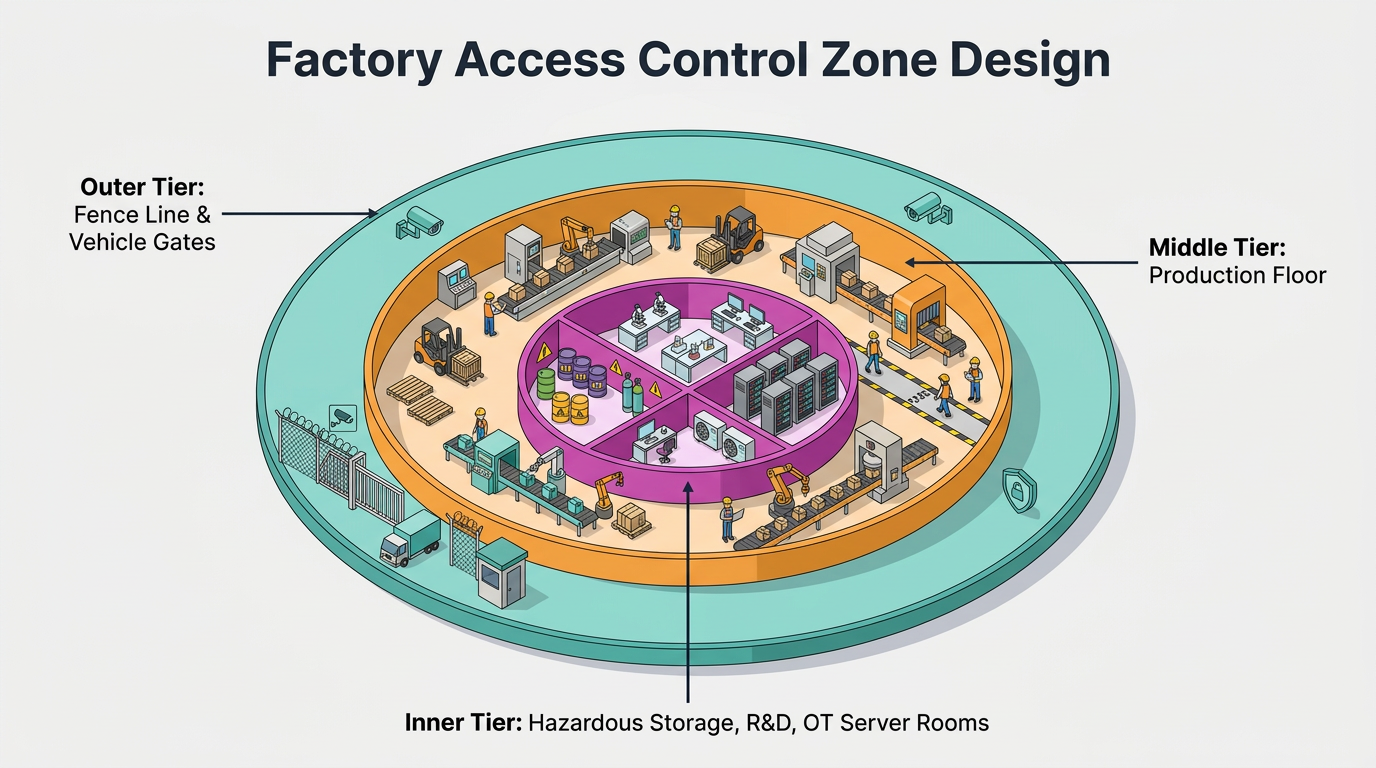
Gate Security and Vehicle Access at Industrial Sites
The truck gate is a key control point in the outer tier because drivers and vendors arrive unbadged. Separate pedestrian and vehicle routes help organize gate traffic, and license plate recognition paired with closed-circuit television (CCTV) provides coverage at those routes.
Check the trailer seal and match each arrival to a booked appointment window. Loading docks get their own zone so a driver cleared for the yard is not cleared for the warehouse floor.
Manufacturing Access Management for Contractors, Visitors, and Shift Workers
Inside the gate, the hardest people to manage are the ones who are only there for a job. OSHA's Process Safety Management standard requires the host employer to develop safe work practices to control contractor entrance, presence, and exit in covered process areas and to obtain and evaluate information about each contract employer's safety performance and programs before allowing work on or adjacent to a covered process. Badge administrators should issue a contractor credential only after the safety briefing is on record. Scope it to the work area and turnaround dates, and set it to expire automatically.
A different colored hard hat lets line workers spot visitors in hazardous areas. Visitor records should capture:
- name and organization
- signature and identification presented
- entry and exit times
- purpose
- host
Revocation needs a defined trigger. Temporary access rights should end when the work does; an HR-to-PACS feed provides that trigger by deactivating a badge the moment a separation is entered.
Connecting Factory Access Control With Video and Artificial Intelligence Monitoring
A badge event proves that a credential was read. It does not prove who walked through, or how many. Anti-passback catches a credential used twice without an exit, but it cannot see a cardholder holding the door for a follower. AI camera analysis can count people per credential event, turning a clean badge log into a tailgating alert.
A door forced open (DFO) fires when the position sensor opens without a matching unlock; a common cause is a mechanical key rather than a break-in, and video shows which. A door held open (DHO) fires after a preset delay; video shows whether a pallet is moving through or the door is propped.
A forklift at an open dock door during a receiving window is routine. The same forklift after the last appointment, with no badge event on the dock reader, starts a theft investigation. A door alarm alone does not carry that context.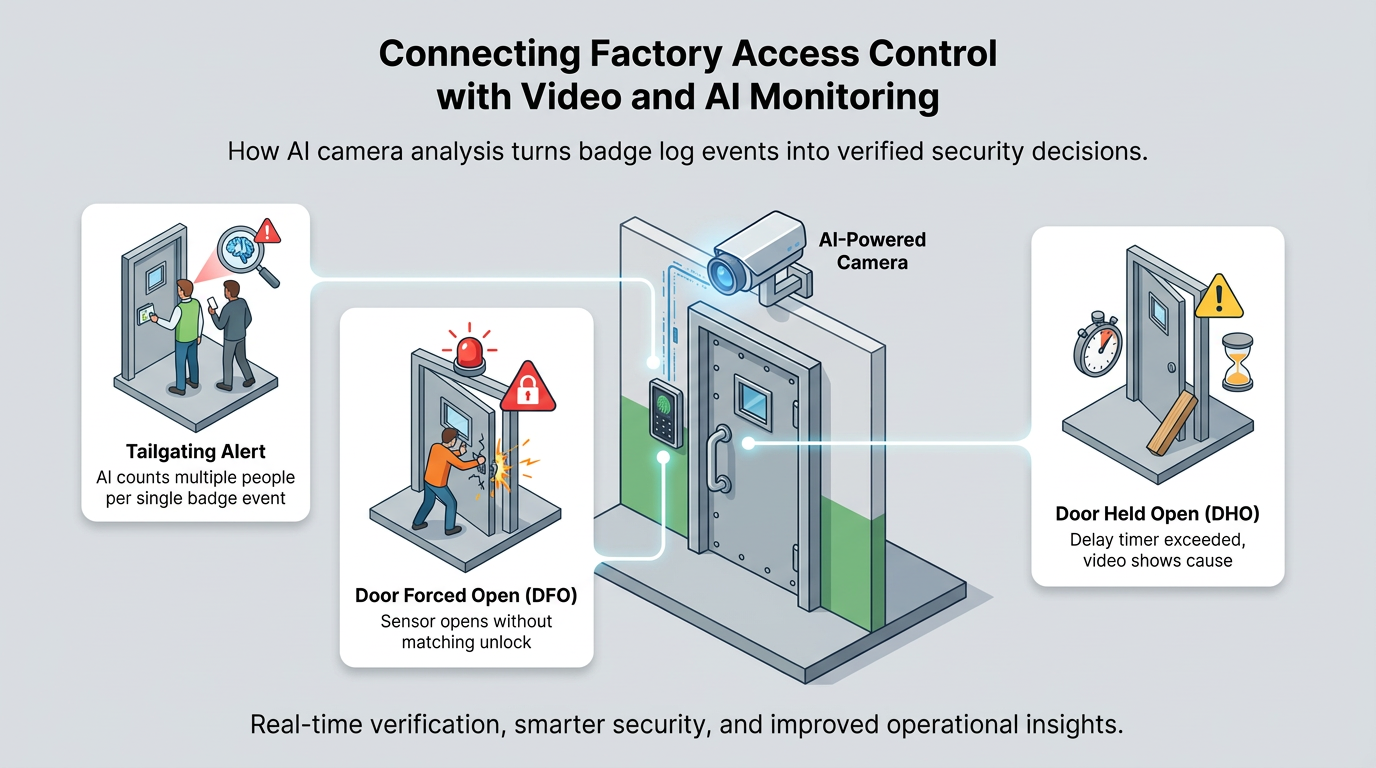
Factory Access Control Use Cases Across Manufacturing Industries
Automotive Plant Access Control for Prototype Protection
Automotive plants put their tightest controls around prototypes. VDA prototype-protection requirements call for a documented process for granting and withdrawing access to security areas, which TISAX assessments check.
Food Manufacturing Access Control Under FSMA
Food plants covered by the FSMA Intentional Adulteration rule must apply mitigation strategies at actionable process steps. Locked hatches and inspection ports are common examples, and gates open only with authority-based credentials.
Pharmaceutical Plant Access Control and DEA Vault Requirements
In pharmaceutical plants, DEA vault regulations specify construction for Schedule II substances and require the vault alarm system to be connected to a central station, police station, or a proprietary security organization. Manufacturing areas are limited to employees whose duties require entry, and employees must observe visitors. Where access records are good manufacturing practice (GMP) electronic records, they need secure, time-stamped audit trails.
Semiconductor and Aerospace Access Control for Cleanrooms and Export-Controlled Zones
Semiconductor fabs control the gowning airlock into the cleanroom, with class parameters set by the ISO cleanroom standard. Aerospace and defense manufacturers designate export-controlled zones because the International Traffic in Arms Regulations (ITAR) treat release of technical data to a foreign person inside the U.S. as a deemed export.
How to Choose an Access Control System for Manufacturing Companies
A plant should compare systems using these criteria.
- Multi-site identity. One identity record should drive permissions at every plant, so administrators can revoke a badge everywhere at once.
- Durability by zone. Specify environmental and impact ratings per area, including hazardous-location certification, rather than setting one specification for the whole site.
- Reader protocol. Use Open Supervised Device Protocol (OSDP), current version v2.2.2, on every new reader, so the reader-to-controller link stays encrypted and supervised; treat Wiegand as a refresh-cycle liability.
- Integrations. Include video through ONVIF Profiles S and T, and access-control and metadata/event integrations through Profiles C, D, and M. Add an HR feed for provisioning and revocation, along with visitor management.
- Audit and compliance reporting. Require event logging and audit trails where regulated records apply. Schedule periodic log reviews.
A head-end can run on local infrastructure or as a cloud service. Plant teams should test whether doors keep enforcing permissions locally if the wide area network (WAN) drops and assess how the head-end sits relative to OT segments. Where it shares segments with OT, apply industrial control system security practices to it.
Steps to Roll Out Access Control Across an Industrial Site
System selection is straightforward. During rollout, access lists can drift. The steps below keep the deployment disciplined from risk assessment through audit.
Start with a risk assessment and zone map. Begin with a risk assessment under a recognized method, then map zones from that assessment and select barriers and vestibules accordingly.
Pilot on one building or gate. Run the first deployment on a single building or gate. Issue each credential against an authorization list so every badge has a named approver and a role before scaling.
Bargain first in unionized plants. In a unionized plant, bargain before installing new access hardware. A 2024 National Labor Relations Board decision restored the clear-and-unmistakable-waiver standard, and the employer in that case had installed monitoring cameras and refused to bargain over them.
Train by role and pair with physical checks. Deliver training tailored to each role, and pair it with physical checks so operators can confirm that credentials, readers, and door hardware behave as configured before wider rollout.
Audit on a schedule. Set a recurring audit cadence. Review access lists periodically, and review logs at defined intervals and after defined events so drift is caught early.
Building Toward Verified Factory Access
An operator should be able to open an alarm and see whether the person and applicable time window are authorized beside the matching camera view, without searching separate systems. That standard turns access control from a collection of door events into evidence for a decision. It also gives teams a practical way to test resilience: local controllers must keep enforcing permissions during a WAN outage, while staff retain enough context to act. As plants refresh systems, they should measure success by faster, more confident verification under actual operating conditions.
Frequently Asked Questions
What are the specific environmental and impact ratings (such as IP and IK ratings) that factory access control readers should have for different zones like wash-down floors, forklift areas, and hazardous dust or vapor zones?
For wash-down floors, look for IP67 or IP68 water ingress protection. Forklift zones typically require IK08 to IK10 impact resistance. Hazardous locations need ATEX, IECEx, or Class I Division ratings depending on jurisdiction and vapor classification.
How do you integrate an HR system feed with a physical access control system (PACS) to automatically revoke contractor and employee credentials upon separation or job completion?
The HR system pushes termination events to the PACS via API or file transfer, triggering credential deactivation. Configure the integration to map HR employee status fields to access rights, ensuring real-time updates when records change to terminated or separated status, eliminating manual delays.
Why should factories use OSDP v2 instead of Wiegand protocol for reader-to-controller communication, and what are the security risks of continuing to use Wiegand?
OSDP v2 encrypts credential data between reader and controller and supervises the link for tampering. Wiegand sends unencrypted voltage pulses that attackers can intercept with a probe to clone or replay credentials without accessing the physical badge.
