AI Hospital Security: Protecting Patients, Staff & Assets
.webp)

Investigations that took days. Now answered in seconds.
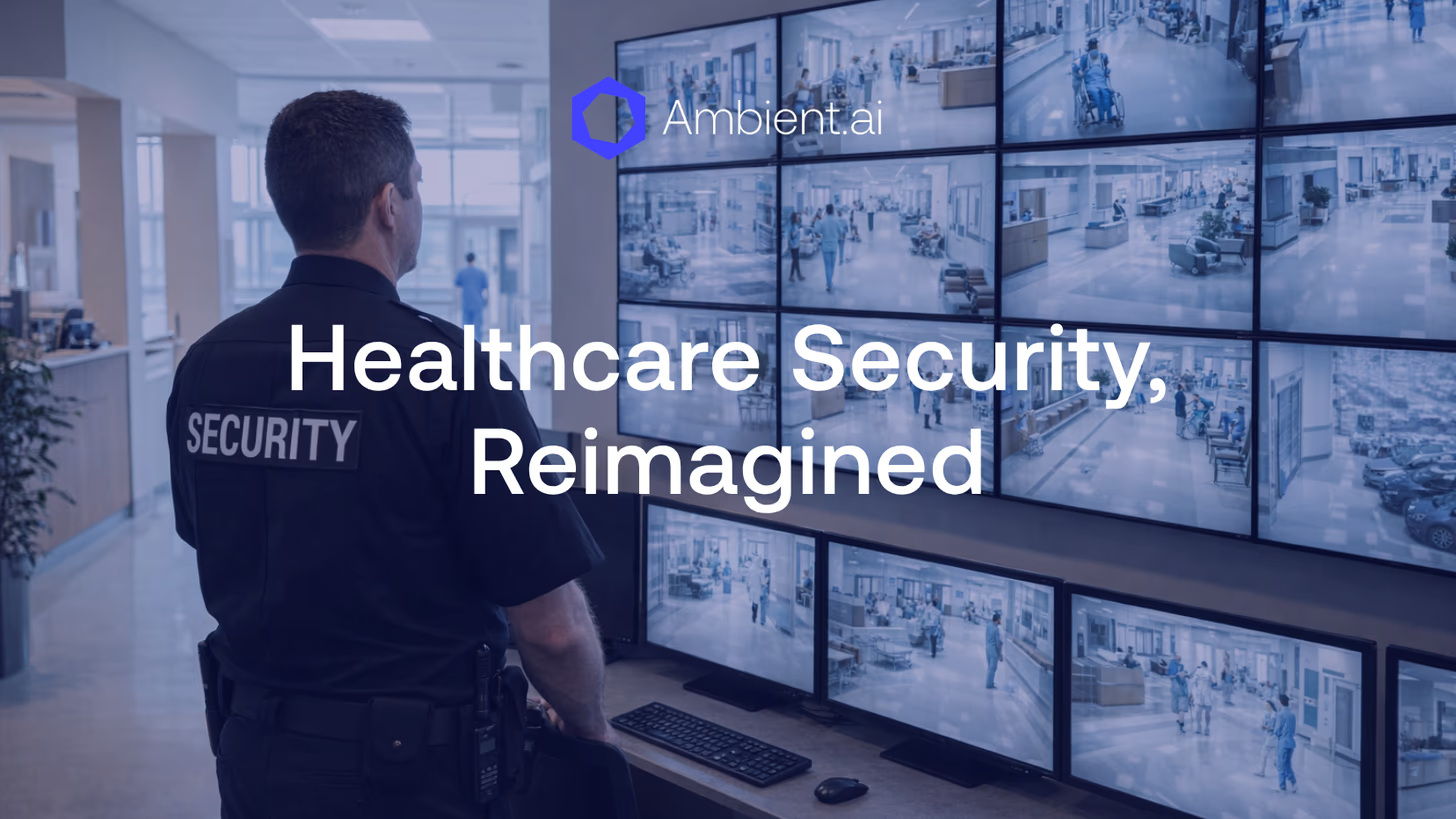
Hospital security systems face extraordinary operational challenges in healthcare environments. Emergency departments operate around the clock with public access, pharmaceutical storage areas contain controlled substances worth millions, and staff navigate emotionally charged situations across sprawling campuses.
AI-powered hospital security systems can finally enable healthcare organizations to implement a more effective security model, one built on proactive detection of behavioral precursors to workplace violence, patient elopement, and pharmaceutical theft, combined with faster, more coordinated response when emergencies unfold.
Key Takeaways
- AI hospital security systems enable proactive threat detection rather than reactive incident response across healthcare campuses
- Leading platforms integrate with existing camera infrastructure to deliver behavioral intelligence without requiring full system replacement
- Healthcare-specific capabilities like patient elopement detection, workplace violence prevention, and pharmaceutical area monitoring address unique hospital security challenges
- Privacy-by-design architecture ensures HIPAA compliance while delivering comprehensive threat coverage
The Healthcare Security Challenge in 2026
Modern hospital campuses present a monitoring challenge that no human team can solve through vigilance alone. IAHSS Foundation research establishes that operators cannot effectively monitor more than a handful of cameras simultaneously, yet major medical centers deploy thousands across patient wards, emergency departments, parking structures, and pharmaceutical storage areas requiring continuous coverage. Research shows that after twenty minutes observing a single screen, operators may overlook up to 90% of activity, a cognitive limitation that compounds across dozens of simultaneous feeds.
Healthcare workers are approximately five times more likely to experience workplace violence than workers in other sectors. Hospitals report high assault rates annually, while workplace violence costs healthcare systems billions annually.
Patient safety risks compound these challenges, and infant abduction data shows healthcare settings remain vulnerable to these incidents.
The regulatory environment has intensified this pressure. The Joint Commission goals for 2026 designate workplace violence prevention as a National Performance Goal, meaning heightened survey scrutiny throughout the year. States, including California and New York already enforce state mandates with active compliance obligations.
Let's examine ten leading AI-powered security technologies deployed in healthcare environments in 2026.
1. Ambient.ai
Ambient.ai delivers the healthcare industry's most comprehensive AI-powered physical security through its Agentic Physical Security approach, serving multiple Fortune 100 organizations.
Instead of presenting security operators with walls of live camera feeds that require constant vigilance, the platform delivers a curated pulse of actionable security intelligence, using contextual scene understanding to automatically distinguish normal hospital activity from genuine security threats.
The platform provides three integrated solutions covering everything from real-time threat detection to post-incident investigation.
Ambient Threat Detection Monitors Continuously
Ambient Threat Detection continuously monitors hospital cameras, analyzing feeds across patient wards, emergency departments, psychiatric units, pharmacies, loading docks, parking structures, and perimeter areas.
With the industry's largest threat signature library containing over 150 detections, the system identifies potential incidents within seconds.
Patient Safety
- Person falling down detection for immediate response to patient falls
- AED cabinet active with person fallen down for cardiac emergencies
- Person running detection for elopement attempts
- Duress button active with person running for coordinated emergency response
Violence Prevention
- Fighting detection to identify physical altercations before they escalate
- Duress button active signatures for staff panic situations
- Crowd formations that could become dangerous
- Weapons, including firearms, knives, and improvised weapons
Pharmaceutical Security
- Unauthorized pharmacy access attempts
- Loitering near restricted medication storage areas
Ambient Access Intelligence Eliminates False Alarm Fatigue
Ambient Access Intelligence solves healthcare security's most persistent challenge, overwhelming false alarm volumes. Traditional PACS generate thousands of daily false positives that exhaust security staff.
Ambient.ai's patented correlation technology analyzes badge reader data alongside camera feeds in real time, automatically dismissing the vast majority of false alarms while immediately escalating genuine security events like tailgating.
This AI-powered filtering can scale to significant operational savings across hundreds of hospital access points.
Ambient Advanced Forensics Accelerates Investigations
Ambient Advanced Forensics replaces hours of manual video review with conversational search. Security operators simply ask: "Show me anyone who entered the pharmacy storage room between 10 PM and 2 AM last Tuesday."
The system returns relevant clips within seconds across hundreds of cameras and weeks of footage, accelerating investigations dramatically.
Privacy-by-Design for HIPAA Compliance
The platform excludes facial recognition and biometric profiling entirely. It tracks individuals through behavioral markers, clothing descriptions, and movement patterns without capturing personally identifiable biometric information.
Seamless Integration Without Hardware Replacement
Ambient.ai retrofits onto existing camera systems as a software layer with cloud-managed architecture and on-premises video processing. The platform integrates with leading security management systems like Genetec Security Center, enabling sophisticated AI analysis across thousands of cameras without expensive infrastructure overhauls.
2. Verkada
Verkada delivers cloud-managed cameras in a proprietary ecosystem that eliminates on-premises servers. The technology analyzes people and vehicle patterns, recognizes license plates, and enables motion-based search with optional face search capabilities.
Healthcare deployments benefit from remote access capabilities, enabling security directors to monitor multiple facility locations from anywhere through subscription-based cloud storage. A unified dashboard consolidates access control, environmental sensors, and video surveillance into a single interface.
3. ZeroEyes
ZeroEyes specializes in AI-powered weapons detection by analyzing existing camera feeds. When the system identifies potential firearms, human verification specialists in ZeroEyes' operations center review potential threats before alerting security personnel and law enforcement. This human-in-the-loop approach reduces false positives critical for busy healthcare environments where speed and accuracy determine outcomes.
4. Spot AI
Spot AI enables cloud-based video intelligence compatible with existing multi-manufacturer camera systems. The technology performs intelligent video search, detects people and vehicles, and generates unusual activity alerts based on baseline deviations. Cross-camera tracking capabilities enable security teams to follow subjects across an entire campus without manually searching multiple feeds, functioning seamlessly across mixed camera environments from different manufacturers.
5. Omnilert
Omnilert combines threat detection with emergency notification systems, coordinating response across multiple communication channels. Beyond weapon detection, the platform includes mass notification infrastructure for emergency response coordination. Workflow automation enables pre-configured response protocols, automatically notifying security teams, initiating lockdown procedures, and alerting law enforcement simultaneously during active threats.
6. Actuate
Actuate layers behavioral intelligence onto existing Video Management Systems, adding capabilities such as people counting, crowd detection, perimeter breach monitoring, and loitering detection. Direct integration with major VMS platforms enables healthcare facilities to enhance their existing video infrastructure without replacing the system or disrupting workflows.
7. Axis Communications with ARTPEC
Axis integrates AI processing at the edge, analyzing video within cameras to reduce data transmission while maintaining privacy. Edge processing enables organizations to process security data locally, keeping sensitive footage on-premises, while maintaining real-time threat detection capabilities. This architecture particularly benefits healthcare facilities with strict data governance requirements around patient-identifying information.
8. BriefCam
BriefCam condenses hours of footage into brief summaries showing all activity simultaneously through video synopsis technology. The platform classifies objects, tracks across multiple cameras, searches by appearance, analyzes dwell time, and generates heat maps. Investigators can review an entire shift's footage in minutes rather than hours, identifying patterns in patient elopement attempts or unauthorized access to restricted areas.
9. Agent Vi
Agent Vi analyzes real-time behavioral patterns through deep learning algorithms, detecting objects, flagging unusual activity, protecting perimeters, and monitoring crowd density. The system continuously learns normal patterns for specific environments, distinguishing expected emergency department crowding from concerning congregation near pharmacy access points, enabling proactive intervention through context-aware alerting.
10. Vintra
Vintra searches video by appearance, including clothing, physical attributes, and carried objects, rather than biometric identification. This privacy-conscious approach addresses concerns about biometric data collection while delivering real-time threat detection and forensic analysis capabilities. Security teams can search for "person wearing red jacket carrying backpack" across all cameras without creating biometric databases.
What Hospital Security Systems Must Deliver in 2026
The technologies evaluated above reveal a clear set of capabilities that define what effective AI-powered hospital security must deliver. These requirements reflect the shift from reactive monitoring to what the industry increasingly describes as agentic security, where systems autonomously detect, assess, and escalate threats across the full security operation.
- Behavioral understanding, not just object detection: Identifying a person in a restricted area is not enough. Hospital security systems must interpret behavioral precursors like loitering near pharmaceutical storage, fighting, or crowd formations, and assess intent based on scene context, location, and time of day
- Proactive incident prevention over post-mortem alerting: The goal is early warning that enables intervention before situations escalate, not forensic review after the fact. Detection of pre-incident behaviors should drive real-time alerts that reach operators within seconds
- Unified intelligence across all security functions: Threat detection, access control, and forensic investigation should operate through a single intelligence layer rather than disconnected point solutions. Correlating video feeds with access control data in real time eliminates the gaps between systems where threats go unnoticed
- Zero-overhead scaling across facilities and regions: Hospital networks span multiple campuses, buildings, and thousands of camera feeds. AI security must scale across this footprint without requiring proportional increases in headcount or infrastructure
- Privacy-by-design architecture: Healthcare environments demand security intelligence without biometric data collection, facial recognition, or patient-identifying information, ensuring HIPAA compliance is built into the system rather than layered on as an afterthought
Beyond these core capabilities, hospital security leaders should evaluate whether platforms integrate with existing cameras, VMS, and PACS without requiring infrastructure replacement, and whether they support the documentation requirements tied to Joint Commission surveys and state-level workplace violence prevention mandates.
The healthcare security industry sits at an inflection point between early adoption and mainstream deployment. The most advanced implementations already deliver on these requirements, moving hospital security programs from reactive monitoring toward continuous, autonomous threat detection and response.
The Path Forward
The healthcare security landscape has fundamentally changed. AI-powered physical security systems are entering mainstream deployment, enabling proactive prevention rather than reactive response.
For hospital security leaders evaluating AI security platforms, the capabilities outlined in this guide provide a framework for assessment. The shift from reactive monitoring to proactive threat detection represents not just a technological upgrade but a fundamental change in how healthcare organizations fulfill their duty of care to patients and staff.
Request a demo to see how the Ambient Platform integrates comprehensive protection seamlessly with systems already in place.
How does AI-powered hospital security maintain HIPAA compliance while monitoring patient areas and detecting threats like elopement?
Privacy-by-design architectures avoid capturing biometric identifiers like facial recognition, instead tracking individuals through behavioral markers, clothing descriptions, and movement patterns. Edge processing keeps video data on-premises rather than transmitting patient-identifiable footage to cloud servers, ensuring compliance.
What is the difference between edge-based AI processing and cloud-based AI processing for hospital security cameras, and which is better for healthcare environments?
Edge processing analyzes video locally on appliances near cameras, minimizing bandwidth and keeping footage on-premises. Cloud processing can centralize intelligence, but many modern AI security camera systems avoid continuous transmission by using on-device or edge processing with intermittent or event-based uploads instead of full-time streaming. Healthcare environments often benefit from hybrid architectures balancing local privacy compliance with centralized management.
How can hospitals integrate AI security systems with their existing camera infrastructure without replacing hardware or disrupting operations?
Hospitals integrate AI security through software that connects to existing cameras via network, processing video through cloud or edge appliances. This preserves capital investment while adding behavioral intelligence, requiring only API integration with current VMS platforms.