Facial Recognition Alternative: Behavior-Based AI Security
.webp)

It's not a people problem. It's a systems problem.
Behavior-based detection challenges the identity-matching premise that biometric surveillance sold physical security teams. That pitch forced a choice between invasive identity tracking and limited protection. A new generation of behavior-based AI analyzes what people do rather than who they are, and the model a security program chooses shapes detection, legal exposure, and civil liberties.
Key Takeaways
- Behavior-based AI evaluates actions and environmental context to assess threats, while biometric identification matches faces against identity databases and carries the legal exposure biometric data classifications create.
- Detection systems that never generate biometric templates fall outside the highest-risk biometric privacy classifications, though European Union AI rules still apply to the deployment.
- Contextual reasoning distinguishes routine activity from genuine danger by weighing the relationship between actions, objects, location, and time.
- Operators retain final judgment and response authority while AI absorbs tactical monitoring across the full detection, assessment, and response loop.
Why Physical Security Is Moving to Behavior-Based Detection
Behavior-based AI in physical security is a form of behavior-based detection that continuously analyzes video feeds in real time to detect risk-relevant actions and context without the identity matching that biometric identification requires.
A Decision Framework for Security Leaders
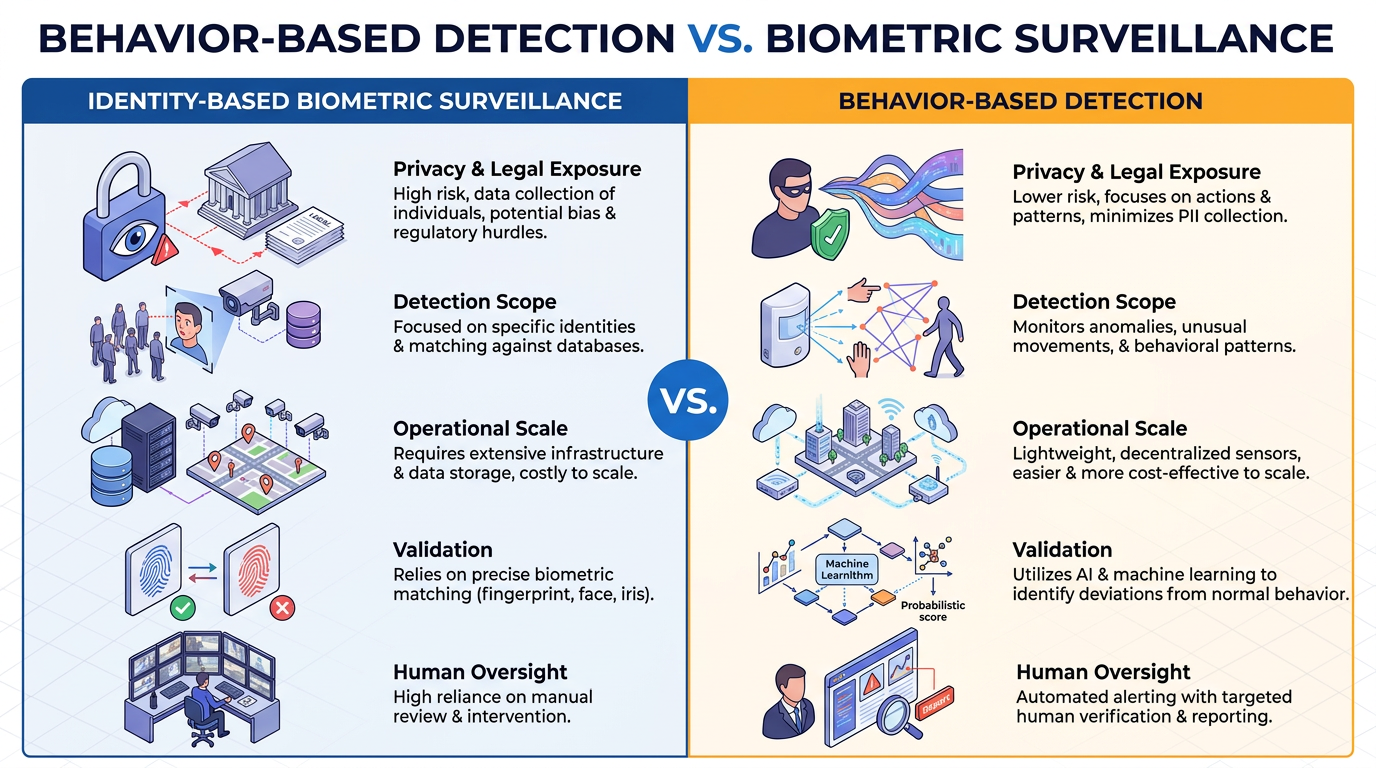
The choice between identity-based surveillance and behavior-based detection can be evaluated across key operational criteria.
| Criterion | Identity-based biometric surveillance | Behavior-based detection |
|---|---|---|
| Privacy and legal exposure | Matches faces against identity databases and may create biometric templates. | Can avoid some biometric classifications when it does not create biometric templates. |
| Detection scope | Identifies people already represented in a database or watchlist. | Evaluates observable actions, context, and precursor behaviors regardless of identity. |
| Operational scale | Depends on identity databases and the relevance of available records. | Continuously analyzes video feeds and prioritizes events for operator review. |
| Validation | Relies on match accuracy and database quality. | Requires contextual reasoning and validation under site-specific conditions. |
| Human oversight | Operators determine what action, if any, should follow an identity match. | Operators review contextual alerts and retain final judgment and response authority. |
For programs prioritizing early warning without biometric templates, behavior-based detection is the closer fit. Programs specifically confirming a person's claimed identity for secured access may still require biometric verification.
The Scale Problem in Traditional Security
Traditional physical security operations already face a structural problem that identity-based detection does not solve. Security teams deploy extensive camera networks, but the volume of feeds far exceeds what any team can actively monitor, regardless of skill or dedication. A Security Management benchmarking survey of enterprise security professionals found that operations centers field more daily alarms than operators can adjudicate during a shift and that a large share turn out to be false.
The posture that emerges is reactive and after-the-fact. Threats are addressed once damage is already done, if they are caught at all, and the root cause, a lack of real-time behavioral understanding, remains untouched.
The Regulatory Risk of Identity-Based Biometric Surveillance
Identity-based surveillance generally carries biometric-specific legal exposure that behavior-based detection may avoid when it does not create biometric templates. Other privacy and AI rules can still apply, and the regulatory gap is widening under the European Union (EU) AI framework.
Where Regulators Have Drawn the Line
The EU AI Act includes biometric prohibitions. They restrict real-time remote biometric identification in publicly accessible spaces for law enforcement outside narrow exceptions, prohibit emotion recognition in workplaces except for medical or safety reasons, and outlaw untargeted scraping of facial images from CCTV to build recognition databases. Those restrictions do not reach biometric verification used to confirm a person's claimed identity for access to secured premises.
In the United States, Illinois' Biometric Information Privacy Act (BIPA) provides a private right of action and anchors a growing patchwork of state biometric privacy laws that any national deployment must account for.
Why Behavior-Based Detection Sits Outside Biometric Privacy Law
The dividing line in many frameworks is the biometric template. BIPA covers scans of face geometry but expressly excludes physical descriptions such as height, weight, and hair color, so behavioral analytics that never extract face geometry or create biometric templates fall outside its definition.
A detection model that never builds an identity template avoids the highest-risk legal classifications before deployment begins. The EU AI Act defines biometric data broadly, so European deployments still merit a specific classification check.
Why Biometric Identification Does Not Establish Threat
Legal compliance does not resolve the more fundamental limitation of identity matching: identifying someone does not establish whether that person's observable behavior represents a threat. The U.S. Federal Trade Commission (FTC) barred Rite Aid from using identity-based biometric surveillance after challenging the retailer's deployment of the technology.
Watchlists Cannot Cover the Threat Population
Even a perfectly accurate match answers the wrong question. A government-funded counterterrorism research summary found that a substantial share of perpetrators of mass-casualty violence and terrorist attacks in the United States were not known to prevention professionals beforehand. No watchlist can match a face it has never held.
The central issue is predicting what a potential threat actor is going to do. Identity establishes who is present, not what is about to happen, and the latter question is the one behavior-based detection was built to answer.
How Behavior-Based Detection Works Without Biometric Identification
Behavior-based AI takes the opposite approach to threat detection. Instead of matching faces against identity databases, it analyzes actions, movements, and environmental context within video feeds.
The AI models behind behavioral detection are purpose-built for interpreting video in real time. A growing class of them are reasoning Vision-Language Models (VLMs), which fuse visual perception with language to interpret scenes and behaviors rather than only detecting objects. These models process feeds continuously, understand what is happening in each frame, and assess whether it represents an event that security operators should review or a potential threat that requires a high-priority alert. Final judgment and response authorization stay with the human operators who review those alerts.
The relevant signal is not who the individual is, but what the person is doing in the context of the environment.
Why Context Changes Everything
Reasoning AI interprets the full scene: not just identifying objects but analyzing the relationship between objects, the environment, and typical behavioral patterns for that specific location and time of day.
Consider a data center. A person wheeling a loaded equipment cart through the loading dock during a scheduled daytime delivery window is routine. A loaded cart moving out an emergency exit overnight has an entirely different threat profile. Reasoning AI models evaluate that distinction without matching a face to a database, and the operator who reviews the alert makes the final call. The action, the object, the location, and the time all feed the threat assessment.
The same contextual reasoning extends to precursor behaviors that often come before serious incidents: loitering near restricted entrances, fence-line breaches, tailgating through secured doors, crowding, and overt threats like brandished weapons.
The Detection, Assessment, and Response Loop
Behavior-based AI is designed around a continuous cycle that mirrors how an experienced security professional would evaluate a situation, but at a scale no human team can match.
- Detection: The AI continuously analyzes video feeds for events relevant to situational awareness, from a package delivery or someone loitering next to an entrance to someone climbing a perimeter fence, tailgating through a secured entry, entering a restricted zone, or brandishing a weapon.
- Assessment: Once an event is detected, contextual threat analysis determines whether it warrants immediate escalation, routine monitoring, or no action.
- Response: Based on that assessment, escalation follows the site's Standard Operating Procedure (SOP), from dispatching a security guard to notifying law enforcement to initiating a building lockdown, with the relevant video context attached.
In practice, the loop turns continuous monitoring into prioritized, context-rich decisions that help teams intervene earlier. Operators engage with incidents that already carry visual evidence and a clear threat assessment instead of scanning feeds manually.
Augmenting Security Teams Through Behavioral Intelligence
A common concern among security leaders evaluating AI is whether automation will displace their teams. The Department of Homeland Security's (DHS) AI directive requires human oversight of its own AI deployments whenever a use is safety-impacting or rights-impacting.
The behavior-based model is built around that division of labor. AI handles the volume of tactical monitoring and surfaces validated, contextual information for human decision-making. This keeps operators focused on judgment rather than continuous feed scanning.
Situational Awareness Before Arrival
Consider a guard who receives an active shooter call and gets dispatched to the scene. Without behavioral AI, that guard arrives with no visibility into what is unfolding, unsure whether to intervene directly or hold position and wait for law enforcement.
When AI handles the handoff, the design intent is that the guard sees a video clip of what is happening, plus a threat-level assessment, before arriving on scene. That situational awareness enables an informed decision, a distinction that can protect both the responder and the people they are trying to help.
Common Pitfalls When Evaluating Behavior-Based AI for Physical Security
Security leaders exploring behavior-based AI as an alternative to identity-based detection should watch for several recurring evaluation mistakes.
- Confusing object detection with behavioral understanding. Detecting that a person or object is present is not the same as interpreting what that person is doing or assessing severity.
- Underestimating contextual reasoning. Without scene-level understanding, systems add to the alarm volume operators already cannot clear, recreating the false positives they were meant to solve.
- Assuming all AI approaches handle privacy equally. Approaches that avoid capturing identity data carry a fundamentally different privacy and regulatory posture than technology built on biometric identification.
- Skipping site-specific validation. The National Institute of Standards and Technology (NIST) AI Risk Management Framework calls for demonstrating performance under conditions similar to the deployment setting, so benchmark scores from another environment are not evidence that technology will perform on your cameras.
- Overlooking the human element. The most effective deployments position AI to absorb tactical monitoring so existing teams spend their time on judgment calls.
A clear evaluation framework helps teams separate activity detection from true behavioral reasoning before a contract is signed.
From Theory to Incident Prevention With Real-World Behavioral Detection
Behavior-based detection can support earlier intervention when observable activity changes over time. Transit environments and school campuses illustrate how precursor behavior can provide warning before a situation escalates.
Preventing a Crisis at a Transit Facility
At a mass transit facility, behavior-based monitoring can identify a person loitering near train tracks and then moving onto them, allowing the security team to review the activity and intervene in real time. Independent evidence is strongest in transit: a peer-reviewed study of AI-assisted closed-circuit television in the Stockholm metro found fewer persons-under-train events related to suicidality after implementation.
Early Intervention at a School Campus
At a school campus, a person might loiter near the perimeter security fence line, jump it, and enter the grounds. Detecting the behavioral sequence rather than an isolated object or identity gives the security team an opportunity to respond before the situation escalates.
Choosing the Signal That Matters
The shift from identity to behavior reflects a deeper change in how security programs weigh risk. Identity establishes who is present; behavior reveals what is unfolding. Programs that prioritize observable actions over database matches gain earlier warning, reduced legal exposure, and a working division of labor between AI and operators that keeps human judgment where it belongs. The next evaluation cycle is the moment to test which signal your program is built to trust.
How Ambient.ai Delivers Behavior-Based Security at Scale
Agentic Physical Security is the destination for programs moving from identity matching to behavioral reasoning, with AI observing, assessing, and escalating risk while people retain authority. The Ambient Platform delivers that shift by unifying existing cameras, sensors, and access systems into a single intelligence layer, without rip-and-replace. The result is proactive prevention: broader coverage across every site, fewer false alarms, and investigations resolved in a fraction of the time.
Trusted by Fortune 100 enterprises, Ambient.ai is ready to show your team what agentic security looks like in action. Request a demo to see it firsthand.
Frequently Asked Questions
How does behavior-based AI distinguish between routine activities and genuine threats without using facial recognition or identity matching?
Behavior-based AI uses reasoning Vision-Language Models that assess relationships between actions, objects, location, and timing within environmental context. By analyzing site-specific patterns, these systems identify deviations from normal activity without creating identity templates or biometric data.
What specific privacy laws like BIPA and the EU AI Act apply to behavior-based detection systems if they don't create biometric templates?
Behavior-based systems remain subject to GDPR, workplace surveillance laws, and sector-specific rules for healthcare or education. Behavior-based systems that do not create biometric templates are generally treated as ordinary video systems, and their video retention periods are governed by policy or sector-specific rules rather than a special, universal retention mandate. The EU AI Act classifies certain biometric video-surveillance uses, such as remote biometric identification, as high-risk rather than treating all real-time video analysis as high-risk regardless of biometric processing.
What should security teams look for when evaluating behavior-based AI vendors to ensure they get true contextual reasoning rather than basic object detection?
Teams should request live demonstrations using their own camera feeds, verify the vendor can explain why an alert was generated, and confirm the system distinguishes between identical objects in different contexts without generating excessive false positives.