The AI Buildout Is Outpacing Hyperscale Data Center Physical Security


Plan security into your next data hall
TLDR
Data center capacity is added on a construction schedule, while the teams that secure it are hired and kept at a human pace. Security teams are growing, but every new hall adds feeds, doors and alarms faster than teams can hire the judgment to read them. The way through is an AI reasoning layer that runs continuously over the cameras and access control a site already has, so awareness grows with the footprint instead of waiting on each hire.
A new data hall comes online on schedule, its cameras mounted and its card readers live. Its feeds join the video wall of an operations center already watching every other hall on campus. The team in that room is growing too, just not as fast as the campus builds. The hall was planned for months, with power, cooling and fiber sized to the megawatt, yet its security was planned the usual way, as more of the same. Repeated across every hall on a campus and every campus in a capacity plan, that moment explains why hyperscale data center physical security is falling behind the AI buildout. Capacity is growing faster than the teams that secure it can be hired and kept.
Data Center Capacity Is Compounding While Security Programs Grow by Addition
In April 2026, Synergy Research Group reported that large data centers operated by hyperscale companies numbered 1,360 at the end of Q4 2025. Those hyperscale data centers now account for 48% of worldwide data center capacity. Synergy expects hyperscale operators to account for 67% of all capacity by 2031.
Power demand points the same way. The U.S. Department of Energy, reporting a Lawrence Berkeley National Laboratory study in December 2024, found data centers of every kind consumed about 4.4% of total U.S. electricity in 2023. The study expects that share to reach approximately 6.7 to 12% by 2028.
Security programs grow differently, by addition: another camera on a new corridor, another guard post at a new entrance, another operator hired once a qualified candidate is found. Finding one is getting harder. In the Uptime Institute Global Data Center Survey 2026, 53% of data center operators reported difficulty finding qualified candidates for vacant roles, up from 46% in 2025. The survey covers data center staffing as a whole rather than security alone. Security teams hire against the same backdrop, in a labor pool with pressures of its own, while the campus keeps building.
Set side by side, the infrastructure is climbing a compounding curve while the security program advances along a straight line, one camera and one hire at a time.
Why Is Data Center Security Falling Behind the AI Buildout?
Data center security is falling behind because capacity grows faster than the teams that secure it can be hired and kept. Every new hall adds cameras, feeds, doors and alarms on a construction schedule. Security teams are growing, but hiring runs slower than construction. Each buildout phase widens the gap between what is installed and what is understood.
Construction and security also run on different clocks. A hall is designed, built and energized against fixed milestones, while security operations mature more slowly. Their procedures, their sense of what is normal in each space, and the judgment of those reading the feeds are built through repetition and near misses, not poured in with the concrete of a new hall.
Human attention also has a ceiling that does not rise when tiles are added to the wall, a limit covered in our analysis of the gaps in data center physical security. At hyperscale, the problem is how quickly a team reaches that ceiling. A team stretched across four halls does not simply work twice as hard across eight. It does a different job with the same tools, often before the new halls' procedures have settled.
Every New Hall Inherits a Security Model Built for One Building
Conventional data center security design grew up around a single facility and an operations room that knew it well. A new hall copies it cleanly: the same camera layout, access control points and guard posts. Many operators route those feeds into a security operations center that covers more sites, more feeds and more alarms per operator, alongside officers on site. What does not copy is the context that made the original work: which doors matter, which corridors stay empty overnight, and which contractor crews belong where.
At campus scale, cost rises in a straight line. More halls mean more cameras, more cameras mean more feeds, and more feeds mean either more operators or thinner coverage from those on shift. Hiring toward coverage is expensive, and it does not hold. In its July 2026 report "Underpaid, Undervalued, and Essential," the UC Berkeley Labor Center found that annual turnover in the U.S. security industry reached 89% in 2024, far above the 66% private-sector average. At turnover anywhere near that level, much of the hiring done to cover a new hall has to be done again, and each departure takes with it the context that officer had built.
Across several campuses, each hall brings its own wall of tiles and stream of door alarms from the Physical Access Control System (PACS), until nobody holds the whole picture. A door held open in one hall during a shift change looks like routine traffic. It is the fortieth alarm of the hour while the operator watches a contractor crew in another building. A vehicle that slows beside a construction gate on a newly energized campus three nights running is never connected across shifts, because no one saw all three passes. Both are the moments a security team exists to notice, which makes losing them to spread-thin attention so costly.
None of this is a failure of the people on shift, who are asked to carry, by hand, a model sized for one building and stretched across many. The fault sits in the design, which is why more people inside it buy time rather than a fix.
The Missing Layer Is Reasoning, Not More Cameras or More Headcount
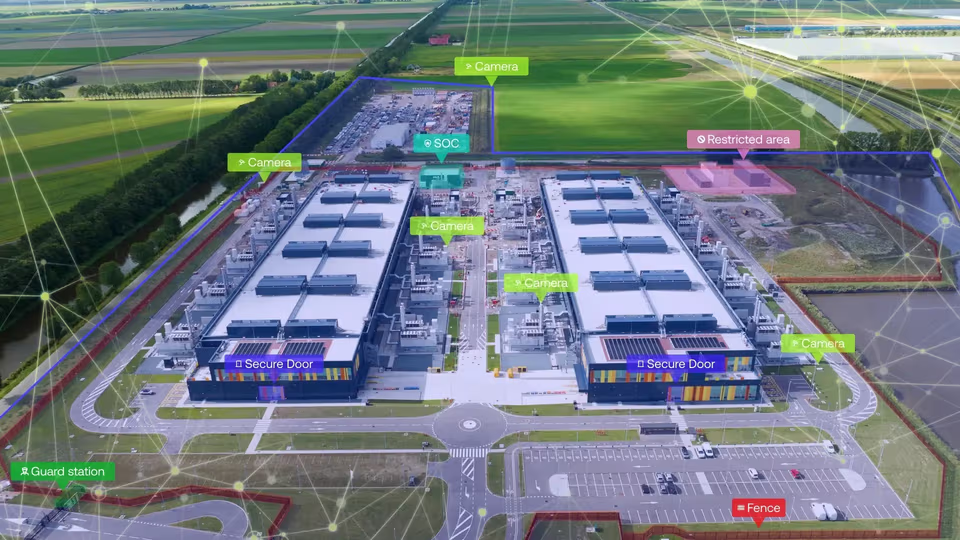
This is the gap Ambient.ai was built to close, with an Agentic Physical Security platform that runs on a reasoning Vision-Language Model (VLM) purpose-built for physical security. It adds a layer that reasons continuously over the cameras and access control a site already has, reading each feed and door event in the context of the space it comes from.
The system takes the first pass of watching, which no team can do by hand at hyperscale. A door alarm from the PACS becomes one signal among many, weighed against what the nearest cameras show, whether anyone is actually present, and whether the activity fits the normal rhythm of that space at that hour. Routine traffic stays quiet, while a moment that does not fit, such as a door held open with no one passing through, reaches an operator with the context needed to judge it.
The operator stays in command, with the system doing the first pass. Decisions to investigate, dispatch or escalate follow the team's judgment and the policies it sets. What changes is where the team spends its attention: on the few moments that warrant it rather than rows of tiles that rarely change.
What matters most is how this scales. The reasoning runs on the cameras and access control already being installed in every new hall, so coverage grows with the camera count. A growing team can hold situational awareness across more halls and more data center campuses as the footprint expands, without that awareness depending on hiring keeping pace with construction. For the full program, see what a modern data center security program looks like.
Security Has to Be Designed Into the Buildout, Not Staffed Into It
The practical change is timing. When security enters the capacity plan as a staffing line added after a hall opens, sized in guard posts and console seats, it starts behind. In a buildout this fast and a hiring market this tight, it has to enter at the design stage, planned alongside power and cooling. The camera plan, access control plan and operating model are then decided together, before the first rack arrives.
Timing also changes what security is for. A team always catching up can only respond, reconstructing an incident from footage after the fact. Prevention depends on noticing precursors, like the repeated pass at a gate or the door tested at the same hour each night. Those are the patterns any security operation exists to watch for. Seen early, they leave time for prevention, although the view across time and buildings that reveals them is the first thing a stretched team loses.
The next hall will open on schedule, its cameras live and its tiles lit on the wall. Under the current model, whether anything reads them still depends on a hire being approved, filled and kept in time. Under a model built on a reasoning layer, every camera that goes live extends what the current team can see, so awareness grows right alongside the campus and attention lands on the moments that matter.

Key Takeaways
Capacity is compounding. Synergy Research Group (April 2026) reported 1,360 large data centers operated by hyperscale companies at the end of Q4 2025, holding 48% of worldwide capacity, with hyperscale operators forecast to reach 67% by 2031.
Hiring is not keeping pace with construction. In Uptime Institute's 2026 survey, 53% of data center operators reported difficulty finding qualified candidates for vacant roles, up from 46% in 2025, a figure that covers data center staffing as a whole. Security teams are growing, and the UC Berkeley Labor Center put U.S. security industry turnover at 89% in 2024.
The gap is structural. Each new hall inherits a model built for one building, and its context does not copy across halls or stay when people leave.
Reasoning is the missing layer. An AI system that reasons over existing cameras and access control scales with the footprint, while operators stay in command.
Design security in from the start. It belongs in the capacity plan alongside power and cooling, framed around prevention rather than catching up.