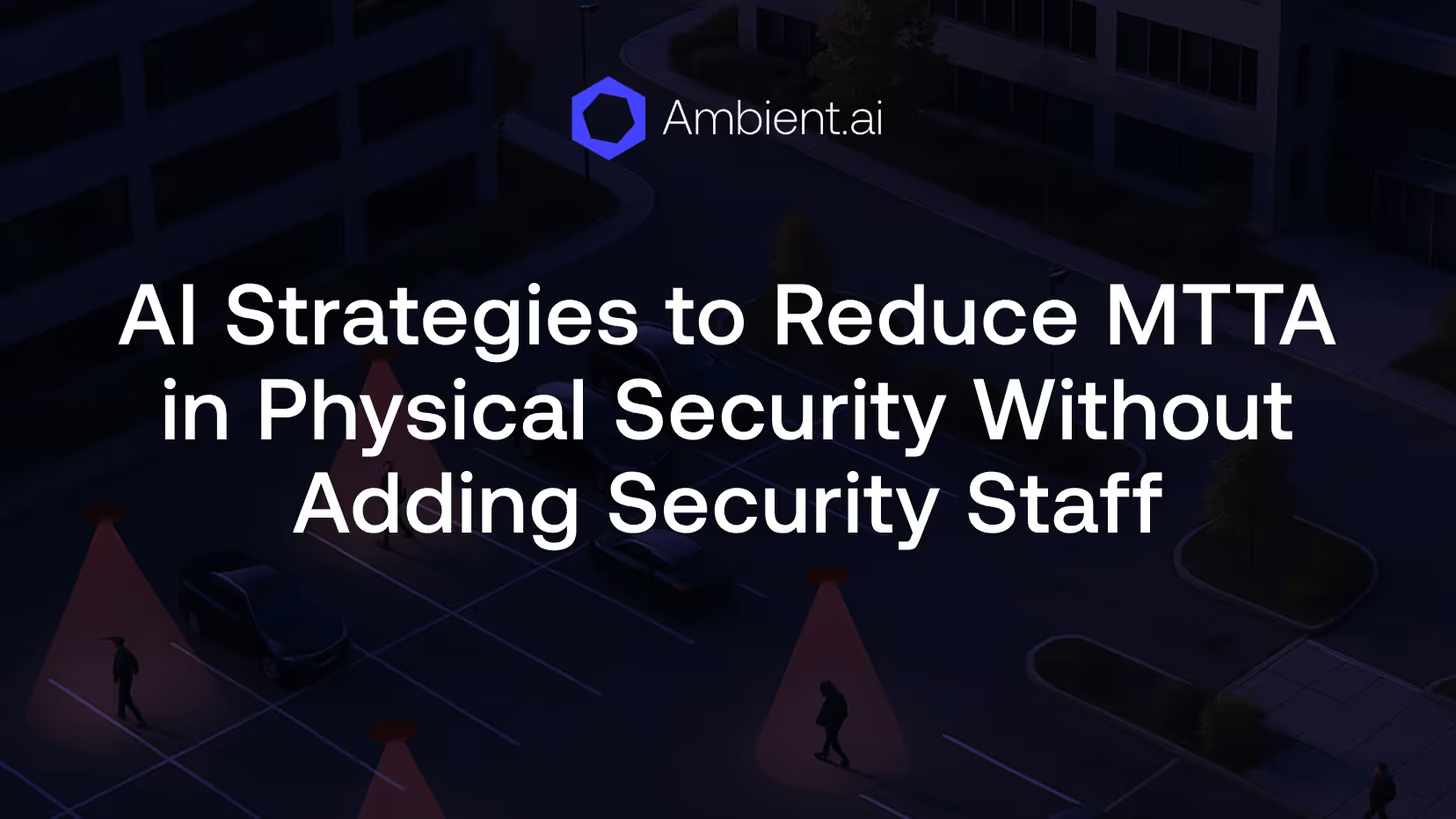
AI Strategies to Reduce MTTA in Physical Security Operations


90%+ alerts resolved in under a minute. See how.
Mean Time To Acknowledge (MTTA) measures the gap between alert generation and operator response—a gap that can mean the difference between intervention and catastrophe. With most active shooter situations over within 10 to 15 minutes, every second of delayed acknowledgment shrinks the window for meaningful action.
Yet operators remain buried in false alarms and scrambling to locate the right camera feed while those critical minutes evaporate. Hiring more staff won't solve the problem—it doesn't address the root causes. AI security systems with Computer Vision Intelligence (CVI) offer a different approach, fundamentally changing how operators engage with alerts.
What Is MTTA?
Mean Time To Acknowledge (MTTA) is a key performance metric that measures the average time between when a security alert is generated and when an operator acknowledges it. In physical security operations, MTTA directly impacts response effectiveness—shorter acknowledgment times give security teams more options to intervene before threats escalate.
MTTA is distinct from Mean Time To Respond (MTTR), which measures the total time from alert to resolution. While both metrics matter, MTTA specifically captures the critical first step: ensuring threats are recognized and prioritized for action.
How MTTA Impacts Security Response
Response time requirements vary dramatically based on threat type, with each scenario establishing distinct operational windows that acknowledgment speed directly influences.
Active Threats: When MTTA Is Measured in Seconds
Law enforcement must initiate containment protocols rapidly upon arrival. Internal security operations must bridge the gap: detecting threats, acknowledging alerts, and initiating protective actions during critical minutes before external responders arrive and begin containment operations.
Perimeter Breaches: MTTA Before They Reach the Door
Perimeter detection systems identify unauthorized entry attempts at building perimeters, parking areas, and restricted access boundaries. Security teams must acknowledge alerts rapidly to enable response before adversaries reach building entry points or populated spaces.
Faster acknowledgment enables proactive interdiction before adversaries reach critical assets, directly impacting the effectiveness of layered security strategies.
Behavioral Precursors: Extending Your MTTA Window
Behavioral indicators like loitering, unusual movement patterns, and Physical Access Control Systems (PACS) violations provide early detection windows. PACS manage credential-based entry through card readers, biometric scanners, and electronic locks—generating alerts when access rules are violated. Security operations identify concerning behaviors—individuals repeatedly circling facilities, testing door access points, or conducting surveillance—that precede hostile actions.
These indicators provide intervention opportunities measured in minutes rather than seconds, but only when operators acknowledge and assess alerts without delay caused by false alarm triage.
Access Control: MTTA Before Intruders Go Deep
Tailgating incidents and door-forced-open alarms require immediate acknowledgment. Each passing second allows unauthorized individuals to move deeper into facilities, beyond initial detection zones and into areas where interdiction becomes increasingly complex.
Off-Hours and Multi-Site: Where MTTA Challenges Compound
MTTA challenges intensify during overnight hours and shift transitions when staffing is thinnest. During low-traffic periods, organizations often operate with minimal Security Operations Center (SOC) coverage.
These windows create conditions where acknowledgment delays are most likely and most dangerous. Effective CVI platforms enable lean operations where a single patrol guard can function as both responder and SOC operator, maintaining rapid acknowledgment capability even during vulnerable off-hours.
Enterprises managing distributed facilities face additional compounded challenges. Operators switching between site interfaces, navigating inconsistent alert formats across locations, and lacking unified visibility all contribute to acknowledgment delays. Without a single-pane-of-glass view across all sites, critical alerts can get lost in the shuffle between disparate systems.
Why Expanding Security Teams Won't Solve MTTA
Adding security staff appears to offer straightforward response time improvement, yet this approach fails because it doesn't address fundamental constraints that degrade response times:
Alert Fatigue Degrades Performance
Traditional video surveillance and PACS generate overwhelming false alarm rates. When operators receive hundreds of false positives daily, they can experience desensitization regardless of team size.
Research shows that after just twenty minutes of observing a single screen, operators may overlook up to 90% of activity in the monitored area—a cognitive limitation that no amount of staffing can overcome.
Distributing alert volume across multiple operators doesn't achieve better threat detection—alert volume overwhelms human processing capacity whether concentrated on one person or spread across team members.
Coordination and Staffing Challenges
As security teams grow, coordination complexity increases substantially, creating communication delays that offset efficiency gains. The industry also faces a persistent retention crisis—in research, more than 40 percent of security service providers identify turnover as their top challenge, ranking it above margins, profitability, and compliance concerns.
This constant churn means organizations are perpetually training new operators who haven't yet developed the situational awareness that experienced staff provide.
AI-powered Behavioral Detection That Reduce MTTA
AI security systems with Computer Vision Intelligence address the root causes of delayed acknowledgment through automated alarm verification, intelligent alert prioritization, and contextual intelligence.
Automated Alarm Verification Eliminates False Positive Triage
CVI systems analyze video feeds in real-time to verify whether alerts represent genuine security events. By automatically clearing false alarms before they reach operators, these systems eliminate the single largest source of alert fatigue and queue buildup.
Beyond improving MTTA metrics, reducing false alarm volume decreases the cognitive load and stress that contribute to operator burnout—directly addressing the retention crisis that plagues the industry.
Intelligent Severity Prioritization Surfaces Critical Threats
AI-powered security platforms with CVI classify and prioritize threats based on severity, context, and risk factors, ensuring critical alerts surface immediately while lower-priority events queue appropriately. This intelligent routing enables critical threat detection to bypass routine alert queues—a brandished weapon alert reaches operators instantly regardless of queue depth.
Automated Escalation Prevents Alert Aging
What happens when initial acknowledgment doesn't occur within threshold? Advanced CVI platforms include automated escalation workflows that route unacknowledged alerts to supervisors or backup operators.
This prevents critical alerts from aging in queues during breaks, distractions, or capacity overload—ensuring no genuine threat goes unaddressed due to temporary operator unavailability.
Instant Visual Context Accelerates Assessment
AI-powered security platforms deliver alerts with embedded video clips, live streams, and visual summaries. Operators acknowledge alerts while simultaneously viewing relevant footage, eliminating the time traditionally required to locate cameras and assess situations.
This integration compresses what traditionally required multiple steps—alert acknowledgment, camera location, video retrieval, and situation assessment—into a single action.
Unified Multi-Site Visibility
For enterprises with distributed facilities, Cloud SOC capabilities provide a single-pane-of-glass view across all locations. Cloud SOC extends traditional security operations center functionality to a cloud-based platform, enabling centralized monitoring regardless of where physical infrastructure resides. This unified visibility eliminates the interface-switching and inconsistent alert formats that compound MTTA challenges in multi-site operations.
Reducing MTTA With Agentic Physical Security
Ambient.ai's agentic AI platform for physical security enables security teams to resolve alerts rapidly by processing all video feeds simultaneously across an organization's camera infrastructure, applying contextual threat analysis that distinguishes genuine security events from routine activity. The platform compresses investigation times through AI-powered search capabilities.
Rather than overwhelming operators with every motion detection trigger or door sensor activation, Ambient Intelligence delivers verified alerts with embedded visual context. Operators receive notifications for high-confidence threats, accompanied by relevant video clips and live streams to enable immediate assessment. Organizations achieve substantial reductions in total dispatches through automated verification and intelligent prioritization.
The platform enables security leaders to track MTTA as a measurable KPI, baseline current performance, and demonstrate continuous improvement. Combined with Cloud SOC's unified visibility across distributed sites and automated escalation workflows that prevent alerts from aging in queues, Ambient.ai addresses MTTA challenges across the full spectrum of security operations—from overnight shifts with minimal staffing to enterprise deployments spanning hundreds of locations.
Key Takeaways
- MTTA is critical for security response—with active shooter situations often over in 10-15 minutes, every second of acknowledgment delay shrinks the window for meaningful intervention.
- Hiring more staff won't fix MTTA—human cognitive limitations, alert fatigue from false alarms, and industry-wide turnover challenges mean staffing alone cannot address root causes of delayed acknowledgment.
- Computer Vision Intelligence reduces MTTA at its source—by automatically verifying alarms, filtering false positives, and prioritizing critical threats, CVI platforms ensure operators focus only on genuine security events.
- Unified visibility and automated escalation close coverage gaps—Cloud SOC capabilities and escalation workflows maintain rapid acknowledgment during off-hours, shift transitions, and across distributed multi-site operations.
MTTA should be tracked as a measurable KPI—platforms with operational insights enable organizations to baseline performance, set targets, and demonstrate continuous improvement in acknowledgment times.