Biometric Access Control Systems: How They Work, Types, and Use Cases
Learn how biometric access control systems work, which modalities suit each environment, and how to build a compliant, layered physical access program.
A biometric access control system verifies identity through a biological characteristic before granting physical entry. Enterprises are evaluating biometrics as part of broader security strategies because the approach can strengthen assurance while reshaping how organizations manage enrollment, exceptions, and data.
The central question is not whether biometrics can open a door, but where they fit within a risk-based physical access program alongside existing credentials, controllers, and operational review. Understanding those tradeoffs is the starting point for deploying the technology responsibly.
Key Takeaways
- Biometric access control systems strengthen identity assurance at the door, but they perform best when layered with a card or PIN at sensitive zones rather than deployed as a wholesale credential replacement.
- Template protection decides whether a biometric PACS stays defensible over time, because a compromised biological trait cannot be reissued the way a password or badge can.
- A valid biometric match confirms who authenticated, not how many people walked through, so tailgating countermeasures and AI video verification close the post-authentication gap that readers alone cannot cover.
- Privacy obligations for biometric PACS vary sharply across Illinois, Texas, Colorado, and the European Union, making written consent, jurisdiction-specific retention schedules, and a non-biometric fallback essential parts of any rollout.
What Are Biometric Access Control Systems?
A biometric access control system is a physical security technology that grants or denies entry to buildings and restricted areas by matching a person's unique biological traits against securely stored templates.
Biometrics operate inside a broader physical access control system (PACS). The Security Industry Association (SIA) defines a PACS as an electronic or digital system that grants access to authorized individuals by confirming identity through factors such as key cards, mobile credentials, and biometrics, and advises using risk-based guidance when selecting authentication mechanisms.
That risk-based approach rests on authentication factors based on something you have, such as a card; something you know, such as a personal identification number (PIN); and something you are, meaning a live biometric. Authentication requirements increase with area sensitivity, moving from basic credential checks in controlled areas to multifactor authentication in the most restricted zones.
One distinction trips up many programs. Combining two biometric modalities, such as fingerprint plus iris, can improve accuracy, but both traits still belong to the same "something you are" category. Stacking them does not satisfy a multifactor authentication requirement, which calls for factors drawn from separate categories, so a card or PIN is still needed at zones that require true multifactor.
How Biometric Access Control Systems Work
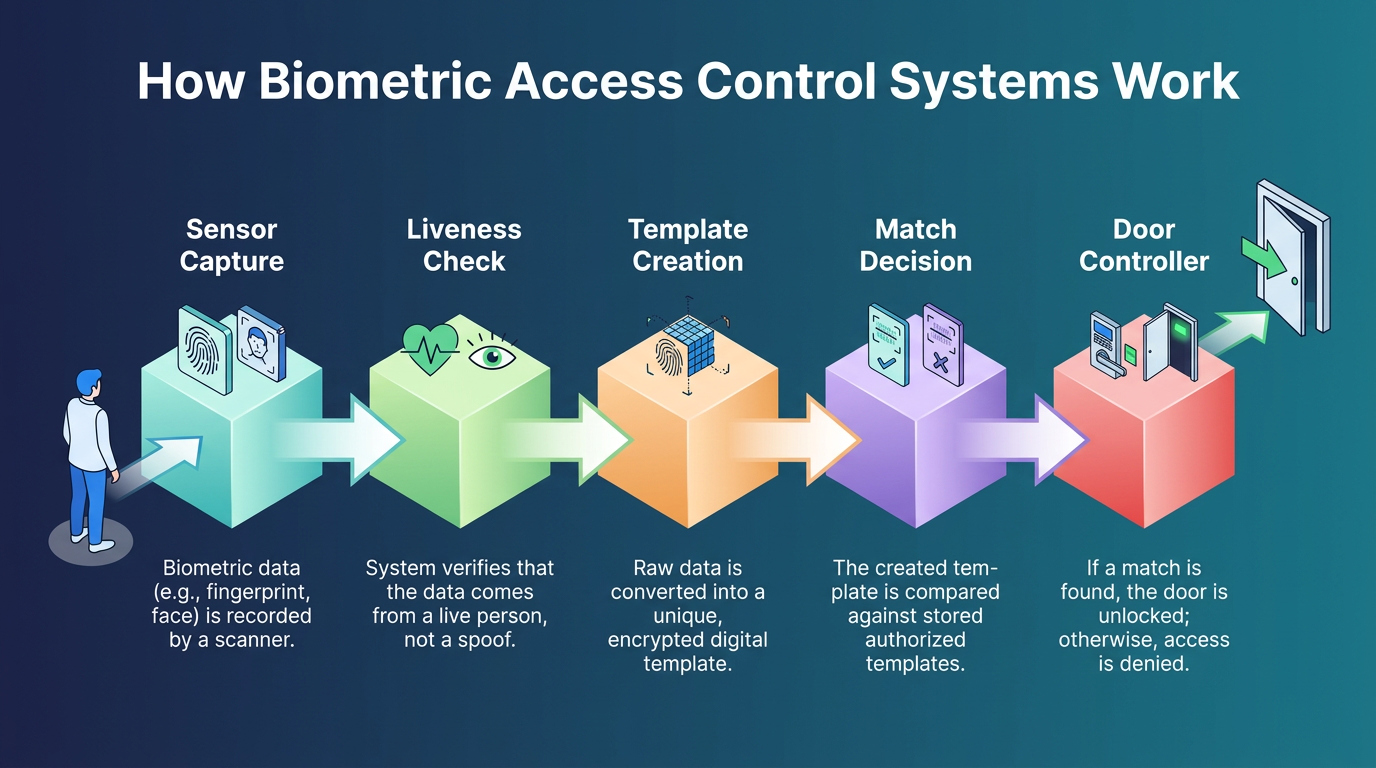
Every modality follows a common pipeline. A sensor captures the trait, the technology runs quality and liveness checks, and the raw sample is converted into a biometric template: a mathematical representation rather than a stored source image. At the door, a fresh capture is compared against enrolled templates, and the match decision is sent to the door controller or turnstile.
Matching can verify a claimed identity or identify a person from an enrolled population. In claimed-identity verification, the person presents a credential and the live sample is compared with the associated template. In population identification, the technology searches the enrolled templates for a match.
Vendor datasheet accuracy figures and real transaction rates are measured differently, so datasheet numbers are not door-level performance. Procurement should account for sensor placement, enrollment quality, environmental conditions, demographic performance, liveness testing, and the operational consequences of false matches and false rejections.
Templates may live on the reader for local matching, on a central server, or on a smart card that releases the template after the correct PIN is entered. Where templates live affects latency, resilience, and privacy obligations.
Legacy Wiegand connections between reader and controller are unidirectional, unsupervised, and unencrypted. The Open Supervised Device Protocol (OSDP) is the current standard and supports biometric devices natively. Its Secure Channel encryption must be enforced.
Types of Biometric PACS
Fingerprint Recognition
Fingerprint readers match the ridge endings and bifurcations in a print against enrolled templates. Readers come in contact and contactless variants, with the index and middle fingers carrying substantial matching information for both. Fingerprint is the most-used modality in enterprise PACS deployments, and contactless multi-finger readers can handle high-throughput turnstile traffic.
Iris Recognition
An iris reader images the externally visible iris under near-infrared (NIR) light and converts the pattern to a template. The modality can suit environments where workers cannot readily present their hands because of gloves, contamination, or protective clothing.
Palm Vein Recognition
Palm vein readers illuminate the hand with NIR light. Deoxygenated hemoglobin absorbs the light, producing an image of the vascular pattern beneath the skin. Vascular patterns are difficult to recreate because they sit inside the hand and, for some approaches, require blood flow to register. The touchless process can also support environments with strict hygiene requirements.
Voice and Multimodal Biometrics
Voice is generally better suited to intercom screening than door authentication, with two-way audio used alongside visual review to vet visitors before entry.
Multimodal fusion, by contrast, combines matching scores from separate biological traits to improve reliability when a single trait is difficult to capture. Fused modalities still register as inherence rather than multifactor authentication at the door.
Biometric vs. Traditional PACS Credentials
Cards fail in ways biometrics cannot. Low-frequency proximity cards can be cloned with widely available copiers; ASIS reports that inexpensive equipment, online research, and minimal reconnaissance can be enough to bypass low-frequency card controls. Employees may also loan badges to colleagues.
Biometrics are not automatically the higher-assurance option, though. Under the Federal Information Processing Standard (FIPS) identity framework, an unattended biometric check earns only medium confidence; a biometric verified in the presence of a guard, or a card-plus-PIN transaction, earns high confidence. Biometrics work best when layered with possession or knowledge factors at sensitive doors rather than used as a wholesale card replacement.
A fallback authentication mechanism is also necessary when biometric data is unavailable because injuries, gloves, and sensor conditions can cause capture failures. Most enterprises therefore run hybrid environments where cards, mobile credentials, and biometrics coexist rather than one displacing the others.
Limitations and Vulnerabilities of Biometric PACS
Spoofing and Presentation Attacks
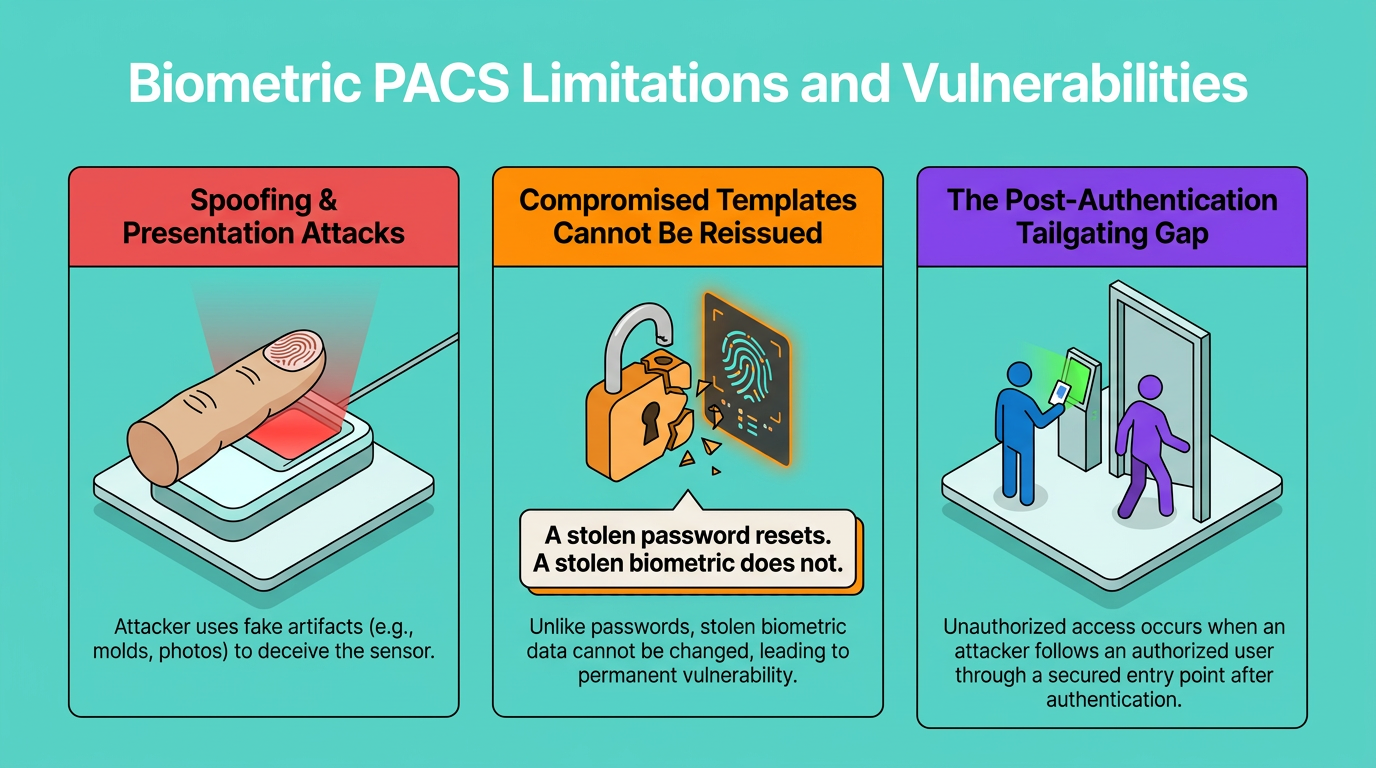
Fake fingers target the sensor rather than the matching database. Presentation attack detection (PAD) is standardized under the International Organization for Standardization and International Electrotechnical Commission presentation attack detection standard, but detection performance can vary across readers and attack types. Procurement testing should therefore assess the artifacts and environmental conditions relevant to the intended deployment.
Compromised Templates Cannot Be Reissued
A stolen password gets reset. A compromised biological trait cannot. SIA's guidance is to store encrypted templates rather than original images and to limit central repositories; matching on the reader or card can keep biometric data off a central server. The biometric information protection standard covers the confidentiality, integrity, and renewability properties those stored templates must have.
The Post-Authentication Tailgating Gap
A valid biometric match proves an authorized person authenticated. It does not prove that only the authenticated person walked through. Tailgating and piggybacking remain common PACS gaps because readers cannot determine how many people passed through after an authorization.
Physical countermeasures include optical turnstiles that detect and alarm, plus security revolving doors and mantrap portals that physically enforce individual passage. Risk-based physical access guidance also recommends gates or turnstiles at sensitive access points so each authentication corresponds to an individual entry.
Biometric Privacy Laws and Compliance Requirements
Illinois BIPA
The Illinois Biometric Information Privacy Act (BIPA) specifies covered biometrics, including retina and iris scans, fingerprints, voiceprints, and scans of hand geometry. Employers must provide written notice and obtain a written release before collection, publish a retention policy, and destroy biometric data when its purpose is satisfied or within three years of the last interaction, whichever comes first.
BIPA carries a private right of action with statutory damages for negligent, intentional, or reckless violations, or actual damages if greater, plus attorneys' fees. That structure has generated a sustained wave of class actions against employers. A recent amendment treats repeated collections of the same biometric identifier by the same method as a consolidated violation and recovery per person.
Texas, Colorado, and the State Patchwork
Texas's Capture or Use of Biometric Identifier Act (CUBI) requires notice and consent before capture and imposes destruction requirements after the collection purpose expires. For employee security biometrics, that purpose is presumed to expire at termination. Colorado permits employers to require biometric consent as a condition of employment only for limited purposes, including secure physical location and system access, timekeeping, and workplace safety monitoring.
The EU AI Act
The European Union Artificial Intelligence Act includes an important carve-out: it excludes from its biometric-identification definition AI systems whose sole purpose is confirming a specific person's identity for security access to premises. Workplace emotion inference, by contrast, is prohibited except for medical or safety reasons.
Practical Compliance Steps
A defensible deployment combines technical controls with documented privacy governance from the start:
- Run a privacy impact assessment before installation; SIA's code of practice recommends it.
- Publish a written policy with jurisdiction-specific retention and destruction schedules; Illinois and Texas set different biometric-data destruction deadlines, while Colorado requires a written retention schedule and deletion guidelines, including deletion once the purpose for collection has been satisfied.
- Collect written consent before enrollment and always offer a non-biometric alternative such as a card or PIN.
- Store encrypted templates rather than original images, and delete raw samples after template creation.
- Flow BIPA's prohibition on selling or profiting from biometric data and CUBI's disclosure restrictions down to vendors and subprocessors in contract.
Together, these controls create an auditable basis for deploying biometric PACS technology while limiting unnecessary collection, storage, and disclosure.
How AI Video Verification Strengthens Biometric PACS
Traditional PACS sensors each report a narrow signal: a door contact registers that a door opened, a badge reader confirms a credential was presented, and a motion sensor detects movement, but none of them explain what actually happened at the door. AI-powered video analytics can answer that question while addressing two operational problems that are often conflated.
The first is alarm noise. Door Forced Open (DFO) and Door Held Open (DHO) door alarms fire for benign reasons throughout the day. For example, a cleaning crew blocks a door with a cart, or someone holds a door for a colleague and then lets go. Computer vision pairs each alarm with the camera covering that door and clears routine events before an operator sees them, so human attention goes to the small fraction that warrants review.
The second is the tailgating gap described above. It typically generates no alarm from readers or door contacts, which cannot determine how many people passed through. Vision-based detection compares people moving through the doorway with credentials presented. When a credential is presented at a server-room door but vision detects additional entrants, the discrepancy is flagged with the matching video for review, supporting credential-to-person alignment.
Contextual analysis goes beyond counting and reads the scene by analyzing the relationships among people, objects, the environment, and typical behavior for that location and time. For example, in a data center, a technician wheeling a server cart through the loading dock during a scheduled delivery window is routine. The same cart moving through a propped emergency exit overnight is a precursor worth escalating, alongside loitering at perimeter doors or repeated denied-access attempts at the same door.
Human judgment stays in the loop, applied to escalation decisions rather than routine alarm clearing. Human attention belongs on decisions requiring trust, context, and accountability, not on repetitive screen watching or alarm verification.
Implementation Considerations for Biometric PACS
Pilot a high-traffic door before committing to a campus rollout; a pilot lane surfaces the lighting, throughput, and exception problems a specification sheet hides. Enrollment deserves its own program plan: identity proofing at the point of enrollment, sufficient staffing and hours for the enrollment window, and a deprovisioning path so templates are destroyed on schedule when someone leaves.
Throughput varies sharply by modality. Contactless multi-finger readers clear turnstile lanes faster than mantrap portals, which trade throughput for greater certainty that an authorized person entered alone. Direct sunlight creates sunlight reflections on iris readers, and an ingress protection (IP) rating describes protection against environmental exposure rather than outdoor matching performance. Plan fallback capacity for capture failures caused by injuries, gloves, or sensor conditions.
The Open Network Video Interface Forum (ONVIF) Profile A and Profile C standardize access-control configuration, basic IP-based access control, door control, and event management. Alarm-to-video synchronization is what makes a PACS event reviewable afterward. Brownfield gateways and parallel-run migration allow an OSDP retrofit to proceed while existing readers stay in service, so the installed base gains new capabilities instead of being replaced.
Biometric PACS Use Cases Across Industries
Data Centers and Critical Infrastructure
A common data-center pattern layers card, PIN, and iris checks at exclusion areas behind mantrap portals that confirm the authorized individual is alone. For bulk electric systems, the North American Electric Reliability Corporation (NERC) Critical Infrastructure Protection physical security standard requires multiple forms of physical entry control for high-impact systems, prompt alerting on unauthorized access, and retained entry logs, with biometric devices expressly recognized as a qualifying control.
The International Organization for Standardization and International Electrotechnical Commission information security standard expects premises to be monitored continuously for unauthorized physical access.
Healthcare
Hospitals can use palm vein readers where touchless entry supports infection-control practices. The modality avoids the shared contact surface associated with fingerprint sensors while still providing a biometric check at restricted doors.
Manufacturing, Pharmaceutical, and Construction Environments
In manufacturing environments, iris readers can work where fingerprints are difficult to capture. Gloved hands, dirty hands, and full protective clothing may leave the eye as the most reliably accessible trait.
Corporate Campuses and Lobbies
Frictionless, high-throughput entry is a common enterprise deployment. Contactless fingerprint readers at turnstiles let employees flow through at speed, while visitor management handles contractors, deliveries, and guests with no enrolled template. These deployments can extend across corporate campuses while preserving fallback credentials for exceptions.
Building a Defensible Biometric Access Program
A biometric reader verifies identity at the door, but the harder work sits in what happens next. Sustainable programs pair biometric authentication with layered credentials, encrypted template storage, jurisdiction-aware privacy governance, and video-backed review that closes the tailgating gap. Treat biometrics as one factor inside a risk-based access architecture, and every access event arrives with the context needed to act on it responsibly.
Frequently Asked Questions
What is the difference between biometric verification and biometric identification in a physical access control system, and when should each be used?
Verification compares one live sample against one stored template, enabling high-throughput access. Identification searches all enrolled templates, introducing latency unsuitable for busy access points but useful when no credential is presented.
Why doesn't combining two biometric modalities like fingerprint and iris count as multifactor authentication?
Both biometrics belong to the inherence category, representing what you physically are. Multifactor authentication requires different authentication categories: inherence must combine with possession factors like cards or knowledge factors like PINs to achieve true multifactor protection.
How do biometric privacy requirements differ between Illinois BIPA, Texas CUBI, and Colorado law, and what specific steps must employers take to comply with each?
Illinois BIPA grants employees private lawsuit rights with statutory damages per violation, driving extensive litigation. Texas CUBI permits only attorney general enforcement, not private lawsuits. Colorado restricts mandatory consent to specific workplace functions with state enforcement only.
