CCTV and Access Control: How They Work Together
Learn how CCTV and access control integration works, from OSDP and ONVIF protocols to event mapping, AI correlation, and cybersecurity requirements.
Closed-circuit television (CCTV) and access control were built for different jobs, and neither one tells the full story on its own. A badge read confirms a credential, not the person holding it. A camera captures the person, not their authorization. Pairing the two turns raw alarms into verifiable events an operator can act on. The protocols, workflows, and design choices behind that pairing are what separate an integration that works from one that only looks connected.
Key Takeaways
- Integration turns each access event into a verifiable record by pairing credential data with the corresponding camera feed at the operator's console.
- OSDP secures reader-to-panel communication with encrypted, bidirectional messaging, while ONVIF profiles govern how controllers, cameras, and management software exchange data across the IP network.
- Operators get useful context instead of extra noise only when doors, readers, and alarm points are mapped to cameras with the right field of view.
- AI moves integration from single-event triggers to continuous correlation, surfacing anomalies across credential and video streams that rule-based logic misses.
What CCTV and Access Control Integration Means for Security Teams
Security teams are drowning in video feeds and alarms, with more than 98% of alerts turning out to be false positives. That volume drives operator fatigue and raises the odds that a real incident gets buried in the noise. Integrating CCTV with access control changes what an alarm actually represents. On its own, a badge read or a door sensor trip is just a data point that needs interpretation. Paired with the corresponding video, it becomes a verifiable event the operator can resolve without leaving the console or hunting through separate systems.
That shift has practical consequences across daily operations:
- Door forced open alarms can be cleared or escalated in seconds instead of being dispatched blindly.
- Tailgating and piggybacking, which credential data alone cannot catch, become visible.
- Post-incident investigations that once meant cross-referencing access logs against video archives collapse into a single timeline.
- Mustering, after-hours access checks, and visitor escort enforcement all draw from the same correlated record.
The value depends on the underlying integration holding up. Protocol choices at the reader, panel, and network layers decide whether events pass cleanly between systems. Event mapping decides which cameras respond to which alarms, and network segmentation decides whether the converged infrastructure stays defensible. When those foundations are solid, the security team spends less time reconstructing what happened and more time acting.
How Access Control and Video Surveillance Integration Works
Integration works by treating video and access control as one shared event pipeline instead of two parallel systems. When an event fires in either one, the other reacts. A door alarm from a physical access control system (PACS) pulls the associated camera feed to the operator's console; a video-side detection can flag the matching access log entry.
Three mechanisms make that possible:
- Event triggering. A specific access event, such as a door forced open or a denied credential, automatically activates the camera assigned to that door and displays the feed alongside the alarm. The operator sees both at once, with no separate interface to open.
- Bidirectional correlation. Operators can start from either side. An access event pulls up the associated video; suspicious behavior on camera can be traced back to the credential activity at the nearest reader.
- Unified timeline. Every access event and its associated video are timestamped and stored together, so investigators and operators can review what happened at a door without stitching two systems together after the fact.
Underneath these mechanisms sit the protocols that carry the signals between readers, controllers, cameras, and management software, which is where the next section picks up.
Protocols That Connect an Access Control System With Video Surveillance
Integration spans multiple layers of the physical security infrastructure, and each layer has its own communication standard.
Reader to Controller
At the field device layer, credential readers communicate with access control panels. The legacy Wiegand interface has long been the standard for this connection. Wiegand transmits unencrypted voltage pulses over two wires. It cannot support bidirectional communication, remote firmware updates, or encrypted credential exchange.
The replacement is OSDP. OSDP supports Secure Channel mode with AES-128 encryption and allows bidirectional communication between reader and panel. Controllers that support both Wiegand and OSDP let teams migrate in phases, without a full hardware replacement.
Controller to Video Management System (VMS) and Management Software
At the IP network layer, ONVIF profiles govern how physical security devices and management software exchange data.
ONVIF organizes its profile specifications into distinct profiles. Each profile defines a set of mandatory and conditional functions, and some also identify optional ones. The profiles most relevant to CCTV and access control integration include:
- Profile A covers access control configuration, including rules, credentials, schedules, and event handling.
- Profile C handles real-time door control and alarm management.
- Profile T covers advanced video streaming.
- Profile M covers metadata and can also support analytics event delivery.
System administrators can combine different ONVIF profiles depending on the application.
Why This Layering Matters
OSDP and ONVIF sit at different layers and serve complementary functions. Organizations that treat integration as a single product decision often introduce gaps at the handoff between layers, because a reader-to-panel protocol problem looks very different from an IP-layer interoperability failure. Testing each layer separately helps teams pinpoint whether a failure comes from field-device communication or IP-layer data exchange.
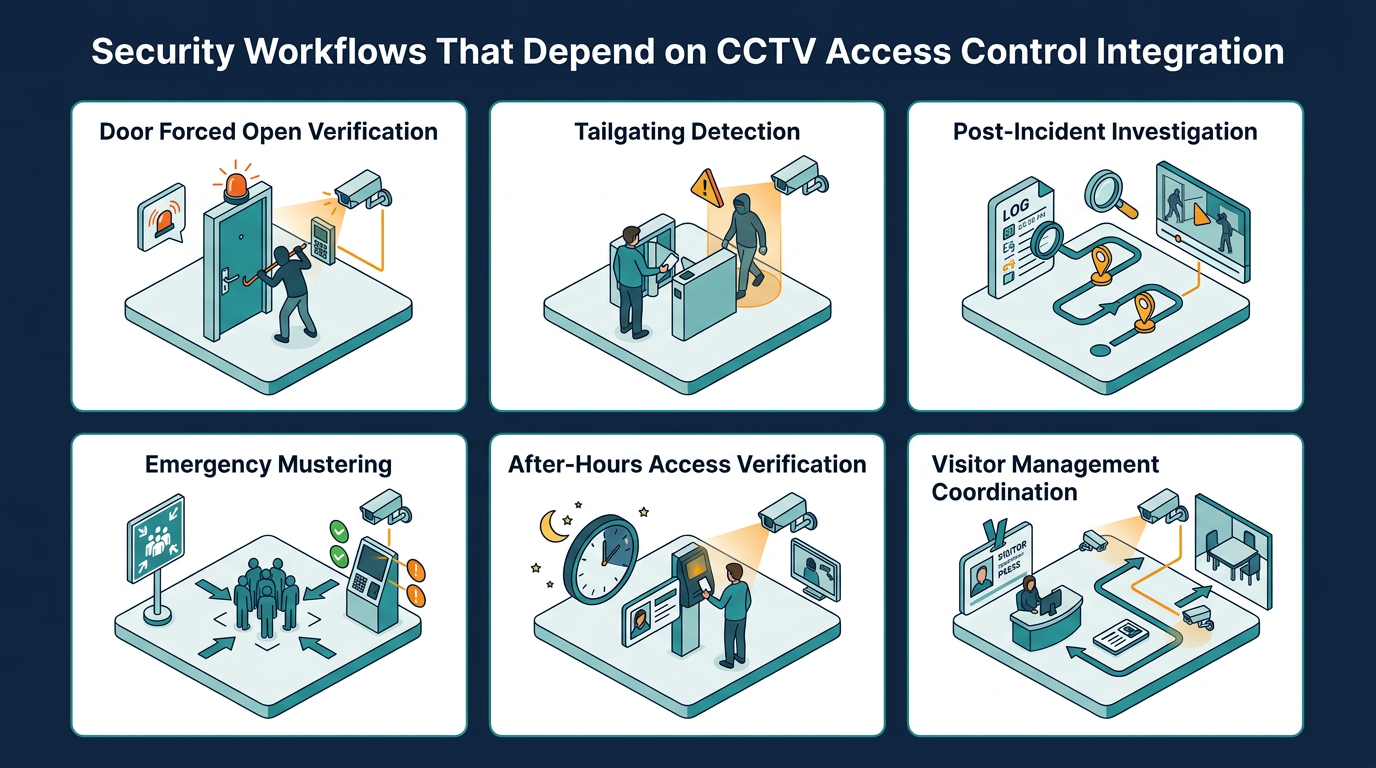
Security Workflows That Depend on CCTV Access Control Integration
Operators evaluate credential data and video together during access events and investigations.
Door Forced Open Verification
A door contact sensor detects an open state with no preceding valid credential read, and the PACS generates a Door Forced Open alarm. In an integrated system, the associated camera feed automatically appears at the operator's console. The operator evaluates whether the door was pried open, whether a badge tap failed to register, or whether the door contact sensor is simply misaligned.
Tailgating Detection
Beyond verifying forced-door alarms, integration can also spot when authorized access involves an unauthorized second person. Standard access control validates a credential but cannot confirm that only one person actually passed through. A video-based detection layer counts individuals crossing the threshold per badge event. When the count exceeds what a single credential permits, the system generates an alert containing both the credential identity and video of the crossing.
That credential-plus-video combination lets security directors distinguish between piggybacking and tailgating. This distinction matters for incident handling and policy response, and each data source tells only part of the story.
Post-Incident Investigation
The same correlation that supports real-time verification also cuts the steps required for later investigations. Without integration, investigators audit the access log, identify timestamps, then separately search video archives for matching footage. With integration, each access log entry links directly to its corresponding video clip, and the manual correlation step disappears. That direct link gives operators a verifiable sequence of credential activity and recorded movement, and it cuts the time needed to reconstruct who used an entry and what happened around it.
Emergency Mustering
Integrated records also support accountability during a broader emergency. During an unplanned evacuation, the access control system provides the data source for personnel accountability: which credentials were last recorded at which zone entry points. Temporary visitor credentials generate access events in the same system, extending that accountability to everyone on site.
Camera feeds covering assembly areas give a remote incident commander visual context on crowd formation and on individuals who may be injured or unable to self-report.
After-Hours Access Verification
Repeated credential attempts at a restricted zone outside normal business hours can be treated as a higher-risk trend. With video integration, the corresponding camera feed accompanies the access event. The operator can confirm the cardholder's identity, see what they carried in, and later verify that they left when expected.
The same logic applies wherever organizations protect sensitive assets or personnel, because credential validity alone does not establish appropriate intent.
Visitor Management Coordination
Visitor management workflows generate temporary credentials with defined access windows. Linking those credentials to camera feeds at lobby entries and elevator banks creates a verifiable record of the visit, and camera coverage at destination floors extends that record along the visitor's route.
If a visitor strays from the expected path or tries to access something outside the authorized window, the integrated system captures both the access attempt and the matching video. That supports escort policy enforcement and reduces reliance on paper sign-in audits.
Implementation: Mapping Cameras to Doors, Readers, and Access Events
Once the protocols and workflows are understood, the next step is implementation. A working integration depends on accurate associations between physical hardware and digital events. The security team needs to define event-camera associations that link each door, reader, and alarm point to one or more cameras with the appropriate field of view.
The relationship is rarely one-to-one. A single secured entry may use an outside approach camera and an interior lobby camera, and a turnstile counting camera can contribute different information to the same event.
Event mapping defines which access events trigger which video responses. A denied credential read might surface a recorded clip of the attempt, while a door held open alarm might pull the live feed and extend the recording buffer. Without explicit mapping, operators either receive too much noise or miss the connections that integration was meant to provide.
Latency tolerances also shape mapping decisions. A door release command that waits for video frame analysis before granting access introduces operational latency, creating a different user experience than one where camera correlation happens after the door cycles. Designing the integration around the security purpose of each event means teams need to treat events individually.
Cybersecurity Requirements for Converged CCTV and Access Control Networks
Mapping decisions define what the integration does; cybersecurity decisions define whether it can be trusted. NIST SP 800-82 Rev. 3 classifies physical access control systems as operational technology (OT), so OT practices apply to the converged stack. Baseline controls include:
- Separating corporate and OT networks, often using VLANs with firewall enforcement between zones.
- Requiring multi-factor authentication for remote access.
- Applying least-privilege access through role-based access control.
Controls have to respect operational constraints, though. A door release delayed by an inspection layer creates a different kind of security problem.
How AI Changes What CCTV and Access Control Integration Can Do
The integration model described above relies on rule-based triggers: a door alarm fires, a camera feed appears. AI adds a layer that correlates continuous event streams instead of waiting for a single trigger.
AI platforms can compare credential activity with video context to surface events worth reviewing, including unusual access activity or threshold crossings that do not match the associated badge event. Real-time correlation of PACS event data with video feeds is a defining characteristic of this approach.
Video surveillance is the most commonly integrated technology pairing in the ASIS International Access Control Research Report. With that foundation in place, the operator's role shifts toward reviewing flagged events and making escalation decisions.
AI adds operational value only when integration is disciplined, and the system is tuned over time. Operators also need clear review boundaries: they need to know when to verify or escalate an alert, and override criteria have to be explicit. Organizations reduce the risk of adding complexity without improving response when they use AI to support skilled operators rather than replace their judgment.
What Integrated Access Control and Video Surveillance Enables
A mature integrated security program improves decisions under pressure by making ambiguous events easier to interpret and giving operators enough context to act with confidence. It also preserves a defensible record of why each response happened. That standard shifts evaluation away from the number of connected devices or generated alerts and toward operational outcomes: faster verification, more consistent escalation, and fewer unresolved events. Integration is reliable when personnel can trust the context it provides, and leadership can assess response quality over time.
Frequently Asked Questions
What are the key differences between OSDP and Wiegand protocols, and why should organizations prioritize migrating from Wiegand to OSDP for access control reader-to-panel communication?
OSDP can encrypt credential data when Secure Channel is enabled and enables two-way communication for remote diagnostics and firmware updates. Organizations should prioritize migration because Wiegand transmits unencrypted voltage pulses vulnerable to interception, while when enabled and correctly configured, OSDP Secure Channel mode protects the reader-to-controller link against interception and replay attacks, but protection against credential cloning depends on the credential technology itself.
How should security teams design camera-to-door mapping to minimize operator noise while ensuring critical access events like tailgating and door forced open alarms are properly covered?
Design mapping by event severity and decision latency. Assign multiple cameras only to high-consequence zones where single angles create blind spots. Use separate cameras for counting versus identification. Differentiate live-feed events from post-event review, as buffering affects storage without adding real-time operator value.
How does AI-driven correlation between access control and video surveillance differ from traditional rule-based integration, and what prerequisites need to be in place before deploying AI on a converged security platform?
AI correlates continuous event streams across credential and video data to surface anomalies, while rule-based integration reacts to preset triggers. Prerequisites include device-to-camera mapping, tuned detection thresholds, explicit operator review boundaries with escalation criteria, and refinement cycles measuring false positive rates against operational outcomes.
