HIPAA Surveillance Cameras: Compliance Best Practices for Healthcare Facilities
Learn how HIPAA governs security camera footage in healthcare facilities, from placement rules to BAA requirements and breach response workflows.
Healthcare facilities deploy cameras for the same reasons any enterprise does: perimeter protection, incident investigation, workplace violence response. HIPAA changes what those cameras record and who can look at it. A lens angled at the wrong whiteboard, a shared guard-desk login, or a cloud recorder onboarded without a business associate agreement can convert a routine deployment into a reportable breach. The practices below map where cameras belong, when footage becomes protected health information, and how to hold the system, and every vendor touching it, to the standard auditors expect.
Key Takeaways
- HIPAA permits security cameras in healthcare facilities and regulates the footage the moment it identifies a patient in a care context.
- Camera placement is the first control: perimeter, lobbies, corridors, and pharmacies are defensible; restrooms, locker rooms, changing areas, counseling and lactation spaces are not, and state law can override signage or consent.
- HIPAA safeguards apply end to end, from unique VMS logins and role-based permissions through encryption, written retention, and documented media sanitization.
- Every vendor that stores, reviews, or accesses identifiable patient video- cloud VMS provider, remote monitoring center, contract guard company, or integrator- needs a signed business associate agreement before the first frame moves.
What HIPAA Compliance Means for a Healthcare Camera System
Compliance is not a single control. A healthcare camera system is HIPAA-compliant when four conditions hold together:
- Cameras are placed where law and clinical context allow.
- Footage that qualifies as protected health information (PHI) is treated as electronic PHI (ePHI) end to end.
- Every person and vendor who can see that footage is authorized in writing.
- Every material action against the system is logged.
Obligations attach once footage qualifies as PHI. The Privacy Rule bars disclosure without a valid authorization or another permission, and footage stored on a server or network video recorder (NVR) can be ePHI when it identifies a patient and relates to care, treatment, or payment; such systems are subject to HIPAA Security Rule safeguards, including 45 CFR § 164.310. Incidental disclosures are tolerated when reasonable safeguards and the minimum necessary standard apply.
Best Practices for HIPAA-Compliant Camera Deployments
The practices below turn the compliance conditions above into an operational baseline that stands up to audit and patient complaints.
Place Cameras Only Where HIPAA and State Law Allow
Cameras belong in perimeter and public zones:
- Main and emergency entrances, parking lots, loading docks.
- Lobbies, reception desks, waiting areas, cafeterias.
- Corridors, elevators, stairwells.
- Pharmacies and medication rooms, to prevent diversion.
Angle lenses away from charts and screens. Whiteboards should also stay outside the field of view, and cameras should remain visible rather than concealed.
A conservative camera plan keeps patient rooms off the security camera plan unless the facility has documented patient consent, and keeps exam rooms and procedure suites off unless there is documented clinical justification. It also excludes:
- Restrooms.
- Locker rooms.
- Changing areas.
- Counseling and lactation rooms.
- Staff break rooms.
The Illinois Compiled Statutes (ILCS), 720 ILCS 5/26-4, name the first three, and 18 U.S.C. § 1801 makes the same conduct a federal crime where a reasonable expectation of privacy exists. Facilities must also account for patient privacy rights in the CMS Conditions of Participation. CMS permits video and audio monitoring of a patient simultaneously restrained and secluded. Outside that context, disable microphones on clinical and waiting-area cameras by default.
Treat Footage as PHI the Moment It Identifies a Patient
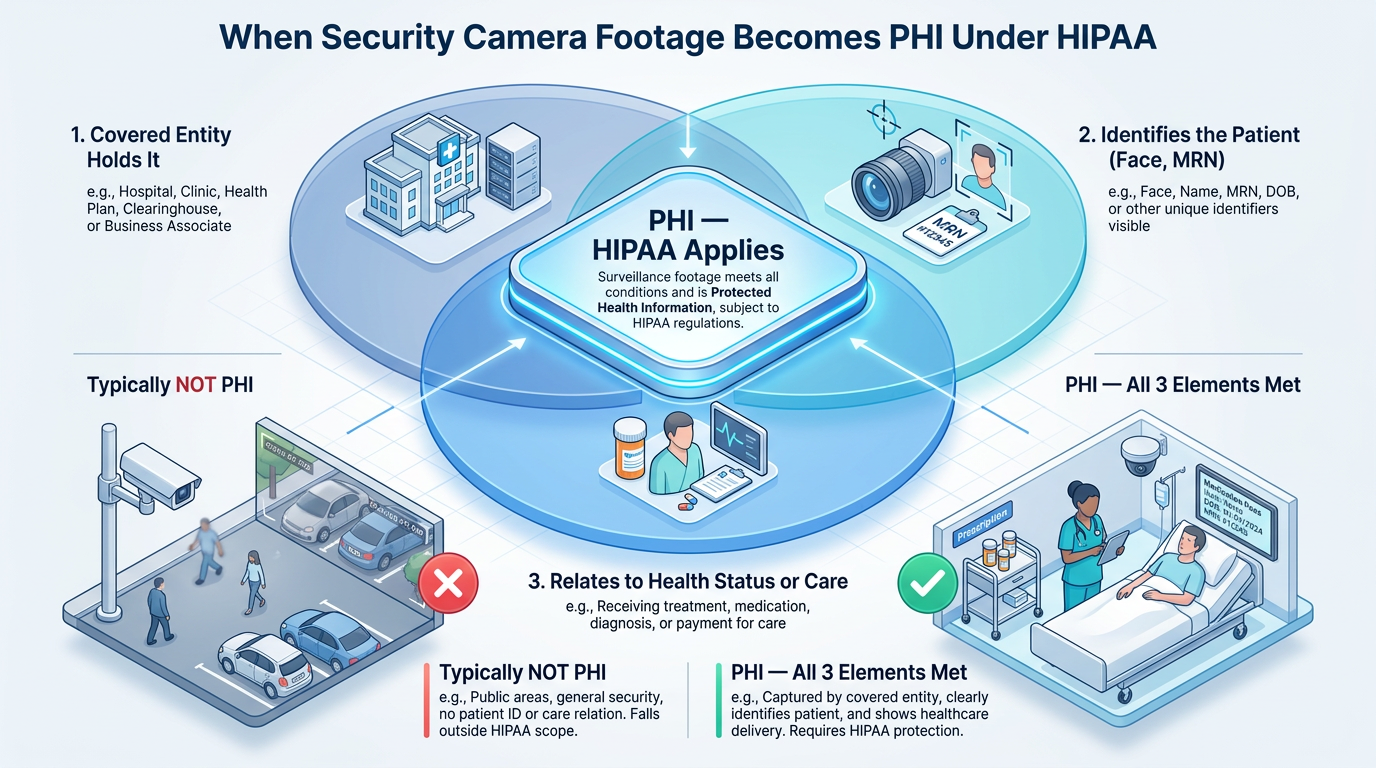
Surveillance footage becomes PHI under 45 CFR 160.103 when three things are true at once: a covered entity holds it, it relates to the person's health status or receipt of care, and it identifies the person. A hospital's own camera system satisfies the first. A visible face satisfies the third element because full-face photographs and comparable images are listed identifiers under the Safe Harbor standard.
The care-relation element is what usually decides borderline cases. Parking lot footage typically fails it and does not become PHI. A clip of a patient's face during a medication pass satisfies all three elements, and so does one that catches a medical record number on a whiteboard. Blurring faces alone is not enough: a clip is de-identified only when it removes every other listed identifier.
Footage a hospital uses to make a decision about a specific patient may become part of the designated record set and fall under the patient's right of access. The privacy officer should decide in writing how the facility will respond before the first request arrives.
Enforce Unique Logins, Least Privilege, and Full Audit Trails
Once footage is ePHI, the Security Rule applies to the NVR, the video management system (VMS) workstations, and any backup media. Under 45 CFR 164.306(d), facilities either implement each addressable specification, adopt a documented equivalent, or document in writing why the specification is not reasonable in their environment.
Three controls do most of the work for a surveillance system. First, the risk analysis required by the Security Rule must include video storage and monitoring stations in its inventory of ePHI assets. Second, every VMS user gets a unique login, retiring the shared guard-desk account and making each viewer individually accountable. Third, audit controls must implement mechanisms to record and examine activity in information systems containing ePHI, which for video systems can include logging access and tracking reviews, file movements, and exports, but HIPAA does not explicitly require logging every viewing, every export, and every alteration in those exact terms. Workstation security keeps monitors out of visitors' sight, and facility access controls protect the recorder closet.
Encrypt, Retain, and Dispose of Footage on a Written Schedule
Encryption of ePHI at rest and in transit is an addressable specification. A facility that chooses not to encrypt an NVR or a backup drive must document why an equivalent measure is sufficient.
The facility sets retention, not HIPAA. HIPAA sets no retention period for surveillance video; the documentation requirement covers the written policy that governs footage, not the footage itself. A workable healthcare camera policy sets a fixed retention window for routine video, and holds flagged evidence until the underlying matter closes or the relevant statute of limitations runs.
Disposal is a control too. Facilities must dispose of media securely by implementing policies and procedures for final disposition and media reuse; HIPAA does not prescribe a specific sanitization-record format, but records can document details such as the media type, the method used, the tool, the verification step, and the person who did the work. Any vendor that touches drives on the facility's behalf needs a business associate agreement (BAA) in place before pickup.
Sign a BAA With Every Vendor That Can See Patient Video
Any outside person or organization that creates, receives, maintains, or transmits PHI for the facility becomes a business associate. For surveillance, the recurring examples are:
- Cloud VMS providers storing footage, even under a no-view service model with hospital-held keys.
- Remote monitoring centers reviewing live or recorded feeds.
- Contract guard companies whose officers see patient footage.
- Integrators with remote NVR access.
The narrow exception is the conduit exception, which covers a carrier that only transports data and accesses content only randomly or infrequently. Everything else needs a BAA. Under 45 CFR 164.504(e), that agreement defines the permitted uses and disclosures of the PHI, requires appropriate safeguards, breach reporting requirements, and the obligation to extend the same terms to any subcontractor; organizations often also include audit rights by contract, though this is not a specific requirement of 45 CFR 164.504(e).
Train the Workforce and Rehearse the Breach Workflow
Written controls only work if the workforce is trained to apply them. The Privacy Rule requires privacy training for every workforce member, with training for new hires within a reasonable period and refreshers after every material policy change. The Security Rule adds security awareness training for management and the guards who watch the feeds.
For a surveillance program specifically, that training should cover what belongs in the field of view, how to handle export requests, how to respond when a camera captures a treatment interaction, and when a disclosure to law enforcement is permitted under 45 CFR 164.512(f). A sanction policy is also required, and you must keep training and sanction records for the same period as other Security Rule records.
Rehearsing the breach workflow closes the loop. Under 45 CFR 164.402, unauthorized acquisition of or access to PHI is presumed a breach unless a documented four-factor risk assessment shows a low probability of compromise. The incident response procedure should name, in advance, who pulls the VMS audit logs, who runs the four-factor assessment, who escalates to the privacy officer, and when a footage-related incident triggers the breach notification workflow. Walking that sequence with the SOC, guard force, and privacy team on a set cadence keeps the roles rehearsed before a real incident forces them.
Post Notice Where State Law or Practice Requires It
HIPAA itself does not require general camera signage or patient consent to record. What it does require, through the Notice of Privacy Practices, is that the facility disclose general PHI uses, and the Privacy Rule bars any use that contradicts that notice, including footage. Visible lobby signage is still worth posting: it makes recording apparent to visitors even where no rule compels it.
State law fills the rest of the gap unevenly. Connecticut General Statutes § 31-48d requires employers to give prior written notice and post conspicuous notice of electronic monitoring, except in public common areas. California Labor Code § 435 and New York Labor Law § 203-c bar recording employees in restrooms, locker rooms, and changing rooms; signage and consent cannot cure a violation. Illinois 210 ILCS 32 requires notice at the entrance and outside each monitored resident room, and Texas Health and Safety Code § 242.842 requires notice to anyone entering one. A state law review during design is the cleanest way to catch these before deployment.
Close the Gaps Where Violations Recur
Enforcement patterns show where camera programs tend to fail. Three failure modes recur:
- Unauthorized disclosure. Posting patient names or photographs publicly without valid authorization is an unauthorized disclosure; so is publishing treatment details or handing footage to marketing.
- Access sprawl. Security guards should not access patient records or footage beyond what their role requires, and shared VMS logins destroy any hope of accountability. Facilities also need to disable former employees' credentials promptly and keep charts, screens, and workstations out of camera views.
- Vendor and media hygiene. A cloud VMS or remote monitoring vendor onboarded without a BAA leaves the facility exposed even when the vendor never mishandles a clip. Unencrypted backup drives leaving the building without a documented sanitization record, and lobby monitors visible from the waiting room, complete the pattern.
How Artificial Intelligence Camera Systems Support These Practices
AI-powered video intelligence platforms map onto several HIPAA requirements at once, turning safeguards that would otherwise depend on operator discipline into system defaults.
Role-based access and automatic audit trails. Administrators scope permissions on least privilege, so a lobby guard sees lobby feeds and nothing else, and a clinical-wing reviewer sees only what their role allows. Every login, view, export, and configuration change writes to an activity record without operator effort, as NIST SP 800-66 Rev. 2 expects for systems containing ePHI.
Behavioral detection over continuous review. Reasoning-based platforms interpret scenes rather than stream raw footage to a wall of monitors. A badged pharmacy technician entering a medication room during a scheduled pass is routine; the reviewer should see the same door opening after hours with no badge read. Surfacing only the exceptions supports data minimization, a privacy-enhancing method in NIST's Artificial Intelligence Risk Management Framework 1.0, and reduces how many staff need direct access to identifiable video.
Access-control correlation and alarm validation. Platforms that fuse video with physical access control system (PACS) events can visually validate door-forced-open and door-held-open alarms, cutting the number of clips a human ever opens. Fewer manual reviews mean fewer touches on PHI and a tighter audit trail on the ones that remain.
Natural-language forensics with a written record. When an incident requires investigation, plain-language search across indexed video lets a privacy officer or investigator retrieve only what the case requires, rather than exporting long clips that sweep in unrelated patients. Every search and export is logged against the requester.
Network segmentation and no patient-identification workflows. The HHS 405(d) technical volume places security cameras in restricted network zones alongside medical devices, and platforms built without patient-identification workflows keep the deployment inside that boundary. Biometric identification of patients deserves particular caution; under the FTC's 2023 biometric policy statement, identifying people at certain locations can reveal whether they accessed particular types of healthcare.
Build Privacy Into Every Camera Decision
Healthcare surveillance will become easier to govern when facilities treat privacy as a design constraint. The most useful measure of maturity is whether the organization can explain why each recording exists and how it supports a defined security purpose, including when that purpose ends. Making that explanation part of procurement and deployment gives privacy and security teams a shared basis for periodic review. That discipline can support new uses as technology changes without turning every added capability into an automatic expansion of surveillance.
Frequently Asked Questions
When does security camera footage cross the line from general surveillance video to protected health information (PHI) under HIPAA, and what are the specific criteria that trigger that classification?
Footage becomes PHI when a covered entity holds it, it captures identifiable information like a face or medical record number, and it documents health status or care delivery. Context determines classification more than camera location alone.
What are the consequences if a healthcare facility deploys a cloud-based video management system or uses a remote monitoring center without first having a signed business associate agreement (BAA) in place?
The facility remains liable for breaches caused by vendors, faces civil penalties up to $50,000 per violation during OCR audits, and may fail to demonstrate HIPAA Security Rule compliance since written BAAs are required administrative safeguards.
How can AI-powered video surveillance platforms help healthcare facilities minimize PHI exposure while still maintaining effective security monitoring?
AI platforms reduce PHI exposure through selective surfacing: instead of streaming all footage continuously, they flag only behavioral anomalies requiring human review, such as unauthorized after-hours access. This minimizes how many staff handle identifiable video while maintaining coverage.
