Security Camera Footage Retention Requirements for Enterprise Security
Learn how enterprise security teams set defensible footage retention periods by reconciling regulations, contracts, and storage capacity across every site.
Security camera footage retention can expose an enterprise when the chosen window does not match its operational and compliance obligations. A defensible period requires more than accepting the recorder's default.
Key Takeaways
- Retention floors for enterprise video come from sector regulations, state and municipal ordinances, and executed customer, insurance, and landlord contracts, and the strictest applicable floor governs each site.
- Storage capacity follows the retention policy, not the other way around.
- Legal holds interrupt the overwrite loop the moment litigation becomes reasonably foreseeable, and a defensible process flags, preserves, and documents chain of custody before the recorder loops back.
- Compliance rests on camera-by-camera retrieval testing that confirms the earliest required date, continuous coverage, timestamp integrity, and usable images, not on the recorder's configured setting.
What a Retention Requirement Actually Governs
A footage retention requirement governs how long recorded video must remain retrievable. It can take one of several forms:
- A minimum period the footage must be kept.
- A maximum period beyond which it must be deleted.
- A purpose-based deletion deadline that ends the recording's authorized use before the system overwrites it.
Storage capacity is how the system meets that period. Where applicable policy and legal obligations allow, footage already exported as evidence follows its own archival schedule outside the recorder's overwrite cycle.
The period appears in two places: the written policy and the recorder configuration. The recorder overwrites on its own schedule regardless of what the policy says, which is why configuration and verification matter as much as the policy language.
Where Retention Requirements Come from
Sector Rules in the United States
Binding retention periods are sector-specific because no federal statute sets a general minimum. The Bank Protection Act's implementing regulations require covered institutions to install cameras and maintain a written security program but do not specify a numeric video retention period. Enterprises therefore cannot infer a universal period from the presence of a federal surveillance rule.
They must determine whether each applicable rule specifies a retention period, leaves it to a risk-based policy, or operates alongside stricter state, local, and contractual requirements.
The State and Local Layer
State cannabis regulations are among the most specific, but required retention periods vary materially by jurisdiction. Municipal ordinances also target specific business types: Houston camera rules require bars, nightclubs, convenience stores, and game rooms to retain footage for a shorter fixed minimum.
A security director with sites across multiple jurisdictions inherits each applicable requirement, so the enterprise schedule may need to vary by site and business activity.
GDPR Pushes the Opposite Direction
The General Data Protection Regulation (GDPR) storage-limitation principle bars keeping personal data longer than the processing purpose requires. A retention period must therefore be tied to that purpose, and longer periods require correspondingly stronger justification.
Privacy authorities may scrutinize a retention period that satisfies a longer minimum elsewhere when an organization applies it to a German warehouse. Global enterprises need site-specific schedules that reconcile local minimums with privacy-driven limits.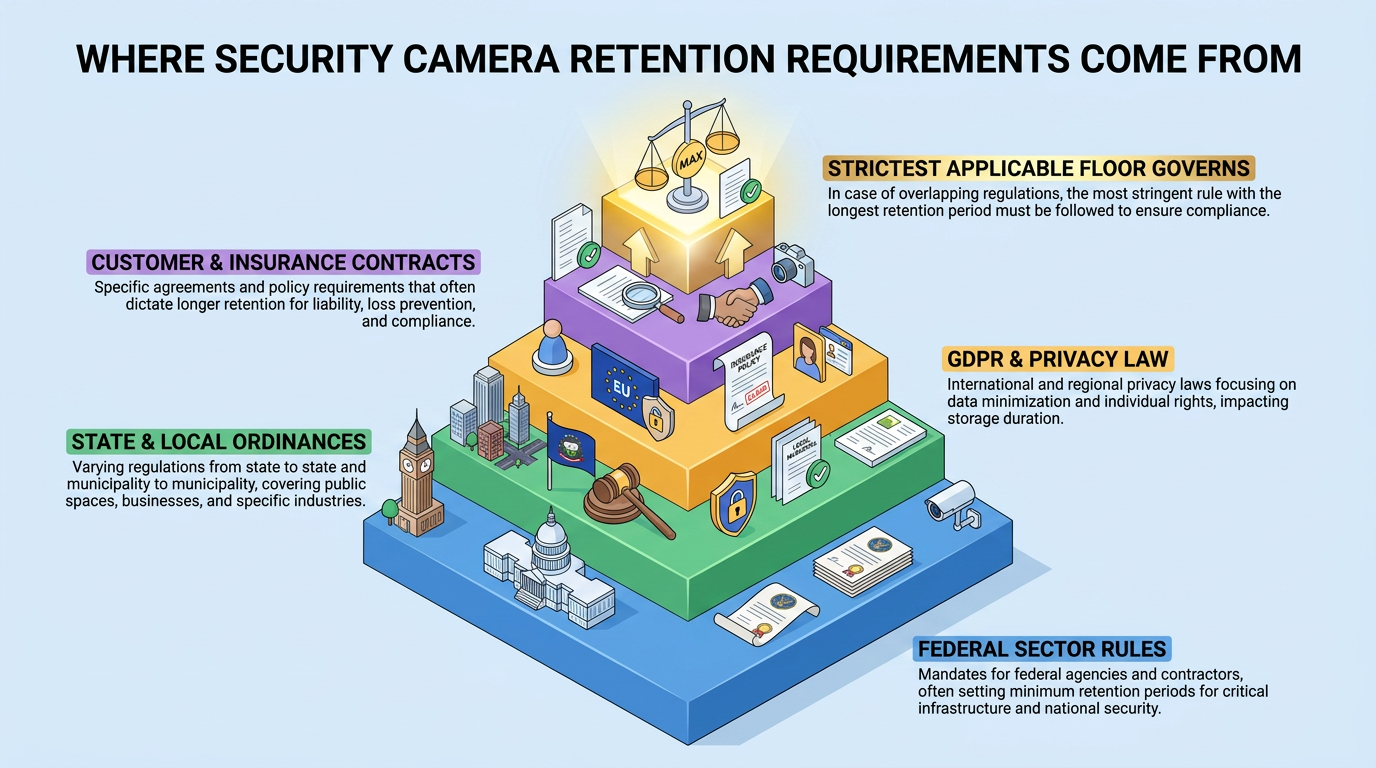
How Recorder Capacity Sets the Real Window
A recorder writes camera streams to disk in a first-in, first-out loop and overwrites the oldest footage when the drives fill. The resulting period is capacity divided by the daily write rate, separate from any chosen legal standard. When installed capacity determines the window, the site is running whatever period the hardware produces, not the period the policy requires.
Retention planning should start from the purpose of the processing and the obligations at each site, then size storage to match that period rather than the other way around.
Contracts Often Set the Real Floor
Contracts with customers, insurers, and landlords often set retention periods that exceed the legal minimum. Enterprise clients frequently attach a security schedule to master services agreements that dictates how long video covering their people, goods, or premises must be kept. Property insurance policies and commercial leases can carry similar clauses. The reliable period is the one in the executed agreement, not the summary in a proposal or a sales conversation.
Enterprises should inventory executed customer agreements by site, then inventory insurance and landlord requirements, and record the strictest applicable contractual floor in the site schedule. Recorder configurations must satisfy that documented period for each affected camera zone, and retrieval testing should confirm that achieved retention matches the contractual obligation.
Legal Holds Override the Overwrite Cycle
A preservation process should begin when litigation becomes reasonably foreseeable, before a demand letter arrives. Under the Federal Rules, sanctions for lost electronically stored information depend on whether the information should have been preserved, whether reasonable steps were taken, whether the loss causes prejudice, and whether there was intent to deprive another party of the information. Routine overwriting is not a categorical safe harbor once information should have been preserved.
The recorder can overwrite footage during the gap between detection and preservation when incident volume and reporting workflows delay a preservation request until after the overwrite loop wraps, or when installed storage does not support the period stated in policy.
A defensible process flags the segment when an incident is verified. It then suspends deletion or exports the segment under documented chain of custody. Each step is recorded. Where an agentic monitoring system verifies events as they occur, that flag lands inside the retention window.
Retention Math and Tiered Schedules
Storage cost rises with camera count, bitrate, recorded hours, and retention length. Resolution and frame rate increase bitrate. Scene activity can also increase it; modern compression can lower it while delivering comparable quality, as research on compression efficiency shows. Event-based recording saves more in quiet scenes but drifts toward continuous in busy ones.
When every applicable regulation and contract permits those recording characteristics, tiered retention helps organizations meet a longer obligation within a constrained storage budget: full-rate video for a short operational window, followed by reduced-resolution or event-only footage out to the mandated horizon on cheaper media. Exported clips follow a separate hold schedule with their own deletion rule. Otherwise, old exports on a shared drive can extend actual retention far beyond the approved period in the least defensible place.
Failure Modes Differ by Architecture
On-premises network video recorder (NVR) and video management system (VMS) deployments fix capacity at install time and can fail due to hardware. A drive failure can erase footage, and another fault during a redundant array of independent disks (RAID) rebuild can lose the volume.
Connectivity loss can interrupt cloud-dependent recording unless the deployment includes local buffering or edge recording; hybrid deployments keep recording locally. An offline camera records no footage, regardless of architecture, so that view has no retention.
What a Defensible Written Policy Contains
A policy that survives an auditor or opposing counsel is specific enough to test against the system:
- A documented retention schedule by site and camera zone, each period tied to a stated purpose.
- A named individual responsible for the system.
- Automatic deletion, evidenced by logs showing the schedule was followed.
- Access controls and audit logging of every access, export, and deletion.
- An exception path that pulls held segments out of the overwrite cycle under chain-of-custody documentation.
Privacy Pressure on the Same Footage
Retained footage is a standing liability when a breach exposes material that should have been deleted. A subpoena may also require its production, and retention can lead to over-production. Illinois's Biometric Information Privacy Act (BIPA) requires a public written biometric retention schedule once a system derives biometric identifiers from video.
Counsel wants minimization; investigators want longer windows. A documented bracket per zone, shortest permissible and longest allowable, settles it.
Configured Versus Achieved Retention
A retention setting in the recorder states an intention; only retrieval testing shows what the device actually holds. The earliest recorded date is one measure and not a sufficient one. A complete test confirms:
- The earliest required date is retrievable.
- Date coverage is continuous, with no gaps inside the window.
- Timestamps remain intact and match wall-clock time.
- Images are usable at the resolution and frame rate the policy assumes.
- Coverage extends across every camera in the estate, not just a headline sample.
Why Achieved Retention Varies by Camera
Recording schedules, motion-trigger configuration, alarm frequency, and scene activity can increase or decrease the retention window depending on the amount of data written, so retention on a busy camera may fall well short on a quiet one connected to the same recorder.
Compliance testing should include direct observation of stored footage across the required period rather than relying on the recorder's reported earliest date. Exports need separate verification, because exported video may not carry its embedded timestamp out of the native system.
Inventory Drift and Ongoing Verification
Camera inventories can drift as administrators add, replace, or reconfigure devices across large estates, and a device missing from inventory has, in practice, unknown retention. A working program does four things on a continuing basis:
- Tests retrieval across the required date range on a rotating sample of cameras.
- Checks continuity and image quality within that range.
- Records camera-specific gaps as they surface.
- Keeps the results as attestation evidence for auditors, customers, and discovery.
Automated per-camera health monitoring can perform that confirmation continuously; manual programs perform scheduled spot checks.
Retention as a Deliberate Decision
The defensible retention window is the one an organization chose, wrote down, and can prove camera by camera. Set the policy from each site's regulatory, contractual, and privacy obligations, then size storage to it. From there, the work is verification: when retrieval tests confirm required date coverage, continuity, timestamp integrity, and usable images on every camera, the requirement is genuinely met.
Frequently Asked Questions
How do you conduct camera-by-camera retrieval testing to verify that achieved retention matches your policy requirements?
Select rotating camera samples, log into the VMS, navigate to each timeline, and attempt playback at the minimum required date. Verify no frame gaps, confirm timestamps advance correctly, and check exported files retain metadata. Document pass or fail results, then rotate quarterly until all cameras are tested.
What steps should a security team take to implement a legal hold on surveillance footage before the recorder's overwrite cycle destroys relevant evidence?
Designate a preservation trigger tied to incident severity, establish immediate export protocols with hash verification, assign custody to a named individual outside operations, and log every handling action with timestamps to create an unbroken evidence chain that survives courtroom scrutiny.
How do you reconcile conflicting retention requirements when GDPR demands shorter retention periods but contractual or regulatory obligations at the same site require longer ones?
Apply the strictest requirement by zone where possible, documenting separate justified periods for high-risk areas under contractual obligation versus low-risk zones where minimization prevails, then obtain legal review confirming the legitimate interest basis survives GDPR's necessity test.
