GSOC as a Service vs. In-House GSOC: Comparison Guide
Compare GSOC as a Service vs. in-house GSOC across cost, staffing, control, and scalability to choose the right model for your organization.
Global Security Operations Center (GSOC) as a Service, or GSOCaaS, is an outsourced operating model for running a GSOC. An in-house GSOC keeps that function on the organization's payroll and inside its walls. The choice shapes how security work is funded, governed, and performed for years, so the comparison needs more than a simple build-versus-buy frame. This guide lays out both models, along with the hybrid patterns that make picking a single side optional.
Key Takeaways
- A continuously staffed operator seat requires a full relief-aware team once leave, training, and turnover are counted, so in-house costs should be modeled as multi-year totals, not initial figures.
- GSOC as a Service goes live faster than most internal builds, absorbs the hiring and retention burden, and brings built-in redundancy, but it introduces data exposure and knowledge retention trade-offs.
- In-house operations genuinely win on control: custom standard operating procedures, escalation authority, chain of command, and handling of sensitive camera feeds.
- Hybrid models, such as a lean in-house command team with outsourced after-hours coverage, are a legitimate answer rather than a compromise.
- Both models depend on human attention, which does not scale with camera count regardless of who employs the operator. AI triage changes the economics of both.
The best choice depends on how each model fits the organization's risk, governance, and operating realities.
What a Global Security Operations Center Does
A GSOC is a facility that monitors and responds to security events across a broad organizational footprint, most relevant when a centralized operation supports multiple sites. That scope distinguishes it from a more locally scoped security operations center (SOC).
GSOC as a Service is an outsourced model for running that function across multiple sites through provider-run monitoring, triage, response, and documentation.
A GSOC collects and acts on data from alarm panels, video management systems (VMS), physical access control systems (PACS), intrusion sensors, and environmental monitors. Mature operations also support intelligence analysis, travel risk, mass notification, and executive briefings.
The difference from a traditional guard desk is scope and analytical function: a guard desk performs localized, reactive monitoring, while a GSOC integrates disparate systems and intelligence sources into a unified operational picture.
How GSOC as a Service Differs from an In-House Operation
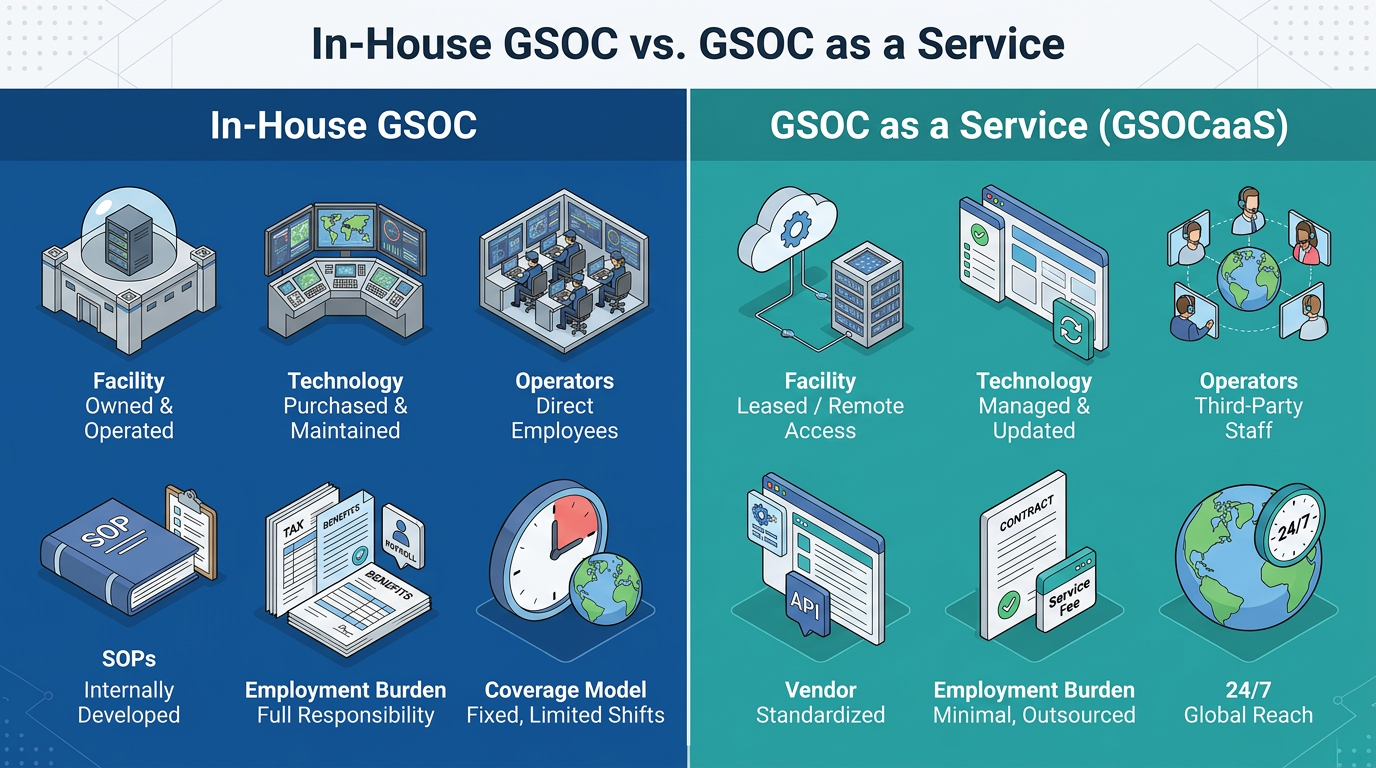
The two models split ownership differently. Hybrid arrangements blend the two, splitting coverage by hours, functions, or sites.
| Responsibility | In-House GSOC | GSOC as a Service |
|---|---|---|
| Facility | Organization builds and maintains | Provider operates from its own command center (or embedded on-site) |
| Technology | Organization buys and manages | Client typically retains cameras, VMS, PACS, and alarm systems |
| Operators | Organization hires, trains, and manages | Provider supplies trained operators covering shifts continuously |
| SOPs | Organization writes and executes | Client defines; provider executes through client platforms |
| Employment burden | Organization carries full HR, management, and retention load | Provider absorbs hiring, staffing, and turnover management |
| Coverage model | Fixed internal headcount | Flexible; expands via contract change rather than hiring |
GSOCaaS combines alarm monitoring with broader investigation, escalation, coordination, and documentation functions. It is not a simple central-station subscription.
The Cost and Control Trade-Off
An in-house GSOC gives the organization tighter control over customization, culture, data access, and incident management. Staff who work on-site develop familiarity with facility layouts, personnel, and local threat patterns that written SOPs cannot fully replicate.
That control carries substantial upfront and ongoing operational costs. Managed models shift much of that buildout into an operating expense handled by the provider, and a virtual GSOC can reduce the internal resource demands and training burden required to stand up the function. Organizations may also phase the transition by blending internal oversight with external resources.
Where Outsourcing Introduces Risk
Outsourced security operations require governance over subcontractor oversight, data confidentiality, incident-reporting practices, and operator quality. ASIS Security Management warns that outsourcing to manage costs can create "additional organizational risk because it requires relinquishing some degree of control over security procedures." Operator quality should be treated as a central evaluation issue, not a line item.
Fully Loaded Cost for In-House GSOC vs. GSOC as a Service
Staffing Math for a Continuous Operator Seat
A continuously staffed console requires 24/7/365 coverage, which no single employee can deliver once weekends, leave, holidays, and training are subtracted. A public-sector staffing audit shows the math: one continuous post takes roughly five employees once relief is factored in. Shorthand estimates of three or four per post understate the real burden.
That multiplier drives the cost. A fully loaded operator seat, covering wages, benefits, and relief hours, carries a substantial annual cost before supervision or facility overhead. Centralized monitoring discussions describe this per-seat cost as a material expense on its own, making it the right starting point for any in-house versus GSOCaaS comparison.
Think in Multi-Year Totals for GSOC Costs
The upfront price tag is misleading for both models. An in-house build-out requires major upfront investment before recurring software licensing, maintenance, refresh, and training begin, and a continuous multi-seat operation carries a full team before any supervisor is hired. Once running, an in-house GSOC typically lands in a high annual operating cost bracket.
Turnover, recruiting, and ramp time act as hidden multipliers, so the honest comparison is total cost, including the redundant infrastructure a resilient in-house center requires.
Staffing Reality on Both Sides of the GSOC Decision
Hiring is the constraint that breaks in-house plans. The security services sector experiences high annual turnover, and operator training takes time before a new hire is fully operational. Small in-house teams also carry single-point-of-failure risk: when the operator who knows the SOPs, escalation contacts, and site quirks resigns, the capability walks out with them.
A service absorbs that burden, but the churn does not disappear, it moves. Providers face high attrition too, and provider turnover erodes account knowledge the same way, which is why attrition reporting and documented knowledge continuity belong in every provider evaluation.
Deployment Speed, Scalability, and Redundancy
An in-house build is usually measured in quarters, not weeks. Facility design, technology integration, SOP development, hiring, and tuning each add time, and mature capability takes much longer than the initial launch. GSOCaaS start-up is typically shorter, depending on location count and platform complexity.
The service model also flexes in ways a fixed internal headcount cannot: adding coverage for a new site or surge period is a contract change, not a hiring campaign. Redundancy comes built in. Providers operating certified monitoring centers must maintain audited facilities with backup systems, a resilience posture an in-house program must fund and test on its own.
Common Delivery Models for Outsourced GSOC Operations
Organizations generally use several common outsourced GSOC patterns, each suited to different operational constraints.
Fully Managed Remote
A third-party provider operates the entire GSOC function from its own command center. The client receives continuous monitoring and operator coverage without building or staffing a facility. This model supports the fastest deployment and a predictable operating structure, but it also increases third-party data exposure and can weaken institutional knowledge retention relative to in-house models.
Embedded On-Site
Provider operators work from within the client's own facility, operating exclusively for that organization. This retains the HR and staffing burden relief of outsourcing while giving operators the opportunity to build site-specific knowledge through physical presence. The cost is typically higher than in a shared remote arrangement because operators are dedicated to one account.
Co-Managed Hybrid
Internal security staff and a managed provider share GSOC responsibilities, split by shift schedule, function, or capability. This is a real answer, not a hedge. A lean internal team retains SOP ownership, escalation authority, and institutional knowledge, while the provider absorbs growth pressure and staffing load. A phased approach works well in practice: start with nights and weekends or basic video and PACS monitoring, prove the partner, and expand from there.
After-Hours and Surge Coverage
After-hours and surge coverage limits the provider role to specific windows or event types, such as nights, weekends, holidays, or surge periods around major events. The internal team handles all primary operations. This model can introduce handoff risk when incidents begin during one coverage window and continue into the next, so structured shift-overlap protocols matter.
The Operational Workflow Inside a Managed GSOC
Regardless of delivery model, managed GSOC operations follow a triage workflow in which alerts are received, assessed, investigated, distributed, and resolved. Alerts from PACS, VMS platforms, intrusion sensors, and environmental monitors flow into a central aggregation layer. An operator or automated system receives each alert, classifies its severity, and routes it through a defined response chain.
Triage Workflow
A common workflow typically includes detection and analysis, followed by investigation and response.
- Detection: the alert is received and queued.
- Analysis: operators assess severity and determine response type.
- Investigation: video clips and access logs are compiled, and field resources are notified.
- Collaboration: information is distributed to managers, on-site guards, and relevant stakeholders.
- Response and resolution: dispatch, stakeholder notification, or emergency protocol activation, followed by incident documentation.
In practice: a door-held-open alarm fires at a distribution center loading dock during an overnight shift. The operator pulls the camera covering that door, sees a pallet wedged against it with no person in frame, dispatches the roving guard to clear it, and closes the incident with video attached. The whole exchange is fast when systems are integrated and slow when they are not.
Client-Specific SOPs as the Operational Foundation
GSOC operations rely on standard operating procedures that are specific to the customer's needs. SOPs vary by industry risk profile, perceived threat urgency, regulatory requirements, staffing model, and how broadly the organization defines the GSOC's mission. In outsourced models the client should own the SOPs contractually, even when the provider executes them.
Technology Requirements for Remote GSOC Operations
GSOCaaS typically runs on technology the customer already owns, accessed remotely by the provider's operators through the client's environment. Four layers matter most:
- Video, PACS, and alarm systems: The VMS is the primary visual interface, with on-premise, cloud-hosted, or hybrid deployments. Interoperability across multi-vendor cameras reduces lock-in, while PACS platforms supply event data on access grants, denials, and credential activity.
- AI threat detection: Sits between raw video and the operator queue, analyzing live feeds so contextual analysis distinguishes routine activity from genuine threats such as loitering, tailgating, crowd formation, or perimeter breaches. Operators spend attention on judgment calls instead of clearing false positives, and providers can meet tighter response SLAs because noise is filtered upstream.
- Aggregation and incident management: A command-and-control layer merges events from video, PACS, intrusion, and environmental sensors into a unified operator interface, reducing fatigue from switching between systems. Incident management software then tracks each event from alert to resolution.
- Cybersecurity for remote connections: When a provider reaches into client video and PACS environments, third-party remote access should be authenticated with multi-factor authentication, encrypted, monitored, and time limited, with role-based permissions, single sign-on, and clear separation between provider access and the rest of the client environment.
Standards and Compliance for Managed GSOC Providers
Licensing and Certification Baselines
Central monitoring certification standards require trained operators on duty at all times, recorded and acted-on signals, and recurring audits. State licensing adds jurisdictional complexity: California, for example, requires out-of-state alarm companies monitoring California systems to hold a state license.
Organizations should confirm how provider staffing and operations align with the compliance requirements that apply in each monitored location, and enterprise procurement teams should still review provider information security controls during evaluation.
Data Privacy and Footage Residency
Remote monitoring means sensitive footage crosses organizational and sometimes national boundaries. ASIS guidance notes that EU-based facility monitoring by a US-based GSOC may be restricted under General Data Protection Regulation (GDPR), and that privacy regimes mandate defined retention policies for video, alarm, and identity data. Where footage lives, who can view it, and how long it persists should be contract terms, not assumptions.
The Metrics That Matter in Any GSOC Model
Whoever staffs the seats, the same measures determine whether the GSOC works:
- Mean time to acknowledge (MTTA): how quickly an operator picks up an incoming alert.
- Mean time to resolve (MTTR): how quickly the incident is closed after acknowledgment.
- Alarm-to-action or escalation-to-dispatch time: how long between validated alert and field response.
- Clearance rate: the share of alerts closed without escalation or missed events.
- False alarm handling: how consistently non-actionable events are filtered without slowing genuine ones.
No universal numeric service-level agreement (SLA) standard exists for GSOCaaS, and providers define these clocks differently, so contracts must specify exactly where measurement starts and stops.
Two operator-side pressures apply equally in-house and at a provider. Human attention on video monitors declines during continuous monitoring, and high false alarm volume trains operators to expect noise when routine events repeatedly turn out to be non-actionable. The staffing model changes who carries the fatigue, not whether it exists.
Evaluating a GSOC as a Service Provider
Security directors evaluating a GSOCaaS provider should press on three areas:
- Operator credentials: Request documentation of active Certified Protection Professional (CPP) or Physical Security Professional (PSP) credentials for named supervisory personnel, not generic team-level claims.
- Operator turnover: Ask providers to report attrition patterns on client accounts and demonstrate documented knowledge continuity processes, since high attrition interrupts continuity, extends ramp time, and erodes account knowledge.
- Redundancy and failover: Confirm that the failover site is physically and geographically separate from the primary facility, and that business continuity plans are periodically tested.
- SLA structure: Require clearly defined response expectations, escalation standards, reporting cadence, and financial remedies for missed performance, expressed in the MTTA, MTTR, and dispatch-time terms defined above.
- Contract and exit provisions: Negotiate data portability rights, transition assistance obligations, defined exit notice periods, and remedies for SLA non-compliance before signing, since switching costs become substantial once SOPs, integrations, and provider familiarity are in place.
- Ongoing vendor governance: Establish recurring business reviews and named accountability so SLA performance is examined on a schedule, not only when an incident forces the conversation.
Risks and Limitations of Outsourced GSOC Operations
Institutional Knowledge and Situational Awareness
Written SOPs capture only part of the site-specific knowledge around layouts, personnel, local threat patterns, and organizational context. This is where in-house genuinely wins. Remote operators monitoring facilities they have never visited face inherent limits in contextual judgment. Mandatory site familiarization visits and structured intelligence packages help, especially when paired with joint exercises between provider operators and on-site personnel.
Vendor Dependency
Custom integrations and provider-held knowledge function as exit barriers, and tuning a managed GSOC takes meaningful time and resources. Organizations should maintain internal documentation of SOPs, integration configurations, and escalation protocols independent of the provider's systems.
Quality Assurance at a Distance
Without direct HR oversight, clients rely on contractual mechanisms to maintain operator quality. Blind-testing protocols, audit rights over training records, and SLA-bound minimum qualifications provide visibility into provider performance. Plan for a meaningful onboarding period before a managed provider reaches steady state.
How Much Watching Still Needs a Human in a GSOC Model
Both models rest on the same foundation: skilled people watching screens, and human attention does not scale with camera count. The build-versus-buy debate optimizes who employs the watchers; the more consequential question is how much of the watching still needs a human at all.
AI triage is answering that in production. Routine alarms can be cleared before dispatch when video verification, PACS context, and incident workflow are integrated. This reshapes the economics of both models: in-house programs need fewer dedicated seats when validated events reach the console, and providers deliver stronger SLAs when operators spend attention on judgment rather than noise.
Choosing the Right GSOC Model for the Organization's Risk Profile
Route the decision through the questions that actually differentiate the models:
- Scale: How many sites, regions, and cameras need coverage? Dedicated GSOC investment usually appears when an organization reaches enough operational complexity to justify centralized command.
- Risk profile: Do mission-critical sites require immediate, context-rich intervention, or is most of the workload routine monitoring?
- Internal talent: Can the organization realistically hire, train, and retain continuous operations staff in its labor market?
- Growth trajectory: Will site count or camera fleet expand faster than an internal team can scale?
- Compliance and data residency: Do regulatory or footage-residency requirements restrict where video can be viewed and stored?
In-house wins for large enterprises with mission-critical intervention needs, strict data residency requirements, and the budget and talent pipeline to sustain the multi-year cost.
GSOCaaS wins on speed to value, lean or fast-growing organizations, and predictable operating expense.
Hybrid wins for mid-sized organizations and anyone building a phased path: keep command, SOPs, and escalation authority in-house, and outsource the hours and overflow that make internal staffing math untenable.
Building Oversight Into the Operating Model
Whichever model wins the evaluation, its ceiling is set by how much noise reaches human operators. Security leaders modernizing GSOC operations are moving toward Agentic Physical Security, where AI continuously observes, assesses, and routes events so operators focus on judgment instead of feed scanning. Ambient.ai delivers that shift on top of existing cameras, PACS, and sensors, with autonomous monitoring that saves 10,000+ operator hours annually and investigations compressed from hours to minutes.
Trusted by Fortune 100 enterprises across campuses, data centers, and critical infrastructure, teams weighing GSOCaaS against an in-house build can request a demo to see how the staffing math changes when the platform handles the watching.
Frequently Asked Questions
How many employees does it actually take to staff a single 24/7 GSOC operator seat when you account for leave, training, and turnover?
Approximately five employees are needed per continuous post. Public-sector staffing audits confirm this multiplier accounts for weekends, holidays, sick leave, vacation time, and mandatory training hours. Common estimates of three or four employees significantly understate actual relief requirements.
What are the biggest risks of switching from an in-house GSOC to a GSOCaaS provider, and how can organizations mitigate vendor lock-in?
Organizations risk losing operational continuity during transitions and face steep switching costs after custom integrations mature. Mitigation requires parallel internal documentation, negotiated data portability rights, defined exit assistance periods, and avoiding proprietary middleware that creates dependencies beyond standard protocols.
How does AI-powered triage change the cost comparison between in-house GSOC and GSOC as a Service models?
AI-powered triage filters noise before reaching operators, reducing per-seat staffing requirements for both models. Fewer continuous operator seats cover the same camera count, narrowing the cost gap between in-house and outsourced models while improving response quality.
