Physical Intrusion Detection Systems (PIDS) and What Changes with AI
Learn how physical intrusion detection systems work, how alarms are verified, and where AI-based detection changes what operators see before responding.
Physical intrusion detection systems (PIDS) give security teams their earliest warning at the perimeter, but the sensor is only the first link in a longer chain that decides whether a real threat gets stopped. This article explains how detection, assessment, and response fit together, and where AI changes the picture.
Key Takeaways
- Physical intrusion detection is the sensing and alarm layer of a broader security system, and perimeter detection is a common use case.
- An alarm counts as a verified detection only after an operator has checked it.
- Rule-based video motion detection adds work for operators because it flags movement without identifying the cause.
- Learned detectors need on-site testing and defeat testing before a team can rely on them.
What a Physical Intrusion Detection System Is
An intrusion detection system (IDS) is the set of indoor and outdoor sensors, surveillance devices, and communication links that together spot an intrusion and raise an alarm, as defined in Unified Facilities Criteria (UFC) 4-021-02. In U.S. Department of Defense (DoD) criteria, the IDS is one part of a larger electronic security system that also covers access control and video used to assess alarms. The UK's National Protective Security Authority (NPSA) uses PIDS for site-boundary detection, which gives the security control room its earliest warning.
Outdoor sensors must handle wind, rain, blowing debris, and animals, all of which can affect performance.
Some sectors must run one. Nuclear power reactor licensees must maintain continuous detection and assessment under 10 Code of Federal Regulations (CFR) 73.55.
Where Detection Sits in a Physical Protection System
In a physical protection system, detection comes first, delay comes next, and response comes last. Security planners place delay elements after detection because a barrier only buys time if the response force already knows to move. Detection sits toward the perimeter, delay sits closer to the target, and total detection and response time has to beat the attacker's task time from the first alarm.
Control room video is part of detection because operators use it to check alarms. Cutting assessment time is one of the few ways to raise system effectiveness, along with detecting earlier and responding faster.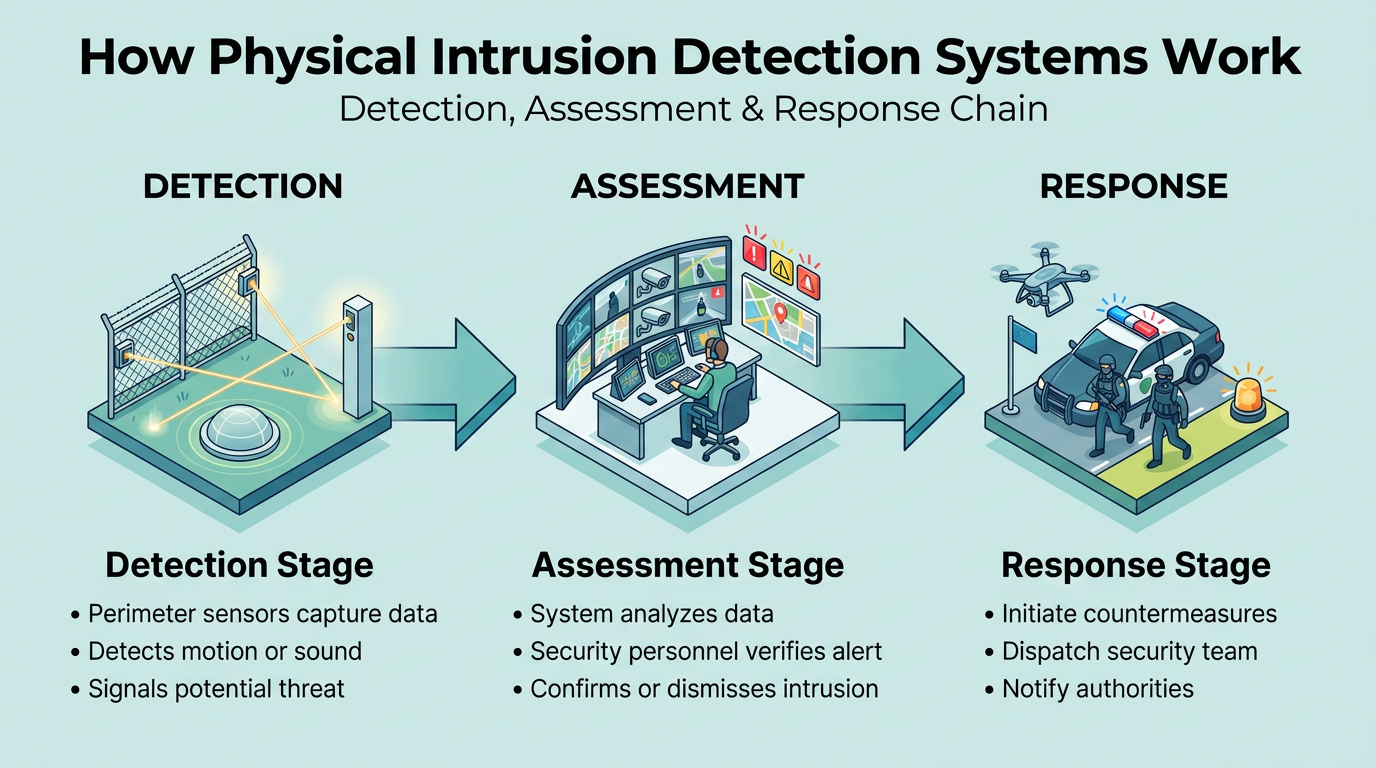
The Sensor Technologies Doing the Detecting
Terrain and fence construction shape sensor choice. Planners should also account for how many nuisance alarms the control room can handle per shift. The perimeter detection guide also treats covertness as a design factor, since a sensor an attacker can see is one they can plan around.
- Fence-mounted and taut wire sensors pick up the vibration or strain of someone climbing the fence, though they have trouble telling animals from people.
- Ported coaxial cable, buried along the perimeter, creates an electromagnetic field between paired cables and alarms when a body distorts it. It is designed to stay hidden and follow the shape of the ground.
- Radar-based perimeter sensing can create volume-based detection zones, but foliage is a known source of nuisance alarms.
- Buried geophones pick up the seismic signature of footsteps and other ground movement.
Indoors, passive infrared (PIR) and microwave sensors cover different directions well. Dual-technology sensors only alarm when both the PIR element and the microwave element fire. This filters out events caught by only one method. Video motion detection watches for brightness changes in the camera signal, while learned detectors add motion-pattern recognition.
Layered physical security spreads detection, delay, and response across multiple security measures rather than leaning on a single sensor.
How PIDS Performance Is Measured
Probability of detection is the product of three probabilities: the sensor picks up the intrusion, the alarm reaches an assessment point, and an operator assesses it correctly. This framework is laid out in a system integration test procedure from Sandia National Laboratories, a U.S. Department of Energy research lab that develops physical security standards for high-consequence facilities. When alarm volume outruns the time available to assess each one, even a reliable sensor delivers poor detection.
A nuisance alarm comes from the environment. The sensor did its job on something real that was not a threat, like vibration from a passing train. A false alarm comes from equipment failure or from problems in design and maintenance. PIDS operation should not assume zero nuisance or false alarms. Isolation zones, sensor fusion, and reference-sensor filtering can cut the count, and video verification helps operators check alarms faster. Vulnerability to defeat varies by sensor technology, and the sensitivity tradeoff means turning sensitivity up raises detection and the alarm count together, while turning it down lowers both.
How PIDS Alarms Reach the Control Room
Field devices and software that follow shared standards push alarms into the operator's queue. Open Network Video Interface Forum (ONVIF) profiles include Profile C for door state and access alarms and Profile M for streaming camera metadata to the video management system. The Open Supervised Device Protocol (OSDP) links readers to access control panels.
The ONVIF Door Control specification defines a door alarm as an abnormal state where a door is forced or held open longer than allowed. Once the event reaches the control room, the alarm validation standard grades how much evidence backs a dispatch request, ranging from no call for service to a confirmed threat to life.
How Detection Systems Are Graded and Certified
Security planners use product evaluations and system certifications to narrow down PIDS options. NPSA's PIDS evaluation scheme gives evaluated PIDS a class rating, while Underwriters Laboratories (UL) requirements in UL 2050 cover the monitoring and operation of whole alarm systems at sites handling sensitive material. Planners can use class ratings to compare products, then use whole-system certification to judge monitoring and operations.
What Rule-Based Detection Can and Cannot Do
Certification sets how a system is evaluated, but the detection method determines what kind of activity it can distinguish. Classic video motion detection watches for changes in brightness in a video signal. Rule-based analytics apply set spatial or timing conditions but do not explain why motion occurred, so environmental motion and an intruder can require the same amount of checking.
Operators absorb the cost, since every alarm needs a look whether the cause was weather, wildlife, or an intruder. A zone that keeps producing nuisance alarms can lose priority and confidence over time. Its contribution to real detection then drops.
What Changes When AI Does the Detecting
Motion-pattern recognition is the entry point, not the endpoint. Some video analytics replace fixed motion responses with learned motion-pattern recognition that identifies possible intruders and filters out background noise, so an alarm can describe a tracked pattern of movement rather than raw activity in a zone. That already cuts the noise operators sift through.
The bigger shift is reasoning about what the movement means. Similar objects and behaviors carry different weight at different times. A contractor leaning a ladder against a substation fence during a scheduled daytime outage is routine. The same ladder in the same spot hours after the site empties may need a closer look. Telling those scenarios apart takes access to schedule, location, and time context layered on top of visual detection, not motion-pattern recognition on its own. This is where reasoning AI, which combines visual understanding with situational context, changes what an alarm can tell an operator before they open the video.
The 62676-6 standard defines performance testing and grading for real-time intelligent video content analysis.
Where AI Detection Still Falls Short
Strong benchmark performance does not prove the system will perform the same way on a site's own cameras. National Institute of Standards and Technology (NIST) surveillance event evaluations used specific airport-surveillance footage, so differences in camera position, lighting, background activity, and local conditions can still change results. Detection built on rigid rules or a single learned model tends to break the fastest under those shifts, which is why platforms that combine multiple detection methods with contextual reasoning hold up better across varied sites.
Other AI failure modes depend on the setup. Networked detection systems also need cyber assurance, because the attack surface reaches beyond the detection model itself. The specification includes networked system assurance alongside detection performance, and any serious evaluation should weigh both the detection layer and the platform hosting it.
Specifying and Commissioning a PIDS
The detection scenario comes before the technology. A sterile zone and an open area call for different sensors, and evaluated product ratings apply to one setting or the other. A site survey comes before any shortlist: terrain, vegetation, drainage, and whatever fence, lighting, and cable routes are already in place. Camera placement follows the same logic, since a detection zone without an assessment view produces alarms no operator can clear.
Site-based maintenance should match the environment the sensors sit in rather than a generic calendar, since seasonal weather and vegetation change what a sensor reports. Operations and maintenance continue after installation and belong in perimeter-system lifetime cost planning.
Judging New Detection by Old Measures
Some classified facilities have to meet Underwriters Laboratories (UL) 2050 requirements. Security planners approve sensors for perimeter duty based on measured detection probability and tolerable alarm rates, and they should apply the same standard to learned detectors. Pilot the cameras. Test nuisance events in the seasons that produce them. Before deployment, use core performance measures to score the detector's probability of detection and nuisance alarm rate. Also test how easy it is to defeat.
Frequently Asked Questions
How does reasoning AI differentiate between a routine event and a genuine security threat using contextual information like schedules and time of day?
Reasoning AI cross-references detected objects and behaviors against access schedules, authorized personnel lists, facility states, and historical baselines for specific locations and times, then assigns threat scores based on deviation from expected patterns rather than treating all motion uniformly.
What is the difference between a nuisance alarm and a false alarm in physical intrusion detection systems, and how does each impact security operations?
A nuisance alarm triggers from real environmental events the sensor correctly detected but that posed no threat, like wind or wildlife. A false alarm is an alarm that does not correspond to a genuine security event; it can be caused by equipment issues, user error, or environmental triggers. Nuisance alarms are typically non-actionable alerts driven by user behavior or site conditions and may be verified, cleared, or tuned out; false alarms do not correspond to real security events and can warrant corrective action such as maintenance, configuration changes, or recalibration.
What steps should security teams take to properly test and validate AI-based intrusion detection before deploying it at a specific site?
Security teams should run seasonal testing to capture weather and vegetation changes, conduct site-specific defeat testing with actual perimeter scenarios, and measure detection probability against evaluated sensor thresholds, ensuring the AI performs consistently across their unique camera angles, lighting conditions, and operational environment.
