Non-Invasive Gun Detection Explained for Security Teams
Learn how non-invasive gun detection works, where it's deployed, and how to evaluate sensor accuracy, staffing needs, and workflow fit for your site.
Non-invasive gun detection screens for concealed firearms without impeding pedestrian flow, letting people keep walking with bags on shoulders and phones in pockets. The category promises throughput without divestment, but the sensor is only one piece of the lane. Whether a deployment holds up at peak arrival depends on the workflow around it: how alerts are resolved, who staffs secondary screening, and what happens when an operator faces a queue.
Key Takeaways
- Non-invasive gun detection succeeds only when the screening lane supports reliable secondary screening and response decisions.
- Higher sensitivity improves detection but also increases false positives.
- Free-flow lanes do not remove staffing needs when site procedures require a person to resolve each alert with a wand or a bag check.
- Site-specific pilots should test actual entry conditions and secondary-screening labor before purchase.
What Non-Invasive Gun Detection Means in Physical Security
Walk-through weapons screening detects concealed threats without stopping the line, and a free-flow lane stops only the subjects the sensor flags. Free-flow is practitioner shorthand for screening without impeding pedestrian traffic. The traditional benchmark, a walk-through metal detector (WTMD), induces eddy currents in metal and requires each subject to pass through a portal.
Non-invasive systems sit on the same continuum but shift the trade-off. They aim to preserve entry throughput while accepting that not every alert identifies a specific object and that some alerts require a secondary check. Evaluating the category means separating the sensor's role from the response workflow. The sensor generates an event. Staff, procedures, and integrations turn that event into an action.
How Non-Invasive Gun Detection Systems Work
Non-invasive detection uses several sensor types, each with a distinct signal path and a distinct failure mode. Sites evaluating the category should match the sensor's coverage to the entry's actual conditions.
Passive Ferromagnetic Systems
Passive ferromagnetic detectors read disturbances in the Earth's magnetic field caused by ferrous metal moving through a corridor. They emit no signal of their own, which simplifies siting reviews near adjacent electronics. Because the signal reflects mass and shape rather than an image, an alert flags a ferrous object of a certain size, not a firearm specifically. Non-ferrous polymer components in some firearms fall outside this signal entirely.
Active Millimeter-Wave Systems
Active millimeter-wave (mmWave) systems use waves that penetrate common clothing to screen for concealed objects and present the results for operator review. Portal configurations that require each subject to pause suit a checkpoint rather than a free-flow doorway. Free-flow mmWave variants exist, but they change the accuracy profile compared to a stationary portal.
Micro-Doppler Radar
Micro-Doppler radar analyzes movement patterns rather than identifying an object directly. A carried object can change those patterns, but staff often need secondary screening to determine the cause. The radar flags anomalous movement rather than identifying the object itself, leaving identification to a follow-up step.
Camera-Based Detection
Camera-based detection requires a visible weapon. These models match the firearm's optical appearance, so they catch what is drawn or partly visible and miss anything under clothing.
The same camera layer can also flag precursor behaviors such as pacing an entrance, loitering near a restricted door, or repeated approach-and-retreat patterns, which often surface before a weapon is drawn.
Camera detection complements concealed-carry sensors rather than replacing them, extending coverage from the earliest behavioral cues through to the moment a weapon appears.
Key Differences Between Non-Invasive and Traditional Gun Detectors
The differences show up at the door. They shape throughput and staffing, while the sensing method determines coverage.
| Dimension | Traditional WTMD | Non-Invasive Free-Flow |
|---|---|---|
| Entry experience | Subject stops, empties pockets into a bin, and passes through a portal one at a time | Subject walks through at normal pace with bags, laptops, and phones in place |
| Footprint | Portal, divest table, and bin staging area, typically requiring several feet of queue space | Consolidated portal with no divest table, freeing lobby space but adding a secondary screening area for flagged subjects |
| Staffing model | Bin operator plus wand operator working the whole line, since every subject may need resolution | Wand operator engaged only on flagged subjects, but staffing floor still applies at every lane during operating hours |
| Coverage profile | Detects metallic objects above configured sensitivity thresholds; generally cannot distinguish ferrous from non-ferrous metals and may miss fully non-metallic materials | Broader signal set that varies by sensor type; may miss ferrous mass a WTMD would catch or flag materials a WTMD would ignore |
| Alert confidence | High confidence per alert on ferrous mass, though the alert names a metal object, not a firearm | Varies per alert and shifts with the sensitivity setting the site actually runs, which may differ from the vendor's published operating point |
| Common nuisance triggers | Belts, keys, phones, and coins during divest, resolved before the subject reaches the portal | Laptops, water bottles, and umbrellas in bags, resolved after the subject has already passed through |
Free-flow lanes let entrants proceed with everyday personal items and without emptying their pockets, which is the gain buyers pay for. In practice, sites may reintroduce divestment when nuisance alerts on laptops, water bottles, or umbrellas become frequent enough to slow the line.
Traditional WTMDs require a defined pass-through zone, a divest table, and staff to run both the bin and the wand. Non-invasive systems consolidate the portal footprint but do not eliminate the need for secondary screening. When operating procedures require manual resolution of each alert, sites should set a trained-staff floor per entry point and per lane, including in free-flow lanes. A handheld wand resolves the subject a sensor already flagged, rather than screening the whole line.
Coverage differences also matter. A WTMD reliably detects ferrous metal above a minimum mass. A non-invasive free-flow system may cover a broader signal set but at a different confidence level per alert. The comparison worth running measures workflow against workflow at the site's actual peak demand, not sensor against sensor.
Where Security Teams Deploy Concealed Weapons Detection Systems
Throughput and staffing trade off differently by setting, and the deployment questions shift with them.
- Corporate lobbies: Lane design should account for whether badged employees and visitors share a line, and test how shift-change arrivals affect queues. Any door where entrants carry laptops may need a site-specific hand-off process, since laptops can trigger alerts.
- Multi-tenant buildings: Owners and tenants settle who staffs and pays for secondary screening before the sensor arrives, and whether loading docks and garage entries fall in scope.
- Schools: Arrival windows compress into short bell periods, backpacks are near-universal, and the response protocol pulls in administrators, resource officers, and often local law enforcement.
- Hospitals: Mixed entrances for staff, patients, visitors, and emergency arrivals carry different objects and move at different speeds, changing what each lane at a door needs to handle.
- Event venues: Volume concentrates into short windows and often demands temporary lanes that assemble and staff up on event day.
- Government buildings: Credential checks layer with screening, which changes where alerts route and who owns resolution at each step.
Accuracy, False Alarms, and Detection Confidence
Higher sensitivity settings improve detection but also increase false positives. Vendors publish detection numbers at a single operating point, but the operating point a site actually runs after go-live may differ from the one used in test conditions.
Everyday hard objects can create nuisance alarms. When staff must resolve too many of those alerts manually, entrance queues grow. Operators facing long queues may lower sensitivity to preserve throughput, which changes the detection profile after acceptance.
Published standards cover traditional walk-through systems, but their scopes do not automatically establish free-flow system performance. A liability designation documents liability treatment; buyers should evaluate accuracy and false-alarm data separately.
How AI Adds Behavioral Context to Gun Detection
A video threat detection layer cannot see a firearm concealed under clothing. It can see behavioral precursors that often surface before an incident escalates: a subject pacing an entrance, loitering near a restricted door, repeatedly approaching and retreating, or moving in ways inconsistent with routine traffic at that location. Those cues don't replace concealed-carry sensing at the door, but they extend the response window by giving operators an earlier signal that something warrants attention.
Alert interpretation depends on context the concealed-carry sensor may not supply. AI adds that context in three ways:
- Body pose and movement across frames: The camera layer reads posture, gait, and hand position over time, giving an operator behavioral cues the concealed-carry sensor cannot see on its own.
- Multi-camera tracking: An operator reviewing a radar alert sees the same subject before and after the flagged moment across adjacent cameras, rather than a single isolated frame.
- Temporal detection thresholds: Requiring a detection to hold across consecutive frames can suppress false positives before they reach the security operations center.
Context determines whether the same radar alert is routine or warrants a response. At a hospital, for example, a radar sensor at the staff entrance might flag a dense object at the hip. On a badged officer walking to a duty station at shift change, staff might treat that alert as routine. If someone paces the ambulance bay doors and repeatedly approaches them, a posture consistent with carrying a firearm warrants a response.
Together, these layers complement the concealed-carry sensor by turning a raw alert into a decision an operator can act on. The behavioral layer closes the gap between an event and a response and often surfaces the earliest signs of an incident before a weapon is ever drawn.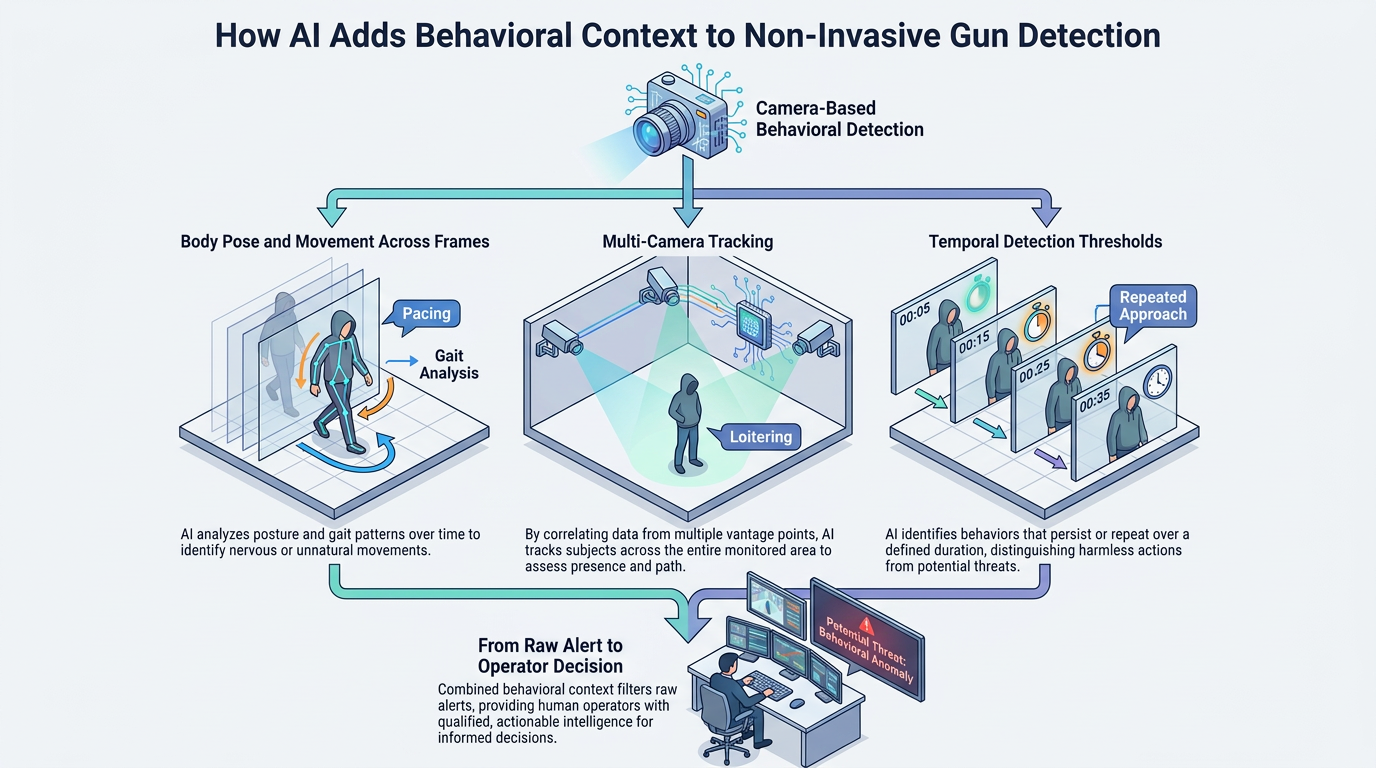
Evaluating a Gun Detection System for Your Environment
Evaluating a non-invasive gun detection system means treating the sensor as one component within a larger buying decision that covers detection accuracy, integration, workflow fit, and total cost. The right questions surface before contract signature, when the site still has leverage. Vendors typically lead with headline metrics and reference deployments, but the details that determine whether a system holds up in production often live below the surface of a standard pitch.
Missing information about alert latency and discrimination should disqualify a system from consideration. The same applies when the vendor doesn't disclose pricing. Both signal that the vendor is not prepared to be measured against operational reality.
Concrete requests for any vendor:
- Demand performance curves across sensitivity settings, not a single operating point.
- Require unredacted test reports covering ferrous and non-ferrous test objects, and disclose the vendor's editorial role.
- Route event metadata to the video management system and access control system through interoperability profiles, with alerts wired to door lockdown or law enforcement notification.
- Run a site-specific pilot at actual crowd density and clothing conditions, with covert red-team walk-throughs at acceptance and on a recurring schedule.
- Price total cost of ownership to include purchase and training costs plus secondary-screening labor per alert, with warranty and maintenance costs itemized separately.
Acceptance criteria belong in the contract, not the pilot report. If the pilot passes but the criteria live only in a vendor deck, the site has no leverage when performance drifts after installation.
What Non-Invasive Detection Changes for Security Operations
Non-invasive detection changes the operating model only when the complete screening and response workflow functions as one system. Security leaders should judge the deployment by the quality of decisions it produces at peak demand, not by the sensor's headline throughput. A useful review asks whether operators receive enough context to distinguish routine activity from a credible threat. It also tests whether escalation remains timely under pressure and whether records support later audit. Future purchases should advance only when a site can show that the complete workflow improves response without shifting hidden burdens to the entrances or the security operations center.
Frequently Asked Questions
How do you determine the right sensitivity setting for a non-invasive gun detection system to balance detection rates against false alarm rates at a specific site?
Run a site-specific pilot during peak traffic with documented sensitivity settings. Measure false alarm frequency against staffing capacity to resolve alerts without queues. Test covert walk-throughs at each threshold and select the setting where detection meets requirements while secondary screening remains sustainable.
What staffing levels and secondary screening procedures should be planned for free-flow concealed weapons detection lanes during peak entry periods?
Free-flow lanes require a trained wand operator per active lane during operating hours, positioned near the exit to intercept flagged subjects. Plan a secondary screening zone with privacy partitions for bag checks without blocking throughput, and assign traffic controllers during peak periods.
How can AI-powered behavioral detection be integrated with concealed weapons screening systems to reduce false positives and improve operator decision-making?
AI analyzes posture, gait, and hand position across video frames to filter sensor alerts, requiring detections to persist across multiple frames. Multi-camera tracking correlates pre-door behavior with post-screening movement, letting operators distinguish routine badge-holder patterns from credible threats based on approach dynamics.
