What Is Physical Security Intelligence and How Does It Work?
Physical security intelligence turns raw alarms and sensor data into actionable judgments. Learn how intelligence-driven operations differ from traditional monitoring.
Physical security intelligence is the discipline that turns alarm noise, access logs, sensor feeds, and outside reporting into judgments a decision-maker can act on. The gap between raw system output and analyzed insight is where incidents get missed, guards get dispatched blind, and risk committees hear noise instead of signal. What separates a busy operations center from an intelligence-driven one comes down to how the work is structured, who directs collection, and where human judgment enters the loop.
Key Takeaways
- Physical security intelligence is the analyzed judgment an operations center produces, not the raw alarms and logs that feed into it.
- An intelligence program starts by naming the decisions it must inform, then directs collection across internal sensors and external reporting to meet those requirements.
- Software correlates records from separate systems onto a shared timeline, freeing analysts to test alternative explanations and issue confidence-rated judgments.
- Governing intelligence as a portfolio, with owners, review dates, and retirement of stale products, keeps analyst capacity aligned to current risk.
What Is Physical Security Intelligence?
Physical security intelligence is analyzed, interpreted information about threats to people and property, produced for a decision-maker who has to act on it.
A door-held-open alarm on a loading dock is data: a single event flagged by a sensor. Placed against a delivery schedule showing nothing expected and a badge log showing no valid entry in the previous hour, that same alarm becomes information: a correlated record with context. An analyst's judgment that the pattern, repeated across a week, matches someone probing the perimeter and warrants a walkthrough is intelligence: a conclusion a decision-maker can act on.
Physical security intelligence is analyzed, interpreted information about threats to people and property, produced for a decision-maker who has to act on it.
A door-held-open alarm on a loading dock is data: a single event flagged by a sensor. Placed against a delivery schedule showing nothing expected and a badge log showing no valid entry in the previous hour, that same alarm becomes information: a correlated record with context. An analyst's judgment that the pattern, repeated across a week, matches someone probing the perimeter and warrants a walkthrough is intelligence: a conclusion a decision-maker can act on.
Each move from data to information to intelligence adds context and a judgment; an alert on its own carries neither. The work also has to reach someone who needs it to decide something, whether that is a shift supervisor, an executive protection lead, or a risk committee. A report produced without a named consumer tends to sit unread, and intelligence that no one acts on has no effect on risk.
How Physical Security Intelligence Helps Security Teams
That progression from data to judgment changes what a security team can actually do in the field. Three effects show up quickly:
- Operator attention shifts from scanning to verifying. When software handles first-pass detection and correlation, operators spend their time confirming or overturning assessed events rather than watching feeds for something to happen. The reliable way to measure the shift is a pilot against the center's own alarm baseline, tracking false-alarm rate and time from alarm to verified cause.
- Responders arrive with context. A dispatcher who receives records from separate systems already joined can tell a responding guard what they are walking into before the guard arrives, rather than handing over a bare alarm code.
- Analysts see series where a queue shows single events. By tracking indicators and warnings against named collection requirements, an analyst who sees a specified pattern show up a third time across different sites reads it as one series, not three unrelated incidents. Those same requirements let analysts direct site teams to the relevant entrances and hours.
How Physical Security Intelligence Differs from Traditional Monitoring
Alarm-based monitoring is reactive by design. A sensor crosses a threshold, sends a message to a console, and the operator decides what response is warranted. At enterprise scale, the volume can defeat even skilled teams. When alarms queue, an operator working through one may be late to the one that matters, and a high alarm rate erodes trust in the system itself.
Intelligence-driven operations start from risk. The analyst asks what events across internal operations and outside reporting say about exposure over the coming weeks, then directs collection toward it. Alarm monitoring remains one collection channel among several, and these programs judge physical security systems by the decisions they inform.
Data Sources That Feed Physical Security Intelligence
Security teams draw internal data from the organization's own infrastructure:
- Video surveillance streams used for perimeter intrusion and tailgating detection.
- Physical access control system (PACS) event logs: access events a team can use to build an audit trail and occupancy record.
- Sensor and intrusion detection networks, where high nuisance alarm rates consume operator attention.
- Visitor management and physical identity records: records showing expected visitors and their hosts, along with the authoritative information used to provision or de-provision access.
- Incident reports and operational logs: what happened and how the team responded.
Analysts also collect external reporting about threats the organization cannot observe from inside. Sector sharing groups and government partners provide relevant threat information. Weather alerts and open-source reporting add environmental and public context. Global Security Operations Center (GSOC) analysts must separate useful signals from disinformation and AI-generated content.
Compatible interoperability profiles let integrators exchange events and metadata between systems, which supports automated correlation. Where systems are not integrated, analysts have to correlate records manually.
How Physical Security Intelligence Works in Practice
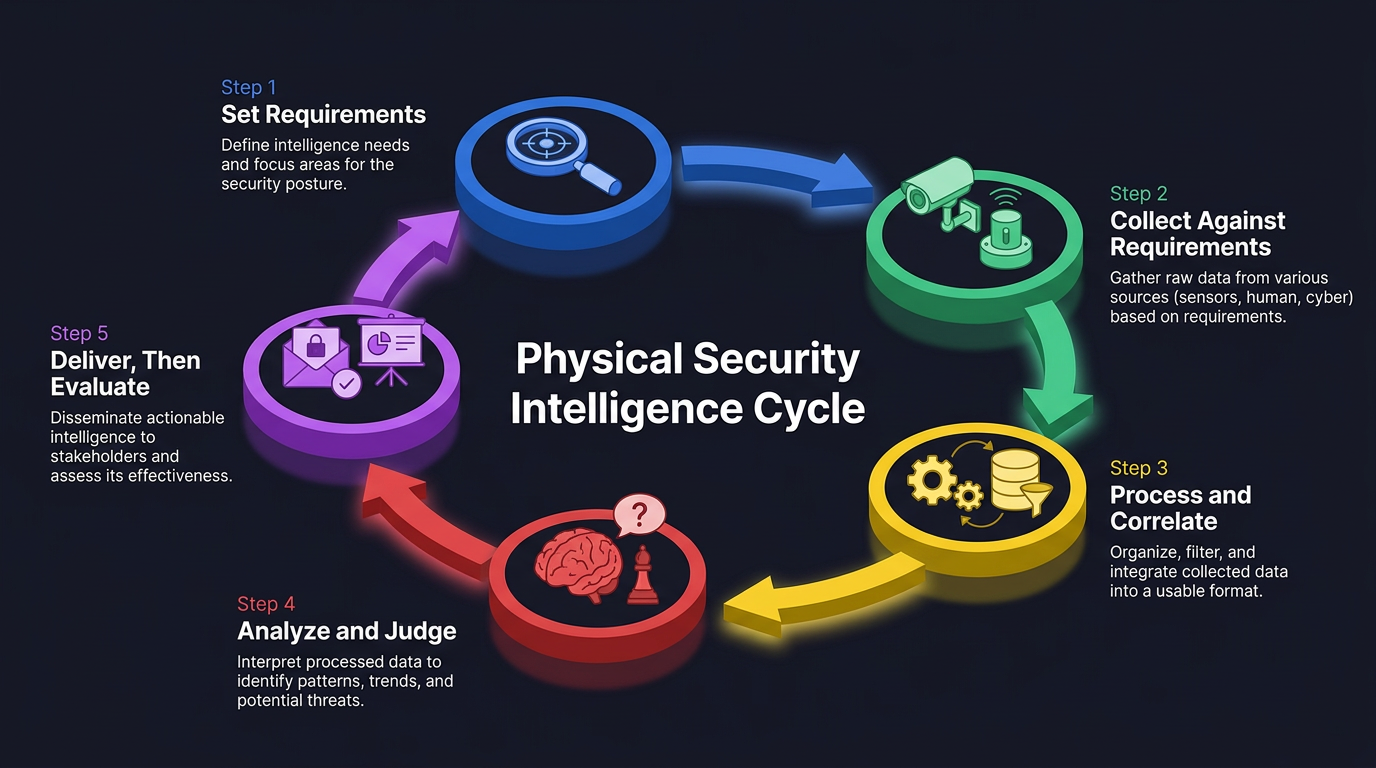
The workflow that turns those sources into an intelligence product runs as a cycle, not a one-way pipeline. These steps carry the work from question to decision and back:
- Set requirements: A security leader names the decisions the program must inform and the threats analysts must track against them. Without this step, a center collects everything and analyzes nothing. Requirements are the reference point every later step returns to.
- Collect against those requirements: The people and systems gathering data pull against the named requirements rather than sweeping in everything available. Internal feeds and outside reporting are directed toward what the decisions actually need.
- Process and correlate: A technical team normalizes incoming records so that events from internal systems and outside reporting sit on a shared timeline. An analyst cannot correlate what is not aligned.
- Analyze and judge: An analyst tests key assumptions and looks for alternative explanations for what the correlated records appear to show. The output is not a raw finding but a confidence-rated judgment: the analyst commits to a conclusion and states how strongly they hold it.
- Deliver, then evaluate: The analyst hands the product to whoever must act, in the form that person can use, whether a real-time escalation to a site team, a travel brief for an executive, or a written assessment for a risk committee. After the decision-maker acts, the analyst evaluates the outcome and uses follow-on questions to sharpen the next round of requirements. A workflow that skips this step drifts because the intelligence stops being tested against real outcomes.
The Role of Artificial Intelligence in Physical Security Intelligence
AI earns its place by taking on the work that scales poorly for humans: first-pass detection, cross-system correlation, and the routine sorting that consumes operator attention.
Rule-based detectors flag configured thresholds like motion in a zone; behavioral detection classifies actions and relationships between subjects, and multi-object tracking follows several subjects across frames.
Standardized metadata exchange lets integrated systems surface related information, joining an access-control record with the related video without a separate query in each platform. Judgment stays with a human. Operators review model outputs and confirm assessed events before the team responds.
Where Physical Security Intelligence Fits in an Enterprise Risk Program
Physical security has to report risk in the enterprise's own terms. Physical security intelligence can provide an evidence base for a physical risk register, adapting the risk-register model into judgments that tell a risk committee how likely a threat is and what it would cost. Business continuity planning can draw on the same judgments.
Security and continuity functions can encounter the same incidents. A cyber intrusion can trigger a physical response, and a workplace violence case can require involvement across the business. The same judgments may also support executive protection decisions about travel and residence risk, so external notifications and internal behavioral case files should feed into the same risk picture.
Turning Intelligence Into an Operating Discipline
A program becomes intelligence-driven the moment it treats every alert as a candidate for judgment rather than an event to close. That shift costs less in technology than in habit: naming the decisions the work must inform, keeping a human on what the models return, and retiring reporting that no longer earns its place. The centers that hold this discipline over time will be the ones whose leaders can walk into a risk committee and defend a specific claim about exposure, not describe a queue of alarms.
Frequently Asked Questions
How do you define and prioritize intelligence requirements so analysts focus on the threats that matter most to the organization?
Define requirements by naming specific decisions security must inform, such as travel approvals or site hardening. Prioritize by mapping each to business impact and decision authority, ensuring collection aligns with stakeholder needs rather than sensor availability.
What metrics should a security operations center track to measure whether it is successfully shifting from reactive alarm monitoring to intelligence-driven operations?
Track time from alarm to verified cause, false-alarm closure rate, percentage of dispatches where guards receive contextual briefing before arrival, repeat-incident correlation rate across sites, and analyst judgment accuracy measured against post-decision outcome reviews.
How should physical security intelligence products be governed and retired to prevent analyst capacity from being consumed by stale or low-value reporting?
Assign each product an owner and review schedule, then track consumption against decisions. Retire products when recipients stop acting on them, the threat scope shifts, no one requests updates, or analyst hours exceed value in quarterly reviews.
